Category: Top News

  • Course Production Newsletter #1 – September 2017


    Welcome to our monthly newsletter on online course production and emerging initiatives. We think course design is a game changer, and we want to keep you informed with all the must-know news, insights, cases and technologies. Click here to subscribe.


    SEPTEMBER 2017 – NEWSLETTER #1

    Syllabus reimagined. The Fall semester is here, and syllabi are the subject of attention. Sean Morris, an instructional designer at Middlebury Digital Learning, reimagines the syllabus in an online environment, encouraging its use as a pedagogical tool.

    Course performance. Recent research from the National Bureau of Economic Research with 4,000 student concludes that task-based goals  (i.e. completing online practice exams) have large and robust positive effect and increase course performance.

    Credit for free. A non-profit initiative called the “Freshman Year fro Free” is offering an open catalog of 40 online College Board CLEP courses, intended to allow students to get college credit for free.

    Science of learning. Coursera’s “Learning How to Learn” course, by Barbara Oakley, has become the most successful MOOC ever, with 1.8 million students in 200 countries. The New York Times dedicated an extensive column to this course.

    Top 50 MOOCs. How many MOOCs have been produced? Over 8,000 from 750 universities worldwide. Class-Central.com has collected the Top 50 MOOCs of All Time. Most of the courses are technology (19) and sciences (15); there are 6 on business and 8 in humanities.

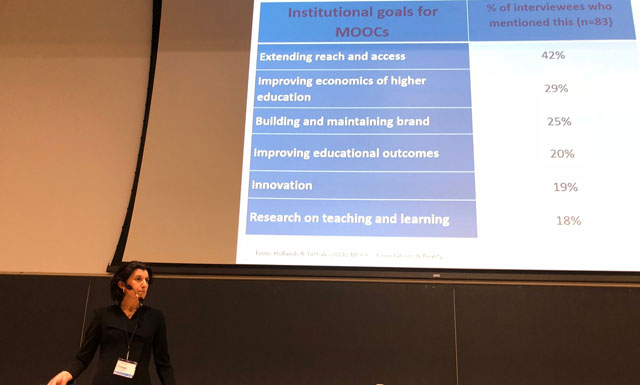
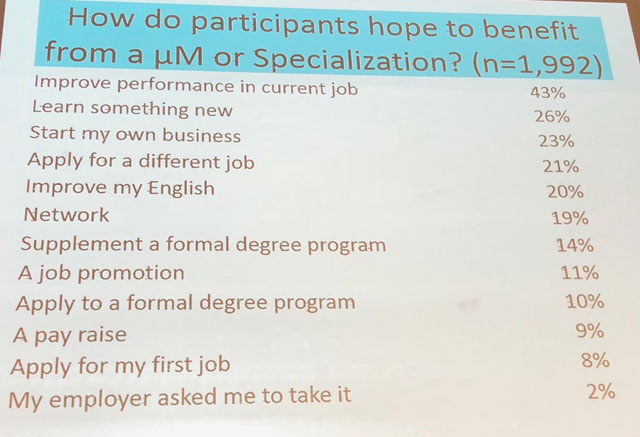
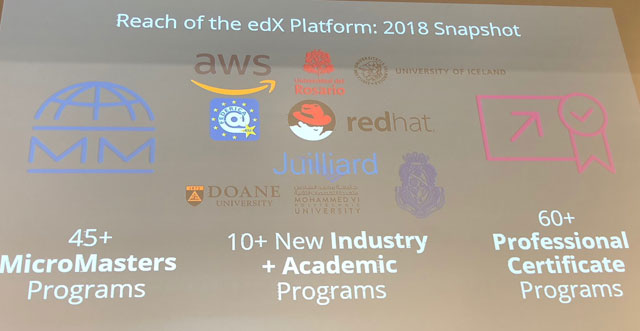
    MicroMasters. edX’s MicroMasters initiative is helping MIT’s and Harvard’s founded consortium to achieve its goal of being economically sustainable in 2020. This year MicroMasters will include 39 subjects from 24 universities. Top brands are endorsing the program.

    Corporate Learning. There’s a shift happening in corporate learning: less professionals and face-to-face classes, new roles, and more asynchronous online classes, skills training and external sourcing. Elliott Masie, CLO at The Masie Center think tank, analyzes this shift.

    Teaching Newsletter. The Chronicle has launched a weekly newsletter about teaching and learning called “Teaching”.

    Transformation. In the same way electricity transformed manufacturing, digital technologies will change higher education. However, it might take a similar 50-year transition, writes Dr. Joshua Kim.

    The Course Production is a topic-curated monthly newsletter compiled by Michael Amigot, Founder at IBL Studios & IBL Open edX. If you enjoy what you read please consider forwarding it to spread the word. Click here to subscribe. View this email on the web

  • Welcome to the Gig Economy With Individuals Required to Be Life Learners

    A new economy is emerging, the “gig economy” –a market where workers have short term contracts or freelance jobs as opposed to traditional full time jobs.

    “By 2020, 40 percent of the workforce will be independent contractors,” recently stated Harry Elam, senior vice provost for education at Stanford University Additionally, experts suggest that 40-60 percent of jobs will be lost by 2030, because of automation and new technologies. 

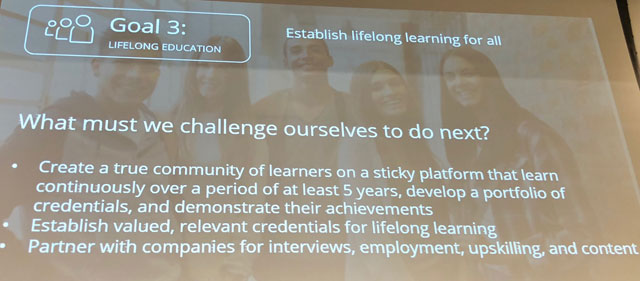
    In this scenario, individuals will be required to be life-long learners.

    Stanford University’s 2025 vision for higher education is based on an “open-loop education model”, where students would take a few courses to gain skills to fill a job, and later return to school to add needed skills, following a continuous cycle until retirement.

    Anant Agarwal, CEO at edX, has suggested an model where individuals would subscribe to college like a magazine, taking courses when they need them throughout their lifetime.


  • Nine of the Top Universities Use the Open edX Platform

    Nine of the world’s top 10 universities –according to the ranking of Times Higher Education– use the Open edX pedagogy and technology and publish courses at edX.org.

    Among the top 10, we find edX partners (OxfordCaltechMITHarvard UniversityPrinceton UniversityImperial College LondonETH ZurichUniversity of Chicago, and University of Pennsylvania ) and one university (Stanford) who has its own independent instance, https://lagunita.stanford.edu/.


  • The Learning with MOOCs 2017 Conference Analyzes the Shift Into Professional Development Courses

    The Fourth LWMOOC Conference, to be held October 8-10 at The University of Texas at Austin, has established as a theme “Developing and Advancing Careers with MOOCs”

    “Though initial visions of MOOCs as free learning resources for the masses have not yet been the reality, millions of learners around the world are using MOOCs to support professional development and career advancement,” have noted the organizers of the conference.

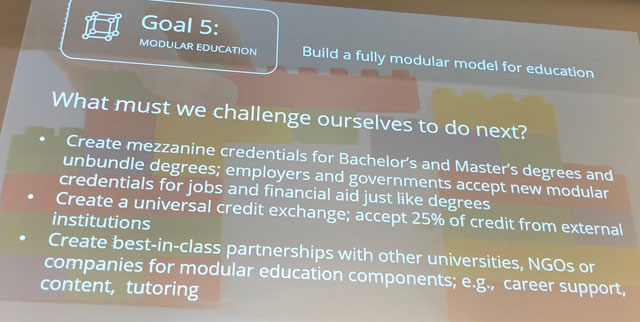
    “This activity represents an important shift from the top-down model of university degrees to a learner-generated, micro-credentialing “bottom-up” model.”


  • The New edX iOS and Android Version Includes Video Improvements

    EdX has released a new version of its app for Android and iOS, 2.10, with video-enhanced features (after all edX’s app is mostly a video companion tool). This app is available for both edX.org and Open edX independent sites’ learners.

    The main two new features empower learners to access all course videos in one place as well as delete downloaded clips (with a left swipe in iOS or a long press in Android).

    Upcoming versions of the mobile app will have tablet support, and will automatically open in Spanish mode if a learner’s mobile phone is set to use Spanish.

    Another interesting improvement at edX.org courses refers to learner profiles. Now they include the date a student joined edX and links to social media accounts. Soon, any certificate earned will be visible on their profiles.


  • First Anniversary of the EdX MicroMasters With New Partners and Courses

    edX’s MicroMasters successful initiative celebrates this September its first anniversary with the extension of the program to 39 subjects from 24 international universities. The University of California, Berkeley is the latest university partner to join the MicroMasters. Its first course will be Marketing Analytics, and it is scheduled for October 3.

    “MicroMasters programs –which are free to try– help to bridge the knowledge gap between higher education and the workplace by offering deep knowledge and credentials in the most in-demand fields, with a pathway to credit in an on-campus program,” explained Anant Agarwarl, CEO at edX.

    Top employers, including IBM, GE, Hootsuite, Boeing, Bloomberg, Walmart, Adobe, Ford, PwC and others are endorsing MicroMasters programs.


  • EdX.org and the French MOOC Platform FUN Will Share Course Content

    France University Numerique (FUN), the French national MOOC platform with over a million students and 300 courses, has reached an agreement with edX.org to share course content and strengthen its partnership.

    FUN learners will easily access the catalog of courses in English and Spanish offered by edX.org, while edX’s students access FUN’s classes. Initially, edX has made available seven courses: three from MIT, three from Harvard and one from Microsoft (see them above).

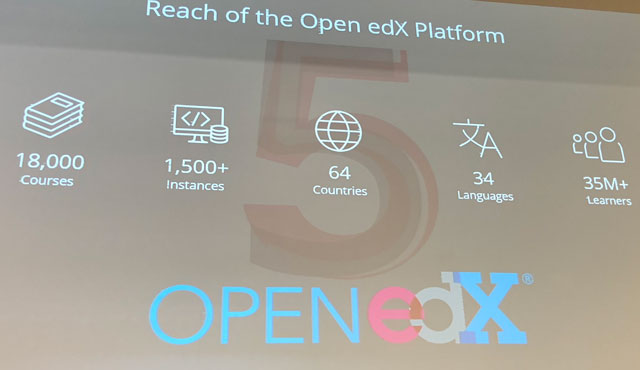
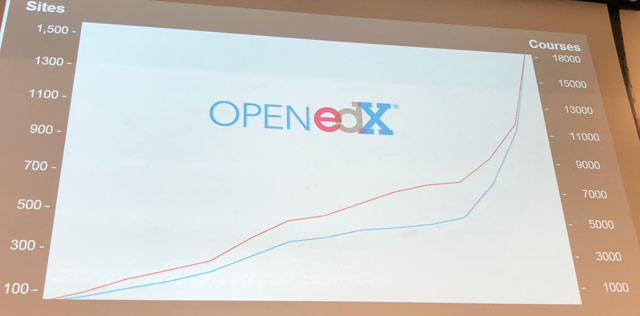
    Created in June 2013, FUN was the first national platform using Open edX. Since then, hundreds of international initiatives have been launched. Today the Open edX universe is being used by more than 300 sites, which host over 4,300 courses in 32 languages.


  • EdX Releases Ginkgo, Its Latest Open edX Software Platform

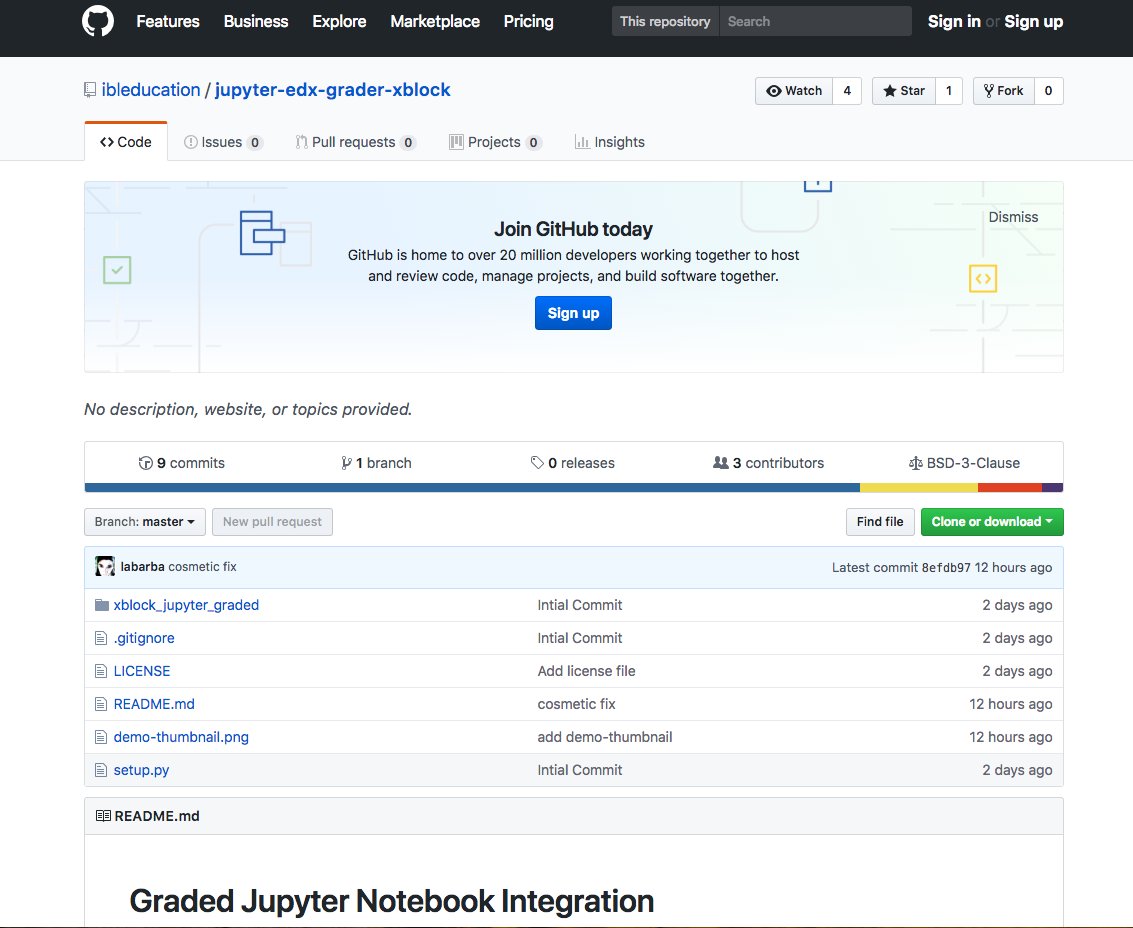
    edX released this week the final version of Ginkgo (Ginkgo.1), the latest Open edX version of the platform. Here is the official announcement, along with docs and release notes. In the guide, there is a new section with details on how to migrate existing data from Ficus.4 to a Ginkgo installation.

    Ginkgo –the seventh Open edX release–  includes changes to the course navigation, video player, proctored exams, accessibility, emails and problems.

    On the LMS (student view):

    • Course outline features a full-page that lists updates, sections and subsections.
    • Video player uses HLS video playback continually checking learner’s internet connection and adjusting the experience to the highest quality possible.
    • Learners receive an email notifications on proctoring exams.
    • Learners can now sort inline discussions by most votes, most activity, and recent activity.
    • Learner responses for open response assessments can now include more than one file. The maximum cumulative upload size has been increased to 10 MB.
    • The LMS is compliant with Web Content Accessibility Guidelines (WCAG) 2.0 level AA. edX has made a number of accessibility improvements that, among other things, provide easier navigation using keyboards, screen readers, or other assistive technology.

    On Studio (course author tool):

    • Course staff can now send emails to learners based on their enrollment track, so all verified or audit track users can be reached at one time.
    • Course authors can move components from one location to another in a course.
    • Instructors can upload transcripts for videos that are not hosted on YouTube on the Basic tab of a video component.
    • The instructor dashboard includes an Open Response Assessment tab to help locate and access open response assessments and provide data about learner progress in completing responses and peer assessments.
    • The Show Results setting for problems allows course teams to hide problem results from learners, including both whether the learner answered the problem correctly and the learner’s score, either temporarily or permanently. Using this feature, course teams can hide exam scores until the exam due date, or administer surveys without revealing responses.


  • An MIT Professors Produces an AP Course Aiming to Help Everyone to Understand Economics

    An MIT professor of Economics, Jonathan Gruber, wants to help everyone to learn basic economics, and for this purpose he has created a course for years: Introductory AP Microeconomics, which has been released on August 15 on edX.org.

    “Economics principles explain so much of what drives our everyday life: how people decide which goods to buy and how to spend their time; how firms set prices and hire workers, and whether the outcomes of markets are fair and efficient.”(…) “Economics is a way of seeing the world that’s useful, but it’s also beautiful and surprising and cool. I truly believe our world would be better if everyone took this course. And I know that you’ll have a great time if you take it,” says Professor Gruber.

    This free, self-paced, 12 week MOOC combines short videos on economics principles with fun applications in order to provide a level of economics knowledge that is sufficient to pass the Advance Placement (AP) College Board exam.


  • MITx will launch 30 MOOCs at edx.org this Fall

    MITx will be launching 30 MOOCs at edx.org this fall. These MOOCs, which allow learners to get an MITx certificate as a credential, will feature the same content as on-campus courses.

    Among the courses, there are two MicroMasters: Supply Chain Analytics (Sept 13), and Microeconomics (Sept 26), as well as the following: