Category: Top News

  • MIT Successfully Starts to Use Blockchain Technology to Issue Digital Certificates

    Blockchain technology arrives to Academia. It means that students will securely own and share with employers their digital diplomas, and these credentials will exist even if the issuing institutions go away.

    MIT -co-founder, along with Harvard, of the edX project– is becoming one of the first universities to use Bitcoin’s blockchain technology to issue recipient-owned virtual credentials, MIT News reports.

    As part of a pilot program, a cohort of 111 graduates became this summer the first to have the option to receive their diplomas on their smartphones via an app, in addition to the traditional format.

    Students use an app, called Blockcerts Wallets, to get a verifiable, tamper-proof version of their diploma that they can share with employers, schools, family and friends. To ensure the security of the diploma, the pilot utilizes the same blockchain technology that powers the Bitcoin digital currency.

    It also integrates with MIT’s identity provider, Touchstone. And while digital credentials aren’t new — some schools and businesses are already touting their use of them — the MIT pilot is groundbreaking because it gives students autonomy over their own records.

    “From the beginning, one of our primary motivations has been to empower students to be the curators of their own credentials,” said Registrar and Senior Associate Dean Mary Callahan. “This pilot makes it possible for them to have ownership of their records and be able to share them in a secure way, with whomever they choose.”

    HOW THE TECHNOLOGY WORKS

    The developed technology used an open-source toolkit called Blockcerts –which any developer or school can use to issue and verify blockchain-based educational credentials. It draws on the Bitcoin blockchain, an open, global ledger that records transactions on a distributed database.

    Each transaction — known as a block — is encrypted, timestamped, and then added to the previous block on the chain, creating a timeline. A transaction cannot be modified once it is recorded, because any change in one block would require the alteration of all subsequent blocks, and because the information is distributed across a decentralized, worldwide network of computers.

    The software Learning Machine –the vendor behind this development– used the Bitcoin blockchain, but it’s not the only blockchain around. There has been a proliferation of new types of blockchains, but that Bitcoin remains the gold standard for Learning Machine’s purposes because it prioritizes security over other qualities like speed, cost, or ease of use. “We believe it’s still the right choice for official records that need to last a lifetime and work anywhere in the world,” he says.

    With Blockcerts Wallet, after the student downloads the app, it generates the public-private key pair and sends the public key to MIT, where it is written into the digital record. Next, a one-way hash (a string of numbers that can be used for verification later) is added to the blockchain. The diploma information itself doesn’t go onto the blockchain, just the timestamped transaction indicating that MIT created the digital record. Finally, MIT emails the digital diploma (a JavaScript Object Notation file, or JSON) with the student’s public key inscribed into it. Because the mobile app on the student’s phone has their unique private key, the student can prove ownership of the diploma.

    For students, the benefits go beyond mere novelty. They can share their diplomas almost immediately with whomever they please, free of charge, without involving an intermediary. This is particularly important for students who need to prove to an employer or another university that they have an MIT diploma.

    And thanks to the blockchain, the third party can easily verify that the diploma is legitimate without having to contact the Registrar’s Office. Using a portal, employers or schools can paste a link or upload a student’s digital diploma file and receive a verification immediately. The portal essentially uses the blockchain as a notary, locating the transaction ID (which identifies when the digital record was added to the blockchain), verifying the keys, and confirming that nothing has been altered since the record was added.

    This adds great value to higher education.

  • TripAdvisor Executive Joins edX as COO

    The edX Inc. nonprofit organization has appointed a former TripAdvisor as its new President and Chief Operating Officer (COO).

    Adam Medros arrives to edX from TripAdvisor, where he was Senior Vice President of Global Product. He will assume the day-to-day management and oversight operations, contribute to edX’s strategy and growth and report to Anant Agarwal, CEO of the company.

    “Medros brings experience in building strong teams and driving innovation. His appointment comes at an exciting time for edX, as the company continues to grow, expanding its global learner base to over 13 million students and offering new, innovative programs and credentials designed to help learners advance their careers,” edX explained on a press release.

  • The Fifth Open edX Conference Will Take Place May 29-June 1, 2017 in Montreal

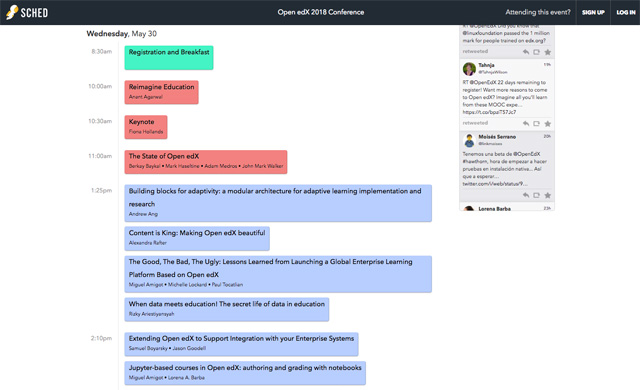
    The 2018 Open edX conference will take place May 29 to June 1 in Montreal, Canada.

    The event will be hosted by Université de Montréal, HEC Montréal and Polytechnique Montréal, the three founding institutions behind EDUlib.

    This will be the fifth Open edX Conference, after Harvard (2014), Wellesley (2015), Stanford University (2016) and Madrid (2017).

    “You can expect all the great features of previous conferences: top-notch presentations, inspirational keynotes, hands-on activities, and plenty of face time with Open edX adopters and extenders from around the world,” explained Ned Batchelder, one of the very few edX engineers who has attended all of the events and remains working at edX Inc.

  • FUN French Open edX Platform Launches New Business Initiatives

    France Université Numerique (FUN), the French national MOOC platform, has launched two initiatives as an effort to generate new revenues: FUN Campus for SPOCs (Small Private Online Courses) and FUN Corporate for corporate training, has reported Letudiant.fr.

    FUN has also begun designing platforms for businesses and adding proctoring services.

    “Clients benefit from our expertise, educational advice, secure hosting and constant technical assistance”, noted Nelly Violette, head of FUN’s white label service.

    With 3.4 million users, 330 MOOCs and 104 schools as partners, FUN, built on the Open edX platform, includes a staff of five developers and eight advisors who help schools run their MOOCs. The French government funds less than half of its €2.5 million ($2.7 million) annual budget.

     
  • The Year of the Microcredential


    If 2012 was “The Year of the MOOC”, 2017 is “The Year of the Microcredential”, says edSurge.

    A growing number of elite colleges now offer short-form graduate and certificate programs that can be taken online for a fraction of the price of a traditional master’s.

    These offerings expand access to graduate education, help workers update their skills and allow colleges to find new sources of revenue as well as save marketing money when advertising their in-person graduate programs.

    • edX lists 40 MicroMasters programs from 24 colleges and universities. [The first course, created by MIT about Supply Chain brought in more than $4 million in revenue, according to Anant Agarwal, CEO of EdX.]
    • Coursera added 50 new “specializations” (series of courses that grant noncredit certificates to students and can’t be transferred for college credit) in the past year.
    • Udacity uses “nanodegrees” ($200 per month) to attract students. They also offer a premium service, for $299 a month, that includes some individualized help and mentorship. Udacity promises a money-back guarantee for those who successfully complete a nanodegree and don’t find a job within six months.
  • Google Will Donate $1 Billion to Education and Professional Training Non Profits


    Google will commit $1 billion over the next five years to nonprofits in education and professional training through its charitable arm, Google.org.

    CEO Sundar Pichai announced a new program at an event this week in Pittsburgh, PAGrow with Googleaimed at training American workers for high-tech jobs and helping build businesses.

    “At Google, our mission is to make sure that information serves everyone, not just a few,” Pichai explained in the address. “A child in a school here in Pittsburgh can access the same information on Google as a professor at Carnegie Mellon. In the end, the internet is a powerful equalizer, capable of propelling new ideas and people forward.”

    Grow With Google will create an online destination for job seekers to get training and professional certificates and for businesses to improve their web services.

    Google said it was donating $10 million to Goodwill Industries, for example, for digital job training programs. Company employees also will volunteer one million hours at those nonprofits.

    CHARM OFFENSIVE ALONG WITH APPLE AND AMAZON

    According to The New York Times, much like a political campaign, Google will go on the road to spread the message about its new program, it said. In the coming months, company officials will make stops in Indianapolis; Oklahoma City; Lansing, Mich.; and Savannah, Ga.

    Google is not the only big tech company that has gone on a charm offensive in recent months. Under fire from President Trump for producing most of its devices in China, Apple announced in May that it was creating a $1 billion fund to invest in advanced manufacturing in the United States. Amazon, another frequent target of Mr. Trump, said in January that it was planning to hire 100,000 new employees over the next 18 months.

  • Woz U Tech School, An Initiative By Steve Wozniak

    Apple co-founder Steve Wozniak has launched Woz-U, an online, tech-focused education school. Today it offers just two online programs, an 8-month computer programming track and a 6-month computer support specialist track. The school promises to add programs in data science, mobile applications and cybersecurity, and add physical campuses in 30 cities.

    Its goal is to help fill the employment gap for high-paying technology jobs across the U.S. “Our goal is to educate and train people in employable digital skills without putting them into years of debt,” said Wozniak.

    Woz U’s parent company, Southern Careers Institute, offers similar computer programming and computer support specialist programs at its six for-profit schools in Texas, alongside programs in cosmetology, welding, medical billing and others.

    It’s unclear how Woz U’s curriculum will differ from its far larger online competitors such as Coursera, edX, Udacity, Pluralsight and others.


  • World's Most Innovative Universities Are EdX Partners

    Seven of the world’s top 10 innovative universities according to the Reuters ranking are edX partners.

    Amongst the top 10 are Harvard University, Massachusetts Institute of Technology, University of Pennsylvania, KU Leuven,  University of Washington, University of Michigan and the University of Texas System.

    Reuters’ list is based on proprietary data and analyses of numerous indicators including patent filings and research paper citations, as well as which universities are doing the most to advance science, invent new technologies and power new markets and industries.


  • A Course About Blockchain and Hyperledger at EdX.org

    The Linux Foundation will launch on October 24th at edx.org an introductory, eight-week online course about the blockchain technology, Blockchain for Business: An Introduction to Hyperledger.

    This course will teach how to start building blockchain applications with Hyperledger frameworks, a skillset increasingly in demand.

    “Software developers, product team, and business managers are desperately eager to figure out how this technology can solve real-world problems,” explained Executive Director of the Hyperledger Project, Brian Behlendorf.

    This is the eight edX MOOC offered by The Linux Foundation. In total, over 850,000 students have enrolled across these free courses, which include Intro to Linux, Intro to Cloud Infrastructure Technologies, Introduction to OpenStack, Introduction to DevOps: Transforming and Improving Operations, Introduction to Cloud Foundry and Cloud Native Software ArchitectureIntroduction to Apache Hadoop, and Introduction to Kubernetes.

  • Three Innovative Ways to Transform Higher Education, According to EdX

    “The next phase of MOOCs is courses and programs that offer pathways to credit at a college or university by blending the best of online and in-person programs,” has explained Anant Agarwal, CEO at edX. “As more colleges and universities begin to accept MOOCs for credit, online learning options will create modularity and offer students more options.”

    There are three ways in which innovative approaches can transform high-quality education, according to Mr. Agarwal.

    FULLY ONLINE DELIVERY WITH BLENDED CREDENTIALS
    An example is the groundbreaking Georgia Tech Online Master of Science in Analytics, in partnership with edX. It enables to earn a graduate degree for less than $10,000. In addition, accepted students can complete a MicroMasters credential, which is about 30 percent of the degree.

    ONLINE-WHILE-ON-CAMPUS DELIVERY
    MIT has offered a fully online version of its popular on-campus Circuits and Electronics course to on-campus students for credit. Students performed well and reported feeling less stress and having more flexibility. Many other universities have begun toying with this online-while-on-campus delivery.

    ONLINE-TO-CAMPUS DELIVERY
    The Global Freshman Academy and the MicroMasters program, both available on edX, are examples of this blend. Students are able to complete coursework at a low cost ($1,000 in fees in the case of MicroMasters) and no admission process, before committing time and money in a degree program.

    In terms of the platform, the head of edX has no doubts: “To offer credit-grade MOOCs, online learning providers must have a platform with high academic integrity — one that maintains high standards and facilitates rigorous assessments. This could include integrating virtual proctoring, hand grading and peer grading, as well as innovative, rich assessments that go well beyond multiple choice.”