Category: Top News

  • The Stockholm-Based Lovable Reaches a Valuation of $6.6 Billion

    The Stockholm-Based Lovable Reaches a Valuation of $6.6 Billion

    IBL News | New York

    The Stockholm-based, three-year-old company Lovable crossed the $400 million annual revenue mark in February, with only 146 full-time employees. In less than one year, it became a unicorn, and now its valuation is $6.6 billion.

    According to its CEO, Anton Osika, over half of Fortune 500 companies are using Lovable to “supercharge creativity.” The company offers a range of security-related features to persuade businesses to use it for more than just prototyping.

    This vibe-coding start-up, alongside Cursor, Replit, Mercor, and others, allows users to create websites and apps with prompts.

    Research firm Gartner predicts that a new wave of unicorns will emerge by 2030 with $2 million ARR per employee. At $2.77 million in ARR per employee, Lovable has already surpassed that number.

    Lovable’s most recent user spike was tied to a specific promotion — Lovable’s SheBuilds initiative for International Women’s Day on March 8, when the whole platform was free for one day.

    This week, Lovable launched a brand campaign, “Earworm,” on social platforms, YouTube, and connected TV. The film follows a woman who can’t rid herself of a song — performed by Swedish band Boko Yout — until she finally opens Lovable and builds it into a working app.

  • Companies Start Tracking Their Workers’ AI Token Usage

    Companies Start Tracking Their Workers’ AI Token Usage

    IBL News | New York

    Companies that regularly use AI have begun tracking their workers’ token use, a new unit of measurement. AI output has turbocharged productivity, changing the nature of work, and the number of tokens burned is the new hot metric.
    Companies like ibl.ai, the parent house of the iblnews service, have launched a token counter.

    Every prompt generates computing resources, measured in tokens. For example, generating 750 words takes about 1,000 tokens. It gets more complicated when writing code, creating video and audio, or enlisting agents to perform elaborate, days-long tasks.

    Another example: Anthropic’s Claude Code to develop around 300,000 lines of code can cost $2,000 in tokens.

    The more work done, the more tokens are used.

    Token pricing has gone down, but costs can be higher for some newer sought-after models. Especially given the fact that most businesses are trying to get their employees to use AI.

    Sometimes, companies opt for pay-as-you-go plans or buy enterprise plans with a set amount of use per worker.

    “Companies need to start measuring token use,” said Brian Jabarian, a researcher with the University of Chicago’s Booth School of Business who studies how new technologies reshape workplaces.

    Some tech startups have even started monitoring token use on a per-engineer basis.

    Explaining Tokens — the Language and Currency of AI


  • Anthropic Issues Takedown Notices to Contain the Impact of the Leak of Claude Code

    Anthropic Issues Takedown Notices to Contain the Impact of the Leak of Claude Code

    IBL News | New York

    Anthropic raced yesterday to contain the accidental leak of Claude Code’s underlying software instructions, which developers analyzed on GitHub.

    By Wednesday morning, Anthropic representatives had used a copyright takedown request to force the removal of more than 8,000 copies, clones, and adaptations of the raw Claude Code shared on GitHub.

    When a developer de-obfuscated it and released the source code on GitHub, Anthropic filed a DMCA complaint — a copyright notification requesting the code’s removal.

    Developers on social media weren’t pleased by the move, which they said compared unfavorably with OpenAI’s rollout of Codex CLI.

    After the leak, developers reverse-engineered Claude Code, and competitors gained access to Anthropic’s feature roadmap and much of its software secrets.

    The leaked zip archive on Anthropic’s own cloud storage, containing the full source code, with nearly 2,000 files and 500,000 lines of code, included dozens of feature flags for capabilities that appear fully built but haven’t shipped.

    One of the crown features of the code was a “persistent assistant” running in background mode that lets Claude keep working even when a user is idle.


  • Claude Code’s Software Accidentally Leaked Via a Map File

    Claude Code’s Software Accidentally Leaked Via a Map File

    IBL News | New York

    Anthropic accidentally leaked to the public part of its Claude Code, its agentic AI, yesterday.

    A 59.8 MB JavaScript source map file (.map), intended for internal debugging, was inadvertently included in version 2.1.88 of the @anthropic-ai/claude-code package on the public npm registry, pushed live yesterday.

    “No sensitive customer data or credentials were involved or exposed,” an Anthropic spokesperson said. “This was a release packaging issue caused by human error, not a security breach. We’re rolling out measures to prevent this from happening again.”

    By 4:23 am ET, Chaofan Shou (@Fried_rice), an intern at Solayer Labs, broadcast the discovery on X, including a direct download link to a hosted archive. The post on X generated over 21 million views. Thousands of developers analyzed the code across GitHub.

    For Anthropic, a company with reported annualized revenue of $19 billion as of March 2026, the leak was a strategic hemorrhage of intellectual property.

    Claude Code, which has seen massive adoption over the last year, helps software developers build features, fix bugs, and automate tasks.

    Claude Code solved “context entropy”—the tendency for AI agents to become confused or hallucinate as long-running sessions grow more complex.

    The leaked source revealed a sophisticated, three-layer memory architecture that moves away from traditional “store-everything” retrieval.

    As analyzed by developers such as @himanshustwts, the architecture employs a “Self-Healing Memory” system.

    At its core is MEMORY.md, a lightweight index of pointers (~150 characters per line) that is perpetually loaded into the context. This index does not store data; it stores locations.

    For competitors, the “blueprint” is clear: build a skeptical memory. The code confirms that Anthropic’s agents are instructed to treat their own memory as a “hint,” requiring the model to verify facts against the actual codebase before proceeding.

    By exposing the “blueprints” of Claude Code, Anthropic has handed researchers and bad actors a roadmap to bypass security guardrails and permission prompts.

    Because the leak revealed the exact orchestration logic for Hooks and MCP servers, attackers can now design malicious repositories specifically tailored to “trick” Claude Code into running background commands or exfiltrating data before you ever see a trust prompt.

  • Amazon Releases Its Healthcare AI, an Assistant that Answers Questions and Connects to Doctors

    Amazon Releases Its Healthcare AI, an Assistant that Answers Questions and Connects to Doctors

    IBL News | New York

    Amazon announced its Healthcare AI agent with free 24/7 access to virtual care for Prime members. This new virtual assistant answers questions, explains health records, manages prescription renewals, and books appointments. Previously, it was only available for One Medical members, the healthcare company Amazon acquired for $3.9 billion in 2023.

    Health AI can answer general health questions without access to an individual’s medical information, but it’s primarily designed to serve as a personalized health assistant that offers tailored guidance and can connect users with healthcare professionals and treatments.

    All interactions with Health AI happen within a HIPAA-compliant environment, and those conversations are protected by encryption and strict access controls.

    With a user’s permission, Health AI gains access to their health information through the Health Information Exchange, the nationwide secure system for sharing patient medical data.

    Health AI can then interpret lab results, diagnoses, and medical records to provide accurate, personalized answers about users’ symptoms and medication, Amazon says.

    Health AI can connect users to a One Medical provider. Prime members in the U.S. using Health AI receive up to five free direct-message care consultations with a One Medical provider for over 30 common conditions, including cold and flu, allergies, acid reflux, pink eye, UTIs, erectile dysfunction, anti-aging skin care, hair loss, and more. Non-Prime members can connect with One Medical providers through Amazon’s pay-per-visit option.

    Users can sign up for Health AI on the Amazon Health page. As Amazon expands access, users will receive an email when they can access the assistant.

    Once users have access, they need to create an account or sign in to their personal Amazon Health profile. They can then start a conversation by typing their health question to Health AI on Amazon.com or in the Amazon app.

    Users can ask questions like “Can you explain my recent cholesterol results and what they mean for me?” or “I’m feeling congested and have a sore throat. What should I do?”

    Amazon’s expansion of Health AI comes as popular AI services have rapidly entered the healthcare space.

    In January, OpenAI released ChatGPT Health, a version of its chatbot tailored to answer health questions.

    A week later, Anthropic announced its own healthcare-focused product, Claude for Healthcare.

  • Meta-Owned Manus Announces a Desktop Application ‘My Computer’

    Meta-Owned Manus Announces a Desktop Application ‘My Computer’

    IBL News | New York

    Singapore-based AI company Manus, recently acquired by Meta for $2 billion, introduced My Computer, a desktop application enabling an agent to interact with local files and applications.

    My Computer runs a CLI (command-line interface) in the user computer’s terminal that allows reading, analyzing, and editing local files, as well as launching and controlling local applications.

    My Computer enables the user to leverage all command-line tools on their computer, including Python, Node.js, Swift, and Xcode. This dramatically expands the possibilities for complex automation and development. The user can build Mac apps, Python scripts, websites, and more through command-line development, with Manus handling the entire process from coding to debugging.

    Furthermore, users can remotely control Manus installed on their home PC by sending commands from their smartphone while they’re out. My Computer integrates with local files and apps, as well as third-party services such as Google Calendar and Gmail, so the user can do things like ‘remotely instruct your home PC to find necessary files and then send them via email through Gmail.

    My Computer is designed to give users control, requiring explicit authorization before any terminal commands are executed. You can choose to ‘Always Allow’ to simplify workflows for trusted tasks, or ‘Allow Once’ to review each operation individually.

    Following the massive success of OpenClaw, which allows users to automate various tasks by having a self-hosted personal AI assistant on their PC, OpenClaw-like AI agents have been appearing one after another from February to March 2026.

    Anthropic announced on February 26, 2026, that it would acquire Vercept, an AI startup that develops AI agents for operating computers, and also released a remote-control function for its coding AI, ‘Claude Code,’ and a PC operation AI,’ Cowork.’

    In March 2026, Perplexity announced ‘ Personal Computer,’ an AI agent that runs on PCs 24 hours a day to support PC work, and it was reported that NVIDIA would release ‘ NemoClaw,’ a platform for AI to autonomously execute tasks on users’ devices.

  • American Universities Continue to Lead Globally by Academic Field, According the QS Rankings

    American Universities Continue to Lead Globally by Academic Field, According the QS Rankings

    IBL News | Washington, D.C.

    American universities continue to lead globally, with 228 ranked institutions — nearly double the next competitor — and the most number-one spots across academic disciplines worldwide, according to the QS World University Rankings by Subject 2026, released this week during the 2026 Global Skills Week in Washington, DC.

    Another remarkable statistic is that just 9 countries account for roughly half of all ranked universities worldwide.

    The top 10 by number of ranked institutions are:

    1. 🇺🇸 United States — 228

    2. 🇨🇳 China — 158

    3. 🇬🇧 United Kingdom — 114

    4. 🇮🇳 India — 99

    5. 🇫🇷 France — 93

    6. 🇩🇪 Germany — 72

    7. 🇮🇹 Italy — 61

    8. 🇪🇸 Spain — 54

    9. 🇯🇵 Japan — 53

    10. 🇰🇷 South Korea — 47

    The most dramatic story in the data is China’s trajectory. In just four years (2022-2026), China went from 90 to 158 ranked institutions, a 75% increase. Other fast risers are:

    • 🇰🇷 South Korea: 30 → 47 (+57%)

    • 🇵🇰 Pakistan: 15 → 35 (+133%)

    • 🇹🇷 Turkey: 15 → 28 (+87%)

    • 🇮🇩 Indonesia: 12 → 26 (+117%)

    • 🇸🇦 Saudi Arabia: 10 → 23 (+130%)

    Notably, India has flatlined at 99 institutions since 2022, growing in number but not adding new ranked programs.

    China alone contributed 34 new subject entries in 2026, with particular focus on Medicine (8), Chemistry (6), Economics (6), Computer Science (4), and Physics (4). India added 20, concentrated in Chemistry (5), Medicine (4), and Computer Science (4).

    Both countries are making deliberate bets on STEM, and it’s showing in the rankings.

    Through its World Future Skills Index, which weights both quality and quantity, QS formalized that the top 10 countries for “Academic Readiness” were:

    1. 🇬🇧 United Kingdom — 100
    2. 🇩🇰 Denmark — 99.6
    3. 🇳🇱 Netherlands — 99.3
    4. 🇦🇺 Australia — 98.9
    5. 🇩🇪 Germany — 98.6
    6. 🇭🇰 Hong Kong — 98.2
    7. 🇺🇸 United States — 97.8
    8. 🇨🇦 Canada — 97.4
    9. 🇮🇹 Italy — 97.1
    10. 🇨🇭 Switzerland — 96.7

    Universities investing in AI programs have been climbing these rankings faster than traditional ones, signaling that the AI capability and institutional competitiveness game is now in the rankings.

    QS is increasingly weighting “employer reputation” and “research citations” — both metrics where AI-focused universities are surging.

    Per institutions, MIT dominates across 12 STEM subjects, including computer science, engineering, and data science. MIT has been ranked #1 overall for 14 consecutive years.

    • Oxford — two departments are top in their subjects globally.
    • FIU — hospitality ranked #3, politics top 15 among US public universities
    • CU Boulder — ranked top 100 nationally in 25+ subjects, including computer science, engineering, business, law, and medicine
    • University of Hawaii Mānoa — 14 programs recognized globally

    In the ranking, data science & AI is now a standalone ranked subject — for the first time, QS treats it as a full discipline, not a subcategory of CS. This is significant because universities investing in AI programs now receive direct rewards in rankings.

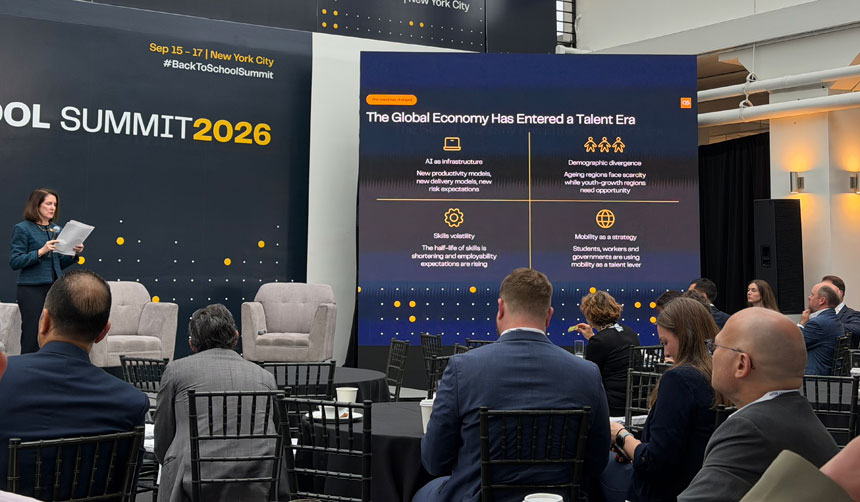
    The ranking and its conclusions were presented by Leigh Kamolins, Vice President, Evaluation and Insights at QS Quacquarelli Symonds, and Jacques de Champchesnel, Head of Consulting, QS Quacquarelli Symonds, during the 2026 Global Skills Conference [in the picture above].

    The session title was “How the Higher Education Sector is Rising to the Skills Challenge: The QS World University Rankings by Subject.” [Slides]

    They both highlighted the US paradox: With over 200 institutions but a median score of less than 50, America has extraordinary peaks — MIT, Stanford, Harvard — but a very long tail of weaker programs that drag the average down. The US ranks 34th in median quality.

    On AI readiness and who’s actually training the AI workforce, QS assessed countries on subjects that directly feed the AI and digital economy: Computer Science, Data Science, Engineering & Technology, Electrical Engineering, Mathematics, Statistics, Linguistics, Psychology, Business, Communication, Library Management, and Art & Design.

    “The pattern is unmistakable: Hong Kong, the Netherlands, Denmark, and Australia consistently outperform the US in AI-related academic quality. The US ranks near the bottom of the top 10 in every single AI/digital category — 43 in Computer Science, 49 in Engineering, 47 in Electrical Engineering,” said the authors to IBL News.

    The top 10 countries were:

    Computer Science:
    Hong Kong 70 → Netherlands 60 → Denmark 58 → Australia 54 → Switzerland 53 → Canada 51 → UK 50 → Italy 44 → US 43 → Germany 42

    Data Science:
    Hong Kong 70 → Denmark 59 → Switzerland 57 → Netherlands 56 → Australia 56 → Belgium 56 → UK 52 → Germany 42 → US 43

    Engineering & Technology:
    Hong Kong 74 → Denmark 66 → Netherlands 66 → Belgium 63 → Australia 59 → Canada 59 → UK 56 → Italy 54 → Switzerland 52 → Germany 50 → US 49

    Electrical Engineering:
    Hong Kong 73 → Netherlands 69 → Denmark 67 → Switzerland 67 → Australia 62 → Belgium 57 → Canada 55 → UK 54 → Italy 50 → Germany 48 → US 47

    Leigh Kamolins and Jacques de Champchesnel highlighted the AI research explosion, as the number of AI publications in Computer Science grew from 100,000 in 2013 to 242,740 in 2023.

    “Universities that aren’t investing in AI research infrastructure are falling behind in real-time.”

    As key takeaways, these two QS researchers insisted on seven points:

    1. Quantity ≠ Quality. The US has the most ranked universities in the world, but ranks 34th in median quality. As mentioned, having 228 programs means nothing if most of them underperform.

    2. The real AI education leaders aren’t who you’d expect. Hong Kong, the Netherlands, and Denmark consistently outrank the U.S. in AI and digital subjects. Small, focused systems beat sprawling ones.

    3. China is the fastest-growing force in global education. From 90 to 158 ranked institutions in 4 years, with a strategic focus on STEM. India has stalled.

    4. Research impact is the differentiator. Countries that score highest in AI subjects aren’t just publishing more — they’re being cited more. Quality of research, not volume, is what separates the elite.

    5. The UK is the world’s most balanced education system. #1 on the Future Skills Index for Academic Readiness — combining 114 institutions with consistently high quality across subjects.

    6. AI publications have grown 143% in a decade, with 2023 seeing the biggest single-year jump (+20.8%) — driven by the generative AI boom.

    7. Higher education is an economic policy. QS’s framing is explicit: countries that invest in AI-, digital-, and sustainability-focused academic programs are positioning themselves for long-term economic competitiveness. Universities are no longer optional infrastructure — they’re strategic national assets.

    “How the Higher Education Sector Is Rising to the Skills Challenge (PDF Presentation Slides)


  • Melania Trump Showed Her Interest in Having More Children Educated by AI-Powered Humanoids

    Melania Trump Showed Her Interest in Having More Children Educated by AI-Powered Humanoids

    IBL News | New York

    Melania Trump, the first lady, appeared yesterday at the White House alongside Figure 3, an AI-powered humanoid, showing her interest in having more children educated by robots.

    Both Mrs. Trump and the robot extolled the virtues of further integrating robots into children’s educational and social lives.

    As first lady, Melania Trump is currently promoting opportunities for foster children, arguing for the eradication of online bullying, and often traveling to military bases in support of soldiers and their families.

    Now, Mrs. Trump is also into robots, and his involvement with a humanoid robot in education policy was a first.

    Figure AI, the California – based robotics company that makes these humanoids, said that these robots can fetch towels, carry groceries, and serve champagne.

    In the history of modern first-lady initiatives, which have included building a national book festival (Laura Bush), reshuffling the food pyramid (Michelle Obama), and advocating for free community college (Jill Biden).

    Both clad in shades of white, the first lady and the visiting robot walked into a gathering of first spouses from around the world, including Sara Netanyahu of Israel, Olena Zelenska of Ukraine, and Brigitte Macron of France.

  • Perplexity Announces “Personal Computer”, an AI System Similar to OpenClaw

    Perplexity Announces “Personal Computer”, an AI System Similar to OpenClaw

    IBL News | New York

    Perplexity announced this month “Personal Computer,” an agentic software that turns a dedicated device, such as a Mac mini, with full local access to files and apps into a controlled AI system similar to OpenClaw.

    The company said that “Personal Computer” is more secure than OpenClaw because it includes a built-in audit trail and requires all actions to be confirmed by the user.

    This AI operating system, which will initially be available only on Mac, takes objectives while a traditional operating system takes instructions.

    A few weeks ago, the company released Perplexity Computer, a cloud-based AI agent. This agent now presents enhanced security controls, compliance features, and single sign-on support. It can run from a mobile phone, not just a PC or Mac.

  • Colleges and Universities Turn to AI to Accelerate Admissions Processes

    Colleges and Universities Turn to AI to Accelerate Admissions Processes

    IBL News | New York

    Amid funding pressures in higher education, colleges and universities’ admissions offices are turning to AI to accelerate their workloads, by reading essays and reviewing transcripts.

    Experts say that 50% of colleges were using AI in their admissions review process.

    One of the most prominent cases concerns Virginia Tech, a large public university with more than 30,000 undergraduates and an acceptance rate of about 55%.

    Applicants are required to write four short essays. The AI system can scan about 250,000 essays in under an hour, compared with a human reader who averages about two minutes per essay.

    “Based on last year’s application pool, we’re saving at least 8,000 hours,” said to Bloomberg Juan Espinoza, vice provost for enrollment management at Virginia Tech.

    “This year, both a single reader and AI will give scores for each essay question, and if there’s a discrepancy, an additional human reader will also give a score,” he added.

    At the University of North Carolina at Chapel Hill, AI is used for initial screening before essays are reviewed by admissions officers. The technology scores student writing based on word choice, sentence structure, vocabulary, grammar, punctuation, and length.