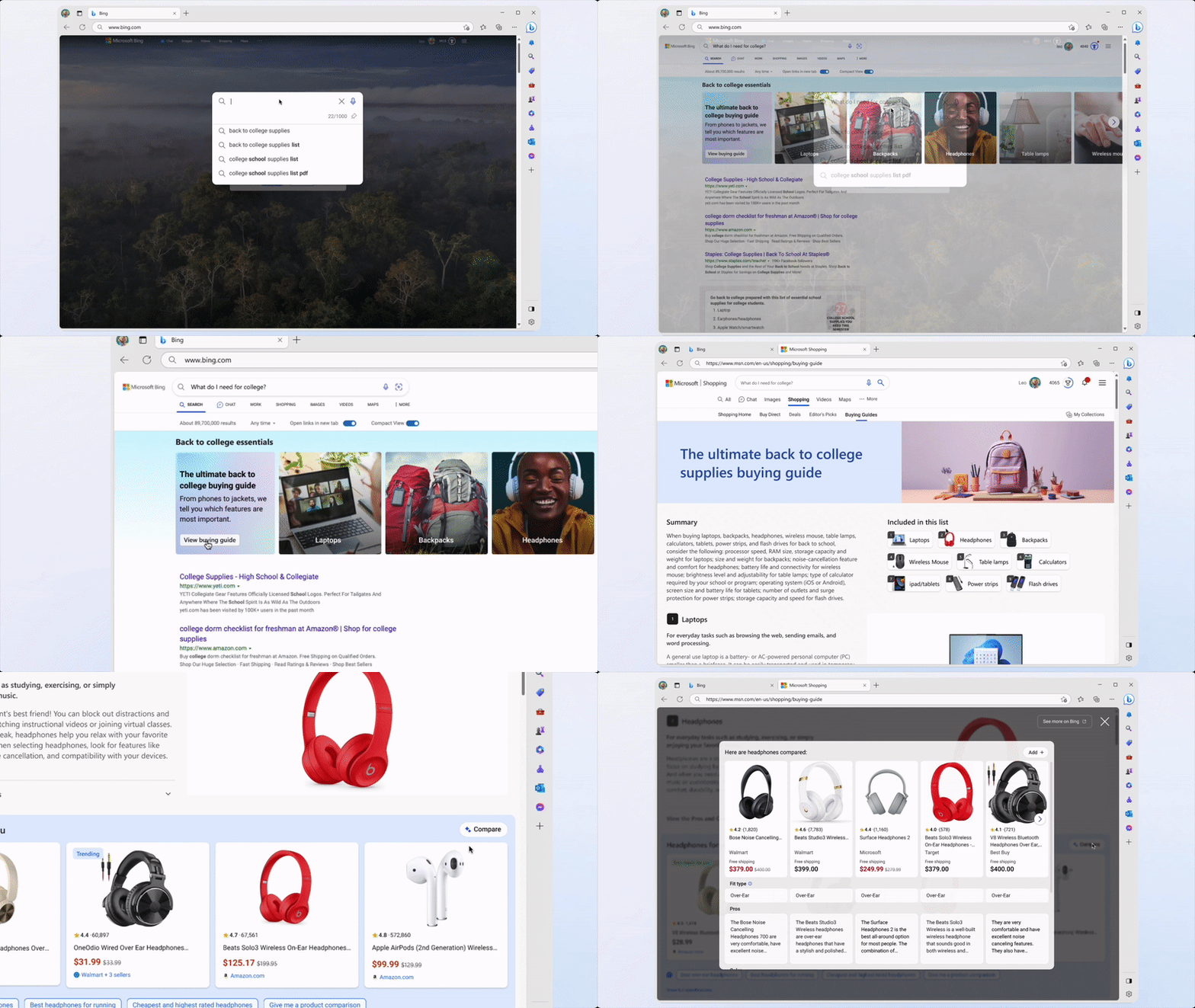
Microsoft, this week, announced new AI-powered shopping tools for its new Bing search engine and the Edge sidebar “to make it easier to discover, research, and complete your purchase all in one place.”
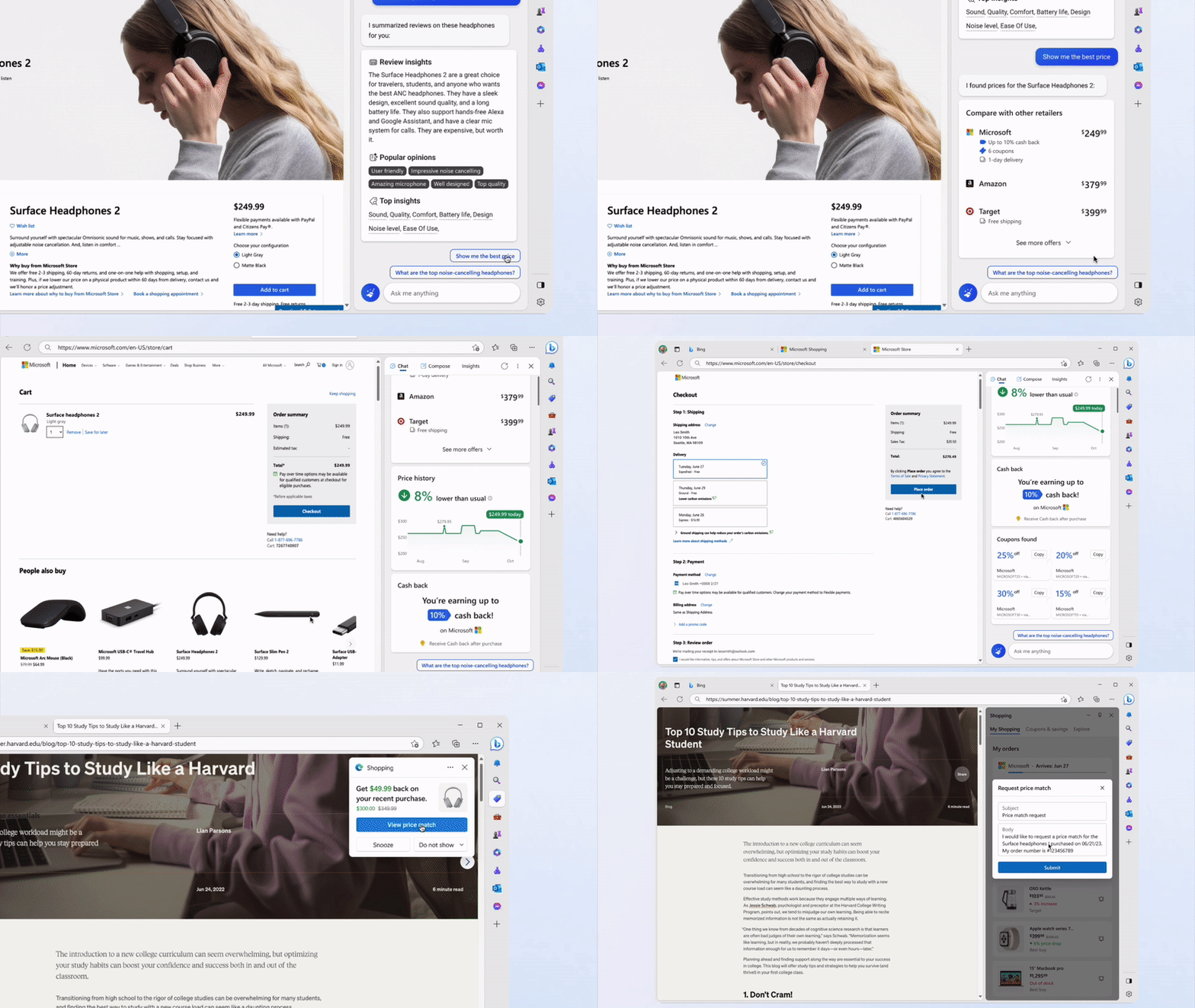
Microsoft’s shopping assistant generates a tailored Buying Guide that tells the user what to look for in each category, offers product suggestions, and shows the specifications of multiple, similar items next to each other in a compare table.
“Price Comparison and Price History are built-in browser features that help ensure you’re buying at the right place and time, and Edge helps you automatically apply coupons and cashback when shopping online,” said the company.
“Price Match will be rolling out soon in the US. Price History, Price Comparison, Coupons, Cashback, and Package Tracking are already available in select markets and built-in to Edge.”
Microsoft will get an affiliate fee when the user buys.
.
Trying to avoid being left behind in the generative AI race, Amazon Web Services, Inc. (AWS) announced this month it will put $100 million in a new program to connect affiliated data scientists, strategists, engineers, and solutions architects with customers and partners to accelerate enterprise adoption an innovation.
The program, called AWS Generative AI Innovation Center, will include free workshops, engagements, and training. Use cases, best practices, and industry expertise will be part of the initiative.
“With over 100,000 clients having used AWS AI and ML services, now, customers around the globe are hungry for guidance about how to get started quickly and securely with generative AI,” said Matt Garman, Senior Vice President of Sales, Marketing, and Global Services at AWS.
According to AWS, healthcare and life sciences companies can pursue ways to accelerate drug research and discovery: manufacturers can build solutions to reinvent industrial design and processes; and financial services companies can develop ways to provide customers with more personalized information and advice.
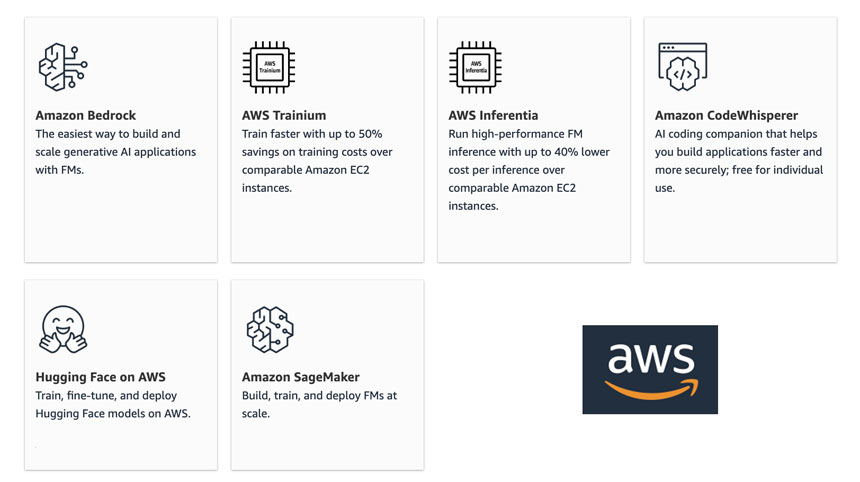
AWS offers several generative AI services, such as Amazon CodeWhisperer, an AI-powered coding companion, and Amazon Bedrock, a fully managed service that makes foundational models (FMs) from AI21 Labs, Anthropic, and Stability AI, along with Amazon’s own family of FMs, Amazon Titan, accessible via an API.
On April, AWS launched a 10-week program for generative AI startups and debuted Bedrock, a platform to build generative AI-powered apps via pretrained third – and first-party models. AWS also recently announced that it would work with Nvidia to build “next-generation” infrastructure for training AI models — complementing its in-house Trainium hardware.
Grand View Researchestimates that generative AI products and solutions could be worth close to $110 billion by 2030.
Salesforce Ventures, Salesforce’s VC division, plans to pour $500 million into startups developing generative AI technologies. Workday recently added $250 million to its existing VC fund specifically to back AI and machine learning startups. OpenAI, the company behind the viral chatbot ChatGPT, has raised a $175 million fund to invest in AI startups. And just this week, Dropbox launched a $50 million AI-focused venture fund.
Accenture and PwC, meanwhile, have announced that they plan to invest $3 billion and $1 billion, respectively, in AI.
According to GlobalData, AI startups received over $52 billion in funding across more than 3,300 deals in the last year alone.
San Francisco – based data storage and management startup Databricks, this week, announced that it will pay $1.3 billion to acquire MosaicML, an open-source startup that enables businesses to build low-cost LLMs (large language models) with proprietary data.
Its two models, MPT-7B and the recent release of MPT-30B, had 3.3 million downloads.
The deal is expected to close during Databricks’ second quarter ending July 31.
“Every organization should be able to benefit from the AI revolution with more control over how their data is used. Databricks and MosaicML have an incredible opportunity to democratize AI and make the Lakehouse the best place to build generative AI and LLMs,” said Ali Ghodsi, Co-Founder and CEO of Databricks.
Databricks intends to combine its Lakehouse Platform with MosaicML’s technology to offer customers a way to train and use LLMs with more control and ownership over how their data is used.
According to MosaicML, “combined with near linear scaling of resources, multi-billion-parameter models can be trained in hours, not days, and it will cost thousands of dollars, not millions.”
Launched in 2021 and with a workforce of 62 employees today, MosaicML had raised $64 million from investors that included DCVC, AME Cloud Ventures, Lux, Frontline, Atlas, Playground Global, and Samsung Next.
Companies like Anthropic and OpenAI license ready-made language models to businesses, which then build generative AI apps on top of them. MosaicML says they can offer similar AI models but at a lower cost and customize with a company’s data. The current cost of training a model on specialized data is estimated at $1 million to $2 million, according to experts.Those kinds of domain-specific models can be more useful for companies than building on top of the entire corpus of data that OpenAI.Large language models are becoming fine-tuned for very specific applications, and at that point, it is so small that they could be embedded into any cellphone.
Some of those models using smaller, pre-trained models are already available in open-source libraries like those offered by machine-learning startup Hugging Face.
.
Inflection AI, which has a small team of around 35 employees and is led by ex-DeepMind leader Mustafa Suleyman, closed a $1.3 billion funding this week. The new capital raised by this one-year-old startup values this company at $4 billion.
The round was led by led by Microsoft, Nvidia, GPU cloud provider CoreWeave, and billionaires Reid Hoffman, Bill Gates, and Eric Schmidt.
The Palo Alto, California-based Inflection sits now behind OpenAI (which has raised $11.3 billion to date) as the second-best-funded generative AI startup — edging out Anthropic ($1.5 billion). Well behind it are Cohere ($445 million), Adept ($415 million), Runway ($237 million), Character.ai ($150 million), and Stability AI (~$100 million).
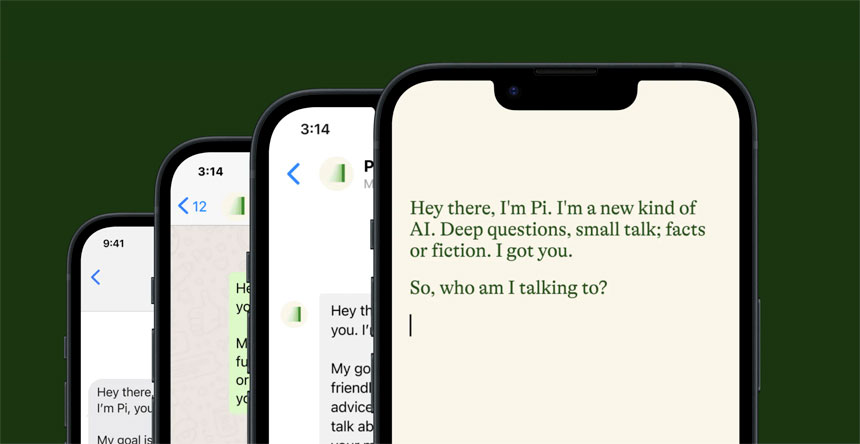
This influx of capital will be used to continue expanding its computing capabilities further developing its AI-powered personal chatbot called Pi.
Specifically, Inflection says it’s working with Nvidia and CoreWeave to build what it claims is one of the largest AI training clusters in the world, comprising 22,000 Nvidia H100 GPUs.
“Personal AI is going to be the most transformational tool of our lifetimes. This is truly an inflection point,” Suleyman said in a statement.
According to Inflection, Pi is intended to be a “kind” and “supportive” companion, offering “friendly” advice and info in a “natural, flowing” style.
Chatbots mimic human speech because the AI that powers them has ingested a huge amount of text, mostly scraped from the Internet. If they ace the bar exam it’s because it’s training data included thousands of practice sites.
The Washington Postanalyzed those websites used to train AI, although companies like OpenAI didn’t disclose what dataset used.
The newspaper worked with researchers of the Allen Institute for AI and categorized the websites, with data from analytics firm Similarweb. Into a tree map of 11 categories.
It started looking inside Google’s C4 data set, which includes 15 million websites from journalism, entertainment, software development, medicine, and content creation, among other industries. Facebook’s LLaMa used it.
The three biggest sites were patents.google.com (which contains text from patents issued around the world), wikipedia.org, and scribd.com (a subscription-only digital library). Also, on the list: the notorious market for pirated e-books b-ok.org a, along with 27 other sites identified by the U.S. government as markets for piracy and counterfeits.
In the area of top business & industrial sites, these were some of the sites: fool.com, kickstarter.com, sec.gov, marketwired.com, city-data.com, patreon.com, myemail.constantcontact.com, finance.yahoo.com, prweb.com, entrepreneur.com, globalresearch.ca.
Top News sites: nytimes.com, latimes.com, theguardian.com, forbes.com, huffpost.com, washingtonpost.com, businessinsider.com, chicagotribune.com, theatlantic.com, aljazeera.com, RT.com (the Russian state-backed propaganda site), breitbart.com, and vdare.com (anti-immigration), among others.
Top Religious sites: patheos.com, gty.org, jewishworldreview.com, thekingdomcollective.com, biblehub.com, liveprayer.com, lds.org, wacriswell.com, wdtprs.com, bibleforums.org, etc.
Top Technology sites: instructables.com, ipfs.io, docs.microsoft.com, forums.macrumors.com, medium.com, makeuseof.com, sites.google.com, slideshare.net, s3.amazonaws.com, pcworld.com, sites.google.com, WordPress, Tumblr, Blogspot, Live Journal, etc.
Data sets used to train AI couldn’t access social networks like Facebook and Twitter, which prohibit scraping.
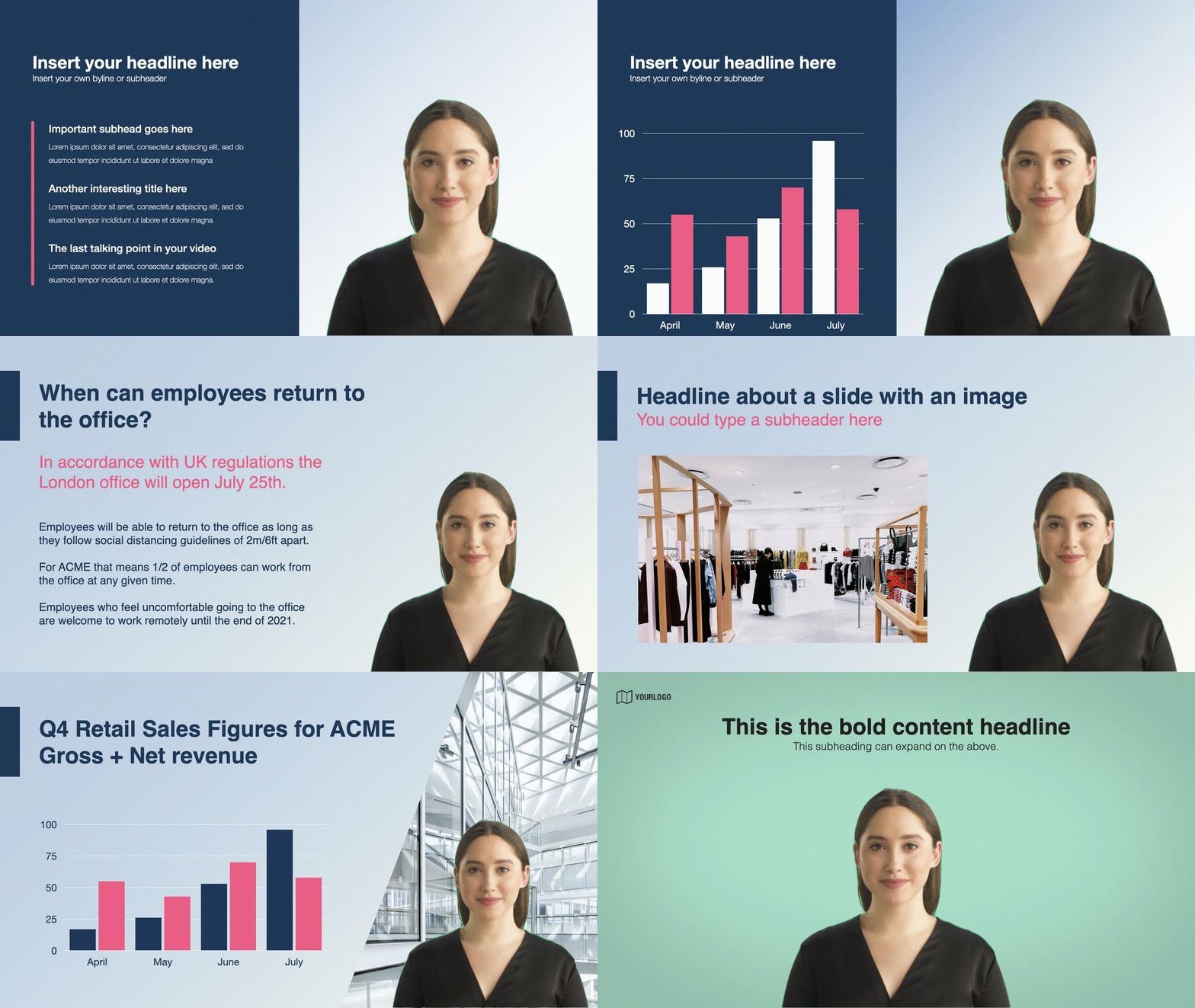
Startup creating AI-driven avatar Synthesia announced this month it raised $90 million in a Series C round led by Accel and participation from Nvidia, Kleiner Perkins, GV, Firstmark Capital, and MMC. To date, the company has raised $156.6 million, with a valuation of $1 billion post-money.
Founded in 2017 and with a workforce of 200 people, Co-founder and CEO Victor Riparbelli ensured TechCrunch that its company has 50,000 customers and is a sustainable business, with 35% of the Fortune 100 as clients.
Synthesia’s AI is trained on real actors, and actors are paid per video generated with their image and voice.
Some experts have expressed concern that tools like Synthesia’s could be used to create deep fakes. The startup responded that it vets its customers and their scripts and requires formal consent from a person before it’ll synthesize their appearance.
.
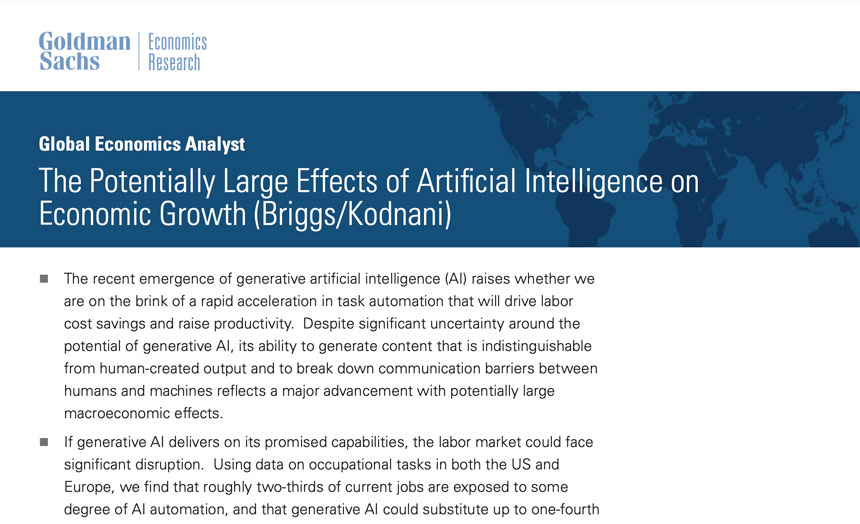
AI has the potential to automate 25% of the entire labor market, which translates to 300 million jobs, according to a research report by Goldman Sachs.
In a research report, the investment bank said that AI could automate 46% of tasks in administrative jobs, 44% of legal jobs, and 37% of architecture and engineering professions.
AI would be the least threatening to labor-intensive careers like construction (6%), installation and repair (4%), and maintenance (1%).
The study concludes that 18% of the global workforce could be automated, while in countries like the U.S., U.K., Japan, and Hong Kong, it’d be 28% of the workforce.
However, Goldman Sachs anticipates that displaced workers will become reemployed in jobs that emerge as a direct result of widespread AI adoption.
Last month, the U.S. Chamber of Commerce called for intense AI regulation at the federal level to ensure job security, national security, and economic stability.
.
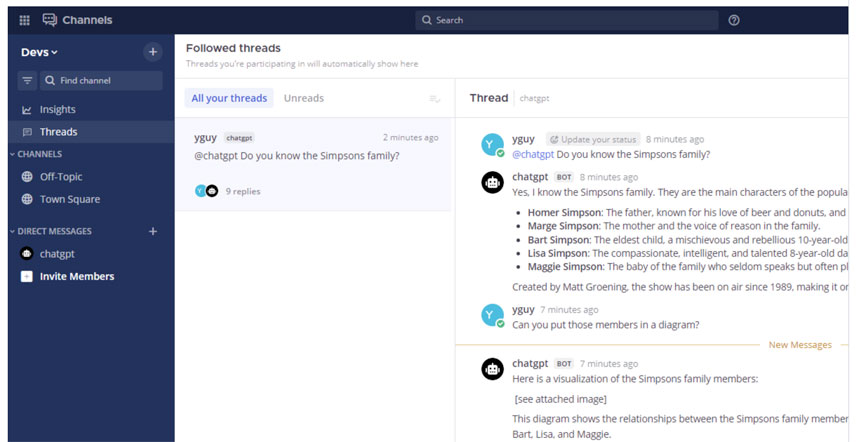
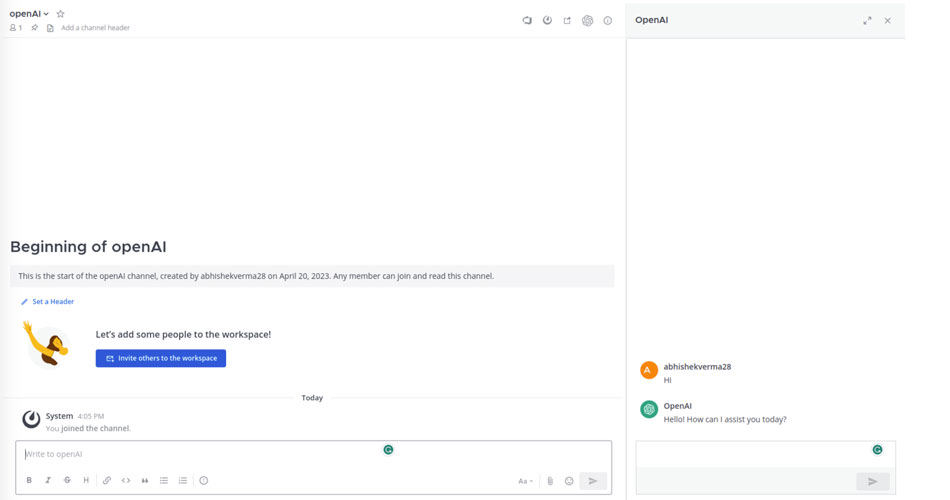
The open-source collaboration platform Mattermost announced this week new solutions for Generative AI, including a customizable ChatGPT bot framework with full control, security, and data privacy. This solution is built to integrate with OpenAI and other cloud LLMs into Mattermost workflows.
As a service, Mattermost provides cloud offerings for authentication and performance. It faces competition from major players such as Slack, Atlassian, and Asana.
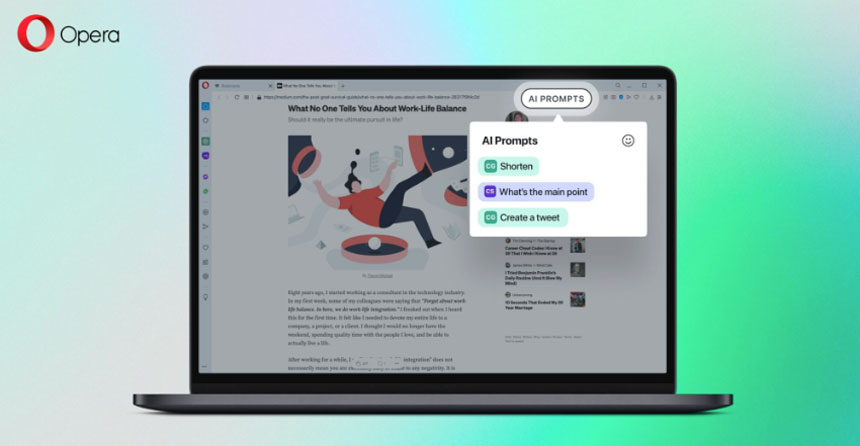
The Opera and Opera GX desktop browsers released a suite of new features, as early access: AI Prompts, sidebar access to ChatGPT, and ChatSonic. Opera follows companies like Microsoft’s Bing, which added GPT-4 into its Edge browser in February.
Opera’s AI Prompts allow users to generate prompts by highlighting text on a website or typing it in.
Some of the prompts include:
Explore
Explain briefly
Explain this article
ELI5 (explain like I’m 5)
Shorten
Show me more relevant content
Create a tweet
Tweet this website like…
What’s the main point
Write a haiku
Make a joke
Opera is integrating the ChatGPT and ChatSonic chatbots into its browsers’ sidebar. ChatSonic can also create images from text inputs.
The company, owned by a Chinese consortium, said that it plans to announce more AI-powered features in the future that would run on its own GPT-based model.
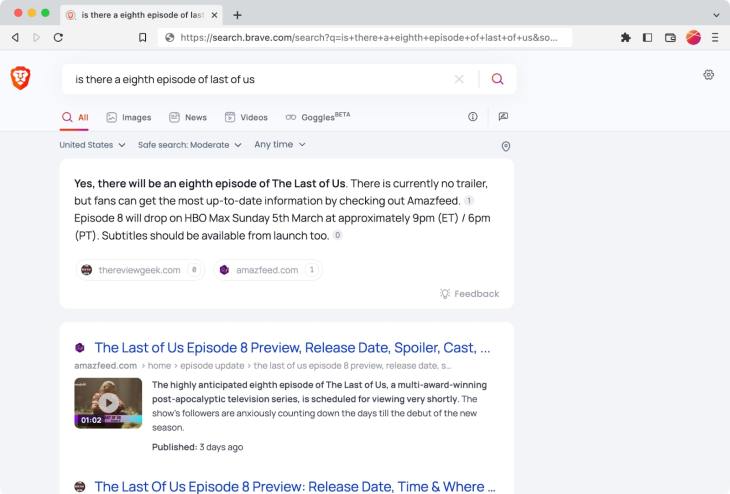
Recently another browser, Brave, introduced an AI summarization feature, powered by its own LLMs instead of OpenAI’s GPT, using a mix of three models: a question-answering model to get answers from text across pages, a classifier to weed out hate speech and spam, and a model that rewrites the sentences to present a concise result.
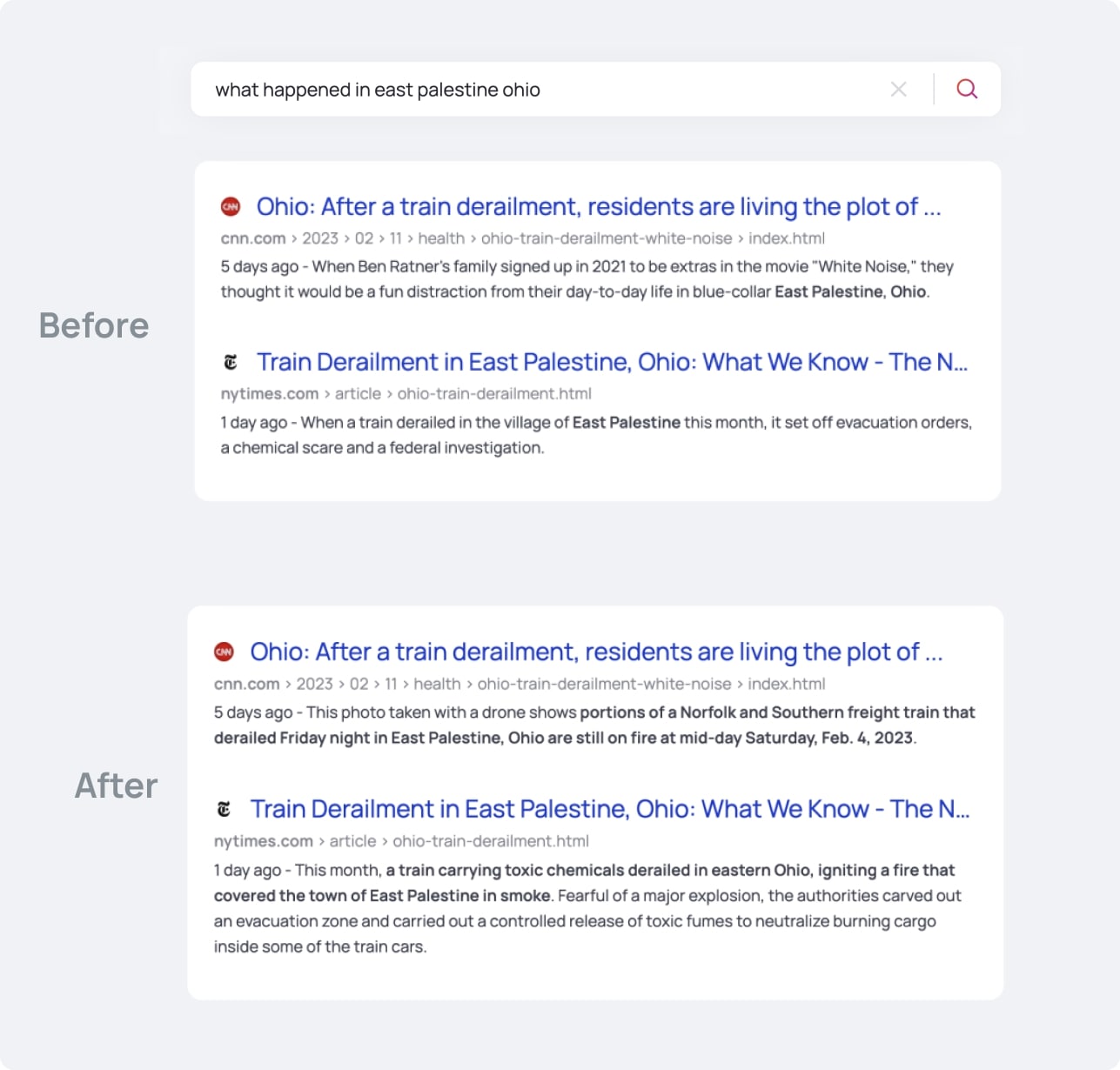
In addition, Brave Search also highlights relevant sentences in listed results as news articles. Previously, it just highlighted search keywords from the page description.
Like other offerings, Brave Search offers citations and links.
The company said that its LLM is trained to fight “unsubstantiated assertions,” referring to AI chat of other search engines like Bing.
“Given the current advancements in AI, it’s crucial to remind users that one should not believe everything an AI system produces, in much the same way one should not believe everything that is published on the Web. At the risk of stating the obvious, we should not suspend critical thinking for anything we consume, no matter how impressive the results of AI models can be,” the company said.
Other smaller players in the space, like Neeva and You.com, have also announced AI-aided search features.
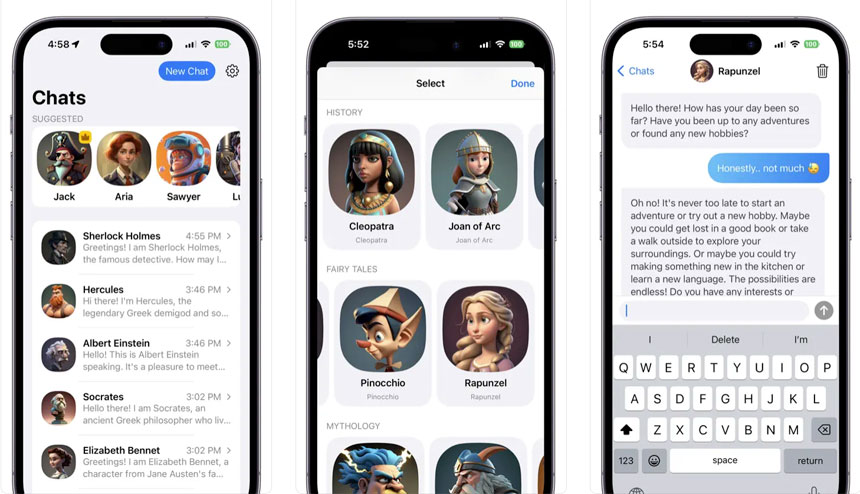
A new GPT-3.5 turbo–powered app called Superchat allows users to chat with historical, fictional characters like Shakespeare, Einstein, or Cleopatra, and experts and representatives from different professions, like lawyers, chefs, or therapists.
The company, Gorilla Technologies, has also created its own characters, like an assistant named Aria. The artwork for the characters was created using Midjourney.
This chatbot can aid users with everyday tasks, like email writing or marketing expertise.
“The goal is to make AI technology accessible to everyone, not just people who know how to write great prompts,” explained Gorilla Technologies CEO Guglielmo Faglioni. “This app will be a great tool for kids who want to learn more about historical figures by chatting to cool characters like Shakespeare.”
The app is structured like a messaging app, allowing users to have multiple conversations with different AI chatbots at the same time.
A number of the characters are available for free with the app download, while others can be unlocked through a premium subscription of $70/year.