Category: Platforms | Tech

  • Coursera for Business Claims 100% Year-Over-Year Customer Growth

    Coursera for Business Claims 100% Year-Over-Year Customer Growth

    IBL News | New York

    Coursera announced yesterday that its enterprise business saw a 100% year-over-year customer growth.

    “In 2019, large organizations including Mastercard, Southwest Airlines, Adobe, and the NYC Department of Small Business Services initiated or continued partnerships with Coursera for Business to equip employees with the skills of the future,” Coursera said in a press release.

    Coursera for Business claims a clientele of over 2,000 companies and governments worldwide, including around 60 companies in the Fortune 500.

    Coursera enterprise’s offer is based on providing curated access to its course catalog for organizations interested in upskilling their workforce. Course content includes certificate programs from 200 top universities and industry leaders.

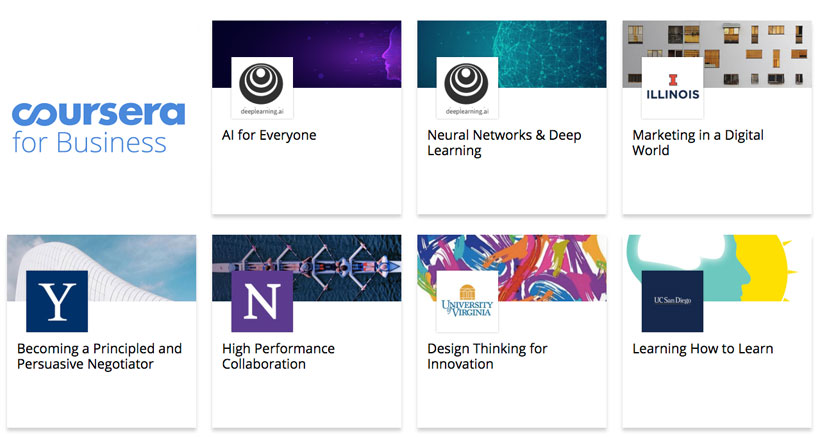
    The most popular courses are the following seven:

    • AI for Everyone –Deeplearning.ai
    • Neural Networks & Deep Learning – Deeplearning.ai
    • Marketing in a Digital World – University of Illinois
    • Becoming a Principled and Persuasive Negotiator – Yale University
    • High-Performance Collaboration – Northwestern University
    • Design Thinking for Innovation – University of Virginia
    • Learning How to Learn – UC San Diego


    More news stories about Coursera for Business at IBL News

  • Khan Academy Launches a Personalized Teaching Tool for Math in K-12

    Khan Academy Launches a Personalized Teaching Tool for Math in K-12

    IBL News | New York

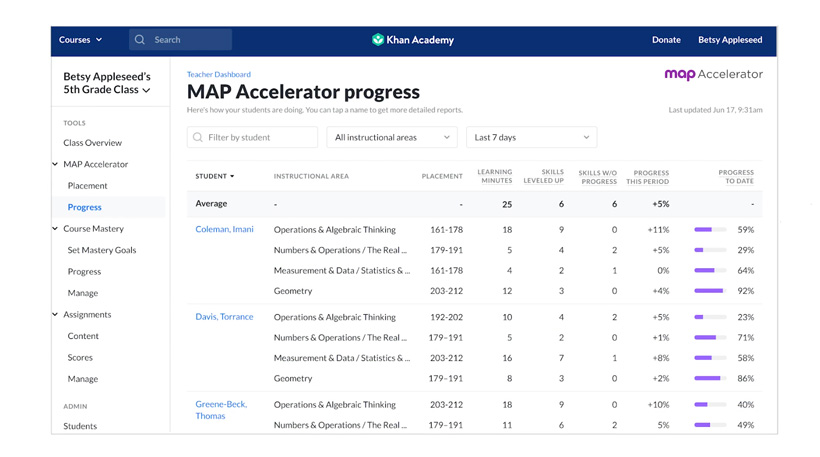
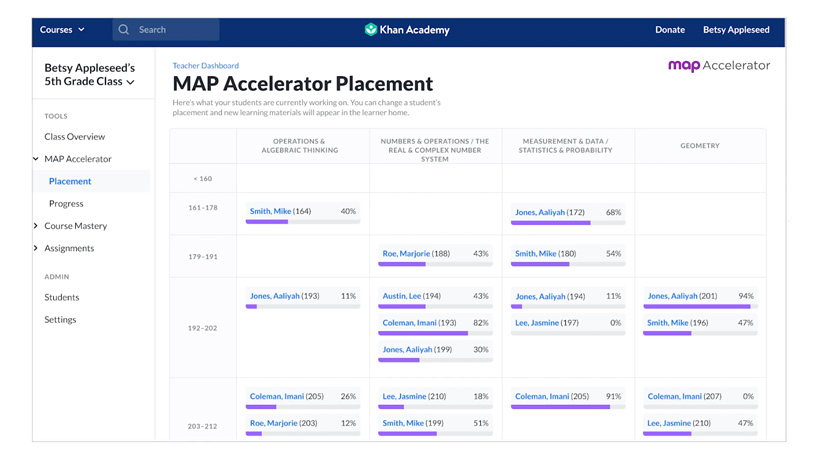
    Khan Academy has launched a tool intended to help school districts’ teachers to differentiate instruction and meet the diverse learning needs of each student.

    This resource, called MAP Accelerator, it uses scores to automatically generate a personalized, mastery-based learning plan for every math student in grades 3 through 8. As a result of it, teachers remain as instructional decision-makers, seeing where students are in their learning journey and pinpointing where students need help.

    Aligned to Common Core State Standards, this learning system includes practice exercises with worked solutions, quizzes, unit tests, instructional videos, and articles.

    For the deployment, oft this technology, the nonprofit organization Khan Academy partnered with NWEA, the creator of MAP Growth.

    Four months ago it developed a pilot for 180,000 students and thousands of teachers in with five school districts: Clark County School District in Las Vegas, Nevada, Jefferson County School District in Louisville, Kentucky, Madera Unified School District, Pajaro Valley Unified School District, and Glendale Unified School District in California.

    “We think MAP Accelerator equips teachers to unlock student potential like never before,” Sal Khan, Founder and CEO of Khan Academy, stated in a blog post.

  • With 30 Million Users and $1.5 Billion Valuation, Doulingo Plans to Go Public in 2021

    With 30 Million Users and $1.5 Billion Valuation, Doulingo Plans to Go Public in 2021

    IBL News | New York

    Language-learning app Doulingo’s CEO stated on CNBC that they are expecting to IPO its company in 2021, following with a long-term plan, along with the desire to make some acquisitions and aspirations to symbolize Pittsburgh’s rebirth. [See the interviews below].

    Luis von Ahn, Duolingo CEO and Co-Founder made these statements after announcing, this Wednesday, it had raised $30 million in a Series F round of funding from Alphabet’s investment arm CapitalG.

    This amount takes Duolingo’s total raised to $138 million, giving it a valuation of $1.5 billion and reaching unicorn status. Existing investors include Kleiner Perkins Caufield Byers, Union Square Ventures, New Enterprise Associates, Drive Capital, Ashton Kutcher, and Tim Ferriss.

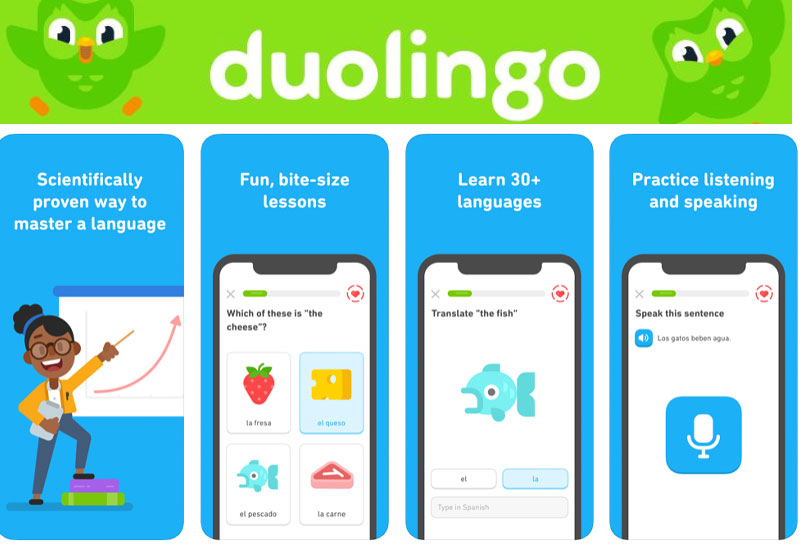
    Duolingo, the most downloaded educational app, has remained focused on its mission of enabling anyone to learn languages for free –though they do offer a $7 per month premium service that removes ads and delivers offline access. It offers 91 courses across 30 languages, featuring 3-minute, bite-sized lessons, and gamified exercises.

    “Duolingo has been adding users and revenue at an impressive pace, continuing to solidify their position as the number one way to learn a language globally,” Laela Sturdy, CapitalG general partner, said in a press release. Duolingo claims 30 million active users, whom are actively learning languages on its platform.

    Founded in Pittsburgh in 2011, the fast-growing app will mostly use the new funding from Google parent Alphabet to double its employee base with a plan to reach 300 by the end of 2021.

    In addition, it will develop new initiatives such as podcasts for Spanish and French learners, events to connect language learners in person around the world, and the Duolingo English Test, a $49 English proficiency test for international students. The company is also looking at investments in machine learning and AI to “offer a more personalized, adaptive experience for learners,” said von Ahn.


  • An Equity Investment Firm Buys Instructure for $2 Billion, Taking It Private

    An Equity Investment Firm Buys Instructure for $2 Billion, Taking It Private

    Mikel Amigot | New York

    Instructure (NYSE: INST), the company behind Canvas LMS, yesterday announced that it agreed to be acquired by the private equity investment firm Thoma Bravo, LCC, in an all-cash deal for about $2 billion –unless a better offer comes along within 35 days.

    The transaction is expected to close in the first quarter of 2020. Upon completion of the acquisition, Instructure will become entirely owned by Thoma Bravo.

    As part of the terms of the agreement, stockholders will receive $47.60 in cash per share, which is a discount of about 10% to Instructure’s closing price of $52.96 on Tuesday. Shares of the company were down to about 10% at $47.85 in premarket trading.

    The price per share represents an 18% premium to the company’s 3-month volume-weighted average price as of October 27, 2019–the day prior to the company’s third-quarter earnings call, at which it announced a strategic review for its Bridge business.

    While pushing for a sale, New York-based Sachem Head Capital Management and other activist firms, have been buying Instructure’s shares over time. The exact size of their position could not be determined.

    The Instructure management team, led by CEO Dan Goldsmith, will continue to lead the Company in their current roles, and the company’s headquarters will remain in Salt Lake City, Utah.

    “Instructure believes the opportunity to become a private company will provide additional flexibility, and position us to invest more strategically to drive innovation for our customers,” said Goldsmith. “We have chosen this path very deliberately; we are confident that making the change from public to private will best serve the needs of Instructure and all of you moving forward,” he announced in a letter to customers.

    Brian Jaffee, a Principal at Thoma Bravo said, “We believe Canvas is a highly unique vertical market SaaS leader with exciting scale and future growth potential. We look forward to building on the strong momentum in the business and accelerating growth and product investment both organically and through M&A.”

    The deal includes a 35-day “go-shop” period expiring on January 8, 2020, which permits the Instructure’s Board of Directors and advisors to consider alternative acquisition proposals.

    J.P. Morgan Securities LLC is serving as the exclusive financial advisor to Instructure and Cooley LLP is serving as the legal advisor. Kirkland & Ellis is serving as the legal advisor to Thoma Bravo.

    At least four firms – Halper Sadeh LLP, Rowley Law PLLC, Bragar Eagel & Squire, P.C., and Rigrodsky & Long, P.A. –announced separately yesterday that they were investigating potential legal claims against the board of directors at Instructure, regarding the possible breaches of fiduciary duties-among and other violations of law related to the company’s sale.


    Past news stories about Instructure at IBL News
     

  • Harvard Changes Its Caption System to Settle Deaf Association’s Suit

    Harvard Changes Its Caption System to Settle Deaf Association’s Suit

    IBL News | New York

    This month, Harvard University will implement a new policy to caption all of the new audio and video content uploaded in the university website as well as any third-party platforms, such as YouTube, Vimeo, SoundCloud or edX.org.

    The decision comes as a is result of a settlement after the National Association of Deaf (N.A.D.) filed a class-action discrimination suit.

    Last Wednesday, November 27th, the association won a landmark settlement intended to require Harvard to abide by standardized accessibility guidelines when captioning online content for those who are deaf or hard of hearing. The organization said that closed captions were either missing or inaccurately transcribed and that the institution violated the Americans With Disabilities Act and the Rehabilitation Act.

    The settlement, which went into effect on December 1st, stipulated that Harvard must provide captions for existing content posted on or after January 2019, within two years, and offer captions for events that are streamed online live.

    In addition, the settlement obliged Harvard to pay $1.5 million in attorney fees and costs to the National Association of Deaf.

    “Ensuring accessibility is not something that can be considered a bonus—it is a fundamental right that everyone deserves. We’re pleased that Harvard will finally be treating all learners with the same standard of respect,” Amy F. Robertson, co-executive director of the Civil Rights Education and Enforcement Center, explained.

    This settlement was reached after four years of litigation. In 2016, Harvard tried to dismiss the suit, but the judge rejected this attempt.

    The settlement represents the most comprehensive set of online accessibility requirements in higher education, according to experts.

  • Black Friday and Cyber Monday: edX, Pluralsight, Udemy and Skillshare Join the Marketing Season

    Black Friday and Cyber Monday: edX, Pluralsight, Udemy and Skillshare Join the Marketing Season

    IBL News | New York

    This year, online education was not immune to the marketing craziness of Black Friday and Cyber Monday.

    Even edX.org, the nonprofit organization founded by Harvard and MIT, and focused on higher education at scale, fell into the guerrilla promotional techniques after the Thanksgiving day.

    Competitors, Coursera and Udacity, the two Silicon Valley largely founded unicorns, contradicted their commercially aggressive reputation and stayed calm. Also, Microsoft’s LinkedIn Learning and 2U’s GetSmarter short courses unit remained quiet.

    On Thursday, edX announced that something big was coming: “Mark your calendars and head over to edx.org tomorrow for the reveal.”

    That big event was no other than a 20% discount on the purchases of courses and programs, as stated on their website, Facebook, Twitter, and LinkedIn:

    edX’s offer highlighted a selection of 24 programs and courses about Data Science, Business, and Computer Science, although the code could be applied to other courses, as MITx reminded on its Twitter account.

    Another large company, Pluralsight (NASDAQ: PS), with a whopping market cap of $2.3 billion, offered a discount of 40% on an annual subscription: prices on regular subscriptions dropped from $299 to $179, and from $449 to $269 on premium. (Connected or not to the deal, Pluralsight’s stock grew 2.23% yesterday.)

    Black Friday savings were also heavily promoted on Udemy.com, with one of the largest catalogs of courses (over 100,000 titles).

    Udemy launched thousands of courses starting at $10 when those classes normally cost $100.

    Skillshare didn’t miss the shopping opportunity and went with a “super sale”.

    Finally, Teachable.com, the course creation platform, launched its first-ever discount (10% to 20%) on basic and professional membership plans. Its main competitor, Thinkific, joined the marketing season, too.

  • Today, MOOCS Are Focused on Online Degrees and Corporate Training, Says Dhawal Shah

    Today, MOOCS Are Focused on Online Degrees and Corporate Training, Says Dhawal Shah

    IBL News | New York

    “In the last few years, MOOCs have been generally focused on micro-credentials and certifications; now, it is more about online degrees and corporate training,” Dhawal Shah, Founder and CEO at Class Central, explained in a video interview with IBL News. [Watch it below]

    The four main MOOC platforms – Coursera, edX, Udacity, and Future Learn – are certainly pursuing revenue-generating opportunities. However, “it seems a sense of balance has been restored since now not everything is behind a paywall,” he adds.

    In terms of the players, Coursera and Udacity, led by some Silicon Valley’s top VC fund, are behaving aggressively, by making fast changes and spending more. Although they are not profitable yet. Coursera made $140 million in revenue last year, and Udacity, $90 million. Meanwhile, edX was in the range of $60 million, according to the creator of Class Central.

    The case of Udacity is more colorful. “It is always a roller coaster with Udacity. Hard to predict. They are more suitable to get acquired; they have their own content and one of the most popular credentials in technology, the Nanodegree.”

    Finally, Dhawal Shah spoke about his own company – “profitable, with a remote-based team, and a clear goal of making online education to work for everyone”.


  • Duke University Introduces an Open Source Tool as an Alternative to a Monolithic LMS

    Duke University Introduces an Open Source Tool as an Alternative to a Monolithic LMS

    IBL News | New York

    Duke University announced Kits, an open-source, next-generation digital learning environment (NGDLE).

    “Relying on any single solution, including the LMS, is s a short-sighted technology strategy,” Jolie Tingen, Product Manager at Duke, explained in an article at Educause Review. “No monolithic system can provide all learning communities with a completely optimal experience. Learning is maximized when appropriate technologies are used in conjunction with evidence-based pedagogies.”

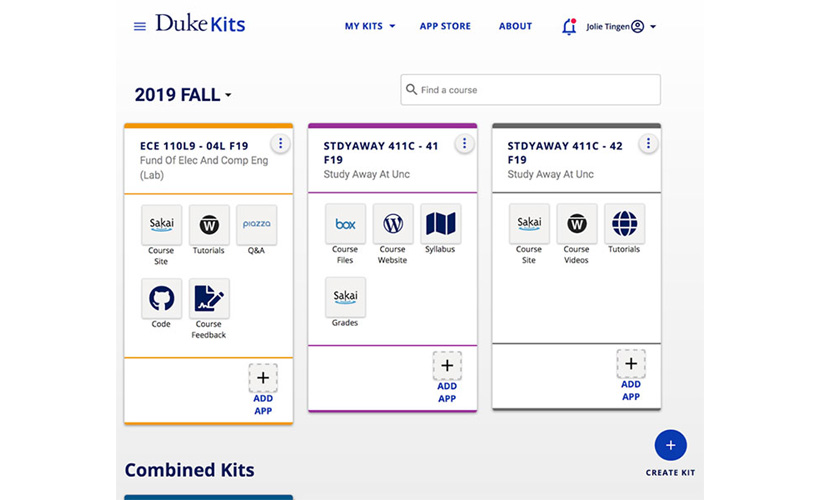
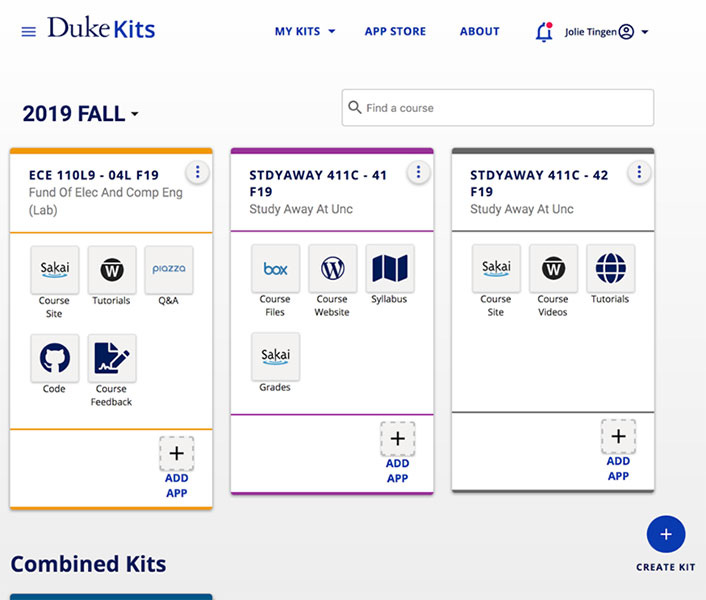
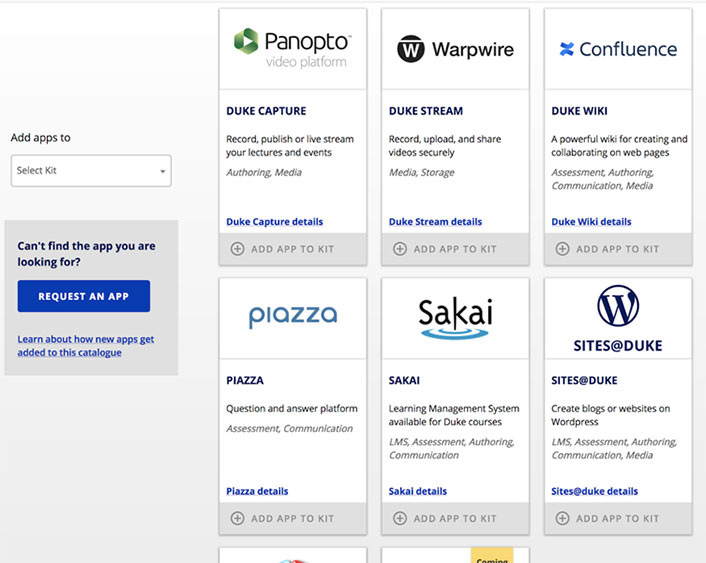
    Kits features a card (a “kit”) for every course. Instructors can add apps to their kits, and those apps are automatically shared with everyone in their courses.  (See images below).

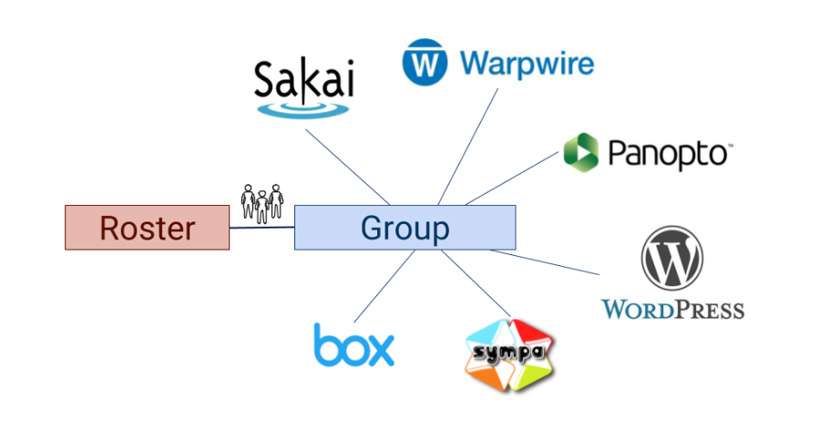
    Developed by Duke’s Learning Innovation and the Office of Information Technology,  Kits – now released as an alpha version – evolved from a home-grown group management solution and it was developed outside the LMS. “It brings together the centralized student access points of the LMS with the flexibility and power of an app-based system.”

    Currently, eight applications are included on Kits, and three more are expected to arrive this year. Learning analytics are in the roadmap, too. The integration was done via LTI standard or API. In addition, Kits comes with a “custom link” option that allows both instructors and students to add any share-by-link application.

    Kits is built with Ruby on Rails (Backend Framework), React (Frontend Framework), Grouper (Group Management), Shibboleth (SSO) and LTI.

    All of the work is open at learnwithkits.com, Duke’s public GitHub repository.


  • edX’s View for 2020: MicroBachelors Programs and Stackable Modular Credentials for Full Degrees

    edX’s View for 2020: MicroBachelors Programs and Stackable Modular Credentials for Full Degrees

    IBL News | New York

    In 2020, edX will launch its “MicroBachelors programs, a series of career-relevant, credit-backed undergraduate online courses”, the organization announced yesterday on its 2020 Impact Report“MicroBachelors programs will be transformative for learners unable to attend or afford traditional bachelor’s degree programs.” 

    In the report, edX highlights its belief that higher education will be “modular and stackable”. “Our vision for the future of education is built on the stacking of modular credentials, sometimes from different institutions, into new types of degrees and programs that fit the needs of learners where they are, no matter their background.”

    Anant Agarwal, CEO at edX, expressed this view at a recent interview and conference.

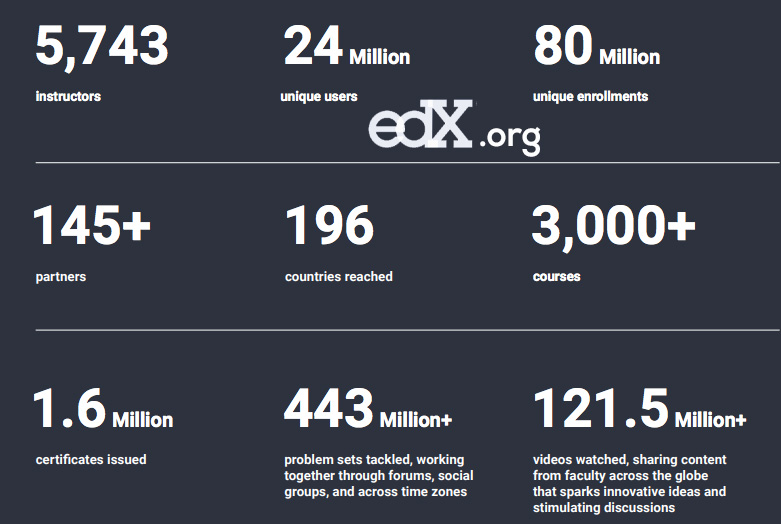
    edX’s 2020 Impact Report is the result of a discussion started earlier this year by the organization itself. Essentially, it’s a 9-page document that explores the milestones accomplished by edX since its foundation in 2012.

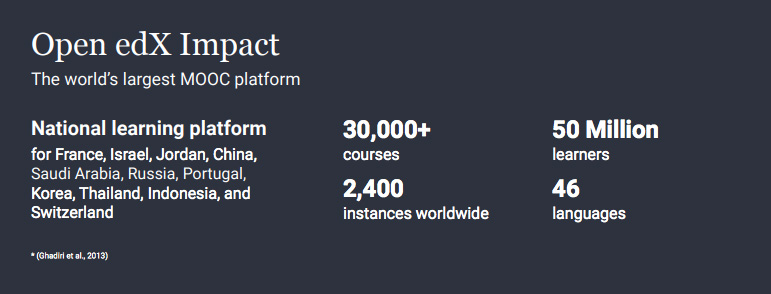
    Its impact is especially notorious regarding the Open edX open-source tool, which has become the learning-at-scale national platform in France, Israel, Jordan, China, Saudi Arabia, Russia, Portugal, Korea, Thailand, Indonesia, and Switzerland, as well as the preferred choice of 2,400 instances. Overall, there are over 30,000 courses built on Open edX, and 50 million learners taking classes in 46 languages.

    The edX.org educational portal is featured as “the Classroom to the World.” “By opening the classroom through MOOCs, edX brings the best courses from the best schools to millions of learners around the world.”

    edX 2020 Impact Report in PDF

  • Novartis Will Grant Employees Free Tuition to Earn Two Master’s Degrees on Coursera

    Novartis Will Grant Employees Free Tuition to Earn Two Master’s Degrees on Coursera

    IBL News | New York

    Novartis will grant eligible employees free tuition to earn two Coursera’s MastersMaster of Computer Science in Data Science from the University of Illinois or the Master of Applied Data Science from the University of Michigan.

    This way, Novartis, a leading pharmaceutical multinational with 108,000 employees, expands its initial agreement with Coursera, which was based on accessing of 3,600 courses.

    “Novartis is the first Coursera for Business customer to offer master’s degrees through our enterprise platform, setting a model for creating diverse and flexible pathways within an institutional learning context,” Leah Belsky, SVP of Enterprise at Coursera, stated in a blog post announcing the agreement.

    “These efforts enable Novartis to boost employee engagement and attract and retain talent in the long-run,” she added.