Category: Platforms | Tech

  • The Top 100 Free Online Courses According to Class Central

    The Top 100 Free Online Courses According to Class Central

    IBL News | New York

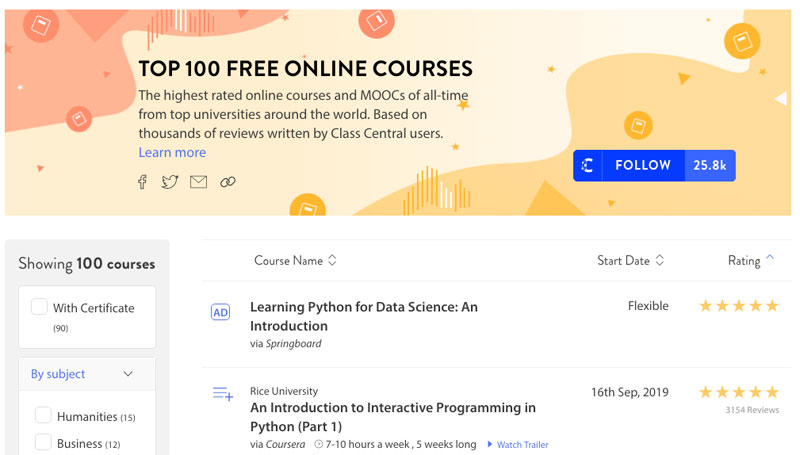
    Class Central online MOOC directory came up with the 2019 top 100 free online courses of all-time.

    These MOOCs have been developed by 53 universities from 18 countries.

    • Three universities – MIT, University of Sheffield (UK) and University of Cape Town (South Africa) – have three courses in the top 100.
    • Three other American universities – Stanford, Michigan, and Pennsylvania – have four courses each.
    • Coursera is the top course platform with 45 courses, followed by edX (24) and FutureLearn (17).

    “We first published the ranking in 2016, and have updated it every year since. In 2019, we increased the number of courses in the list from 50 to 100, drawing on more than 60,000 learner reviews,” explained Dhawal Shah, Founder and CEO of Class Central.

    Globally, there are over 13,000 MOOCs from almost 1,000 universities.

    These are the first 50 courses:

    Rice University
    An Introduction to Interactive Programming in Python (Part 1)

    University of Alberta
    Mountains 101

    University of California, San Diego
    Learning How to Learn: Powerful mental tools to help you master tough subjects

    University of Tasmania
    Understanding Dementia

    University of Cape Town
    Extinctions: Past and Present

    University of Michigan
    Programming for Everybody (Getting Started with Python)

    University of Tasmania
    Understanding Multiple Sclerosis (MS)

    Universidad Nacional Autónoma de México
    Aprender

    Technische Universität München (Technical University of Munich)
    Six Sigma: Define and Measure

    Santa Fe Institute
    Introduction to Complexity

    Georgetown University
    Quantum Mechanics for Everyone

    University of Tasmania
    Preventing Dementia

    Tomsk State University
    Presentation skills: Designing Presentation Slides

    Princeton University
    HOPE: Human Odyssey to Political Existentialism

    Monash University
    Maintaining a Mindful Life

    McMaster University
    Mindshift: Break Through Obstacles to Learning and Discover Your Hidden Potential

    Indian School of Business
    A Life of Happiness and Fulfillment

    California Institute of the Arts
    Introduction to Real-Time Audio Programming in ChucK

    Vanderbilt University
    Introduction to Programming with MATLAB

    Harvard University
    Justice

    Arizona State University
    Learning How To Learn for Youth

    University of Groningen
    Introduction to Dutch

    Tsinghua University
    Tsinghua Chinese: Start Talking with 1.3 Billion People

    University of Cape Town
    Understanding Clinical Research: Behind the Statistics

    Santa Fe Institute
    Introduction to Dynamical Systems and Chaos

    Goldsmiths, University of London
    Machine Learning for Musicians and Artists

    University of Cape Town
    What Is a Mind?

    University of Urbino
    Umano Digitale

    University of Helsinki Reaktor
    Elements of AI

    Monash University
    Mindfulness for Wellbeing and Peak Performance

    California Institute of the Arts
    Sound Production in Ableton Live for Musicians and Artists

    Y Combinator
    Startup School

    The Hong Kong University of Science and Technology
    Fibonacci Numbers and the Golden Ratio

    The Hong Kong University of Science and Technology
    Matrix Algebra for Engineers

    California Institute of Technology
    The Science of the Solar System

    British Council
    English for the Workplace

    Emory University
    The Bible’s Prehistory, Purpose, and Political Future

    Duke University
    Medical Neuroscience

    Doon University, Dehradun UGC
    Mathematical Economics

    The University of Sheffield
    Forensic Facial Reconstruction: Finding Mr. X

    British Council
    English in Early Childhood: Language Learning and Development

    The University of Sheffield
    Discover Dentistry

    Stanford University
    Machine Learning

    Universitat Politècnica de València
    Basic Spanish 2: One Step Further

    Leiden University
    EU policy and implementation: making Europe work!

    Georgia Institute of Technology
    Mechanics of Materials I: Fundamentals of Stress & Strain and Axial Loading

    Newcastle University The University of Sheffield University of Liverpool
    The Musculoskeletal System: The Science of Staying Active into Old Age

    University of Toronto
    Learn to Program: The Fundamentals

    Esri
    Cartography

    University of Alberta
    Dino 101: Dinosaur Paleobiology

    The full list of the top 100 rankings is on the Class Central website.

  • Novartis’ 108K Employees Will Have Unlimited Access to Coursera’s Catalog

    Novartis’ 108K Employees Will Have Unlimited Access to Coursera’s Catalog

    IBL News | New York

    Coursera announced Thursday that the global pharma company Novartis will provide unlimited access to the platform catalog of 3,600 courses to its 108,000 employees.

    This global force will also have access to a stackable curriculum on data science, digital technologies, and soft skills.

    This offering follows a pilot earlier this year with 2,000 employees enrolled in certified classes on Coursera.

    “This collaboration is an important part of our efforts to unleash the power of our people and reimagine medicine in new and powerful ways,” said Simon Brown, Chief Learning Officer at Novartis. “We have set an ambition to support our associates in spending 5% of their time (about 100 hours a year) on learning”.

    Novartis claims that it committed to $100 million of new investment in learning over the next five years.

    According to Coursera, pharmaceutical companies overall have lower skills proficiency in data science and computer science compared to other industries, ranking in the 30th and 10th percentile, respectively.

    Coursera for Business claims over 2,000 corporate clients.

    According to Deloitte’s Human Capital Trends in 2019. 54% of all employees will require significant reskilling and upskilling in just 3 years.


    Blog on Coursera: Exploring curiosity with Simon Brown, Chief Learning Officer at Novartis

  • EdX Appoints New Managers; JP Beaudry Will Lead the Open Source Operations

    EdX Appoints New Managers; JP Beaudry Will Lead the Open Source Operations

    IBL News | New York

    The edX organization announced September 10 the hiring of a new CMO and VP of Engineering, as well as the promotion of two officers.

    “These appointments come at an exciting time for edX, as the company continues to grow, expanding its global learner base to over 20 million learners and offering new, innovative programs and credentials designed to help learners advance their careers,” edX explained in a statement.

    • Johannes Heinlein, former Vice President of Strategic Partnerships at edX, has been promoted to Chief Commercial Officer and Senior Vice President of Strategic Partnerships;
    • Lauren Holliday, former Senior Director of Product, has been promoted to Vice President of Product;
    • Stephanie Brocoum has been hired as Chief Marketing Officer;
    • JP Beaudry has been hired as Vice President of Engineering.

    Stephanie Brocoum, former CMO at Yaymaker and vice president of marketing and member of the founding team at Rue La La, will lead marketing activity for edX by “developing and implementing strategies to further build the edX brand and to drive continued awareness of edX’s innovative offerings”.

    JP Beaudry, former senior director of technology at Vistaprint, will lead software engineering initiatives across all of edX including product development, cloud infrastructure, data warehouse, and the open-source project, Open edX.

    In 2014, edX hired another Vistaprint executive, Wendy Cebula, as CCO and President.

  • A MOOC that Teaches How to Create Viral Content Gets 86,000 Enrollees

    A MOOC that Teaches How to Create Viral Content Gets 86,000 Enrollees

    IBL News | New York

    Over 86,000 learners have enrolled in the “Viral Marketing and How to Craft Contagious Content” MOOC at Coursera.org.

    This free, 6-hour course, developed by the University of Pennsylvania, explains how to apply viral marketing ideas and be more effective when developing brand and product campaigns.

    Drawing on principles from his best-selling book, “Contagious: Why Things Catch On”, Professor at Wharton School Jonah Berger [in the picture] illustrates successful strategies and explains how to craft stickier content, generate more word of mouth and create viral campaigns.

  • IBM Releases a Video Tutorial Series and Textbook to Educate on Quantum Computing

    IBM Releases a Video Tutorial Series and Textbook to Educate on Quantum Computing

    IBL News | New York

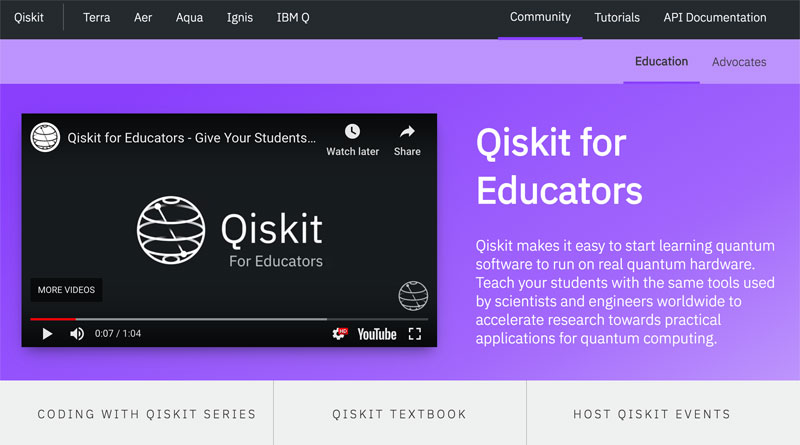
    IBM announced last week the release of a video tutorial series, an open-source textbook, and a university hackathon program, in an effort to massively educate on quantum computing. This set of features are available on IBM’s Qiskit learning platform.

    A part of this education push is also the new 5-qubit systems for educational use, as well as a new feature to reserve uninterrupted time on one of IBM’s quantum computers for running experiments.

    “Our team is committed to making quantum sciences more approachable by investing heavily in the education to support this growing community and establishing the emerging technology as the next generation of computing,” Jay Gambetta, Vice President of quantum at IBM, said in a blog post.

    “We need more students, educators, developers, and domain experts with ‘quantum ready’ skills. This is why our team is proud to release educational resources and tools, while also increasing the capacity and capability of our IBM Q systems,” he added.

    Quantum computers use qubits, not bits, and programming them is quite different than traditional computers. However, IBM’s Q System can be programmed using Python.

    IBM launched the IBM Q Experience quantum cloud platform in 2016, making 5-qubit quantum processors and a simulator available online to the public.

    Since then, IBM has released the Qiskit framework to enable users to more easily write and run code for quantum devices as well as providing a more advanced 16-qubit processor.

    Over 28 million of experiments and simulations have been conducted to date, IBM says.


    Aiming at Self-Learners and Educators

    The ‘Learn Quantum Computation Using Qiskit’ open-source textbook allows students to learn quantum computation through practical problem sets run on real systems. It is aimed at both self-learners and educators.

    The co-author of the book said that a strong background in quantum mechanics is not required.

    IBM is also offering a ‘Coding With Qiskit’ video series.

    Lastly, IBM is featuring a series of events:

    • The IBM Q Award Challenges are semester-long competitions on various topics, open to everyone.
    • The University Hackathon Partnership Program lets universities partner with IBM’s global teams to host a hands-on Qiskit experience, where students get to collaborate with IBM Q experts for developing quantum software programs.
    • International Qiskit Camps in Asia, Africa, and Europe for competing in teams.
    Early this year, IBM showed the IBM Q System One at CES, in Las Vegas. It also announced plans to commercialize a 58-qubit quantum computer within the next several years.
  • Building Digital Programs Step-By-Step To Generate a Revenue Stream

    Building Digital Programs Step-By-Step To Generate a Revenue Stream

    Marie I. Rose | IBL News

    The reality is that any college can introduce online programs step-by-step and build digital degrees in an unbundled way.

    And while online numbers skyrocket, dozens of American colleges are at risk of going under due to insufficient physical enrollment and revenue.

    Should schools then avoid this financial hole and aggressively invest in the new market of online education?

    Expert Robert Ubell notes in an article on EdSurge that there is “a major sabotaging myth that digital instruction is far too expensive.”

    “Start by corralling a few daring faculty members to work together with a couple of new hires, especially an experienced instructional designer,” Ubell says.

    As a software infrastructure, there are excellent choices of learning platforms that allow creating replicas of Coursera.org or edX.org starting at $10K.

    “Tactically, it’s wise to build only the one or two needed to deliver for the first semester. Tuition generated from those initial courses is likely to subsidize the next ones. And so on. By the time a college is ready to launch its next round of online degrees, tuition revenue from those delivered in the initial semesters will help drive the next few,” advices Robert Ubell, who successfully followed this approach at Stevens and NYU.

    “A full program, say, of six courses, should cost $150,000 to $200,000,” states John Vivolo, director of Online Education at Katz School of Science and Health at Yeshiva University.

  • Curtin University and Universidad Anáhuac Contribute to the edX Consortium

    Curtin University and Universidad Anáhuac Contribute to the edX Consortium

    IBL News | New York

    The edX Consortium continues to expand by adding new members and expanding its reach.

    This week, Curtin University joined the edX University Advisory Board (UAB) as a contributing charter member.

    “Joining edX in 2015 has opened up many opportunities for Curtin University to collaborate with leading global universities to deliver innovative learning and teaching options,” said Professor Deborah Terry, Vice-Chancellor at Curtin University.

    Curtin University currently hosts a Master’s Degree in Marketing on edX, and three MicroMasters: Marketing in a Digital World, Internet of Things (IoT) and Human Rights.

    Another recent incorporation into the Cambridge, Massachusetts-based nonprofit consortium, was Universidad Anáhuac, located in Mexico.

    The institution will start offering three professional certificate program in Spanish, starting in September and October:


  • Bertelsmann Will Fund 15,000 Scholarships to Learn Data, AI and Cloud Computing on Udacity

    Bertelsmann Will Fund 15,000 Scholarships to Learn Data, AI and Cloud Computing on Udacity

    IBL News | New York

    Bertelsmann, the German media and services multinational corporation, announced on September 5 that it will fund 15,000 scholarships in Data Science, Artificial Intelligence (AI), and Cloud-Computing-related courses hosted on Udacity.

    “We invite any learner, whether beginners with basic computer skills or an experienced programmer, to apply for a scholarship,” wrote Lalit Singh, Chief Operating Officer at Udacity. Applications are due November 6, 2019.

    The initiative is part of the Bertelsmann Technology Scholarship Program, structured in two phases. First, 15,000 scholarship recipients will participate in self-paced 3.5-month courses, from November 2019 to March 2020. Second, the top 1,600 performers will receive full Nanodegree scholarships beginning in March 2020.

    The scholarship program is part of a three-year commitment by Bertelsmann to fund 50,000 scholarships at Udacity.com. “Bertelsmann is investing several million euros in funding in as many as 50,000 tech scholarships on the online education platform Udacity,” the company stated.

  • Chegg Will Buy Coding Bootcamp Thinkful for $80 Million

    Chegg Will Buy Coding Bootcamp Thinkful for $80 Million

    IBL News | New York

    Edtech company Chegg Inc. (NYSE: CHGG), announced yesterday the acquisition of the online coding school Thinkful, for $80 million in cash, with potential additional payments of up to $20 million, according to a statement.

    The purchase, which was approved by the boards of directors of both companies, is expected to be closed early in the fourth quarter of 2019.

    “With the anticipated addition of Thinkful to our platform, Chegg will continue to expand our offerings and make it easier for students to accelerate their path from learning to earning,” said Dan Rosensweig, CEO of Santa Clara, California-based Chegg.

    Founded in 2012 by Darrell Silver and Daniel Friedman, Brooklyn-based Thinkful seeks to make its programs broadly available by offering content at low costs and with a variety of payment options, including income share agreements.

    Thinkful claims that its average customer is 30 years-old, two-thirds of its customers work while in their classes, and half do not have a college degree. Also, it says that 85% of Thinkful graduates get jobs in their field of study within six months of graduating their program.

    For Chegg, this latest acquisition will expand its direct-to-student learning platform and add more technology career courses.

    Chegg had been holding onto $1.1 billion in cash, according to edSurge. Last year, it bought WriteLab for $15 million in cash.


  • Universidad de los Andes Will Develop the First MOOC-Based Master’s in Spanish

    Universidad de los Andes Will Develop the First MOOC-Based Master’s in Spanish

    IBL News | New York

    Universidad de los Andes, a leading institution in Colombia, will develop the first top-tier online master’s degree at scale in Latin America. It will be also the first Spanish-language degree on Coursera.

    This Master’s in Software Engineering will prepare Spanish-speaking learners — even those without a bachelor’s degree in computer science — to lead high-performance software development teams,” said Dil Sidhu, Chief Content Officer at Coursera, in a blog post.

    Latin America currently has an estimated shortage of nearly 450,000 IT professionals.

    Admissions are expected to begin by August 2010, and launch in 2021, after official approval from the Colombian Ministry of Education.

    The degree will be comprised of 18 courses, with two credits and eight weeks per course. Pricing has not been announced yet.

    “Businesses today need software engineers that can lead teams, coordinate complex projects, and bring new ideas to the forefront but there aren’t enough qualified graduates in Latin America to help move the industry forward,” said Alfonso Reyes, Dean of the School of Engineering at Universidad de los Andes.