Instructure (NYSE: INST) announced yesterday that Dan Goldsmith will be stepping down as CEO and as a member of the Board of Directors within two weeks. Goldsmith will remain with the company until March 6 “to help with the transition”, while a new replacement is sought through an executive search firm.
Dan Goldsmith will receive a “golden parachute compensation” of over $12 million, sources exclusively told IBL News.
This manager [in the picture, above] joined Instructure as president in June 2018 and became CEO in January 2019.
The reason why he abruptly resigned or was removed was not officially disclosed, although investment banks speculated that the move increased the likelihood of the transaction getting completed. Apparently, Thoma Bravo’s offer of $49 per share was not sufficient to convince opposing investors.
Also, yesterday, Instructure’s Board approved Thoma Bravo’s revised proposal based on buying the company at $49 per share in cash through a “tender offer” designed to acquire all outstanding shares of common stock directly from stockholders.
“We encourage all stockholders to tender their shares in support of the transaction,” said Josh Coates, Executive Chairman of the Instructure Board of Directors.
Pursuant to the revised agreement, Instructure finally announced that it will no longer hold the vote on the special meeting with stockholders, scheduled for February 25, 2020.
This week, Coursera started to pilot a new annual subscription program for individual learners at $399 per year. This offering, called Coursera Plus, resembles the existing subscription plans of Coursera for Business and Coursera for Campus – although these ones include analytics and other integration services.
Coursera’s plan follows the trend towards the subscription pricing model, increasingly executed among MOOC platforms and initiatives at scale such as Pluralsight or A Cloud Guru.
Essentially, Coursera Plus allows to access 90% of the courses, Specializations and Professional Certificates on its catalog – over 3,000 classes. There is no limit to the courses that the learner can enroll in or the certificates that can be earned, as long as those petitions fall into that program.
However, some popular courses, such as those of co-founder and AI-guru Andrew Ng e.g. “Machine Learning”, or professional certificate courses from IBM, AWS, and Stanford University, are not available.
The Coursera organization lets its partners decide whether or not to make their content part of the Plus initiative.
In addition, existing subscriptions to Coursera specializations will not be automatically canceled. Users must cancel their existing subscriptions to avoid being charged for both Coursera Plus and single Specialization subscriptions.
Anubhav Chopra, Lead Product Manager at the educational company, explained in a promotional blog post: “Coursera Plus is one of many enrollment options available on Coursera including the ability to audit a course, take a course for free, apply for financial aid, or pay for a course, Specialization, or Professional Certificate individually.”
Coursera encouraged students to explore the following examples:
The world’s largest smartphone technology annual conference, the Mobile World Congress in Barcelona, Spain, was canceled yesterday over worries about the Coronavirus outbreak from China. It was another demonstration of the ripple effect the virus is having on businesses globally.
GSMA, the conference organizer announced that was pulling the plug. The decision was taken after almost all of the big-name corporate participants – from Nvidia and Intel to Amazon and Facebook – backed out amid fear about the safety of their employees.
“The global concern regarding the coronavirus outbreak, travel concern and other circumstances make it impossible for the GSMA to hold the event,” the group’s CEO, John Hoffman, said in a statement.
The event, scheduled to kick off on Feb. 24, typically attracts more than 100,000 attendees each year, generating over $600 million in revenues. Since the first edition in Barcelona in 2006, the GSMA convened the industry, governments, ministers, policymakers, operators and industry leaders who attend the show to check out the latest in smartphone technology.
According to local media reports, the GSMA was heavily pressuring Catalonian officials to declare a health emergency. That would have allowed the GSMA to cancel the event and collect on insurance to cover its losses. However, the government declined, saying there was no reason to make such a declaration. The GSMA still decided to cancel, so it’s probably taking a serious financial hit.
Trade Shows, Events, and Flights Affected by the Outbreak
Other trade fairs and business events have also been affected by the spread of the Coronavirus. More than two dozen large industry conferences in Asia have been postponed, shuttering events where billions of dollars worth of deals have been signed-in the past.
Coronavirus’ death toll surpassed 1,100 on Wednesday, and more than 45,000 cases have been reported globally, most of them contained to mainland China.
Companies continue to watch and wait to see how long the outbreak lasts and affects China’s economy, with thousands of factories and shops closed.
The United States Parcel Service suspended shipments to China and Hong Kong, as major airlines have suspended flights to the region.
The outbreak also raised fears for the global economy overall, with Boeing saying yesterday that the virus was a drag on its first-quarter deliveries.
“The immediate and most significant economic impact is in China but will reverberate globally, given the importance of China in global growth as well as in global company revenue,” said Jessica Gladstone, an associate director at Moody’s.
The 2U (NASDAQ: TWOU) stock saw this Friday a surge of 11.39% to $25.33 per share, as the investors were surprised with the educational company quarterly reports, which registered a loss of $0.18 per share versus the Zacks Consensus Estimate of a loss of $0.22.
2U posted revenues of $163.18 million for the quarter ended December 2019, surpassing the year-ago revenues of $115.10 million. The company expects to generate sales between $170 million and $180 million in the current quarter and between $725 million and $750 million for the full year 2020; consensus expectations are for $172.45 million and $729 million, respectively.
So far, 2U has underperformed the market, with the shares losing 8.8% since the beginning of the year versus the S&P 500’s gain of 3.2%.
In the last year, shares have lost more than half their value. They were hit by an August announcement that the company was lowering its near-term growth expectations prompted investors to question whether 2U was a long-term growth stock.
Ahead of this earnings release, the estimate revisions trend for the 2U stock price is mixed. In its forecast for 2020, the education company said it expects full-year adjusted EBITDA to range from a loss of $5 million to a gain of $10 million.
During the Q4 Earnings Call [Transcript here], Christopher “Chip” Paucek, Co-Founder and CEO at 2U, was bullish.
“2U is starting 2020 with tremendous momentum. We had a strong finish in 2019 and we are excited to see what’s happening. Universities are launching more with us. Our degree business is turning the corner. Our short course business is sliding new courses and enrolling students in record numbers and our boot camp business is starting to deliver on the strategic value of our acquisition. As we move through 2020, we will improve our operational efficiency with continued realignment and short corporate hygiene.”
“Looking to the future, university demand for our full investment revenue share model is strong and we are managing our launch cadence to optimize growth, cash flow and profitability. Add all this up and we are expecting double-digit revenue growth and increasing segment profitability in 2020,” added the CEO.
2U launched 15 new degree programs in the quarter, claiming that it achieved an 82% student retention rate in the segment.
“In conclusion, 2019 was challenging. But last year we took actions to deliver long-term value for all of our stakeholders. Our grad business is turning for the better. We added a product line that opens a significant new segment of the market. We more than doubled our client base and currently have a portfolio of over 400 product offering. We delivered strong second half results and we believe we turned the corner going into 2020. 2U expects to maintain industry-leading growth, while delivering margin improvement over the course of 2020 and driving toward positive free cash flow, all with a relentless focus on quality and outcomes,” said Christopher “Chip” Paucek.
Regarding the sale rumors spread by activist investors, 2U’s management declined to comment.
The planned acquisition of Instructure by Thoma Bravo might not take effect as expected. In this uncertain scenario, the Salt Lake City-based educational software company would continue in the stock market, evaluating new strategic options in March – sources told IBL News.
The group of four opposing investors, led by Praesidium Investment, might get a majority vote on the special meeting at Salt Lake City headquarters on February 13.
The dissident shareholders, with over 20% of equity at Instructure, are decided to derail the deal unless they see an improved proposal from Thoma Bravo. They all defend that the $2 billion deal – which is about six times Instructure’s expected 2020 revenue – undervalues Instructure.
Currently, equity firm Thoma Bravo offers $47.60 per share in cash in a transaction valued at 2 billion.
The dominant speculation is that unless Thoma Bravo increases the pricing per share and reaches an agreement with opponents the sale won’t go through.
If a new offer is made before the vote, the February 13th meeting could be postponed for a period of time to give shareholders time to review the new offer.
ASU registered this week the first coronavirus case among universities in the nation. The institution is now trying to dispel all concerns, an Arizona State University’s (ASU) top official told yesterday IBL News.
The case is creating a huge controversy in the ASU community, which has been on edge since the Arizona Department of Health Services announced on Sunday that someone at the school had been diagnosed with the 2019 novel coronavirus.
It’s not clear if the patient involved— who recently traveled to Wuhan, the epicenter of the outbreak — is a student, faculty or staff member, but school’s officials noted the patient “does not live in university housing, is not severely ill and is currently in isolation to keep the illness from spreading.”
In the days since, there’s been a Change.org petition with over 24,000 signatures to cancel classes. “Until proper precautions have been taken to ensure the wellbeing of the students, such as disinfecting areas the student with Novel Coronavirus was present, ASU students want their classes canceled. (…) We do not want to risk our lives by attending class,”reads the petition.
In addition, Asian students at ASU are saying that they are being treated differently facing xenophobic looks whenever they cough or sneeze. Surgical face masks have sold out at stores near campus.
ASU Provost Mark Searle on Monday said the school would not cancel classes.“We have received many inquiries about university operations in light of this case. The university remains open and classes are not canceled,” Searle wrote in an email to the ASU community, according to AZ Central.
The news came after the University of Southern California (USC) was forced to respond following an erroneous social media-fueled claim that a student was diagnosed with the novel coronavirus.
George Mason University student cleared of coronavirus
On the other hand, test results for a George Mason University student who was being tested for the novel coronavirus have come back negative, the Virginia Department of Health said on Friday.
That person was identified by the university as an off-campus George Mason student who had been self-isolating while awaiting results.
University of Wisconsin, Miami University, NYU, Duke, UB
In addition, two undergraduate students from Wuhan, China, at the University of Wisconsin-Platteville were moved into a special dorm room and told to frequently take their temperatures.
Basketball games at Miami University in Ohio were postponed after two students reportedly showed possible symptoms.
Duke University has also postponed the start of the semester at its campus in Kunshan, China, until Feb. 17 and has restricted access to the campus.
University at Buffalo (UB), with about 1,500 students from China, sent an alert on Thursday with general advice on how to monitor their health. This warning happened after an official estimated that about half of those students traveled to China for winter break and returned before classes started Monday.
UB officials are now holding a press conference on precautions the university is taking reacting to the #coronavirus outbreak. There are no known cases at UB or in Erie County. @WGRZpic.twitter.com/Mio1a9j3M1
It is expected that given the fact that college campuses can be grounds for infectious diseases, university officials will be prompted to take urgent measures.
Regarding this anxiety in classes and dorms, TheNew York Timeselaborated today a report about how the fear of the Coronavirus is coming to U.S. colleges.
When in mid-November the first activist investor put its eyes on Instructure/Canvas LMS, the edtech startup entered a phase of uncertainty.
It happens. When Wall Street smells serious money on a potential buyout, soulless executives emerge, trying to control the narrative.
No surprise that quiet workers at Canvas in Salt Lake City are still in shock.
Now, they see how their company is publicly portrayed as a rigged machine, riddled with conflicts of interest, and setting a dishonest process to avoid superior offers.
On February 13, 2020, at the special meeting of stockholders in Salt Lake City, Utah, shareholders will vote on the proposed transaction with Thoma Bravo. At that moment we will discover what the play of many opposing shareholders is and what’s real vs. distracting smoke.
In the meantime, an attentive reading of the filings to the SEC can provide us with an immediate clue.
Indeed, the December 23, 210-pages proxy statement about the proposed acquisition is a gold mine. It allows anyone to understand what’s going on beyond the negative public messages towards Instructure’s management team.
Investors and analysts who said the process is unfair and obscure will find on pages 26 to 43 plenty of details showing that the Board ran a rigorous and transparent process, evaluating dozens of proposals. The transaction took into account the evolution of the industry and possible alternatives. There were 55 contacted parties; early 20 went under NDA. And Thoma Bravo’s $2 billion all-cash bid was superior in value.
The speculation that the deal is pierced with conflicts of interests and CEO Dan Goldsmith was hired to primarily sell the company and to benefit Thoma Bravo doesn’t seem too accurate. In fact, Goldsmith [in the picture above] wasn’t part of the transaction committee and did not have a role there, according to the proxy. The statement also shows that he regularly talked to many bidders over the course of many months, reporting such interests to the Board.
Inevitably, the CEO of an NYSE or Nasdaq traded company is always under suspicion when high compensations are on the table. However, in this case, the decision to proceed with the transaction with Thoma Bravo came unanimously from the Board.
Dealing with the SEC is no joke and Instructure reflects on their documents (pages 27, 42-46) that to avoid the appearance of impropriety, on multiple occasions Dan Goldsmith left the room, being excused from the Board’s deliberations or debates where conflicts existed. The Company’s secretary kept track of inbound logs to ensure that the process was overseen by the board.
In the end, the market dictates the price, while the SEC regulates and protects investors.
Soon we will see whether or not Instructure finally goes private, and whether Thoma Bravo decides to grow the company as a whole or break it into multiple pieces, extracting value from the Bridge corporate platform, the leading position of Canvas and especially the hidden wealth of users’ data.
The reality detailed by the SEC filings doesn’t show any deceptive or misleading tactics played by Instructure Inc.
It looks like some high-profile investors are not willing to accept the price of $47.60 in cash per share. They might believe that winning the public perception battle will enhance their position in negotiations to obtain a higher price.
edX.org announced yesterday the launch of the so-called MicroBachelors Program, intended to adult Americans who cannot afford a traditional Bachelor’s degree and cannot take the time away from work to pursue one.
These fully online programs consist of three to five courses, without admission requirements or application, and are priced between $500 and $1,500 (roughly $166 per credit).
Once learners complete the full program and pass, they will earn a MicroBachelors program credential from the university offering the program. This stackable credential can be applied toward a full bachelor’s degree.
The first two MicroBachelors are IT Career Framework, from Western Governors University (WGU), and Computer Science Fundamentals, from NYU. A third one, Professional Writing, from Arizona State University (ASU) is forthcoming.
The NYU’s Computer Science Fundamentals is a 6-month program with three courses and costs $500. However, this program is pending recognition for credit by Thomas Edison State University (TESU).
In the whole MicroBachelors program, learners will be able to apply credits from one of edX’s university credit partners toward a full Bachelor’s degree.
“This is the first credit-backed stackable credential, marking a significant milestone in online learning,”Anant Agarwal, co-CEO at edX wrote in a blog post.
“These programs are a significant step towards making a key academic milestone — the Bachelor’s degree — accessible and doing so in a way that positively impacts the members of our workforce most at risk to be displaced by automation and other changes in the workplace,” he added.
In addition to WGU, NYU, ASU, TESU, edX is collaborating in its MicroBachelor program with organizations such as SunTrust Foundation (now Truist Foundation) and Walmart.org.
In this regard, the Truist Foundationannounced yesterda that it has awarded a $1 million grant to edX to support the initiative.
“Our participation in the edX MicroBachelors Program Skills Advisory Council, a group bringing together the key stakeholders in this arena, is a fundamental part of creating these conversations,” said Lynette Bell, President of the Truist Foundation.
edX plans to continue adding more MicroBachelor programs and new credit pathways that stack into full degree options with other university partners in the future.
Esri, the Redlands, California-based company that manages the GIS mapping software, has been quietly developing a successful and free MOOC program, setting a reference in the corporate world for digital education at scale.
Esri’s MOOCs, now part of the Top 100 Free Online Courses list provided by Class Central, has attracted over 150,000 enrollments worldwide, as mentioned in an interview with IBL News. [Watch the interview below].
The most successful open course has been “Cartography”, with 80,000 learners.
So far, they have developed five MOOCs, ranging between 4-6 weeks long, and include certificates of completion, free of charge.
A sixth course, titled Spatial Data Science, is currently in the works. Esri’s passionate subject matter experts teach those online classes.
The completion rate numbers on these courses are as equally impressive, varying between 25% to 30%. “Our students must be more motivated than others,” Adena Schutzberg, MOOC Program Manager at Esri, explained.
Esri’s MOOC program was started by David DeBiase, a GIS instructor and manager within the company. His idea was based on expanding teaching while driving marketing opportunities.
In addition to MOOCs, Esri offers a hundred short classes intended to keep up with the fast-paced developments in geospatial technology. The corporation uses its own home-made LMS.
To promote active learning and engagement in courses, the MOOC instruction team nudged students toward active, independent and social learning.
“Our tough-love approach guided students to practice a skill needed for future success and provided the instruction team members with a new perspective on their roles in teaching and learning,” stated Adena Schutzberg.
She keynoted the last IEEE Learning with MOOCs conference, which took place in October 23-25 in Milwaukee, WI.
Her talk titled “Using Tough Love to Promote Active Learning” was exclusively recorded by IBL. [Watch it below]
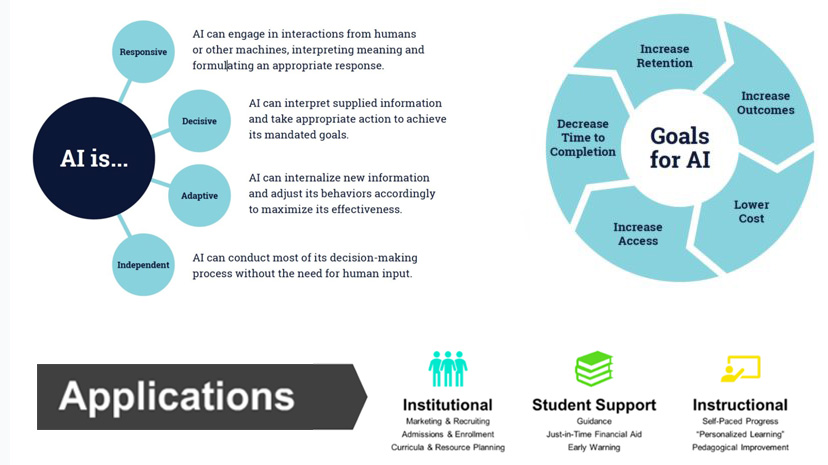
“In education, AI is still a sleeping giant,” researcher Dr. Tony Bates wrote in a must-read article.
Today, one of the most extended cases of AI in teaching and learning lies in chatbots. These intelligent tutoring systems, that guide conversations or “chat” through text or voice interactions, are on the rise.
In a recent interview with IBL News, David Joyner, Associate Director of Senior Experience at the Online Master of Science Computer Science and instructor of the program, commented on the new role of Georgia Tech’s AI-agent –formerly known as Jill, and now named ATA– on how it is connecting students to other learners in the same class. “It’s a social TA (Teacher Assistant),” he explained.
Chatbots have become a common tool for banks and large finance and marketing companies as a way to reduce costs and response times. Now, a growing number of colleges and universities use this technology.
Two examples:
Australia’s University of Adelaide announced that students received responses 13 times faster, and learners’ approval of the quality of service increased by 60 percent, after deploying a chatbot to deal with admissions questions in 2018.
Western Governors University, or WGU, in 2018 received a $750,000 award from the National Science Foundation to use machine learning in order to improve interactions with students and help them with the decision-making process, i.e., to find programs.
Among many others, companies like Oracle, AdmitHub, and Ivy.ai, also provide this type of solution.
As AI-based adaptive technology advances, systems will deal with several tasks, as Tony Bates reminds.
At least, they will:
Provide teaching content to students and simultaneously provide support by giving adaptive feedback and hints to solve questions related to the content, as well as to detect students’ difficulties/errors with content or exercises.
Curate learning materials based on students’ needs, such as providing specific recommendations regarding types of reading materials and exercises, along with personalized courses of action to aid in the students’ learning experience.
Facilitate collaboration between learners by providing automated feedback, generating automatic questions for discussion, and an analysis of the process.
It is undeniable that there are inflated expectations for AI –a term that is often incorrectly used to describe any computational activity.
Beyond the extreme hype, there are clear areas of application. AI enables adaptive learning by recommending personalized content, predictive analytics, automated feedback and support in many conversations.
Artificial Intelligence is not a panacea for education. However, by having access to massive amounts of information and analyzing these data sets through algorithms and computational power, innovative software organizations can develop worthwhile applications.