Category: Views

  • Ideas to Boost Your Course Completion Rate

    Ideas to Boost Your Course Completion Rate

    Mikel Amigot | IBL News

    Completion rates of free massive online courses have traditionally been low, at an average of 5%. This is mostly because these online classes are not offering an appealing benefit in career advancement and do not include tutoring to follow up with learners.

    In addition, requiring students to make an upfront payment, often with a minimal fee, show their commitment to the class. It is like in brick-and-mortar colleges: those who pay their own tuition are more likely to continue.

    As an instructional designer, a good technique to increase engagement is to place a survey at the beginning of the course asking students how they will apply their new knowledge and what their expectations are.

    It is also very helpful to feature the materials available for certain course intervals and include synchronous sessions and live office hours. Whatsapp, Slack, Twitter, Facebook or even Google Hangouts are efficient tools for a face-to-face conference.

    This can be combined with group projects and peer assessments ––Open edX includes those two functionalities.

    Naturally, discussion forums and problem submissions must be managed. Having at least one teaching assistant who interacts with students via forums, Piazza-style boards or email will end up motivating learners.

    Chatbot agents and AI-Teaching AssistantsGeorgia Tech-style, which are able to personalize experiences are also an option.

    Economic incentives, such as AWS’ or IBM’s cloud free-credit for young entrepreneurs, are smart approaches.

    Imposing deadlines for course completion tends to work well but it could also discourage enrollment. A solution can be to keep parts of the course open without registration. (This possibility –available on Open edX, too– is beneficial for SEO purposes, since Google and other search crawlers can index your public courses.)

    Finally, consider adaptive learning. AI-driven adaptive or personalized courses are becoming a reality. Behavioral Sciences and predictive analytics help learners succeed. New learning ecosystems are being designed with this requirement.


  • View: Are the Golden Years of Education Entrepreneurship Gone?

    View: Are the Golden Years of Education Entrepreneurship Gone?

    Mikel Amigot | IBL News

    The push to launch start-ups is certainly over. In 2013, nearly 768 education companies were founded. Today that number has dropped below 125.

    Within 18 months, from late 2011, we saw the launch of MOOC platforms Coursera, edX, Udacity and FutureLearn. In addition, in 2012, three more lifelong learning organizations were founded: Degreed, Minerva and Flatiron School.

    After many tweaks, those companies finally found successful revenue models.

    Looking today, something strange is happening. Creativity and entrepreneurial spirit haven’t decreased. But monetization is tougher, and investors do not have the patience they showed a decade ago.

    Colleges and universities have mostly behaved as anti-innovation engines, mainly because of traditionalists within the faculty and administrators’ exclusive concern with revenue generation. Large corporations have concentrated on their core businesses, paying little attention to new forms of training and education. Non-profits and philanthropist-driven organizations have played it safe, too, promoting partnerships with traditional universities.

    There is much to fix and new times will arrive. Higher ed institutions and businesses need to think differently in order to adequately respond to the new demands of lifelong learners.

  • View: A MOOC Platform Catalog is No-Marketing. Leveraging Institutional Networks Is Key

    View: A MOOC Platform Catalog is No-Marketing. Leveraging Institutional Networks Is Key

    Mikel Amigot | IBL News

    An effective marketing plan will drive enrollment, engage with learners and increase word of mouth awareness.

    We start defining our target audience: who are the type of students who would be interested, what is the course about, and why should learners enroll in the course –what new skills and knowledge will they gain, and how will they benefit and help advance their career. In addition, we need to determine what is the key differentiator of the course: is it the institution, the instructor, the topic?

    We all agree on this approach. We also agree that promoting the course description page (or About page) will require an SEO, Twitter / Facebook / LinkedIn social campaign and maybe some paid Adwords.

    But this isn’t enough. A well-crafted plan needs to activate the college’s existing institutional web properties, faculty networks, PR department media capabilities, blog spaces, newsletters, and landing pages. The outreach of the organization, either is a university or a large company, is simply impressive.

    A client of ours forgot or was unable to activate, this little detail, and the enrollment fell short. This department thought that the failure was due to the lack of presence on a catalog of a big MOOC platform like Coursera o edX.

    Institutions tend to believe before joining a consortium that a MOOC platform is a magic bullet for marketing. When they launch their first course or program, they discover that enrollments are surprisingly low. What happens? Well, first, they put too much faith on those platform advertising pitches, and, second, they don’t activate their institutional networks.

    Truth be told, Coursera and edX do advise about the importance of undertaking an integrated marketing approach between the institution and MOOC platform, with the university’s web assets as the most important. In the end, Google is always your best ally. A centralized catalog has a limited impact.

  • A Billionaire Will Cover the Cost of Coursera’s Illinois Data Science Master’s Degree for His Employees

    A Billionaire Will Cover the Cost of Coursera’s Illinois Data Science Master’s Degree for His Employees

    Marie I. Rose | IBL News

    AI-software provider C3.ai, a company owned by billionaire Tom Siebel, has started to offer employees a fully paid tuition for the Master of Computer Science in Data Science (MCS-DS) from the University of Illinois at Urbana Champaign, available on Coursera for $21,000.  

    Those who complete the degree will get three more career incentives: a $25,000 cash bonus, a 15% salary increase, and a stock option equity award.

    “In this new economy where people are talking about digital transformation; for companies to stay at the top of their game they need to have state-of-the-art continuing education programs,” said Siebel, who got a degree in Computer Science –although residentially – at the same university.

    In 2007, Thomas Siebel, 66, pledged $1000 million to support science and engineering at this institution. Currently, CEO at C3.ai, Siebel, with a fortune of $2.9 billion, is a former salesman who became a billionaire after creating and selling Siebel Systems to rival Oracle in 2006 for $5.8 billion. C3.ai is valued at $2.1 billion.

    In addition to this degree, C3.ai employees, 330 in total today, already have free access to other Coursera courses and Specializations in AI, IoT, clouding computing, and advanced computing.

    “This model of stackable learning will become standard as more companies realize the value of providing a variety of flexible learning pathways for employees to acquire critical skills,” stated Leah Belsky, VP of Enterprise at Coursera.

    “We believe that more and more companies will move in this direction in the future. C3.ai is showing real foresight, and they are putting an incredible amount of employee support behind that foresight,” said Rashid Bashir, Dean of The Grainger College of Engineering at the University of Illinois. “New modes of delivering professional education are crucial to both companies like C3.ai and to universities like Illinois.”

    The Coursera-based MCS degree was launched in 2016. Nearly 700 hundred students are enrolled in the program. The acceptance rate is 30%.

    Illinois’ Department of Computer Science is consistently ranked as one of the top computer science programs in the world. In 2018, it was ranked #5 on the U.S. News and World Report list of Best Computer Science Schools.

    Thomas Siebel, in the picture, shows a clear vision: “At C3.ai, we are assembling a team of inquisitive self-learners, motivated and properly trained to solve some of the world’s most challenging technology problems. This program further enables our employees’ success by encouraging them to further develop their computer science and AI expertise at one of the world’s leading universities.”

    Siebel’s educational offering to employees is probably the most generous one within corporate America, beyond  Starbucks‘, which covers a portion of the tuition for those who earn online B.A.’s from Arizona State University, and Walmart‘s incentive of $1,500 cash bonuses to some workers who finish degrees at three subsidized schools.

    He claimed in Forbes that “the money his company will spend on employee degrees and cash bonuses are a drop in the bucket when you consider how much we spend on human capital.” When you add in other benefits and travel, he says each employee already costs the company more than $350,000 a year. “If someone is increasing their skills, advancing their career, setting themselves up for multiple promotions, providing better service for their customers, in that context the amount we’re spending on this benefit is nothing.”

  • An Institution Prepares Students for Jobs which Won’t Be Automatized

    An Institution Prepares Students for Jobs which Won’t Be Automatized

    Mikel Amigot | IBL News (Boston)

    Job automation has already started. Stats indicate that 10% of American jobs will be automated in 2019. An upsetting forecast indicates that up to 73 million U.S. jobs will be automated by 2030.

    But there is hope. First: nearly 2 million new non-routine jobs which machines cannot easily perform are being created every year in the United States. Second: an increasing number of colleges and universities understand the challenge and are starting to prepare students who demand jobs which won’t be automated.

    Foundry College is one of them. Its Founder, Dr. Stephen Kosslyn, addressed the issue yesterday during the Eduventures Summit in Boston with a physician example. “Diagnosis of illness will soon be accomplished well by machines. But sitting with the family to discuss treatment options will be difficult to automate.”

    At least two skills are automation resistant: “Recognizing and responding to emotion when communicating and making decisions. And taking context into account when analyzing situations, creatively solving problems, and prioritizing goals,” Stephen Kosslyn said.

    Foundry College, which is focused on what’s difficult to automate, has listed five key underpinnings:

    • Critical thinking
    • Creative problem solving
    • Clear communication
    • Constructive personal interactions
    • Good judgment

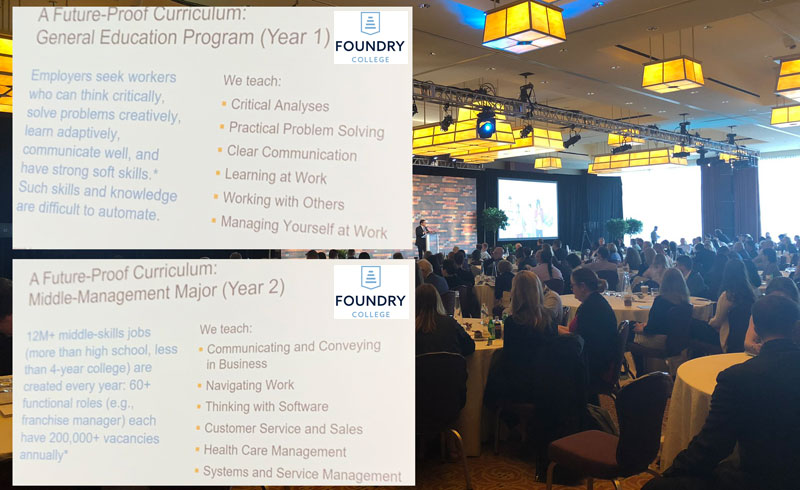
    To pair these essential skills, this institution has reimagined a future-proof, two-year curriculum. On the first year, Foundry teaches:

    • Critical Analyses
    • Practical Problem Solving
    • Clear Communication
    • Learning at Work
    • Working with Others
    • Managing Yourself at Work

    On the second year:

    • Communicating and Conveying in Business
    • Navigating Work
    • Thinking with Software
    • Customer Service and Sales
    • Health Care Management
    • System and Service Management


  • View: A Model Involving Faculty for Course Design

    View: A Model Involving Faculty for Course Design

    Mikel Amigot | IBL News

    The course development process usually tends to be too complex. As instructional designers, we schedule too many milestones and we overcomplicate things.

    Two experts in the field shared their view at SUNY’s annual technology conference, CIT, which took part this May 29-31 in Purchase, New York.

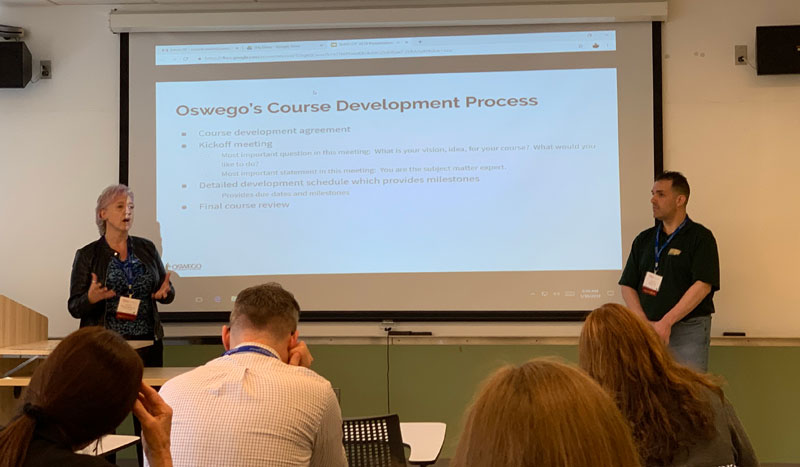
    Learning designers Joseph Stabb and Theresa Guillard-Cook [in the picture] described SUNY Oswego’s four-step process for course development: 1) Agreement; 2) Kickoff Meeting; 3) Schedule Set Up; 4) Final Course Review.

    The second one is particularly critical. The most important questions in the meeting with professors are: “what is your vision and idea for your course? What would you like to do?” These obvious questions and answers are usually forgotten; consequently, the class becomes ineffective.

    “The most important statement in this meeting is: you are the subject matter expert,” said Joseph Stabb and Theresa Guillard-Cook.

    Regarding the third stage, a detailed development schedule with milestones and due dates is required. A template is necessary.

    A well-defined process, based on continuous collaboration where faculty feel supported, will meet educational standards and drive student outcomes.

  • Georgia Tech Will Deploy this Summer an Improved Version of its AI-Based Teacher Assistant

    Georgia Tech Will Deploy this Summer an Improved Version of its AI-Based Teacher Assistant

    Mikel Amigot | IBL News 

    A refined and revised version of Georgia Tech’s first AI-based teacher assistant will be introduced this summer as a way to enhance some of the syllabi at the school. This virtual agent, known as Jill Watson and developed by Professor Ashok Goel, will turn three years old.

    Yakut Gazi, Associate Dean of Learning Systems at Georgia Tech, highlighted during the 2019 Learning Impact Leadership Institute conference, last week in San Diego, the fact that her institution “is leading efforts in Artificial Intelligence’s development”. “Many students of the OMSC degree didn’t know that an AI agent was responding their questions until the end of the semester,” she added.

    Jill Watson is the result of the work of Prof. Goel [in the picture] with a team of graduate students in his Design & Intelligence Laboratory (DILAB). This team created this chatbot to answer routine, frequently asked questions in the forum for his online Knowledge-Based Artificial Intelligence (KBAI) class.

    The original intent was to free up time for the course TAs (Teacher Assistants), so they could concentrate on more creative and less repetitive tasks. But an expected outcome arose: more learner engagement. Before Jill Watson, students averaged 32 comments per semester; after Jill Watson, each student averaged 38 comments per semester.

    In the spring of 2016, once this AI-agent’s identity was revealed, the reaction was overwhelmingly positive.

    One student wanted to nominate Jill for the Outstanding TA award, and not one student complained.

    National news outlets such as the Wall Street Journal and Washington Post ran stories on her. Ashok Goel gave a TEDxTalk on Jill, and he was invited by the Gates Foundation in January 2018 to participate in a brainstorming session on the future of AI in education.

    Georgia Tech’s motto is affordability, accessibility, and applicability, and Jill Watson can help human teachers deliver education at scale.

    Georgia Tech: Jill Watson’s Terrific Twos

  • UBx, University at Buffalo’s Continuing Education Open edX-Based Platform, Expands with New Courses

    UBx, University at Buffalo’s Continuing Education Open edX-Based Platform, Expands with New Courses

    Marie I. Rose | IBL News (Purchase, NY)

    UBx, University at Buffalo’s learning platform for continuing and professional education, plans to issue seven new courses this year, after the recent launch of the “Empowering Yourself in a Post-Truth World” and “Introduction to ArcGIS Pro” classes. These courses, now in development, will cover areas such as Jupyter Notebooks, Writing College Essays, Faculty Development, and Robot Safety.

    UBx is one of the first nationwide Open edX-based platforms on professional development at the university level. “We use this LMS for online learning where departments are able to generate and keep most of the revenue,”  explained Jay Stockslader, Director of Continuing Education at the College of Arts and Sciences at the University at Buffalo [in the picture above].

    Jay Stockslader, with years in experience in continuing ed, presented its initiative last Thursday at SUNY’s CIT2019 conference throughout a talk titled “Emerging Technologies and Digital Strategies”.

    The platform, integrated with the University at Buffalo’s payment portal, has been conceived for non-credit bearing courses, although some scholars at the SUNY system are considering using it as a testing ground for future credit classes.


  • Canadian Educator Heather Payne Says that Tenure Should Be Abolished

    Canadian Educator Heather Payne Says that Tenure Should Be Abolished

    John G. Paul | IBL News

    One hour after delivering the keynote address of the day, Heather Payne, speaker and entrepreneur, tweeted: “Just told a room full of tenured professors that tenure is dumb and should be abolished and lived to tell the tale. Thanks for having me, State University of New York!”.

    Heather Payne’s post was a rightful summary of an energetic conference that shocked many professors gathered in the auditorium of SUNY’s Purchase College in New York, yesterday during the second day of the CIT2019 event.

    This young Canadian educator, founder and CEO of the HackerYou coding bootcamp, and named one the top innovators in North America, delivered a one-hour talk featured as “Starting from scratch. How higher ed needs to change its contract with its students”.

    The main thesis was that “college isn’t designed for students”. Collectively, 44 million Americans owe $1.5 trillion in student loans. Besides, as she highlighted, there is a mental health crisis, with many students experiencing episodes of overwhelming anxiety. The university system has its origins in Medieval Europe, where the instruction was based on delivering lectures, and main teaching subjects were arts, law, theology and medicine.

    “Higher education needs to be fully redesigned,” claimed Heather Payne [in the picture], before explaining how new colleges should function.

    In addition to eliminating stadiums, as a metaphor of sports programs, Mrs. Heather stated that tenure should be eliminated, along with the research job. “No tenure. And professors should do no research”.

    “Tenure is job protection that none of the rest of us have access to, nor is it something any of us should want for our society. It removes the incentive to improve and keeps professors in jobs they should move on from”.

    “We want professors to spend their energy coaching, mentoring and guiding the leaders of tomorrow. Research in higher ed has been nothing but a distraction at most schools, taking away from the student experience”.

    She proposed no tuition payment upfront and an income sharing agreement with students when they land their first job after graduating from college. This model is being implemented in her 30-employees, Toronto-based start-up, which teaches 9-week long web coding-related programs, helping learners transition from low paying jobs to $50k+ ones.


  • NY University System Will Focus on Increasing its Online Presence

    NY University System Will Focus on Increasing its Online Presence

    John G. Paul | IBL News (Purchase, NY)

    SUNY, the State of New York University System, will heavily focus on increasing its online offer, by scaling its main programs to 1,000 students in three years. It will also target post-traditional learners, not only in New York but also out of the state and internationally. The goal is also “to bring back the 40,000 New York residents who are going to non-NY online institutions”. 

    Tod A. Laursen, Senior Vice Chancellor and Provost, unfolded all of these remarks on Wednesday during the opening keynote of the CIT 2019 conference in Purchase, New York — a gathering of 400 educators and technologists within the SUNY system.

    This plan will be implemented throughout multiple phases, until its launch in the Fall of 2020. Part of the strategy will be the data initiative, based on moving towards predictive data analytics.

    Brian Digman, new CIO of SUNY, whose keynote was titled “Disruptive technology arrives”, insisted on the importance of data to predict the future. “Data is the new oil, but data wisdom is yet to be revealed,” said during his remarks at CIT 2019.

    In addition, Tod A. Laursen highlighted the growth of OERs (Open Educational Resources) on SUNY, saving $16 million in course material costs.

    See some of the slides below.