Category: Views

  • Illinois Shuts Down its Traditional MBA and Focuses into Online’s iMBA

    Illinois Shuts Down its Traditional MBA and Focuses into Online’s iMBA

    Marie I. Rose | IBL News

    The University of Illinois at Urbana-Champaign will shift investments away from its residential MBA programs to focus on its rapidly growing online iMBA, which is delivered through Coursera.org at $22,000 (compared to traditional MBAs that can cost three or four times more.)

    The ending of this face-to-face program happens in an environment where several universities have scaled back or eliminated traditional MBA programs.

    The University of Illinois will allow current MBA students and those planning to start programs this year to finish.

    “The iMBA is the right format for the times – providing a powerful learning experience with anytime/anywhere accessibility at an affordable cost,” said Jeffrey Brown, Dean of Gies College of Business, in a statement. “Given the global reach and accessibility of this program, we are creating what I call the world’s MBA. With this and with our innovation in undergrad, specialized masters, and lifelong learning, we are playing to our competitive advantages and positioning ourselves for tremendous impact and steady growth. These moves will focus our investment in ways that will make us unquestionably one of a handful of the world’s very best and most innovative business schools.”

    Applications to the iMBA have nearly tripled – from 1,100 in 2016, when the program was launched, to a projected 3,200 in 2019.

    “The program is revolutionary in its delivery, stackable structure, concentrations, immersions, accessibility, and career-curated content. It combines the material in ways that professionals use it in the real world, not in traditional academic silos. iMBA students earn the same MBA that on-campus students have been earning for decades. At a total cost of less than $22,000, the program is designed to be affordable at a time when MBAs can easily cost $80,000 or more.”

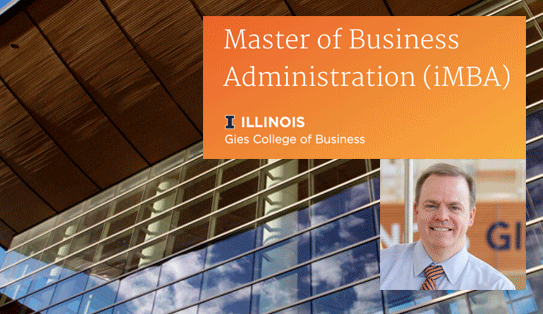
    “Our iMBA is the most innovative, highest-value MBA of any kind anywhere in the world,” said Brown [in the picture]. “Because it is online and offered at an affordable cost, it creates access to high-quality, high-impact business education for larger numbers of talented people. It fulfills our land-grant mission and serves our state spectacularly well. At the same time, by being fully online, it extends and deepens our reach as a global player — ensuring a worldwide reach for our College and alumni network.”

    In addition to the iMBA, Gies College of Business will focus its investments on a suite of rapidly growing market-driven master’s programs, undergraduate education, and lifelong learning. Gies will seek to expand and add to its line-up of high-quality specialized masters degrees in fields such as accounting, finance, and technology management.

    Gies will also increase investments in its undergraduate programs. Last year, 99% of students were employed, continued their education, or entered volunteer service within three months of graduation. In addition, the College is offering an online business minor, which has experienced remarkable success and currently enrolls about 1,000 students.

    “With how quickly business and technology are changing, lifelong learning is another high-impact, high- growth field,” said Brown. “People need to keep up with business and technology changes in order to build careers and create value. We’ll be right there for them.”

    The College claims that “is honoring its commitment to current and incoming MBA students, ensuring they will have access to the same outstanding faculty, curriculum, action learning experiences, and career advising until they complete their degree. Recognizing that the announcement may impact some students’ decision about whether to attend Gies, the College extended the deadline for refunding deposits from June 3 to July 1 and also offered automatic admission into the iMBA as an option.”

    “The full-time and part-time residential MBA programs are excellent, as are the students and alumni of those programs,” said Brown. “Yet market demand for traditional formats is declining nationwide. Meanwhile, demand, as well as the needs of businesses and individuals, is growing in these other areas. We believe in innovating and staying ahead of trends in business education and on top of the needs of business and society.”

    The Gies College of Business College received a $150 million gift in 2017 from Chicago businessman Larry Gies and his wife, Beth Gies, who graduated there. 


    RESOURCES

    • Illinois Gies College of Business: Gies Announces Strategic Shift

    Forbes: Why Business Schools Are Shutting Down Their MBA Programs

    IBL News: Master’s Degrees which Can Be Completed Online

    IBL News: 45 MOOC-Based Master’s Degrees Worldwide

  • What’s Next for Coursera and FutureLearn? Insights Revealed at the EMOOCS Conference

    What’s Next for Coursera and FutureLearn? Insights Revealed at the EMOOCS Conference

    John G. Paul | IBL News

    Coursera, with fourteen MOOC-based degrees in its catalog, is seeing slow progress in this modality. “They are growing slower than we expected,” revealed Dil Sidhu, Chief Content Officer at Coursera, at the EMOOCS 2019 conference, which took place last week at the University of Naples Federico II, in Italy.

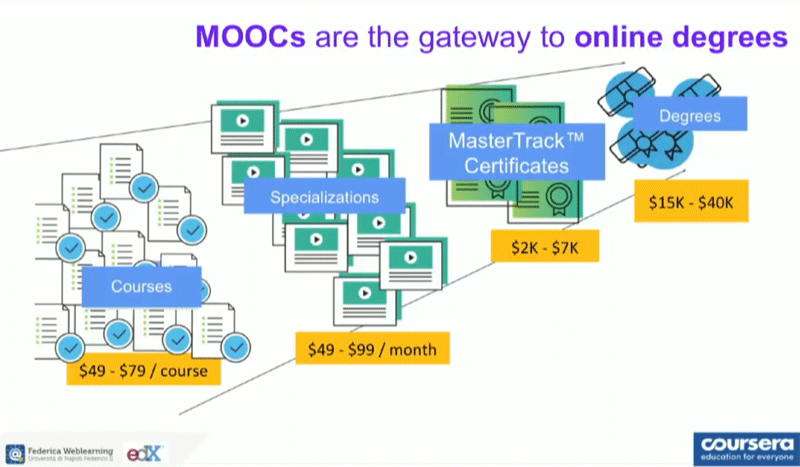
    Dil Sidhu, who started his work at Coursera at the beginning of this year, provided during his talk an interesting piece of data: “62 percent of those who take an online degree [in Coursera] started with a MOOC”. “MOOCs are the gateway to online degrees,” he stated. (See the graphic above).

    This executive provided a snapshot of what lies ahead for Coursera: “Inclusion of Behavioral Sciences to help learners succeed. Data analytics to help identify content and learners habits. Help partners succeed (…). Social impact: Coursera for refugees, veterans, and incarcerated populations”.

    During the same session at the University of Naples Federico II, Anant Agarwal, CEO at edX, and Simon Nelson, CEO at FutureLearn, stressed the impact of in-demand MOOCs on up-skilling and re-skilling employees as well as setting up lifelong learning habits.

    Simon Nelson, whose company received a recent investment of $64 million, announced that FutureLearn will invest money in creating high-quality content. So far the three big MOOC providers have not invested in content, relying instead on universities’ and industry partners’ offerings.

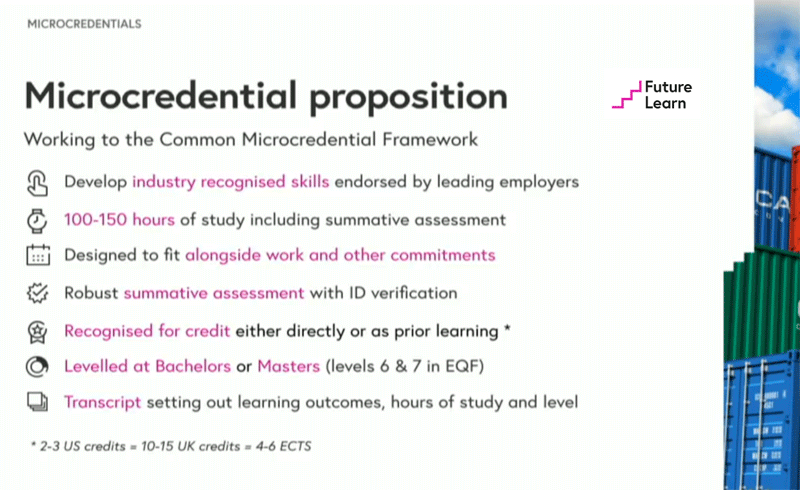
    The CEO of FutureLearn also disclosed that his organization is working, along with some other European MOOC providers such as France Universite Numerique (FUN) and Spanish Telefonica’s MiriadaX, in a common microcredential framework, recognized for credit by leading employers. This new credential will be provided after 100 to 150- hour classes. (See the screenshot below).

  • The New Standard LTI 1.3, which Allows Interoperability of Grades and Assignments, Excites the Industry

    The New Standard LTI 1.3, which Allows Interoperability of Grades and Assignments, Excites the Industry

    Mikel Amigot | IBL News (San Diego)

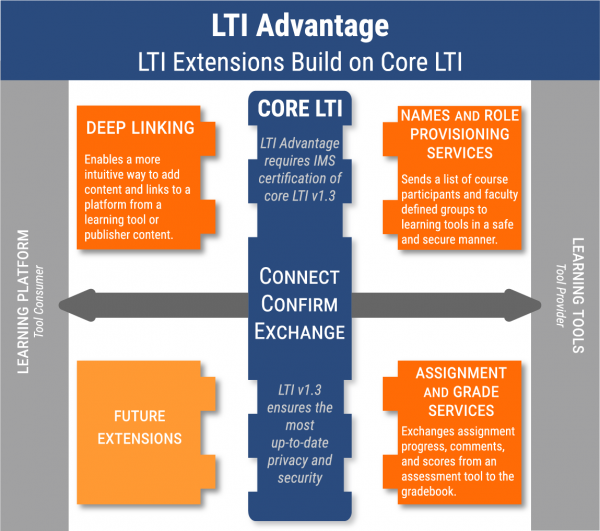
    The new standard of LTI 1.3 and LTI Advantage is here.

    These two open industry standards by IMS Global provide secure connections between learning platforms and the digital edtech ecosystem.

    On May 15, the IMS Global Learning Consortium, specializing in edtech interoperability, announced the availability of Learning Tools Interoperability (LTI) version 1.3, a significant update to the core standard, along with three new services that comprise LTI Advantage.

    This technology, which enables interoperability of grades and assignments and other data transfer, was in the center of the conversation of those of us who attended the Learning Impact Leadership Institute this week in San Diego, around six hundred professionals in total.

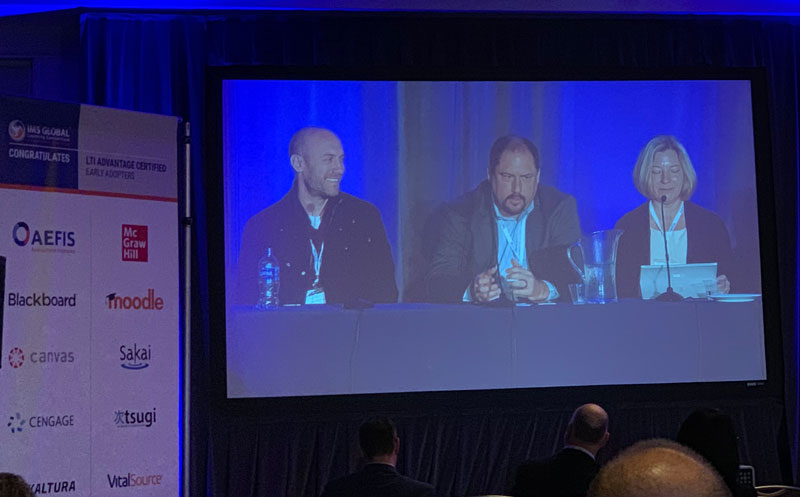
    There are some early adopter LMS’s and portals achieving IMS certification, including Blackboard, Moodle, Canvas, Sakai, Cengage, Tsugi, Kaltura, McGraw-Hill and VitalSource. They were all prominently featured during the conference [see the picture above].

    LTI Advantage, built on LTI 1.3, deep links and enhances the integration by provisioning usernames and roles, and exchanging the assignments and grades.

    During the conference several LTI Advantage bootcamp sessions took place.

    Participants saw demonstrations, were immersed about Caliper Analytics and proctoring specifications, and learned how to migrate LTI 1.x implementations to LTI Advantage.

    LTI has long been the gold standard in interoperability for edtech, enabling secure plug-and-play integration of learning systems.

    Dr. Charles Severance, who invented this tool, told IBL News that LTI 1.3 is making a real difference and LMSs without it could be out of the market.

    Many attendees showed their excitement around the new standards and mentioned the alignment between K12/Higher Education and the industry.

    An example was Terry O’Heron, Director of Operations at Penn State University, who highlighted how LTI and open standards expedited the integration process at his institution, which uses CanvasLMS.


    [IBL News was one of the three media sponsors of the 2019 Learning Impact Leadership Institute Conference]


  • A Fascinating Free Course About Beethoven’s Music from Stanford University

    A Fascinating Free Course About Beethoven’s Music from Stanford University

    John G. Paul | IBL News

    Stanford University has launched this spring a new online, free course on Beethoven, his music and development as a composer.

    The class, led by music historian Stephen Hinton, is designed for any level of musical literacy, with the aim of enhancing people’s understanding of Beethoven’s music through the study of his string quartets –a genre of music involving two violins, a viola, and a cello. It features performances by and discussions with the St. Lawrence String Quartet, Stanford’s ensemble-in-residence.
    “His last five string quartets are widely considered to be the pinnacle of Western art music,” said Professor Stephen Hinton.

    Defining the String Quartet II: Beethoven, a seven-week course, now open for enrollment, has attracted nearly 800 participants so far. Many of them share their interpretation and experience with Beethoven’s music in the course’s online forums. Students who successfully complete the full course can receive a statement of accomplishment that reflects their level of participation and achievement. After June 11, the class will reopen on a self-paced modality.

    This course –which is included on Stanford Online’s Open edX-based platform– is a sequel to Stanford’s first free online course on classical music appreciation, called Defining the String Quartet: Haydn, that launched in 2016.


  • Chatbots Gain Traction Among Businesses – Now a Course About Them on edX

    Chatbots Gain Traction Among Businesses – Now a Course About Them on edX

    Mikel Amigot | IBL News

    Chatbot–based customer services are increasingly in demand. Advancements in AI technology, natural language processing, neural networks and speech recognition are making chatbots more effective and affordable. However, they are still in an early phase of development.

    These revolutionary applications – which allow users to engage in interactive conversations using text or natural voice – have the potential to save businesses a fortune – over 8 billion annually by 2020 according to Juniper.

    Artificial Intelligence Chatbot technology is not ready to replace top customers agents when assisting customers yet, but is advancing rapidly. A well-performed human experience is unbeatable.

    Trying to trick customers by making them think that an AI chatbot is a real person only speaks poorly about that company. Customers get easily annoyed if they are asked the same information repeatedly. If they feel that an algorithm is in the works trying to match the best response, they will inevitably feel played.

    Antonio Cangiano, an IBM manager who teaches a class on chatbots on edX, highlights that these tools “augment humans, not replace them.” Despite being imperfect, they represent a growing business opportunity.

    The mentioned course helps to build, analyze, and deploy chatbots powered by IBM’s Watson. In addition, it teaches how to make money by selling chatbot services to clients, even by deploying them in WordPress sites.


  • Analysis: Sebastian Thrun, Creates the University of Silicon Valley and the Fourth Degree

    Analysis: Sebastian Thrun, Creates the University of Silicon Valley and the Fourth Degree

    Mikel Amigot | IBL News

    Sebastian Thrun, Founder and CEO at Udacity, is not shy when he claims, in a recent post, that his company will become the “University of Silicon Valley”. “Every student will now have technical mentors, expert reviewers, career coaches, and personalized learning plans on their side, in every Nanodegree program,” he writes before welcoming everyone “to the future of e-learning”.

    Class Central criticized Sebastián Thrun’s missteps with its restructuring plan, initiated in late 2018, with three rounds of layoffs of 40% of its employees, and offices around the world closed or downscaled. In addition, Vishal Makhijani stepped down as CEO and the Founder stepped in at the company he created in 2012. The startup, with over $90 million in revenue, now employs 300 full-time equivalent employees and about 60 contractors.

    Sebastian Thrun, 52-years old and born in Solingen, Germany, is a tough entrepreneur, who completed his Ph.D. in computer science and statistics in 1995 at the University of Bonn. He taught computer science at Carnegie Mellon and Stanford University and worked at Google as VP, founding Google X and Google’s self-driving car team. He led the development of the robotic vehicle Stanley which won the 2015 DARPA Grand Challenge. Thrun is also the CEO of Kitty Hawk Corp, a flying-car startup. He is known for his work on probabilistic algorithms for robotics. At the age of 39, he was elected into the National Academy of Engineering in DC.

    He describes himself as “a scientist, educator, inventor, and entrepreneur”. What Sebastian Thrun doesn’t highlight, however, is the fact that he is running a company with the iron rod of a Wall-Street CEO –which isn’t that cool in elitist Academia. Instead, he claims that his “mission is to democratize education by providing lifelong learning to millions of students worldwide.”

    A scientist whose company has achieved the status of a unicorn of $1 billion is certainly not an easy sell in higher education. Being a billionaire and a genius scientist only happens in a Hollywood play. And superheroes as Tony Stark in Iron Man, are fictitious.

    What everyone we talked to agrees on is that Sebastian is a relentless innovator in online learning.

    He is convinced that more support results in improved outcomes for students and helps them to find better jobs.

    “Only 4% of students ever complete a MOOC. At present, our Nanodegree programs have a 34% graduation rate, thanks to the tireless efforts of the hard-charging Udacity team. When paired with our new personalized mentorship programs in past experiments, cohorts have commonly exceeded 60% graduation rates.” (…) “For our Nanodegree Plus pilot, an independent accounting firm verified that among our career-seeking and job-ready graduates, 84% found a new, better job within six months of graduation. And for that 84 %, the salaries went up, by an average of $24,000 per person. So much that on average, those students recouped their entire Udacity tuition fee in just three weeks.” (…) “No other online learning platform provides this level of end-to-end personalized mentorship.”

    Along with tutoring and mentoring, another signature area of innovation at Udacity is credentialing.

    Sebastian Thrun states that Udacity’s Nanodegree program –with 75,000 graduates and 200 industry partners– is “the new fourth degree”, beyond “the three common university degrees — the Bachelor’s, Master’s, and PhD.”

    “The Nanodegree program is well on its way to becoming a de-facto standard for hiring and corporate training in the tech industry. This is in no small part because partners like Google, Amazon, Facebook, AT&T, IBM, Mercedes, and so many others help us develop our curricula, and hire our graduates. If Udacity was an actual university, we would be “accredited by industry.” Who would know better what it takes to get a job at your dream company than our own corporate partners?”

    Grand statements. It would be interesting to know what Stanford University, and other elite schools and platforms like Coursera and edX think about all of this.

  • View: Instructional Designers Forget What Makes a Course Successful

    View: Instructional Designers Forget What Makes a Course Successful


    Mikel Amigot |  IBL News

    When we create courses, we follow the latest pedagogical innovations along with Backwards design rules, and this seems to be the right approach. The problem arises when our online courses get few enrollments and the economics of the course put our project in danger.

    What we are doing wrong? What needs to be fixed?

    As instructional designers, we forget what motivates enrollment and purchase’s decisions.

    Learners want real outcomes. How the online class they are enrolling in is going to change their life.

    It is all about career advancement. It is all about a direct impact on their earnings, income, and job promotion.

    If the promised transformation is not convincing, we won’t attract enough students to make the course or the program sustainable.

    A second requirement: we need to establish trust.

    Our instructor, or staff or instructors, need to prove that they are the right fit for the job. They should be authorities in that instructional field. They must be committed to teach you and deliver a transformational experience, too.A welcome trailer will prove all of it. Additionally, video testimonials from learners will be helpful.

    Third, we need to avoid unnecessary material and present a compelling, content outline. We will feature only the lessons required to achieve the goal. Long programs usually discourage learners.

    To make sure, it’s key we collect continuous feedback from reviewers prior to the launch, in order to validate the concept and the outline. Redo what needs to be redone, including videos and animations, and remove whatever seems redundant.

    Refining the course will ensure a great performance when it goes public.

    Let’s follow all of these ideas when we engineer a program!

  • View: Reaching the Right Audience for Your Courses on Twitter

    View: Reaching the Right Audience for Your Courses on Twitter

    Mikel Amigot

    Twitter outranks YouTube, Facebook, and Instagram in online marketing effectiveness among businesses in the U.S. Around 75% of B2B business and 65% of B2C business use Twitter, according to Statista.com.

    To gain effectiveness on Twitter, there is just one single rule: create high-quality content for your target audience.

    However, getting real followers is a tough business. A fast way to grow organically is by paying for a Twitter Ads campaign; naturally, after having great content.

    The practice of buying fake followers and interactions on sites such as AudienceGain.com or GetAFollower.com is dangerous. This can damage your reputation. Twitter warns that it can result in an account suspension.

    With a Twitter Ads Campaign, note that the acquisition of followers is not guaranteed. Truly, you are paying for the opportunity to reach the right people for your business.

    These campaigns enable you to use a variety of methods to identify your target audience, reach engagement and pursue business conversions.

    There are two ways to begin advertising on Twitter: click on “View Tweet Activity” and “Promote your Tweet”, or go on your profile to “Twitter Ads” and “Create Campaign”.

    In your promotional effort to drive engagement and revenues for your online courses, keep in mind that Twitter is a medium designed to encourage meaningful conversations and connections among users. Adjusting your marketing to this reality, while being authentic, is the way to go.


  • The Good and the Bad: Choose the Best OPM, According to Dr. Chuck

    The Good and the Bad: Choose the Best OPM, According to Dr. Chuck

    Mikel Amigot, Zoe Mackay | IBL News

    Dr. Charles Severance, Clinical Professor at the University of Michigan School of Information and world’s #1 Python teacher, spoke with IBL News about OPMs and UMs upcoming online MOOC-based degrees.

    Online program management (OPM) companies are on the rise, but in Severance’s view, there are good OPMs and bad OPMs. “The best way to describe the difference between [them] is that good OPMs take less of your money than the bad OPMs. The bad OPMs like to take more than 50% of the revenue.”

    edX and Coursera are good OPMs, says Severance, “in that they bring a lot to the table, the market, they do things globally that no school will ever be able to do. The University of Michigan could never have the global reach, no matter how many people we hired, that we get by being part of edX and Coursera.”

    This he sees as a value, where edX and Coursera have changed the world positively, which is worth investing in further.

    As one of the most successful MOOC universities today, the University of Michigan is starting MOOC-based degrees with their own unique approach. The Online Masters in Applied Data Science will launch in the fall of 2019. It encompasses 36 credits, where every class is 1 credit and 4 weeks long. “We are envisioning [full online degrees] very differently,” he says, “it is it’s own disruptive idea.

    The idea of an online MOOC-style degree fills a gap. Individual MOOCs are wonderful, specializations and micromasters are wonderful, but online full degrees are a completely different thing. And the key difference is the pace.”

    With actual online degrees, with online support, we can move you through material that after a year or two years, you are truly transformed and you truly know a lot of things you didn’t know before.”


    The Future of UMs Online Degrees and How to Innovate

    The Online Masters in Applied Data Science, coming in the fall of 2019, will be offered for the price of in-state tuition, regardless of where students live. Severance and his team would eventually like to lower that cost.

    That’s one of the things I like about Georgia Tech, they actually reduced the cost to reflect some of the reduce costs to produce.”

    The University of Michigan School of Information aims to expand rapidly but start small, says Severance, “I think it could easily get to 600 students per year,” from their current 100-150.

    I’m seeing a pattern between how we’re doing this and how the open university does their teaching at scale and that is that they have a faculty that creates the content and then they have a smaller ratio of mentor faculty that stay close to the student and that scales up pretty well.

    Severance’s hope is that the teaching assistants will scale up nicely, with a ratio of 50-100 to 1, and the faculty with a ratio of 100-200 to 1. While the Online Masters in Applied Data Science is breaking the traditional mold of online degrees, he finds that MOOC platform vendors have not shown they listen when universities ask for new features.

    “If you want to do something bold, you have to find an integration point like learning tools interoperability or xblocks and plug in what you’re going to do. It is folly to hope that OPM providers will change their platform to meet your needs.”


    Watch the second part of the interview with Dr. Chuck Severance in the two videos below (the first part of the interview is here).


    Part III


    Part IV

  • Red Hat and Microsoft Partner Together, While IBM’s Acquisition Is Approved

    Red Hat and Microsoft Partner Together, While IBM’s Acquisition Is Approved

    Mikel Amigot | IBL News (Boston)

    “Red Hat has evolved from a one-product company to the enterprise open source leader with a full portfolio stack,” said its CEO Jim Whitehurst during the first annual summit, which took place this week.

    To highlight the moment, Red Hat modified its logo and launched a campaign around “open source” and how “it unlocks the world’s potential”.

    “We hope you share the same passion”, encouraged Tim Yeaton, Executive Vice President and Chief Marketing Officer.

    To live by the example, this manager inked himself with an arm tattoo displaying the company logo. He proudly showed it on stage during a talk about “open source stories” this Wednesday.

    Another executive, Leigh Day, Marketing Communications Manager, did exactly the same.

    In addition to updating its brand, Red Hat publicized several case studies (from

    giants such as Delta or Deutsche Bank to farming and educational projects) who utilize open source hardware and software.

    The Red Hat Summit in Boston was also notorious for the visit of Microsoft CEO Satya Nadella, who walked on stage to talk with Jim Whitehurst, and bear the news of a new joint Microsoft-Red Hat program: Azure Red Hat OpenShift.

    Two decades ago Microsoft’s Chairman Steve Ballmer claimed that “Linux is a cancer”, and now its CEO is coming into a major Linux tradeshow and announcing a partnership. (On the open source Open edX universe we’ve also seen a similar approach from Microsoft).

    Satya Nadella explained that Microsoft has embraced open source, “because it’s driven by what I believe is fundamentally what our customers expect for us to do. Which is to say: Doing what’s best for both companies’ customers.”

    “We have to be a bit more humble and say, ‘Okay, how do we bring value to the table with great technologies coming from a lot of places?,’” he added.

    Whitehurst replied: “Five years ago we had been linked to the whole adversary relationship. It’s just amazing to see how much progress we’ve had together. And I think that’s on both sides and both desire to serve our customers, and we found such great range to work together.”

    Microsoft’s move seems mostly motivated because its interest on promoting Azure on its fight with AWS, Google Cloud and others.

    Last year, Red Hat brought its enterprise Kubernetes OpenShift platform to Microsoft’s Azure cloud.

    The two companies see this pairing as a road forward for hybrid-cloud computing.

    IBM’s Acquisition Approved

    Just ahead of this conference, the US Department of Justice approved IBM’s proposed Red Hat acquisition, which was announced last October. This means the IBM/Red Hat acquisition for $34 Billion is still on track for the second half of 2019.

    During the summit, IBM Chair and CEO Ginni Rometty reiterated Tuesday that Red Hat would remain independent as promised.

    “Jim and I have both agreed—Red Hat should stay an independent unit,” she said during his keynote.

    “I’m not buying them to destroy them. It’s a win win for our clients. It’s a way to drive more innovation.”

    Resource: Red Hat’s Press Conference Materials (PDF)

    • Video recap of the Summit


    [Note: Microsoft, RedHat and IBM are edX partners and utilize the Open edX platform in their training at scale]