Category: Views

  • Linda McMahon Will Send Education Back to the States and Defend Universal School Choice

    Linda McMahon Will Send Education Back to the States and Defend Universal School Choice

    IBL News | New York

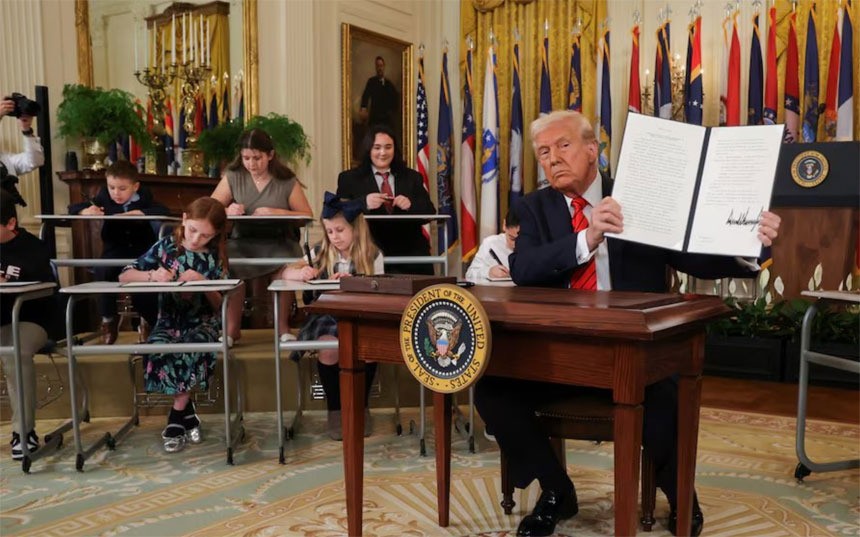
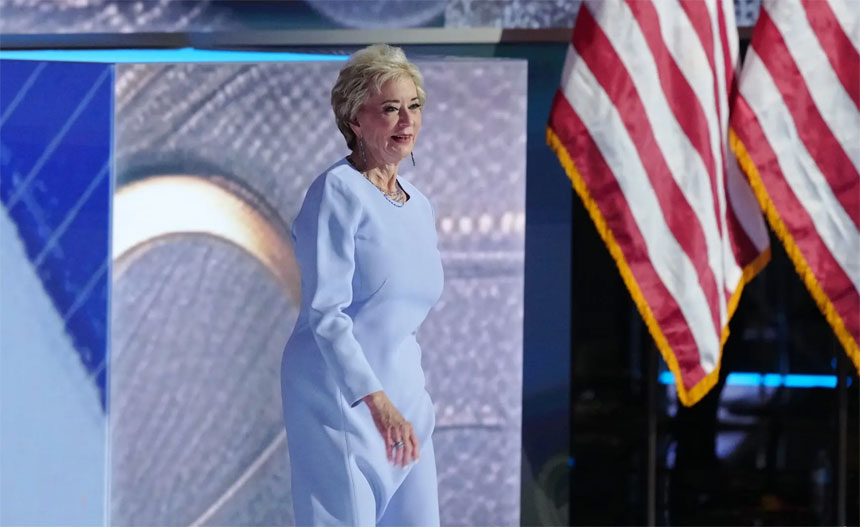
    Linda McMahon, President-elect Donald J. Trump’s pick for education secretary, will work on “sending Education back to the states” while reducing or eliminating the federal Department of Education. This was one of Trump’s key education campaign pledges.

    With a slimmer educational résumé than typical of candidates for the Secretary of Education position, she served 16 years on the board of trustees for Sacred Heart University in Fairfield, Connecticut, where a student center is named for her.

    She also spent just over a year on the Connecticut State Board of Education, where she was one of fifteen members overseeing all public education in the state, including its technical high school system. Later, in 2010, she would resign to run as a Republican for a Senate seat.

    Linda McMahon, a leader of President-elect Donald Trump’s transition team, is known for her many years in wrestling as the former chief executive of World Wrestling Entertainment (WWE).

    According to President Trump’s statement, her approach to education is based on advocating for parents’ and families’ rights and universal school choice. This means that money typically flowing to public schools will instead go to families so they can spend it on private education.

    “As Secretary of Education, Linda will fight tirelessly to expand ‘Choice’ to every State in America and empower parents to make the best Education decisions for their families,” Mr. Trump said.

    On Tuesday, Ms. McMahon posted a message on social media praising “apprenticeship programs” and highlighting their examples in Switzerland, which is often cited as a high-performing country whose model the United States should follow.

    She also has backed a House bill to make federal Pell Grants available for those pursuing skills training programs and technical education, not just traditional college degrees.

    The for-profit college sector applauded Ms. McMahon’s selection.

    “Under her leadership, we are confident that the new Department of Education will take a more reasoned and thoughtful approach in addressing many of the overreaching and punitive regulations put forth by the Biden administration, especially those targeting career schools,” Jason Altmire, president of Career Education Colleges and Universities, a trade group that represents the for-profit sector, said in a statement.

    • NYT: How Linda McMahon Might Approach the Dept. of Education — Comments of the audience

  • New Research Suggest How AI Should Be Integrated on Learning Environments, Research, Administrative, and Campus Operations

    New Research Suggest How AI Should Be Integrated on Learning Environments, Research, Administrative, and Campus Operations

    IBL News | New York

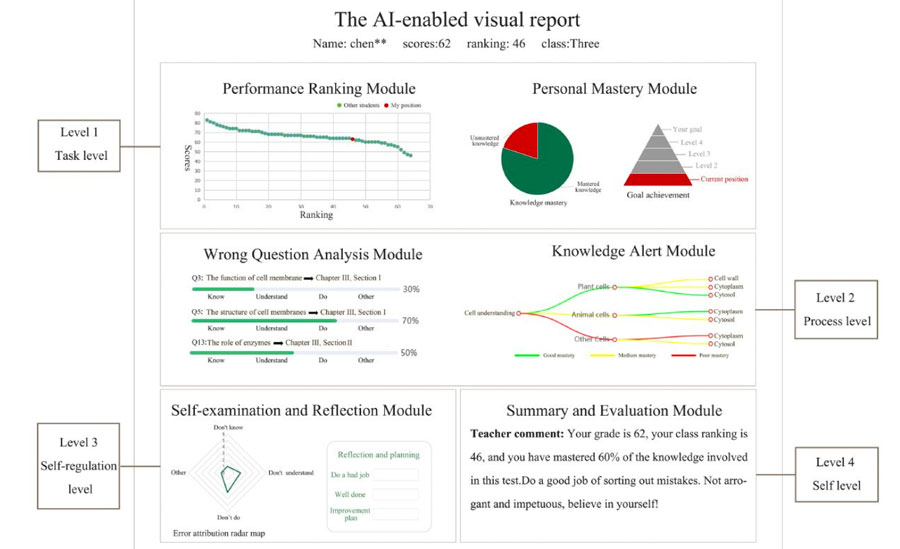
    AI’s integration into learning environments, research, administrative functions, and campus operations reshapes how institutions operate, faculty teach, students learn, and staff perform their roles.

    It’s not about blindly accepting AI in higher education or banning its use.

    It is crucial to thoughtfully examine AI’s impact on higher education, specifically on student success, financial sustainability, accountability, and equity.

    This is the main conclusion of researcher Joe Sabado, who shared research titled “AI in Higher Education—Frameworks for Critical Inquiry and Innovation.”

    This document, created using AI, guides institutions through AI’s transformative process, helping them leverage this technology. It provides ten frameworks, offering valuable insights for all stakeholders: educators, administrators, policymakers, students, staff, and journalists.

    AI in Higher Education – Frameworks for Inquiry and Innovation (PDF)

  • Apple’s Generative AI Suite for iPhone, iPad, and Mac Will Roll Out in October

    Apple’s Generative AI Suite for iPhone, iPad, and Mac Will Roll Out in October

    IBL News | New York

    Apple announced yesterday that its Generative AI suite, Apple Intelligence, will start rolling out in beta in October 2024 in the U.S. with iO 18.1, iPad 18.1, and macOS Sequoia 15.1.

    In addition, Apple introduced the new iPhone 16 lineup (iPhone 16 Plus, iPhone 16 Pro, iPhone 16 Pro Max, iPhone 15 Pro, iPhone 15 Pro Max), built for Apple Intelligence and features more advanced A18 and A18 Pro chips.

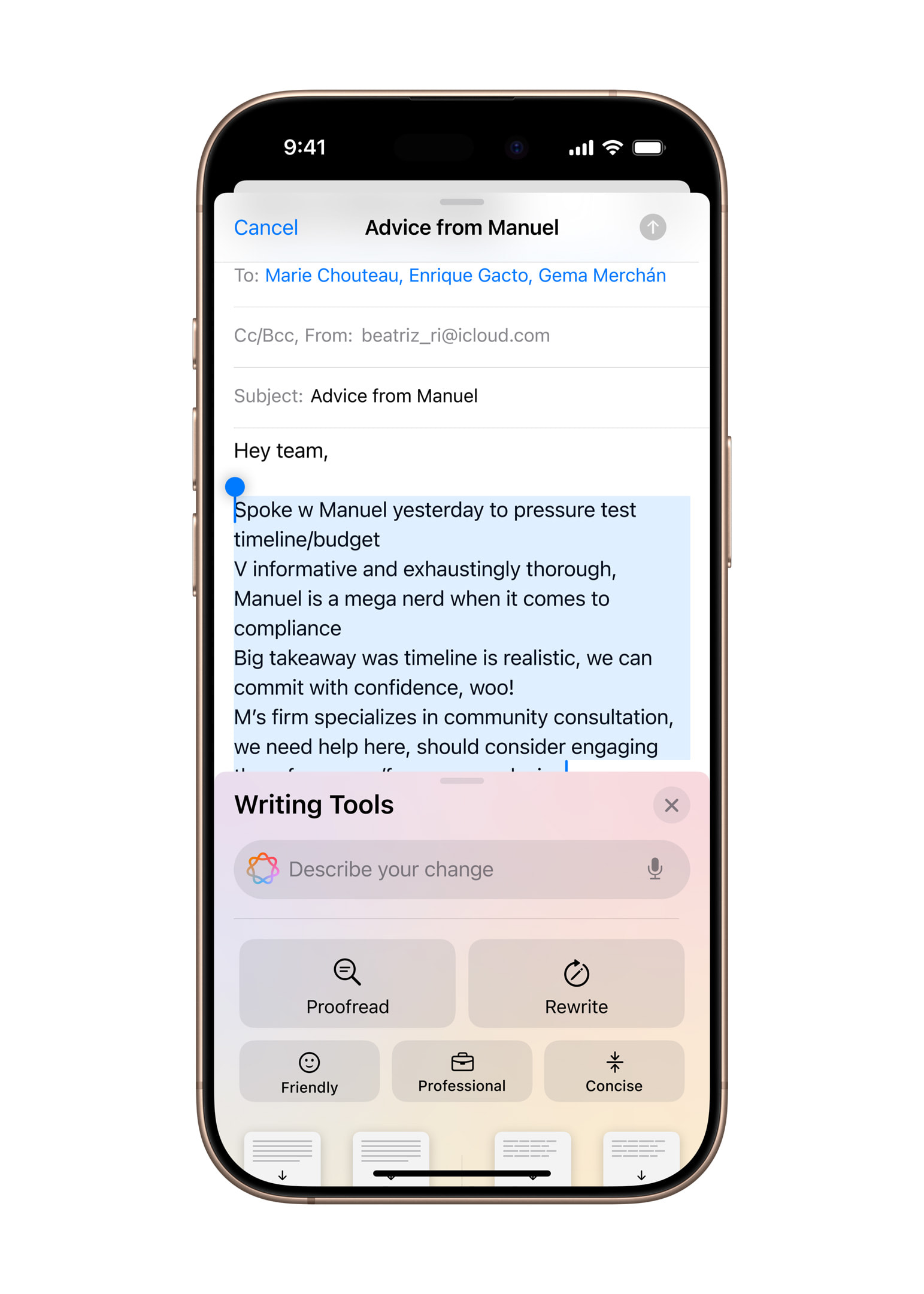
    This AI suite, available as a free software update, will include improved Siri, which will have a brand-new design and a glowing light that wraps around the edge of the screen when active on an iPhone, iPad, or CarPlay.

    It will also include Writing Tools for rewriting, proofreading, and summarizing text nearly everywhere they write, including Mail, Notes, Pages, and third-party apps.

    In Photos, the Memories feature now enables users to create movies by simply typing a description. In addition, natural language can be used to search for specific photos and videos.

    The new Clean Up tool can identify and remove distracting objects in a photo’s background without accidentally altering the subject.

    Users can record, transcribe, and summarize audio in the Notes and Phone apps. The phone app automatically notifies participants when a recording is initiated while on a call. Once the call ends, Apple Intelligence generates a summary to help recall key points.

    Across a user’s inbox, summaries convey the most important information of each email instead of simply previewing the first few lines.

    Smart Reply in Mail provides users with suggestions for a quick response and identifies questions in an email to ensure everything is answered.

    More Apple Intelligence features will roll out later this year and in the months following.

    Users can access ChatGPT for free without creating an account, and ChatGPT’s data-use policies apply—for example, IP addresses are obscured, and requests are stored.

  • An Autonomous AI Agent Called ‘Devin’ Plans and Executes Complex Coding Tasks

    An Autonomous AI Agent Called ‘Devin’ Plans and Executes Complex Coding Tasks

    IBL News | New York

    Cognition AI, which builds AI teammates, introduced this week an autonomous AI software engineer called Devin.

    This AI agent can independently write entire software projects from scratch based on simple text prompts.

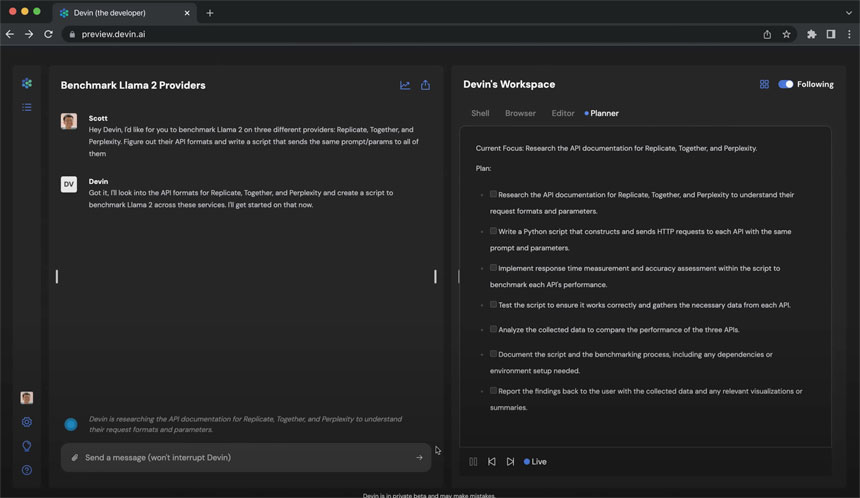
    Devin can plan and execute complex coding tasks with hundreds of steps.

    The autonomous agent can code while learning, recall relevant context at every step, fix errors, and collaborate with users in real time.

    “With our advances in long-term reasoning and planning, Devin can plan and execute complex engineering tasks requiring thousands of decisions,” said the company.

    Cognition AI has equipped Devin with common developer tools including the shell, code editor, and browser within a sandboxed compute environment.

    This agent can report on its progress in real-time, accept feedback, and work together with the user through design choices as needed.

    In the demos shown below, Devin built complete websites and apps in under 10 minutes. It also successfully completed real gigs posted on Upwork by itself.

    On a coding benchmark, the AI agent solved 13.86% of real-world GitHub issues end-to-end, crushing the previous SOTA benchmark of 1.96%.

    Funded with a $21 million Series A led by Founders Fund, Cognition AI is dedicated to building AI teammates with capabilities far beyond today’s existing AI tools by solving reasoning.
    .

  • The Humanoid Robot StartUp Figure AI Attracted the Support of Open AI, NVIDIA, Microsoft, and Jeff Bezos’ VC

    The Humanoid Robot StartUp Figure AI Attracted the Support of Open AI, NVIDIA, Microsoft, and Jeff Bezos’ VC

    IBL News | New York

    The final form for ChatGPT is not a bot.

    Figure AI, a startup working to build humanoid robots that can perform dangerous and undesirable jobs, got support from OpenAI and other large names in AI, such as NVIDIA, Microsoft, and Jeff Bezos’ venture fund.

    The Sunnyvale, California-based company announced on Thursday that it raised $675 million in Series B funding at a $2.6 billion valuation with investments from Microsoft, OpenAI Startup Fund, NVIDIA, Jeff Bezos (through Bezos Expeditions), Parkway Venture Capital, Intel Capital, Align Ventures, and ARK Invest.

    Focused on deploying humanoid robots to assist people with real-world applications addressing labor shortages, Figure recently announced its first commercial agreement with BMW Manufacturing to bring humanoids into automotive production.

    The Figure team, made up of top AI robotics experts from Boston Dynamics, Tesla, Google DeepMind, and Archer Aviation, has made remarkable progress in the past few months in the key areas of AI, robot development, robot testing, and commercialization. Founded 21 months ago, Figure currently has a team of 80 employees and is led by serial entrepreneur Brett Adcock.

    The new capital will be used to accelerate the timeline for humanoid commercial deployment as AI training, robot manufacturing, and expanding engineering headcount will be scaled up.

    The collaboration with OpenAI will help to accelerate “Figure’s commercial timeline by enhancing the capabilities of humanoid robots to process and reason from language,” stated the company.

    Peter Welinder, VP of Product and Partnerships at OpenAI, said: “We’ve always planned to come back to robotics and we see a path with Figure to explore what humanoid robots can achieve when powered by highly capable multimodal models. We’re blown away by Figure’s progress to date and we look forward to working together to open up new possibilities for how robots can help in everyday life.”

    Figure will use Microsoft Azure for AI infrastructure, training, and storage.

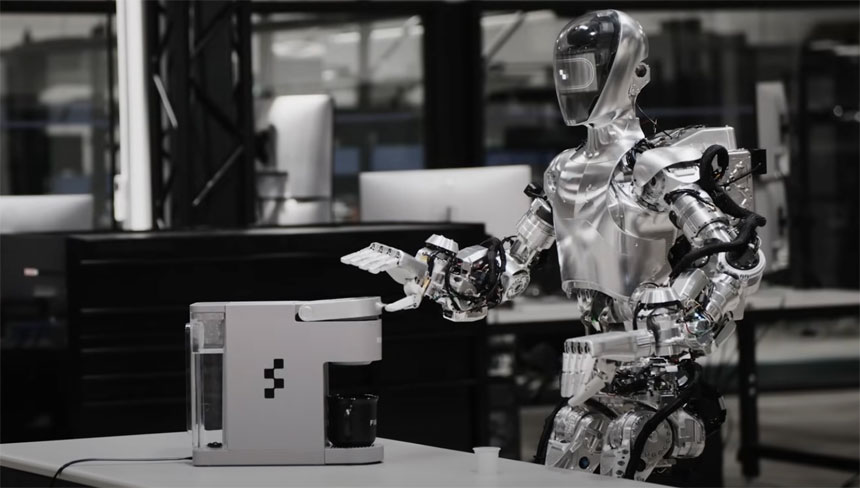
    To date, Figure AI has developed a general-purpose robot, called Figure 01, that looks and moves like a human. The company sees its robots being put to use in manufacturing, shipping and logistics, warehousing, and retail, where labor shortages are the most severe.

    Earlier this week, the company released a video showing Figure 01 in action (see below). The robot, attached to a tether, walks on two legs, and uses its five-fingered hands to pick up a plastic crate, then walks several more steps before placing the box on a conveyor belt.

    Figure’s ultimate aim is for Figure 01 to be able to perform “everyday tasks autonomously.” The company says getting there will require it to develop more robust AI systems.

    There is a crowded field of companies vying to make humanoid robots a reality, although the market is nascent. Amazon-backed Agility Robotics plans to open a factory that can produce up to 10,000 of its bipedal Digit robots per year.

    Tesla also trying to build a humanoid robot, called Optimus, while robotics company Boston Dynamics has developed several models. Norwegian humanoid robot startup 1X Technologies recently raised $100 million with backing from OpenAI.
    .

  • OpenAI Shows ‘Sora’, an AI Model that Generates Photorealistic Videos

    OpenAI Shows ‘Sora’, an AI Model that Generates Photorealistic Videos

    IBL News | New York

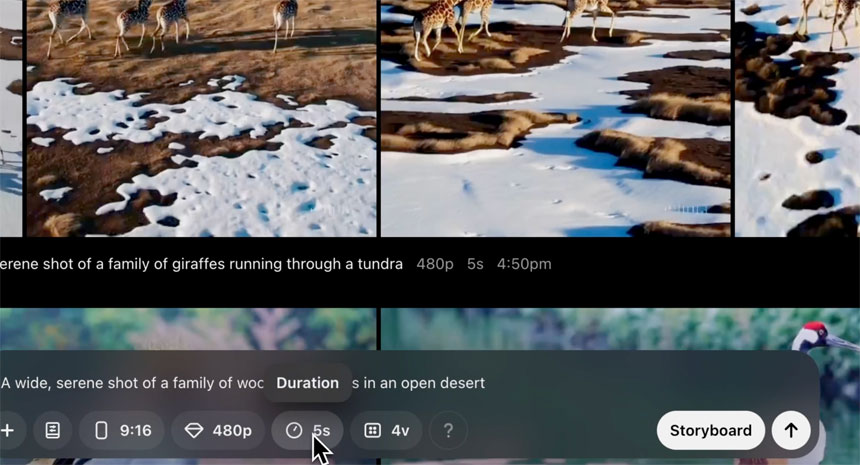
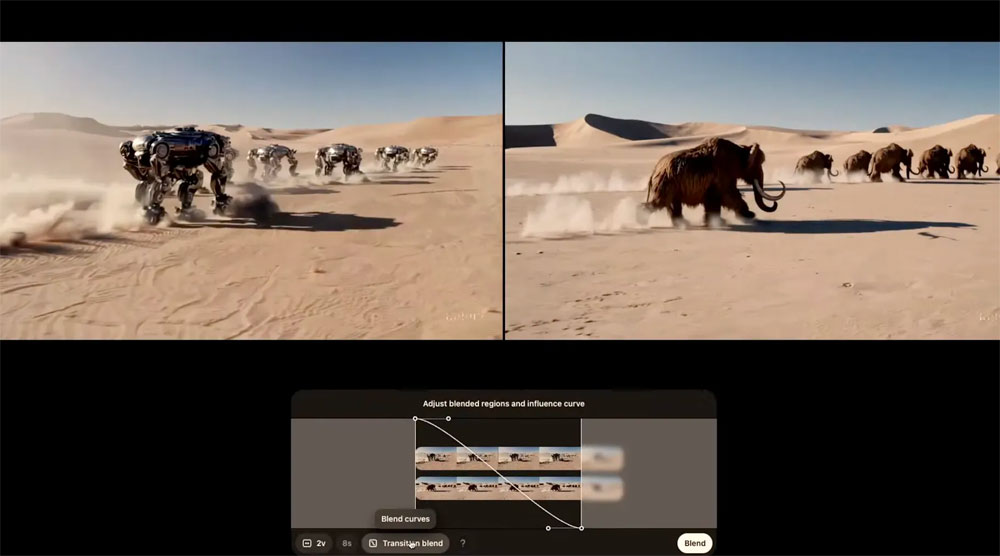
    OpenAI shared yesterday a new AI technology called ‘Sora’ that instantly generates eye-popping videos and can speed up the work of moviemakers while replacing less experienced digital artists.

    The San Francisco-based start-up shared this tool with a small group of academics and researchers.

    In an interview with The New York Times, the company said that it had not yet released Sora to the public because it was still working to understand the system’s dangers.

    OpenAI calls its new system Sora, after the Japanese word for sky.  It chose the name because it “evokes the idea of limitless creative potential.”

    In April 2023, a New York start-up called Runway AI unveiled technology that lets people generate videos simply by typing a prompt. Ten months later, OpenAI has unveiled a similar system that creates videos with a significantly higher quality.

    A demonstration included short videos created in minutes, like the ones shown below.

    OpenAI, which owns the still-image generator DALL-E, is now in the race to improve the AI video generator. Google and Meta are in this business, too.

    OpenAI declined to say how many videos the system learned from or where they came from, except to say the training included both publicly available videos and videos that were licensed from copyright holders. The company says little about the data used to train its technologies, most likely because it wants to maintain an advantage over competitors — and has been sued multiple times for using copyrighted material.

    The company is already tagging videos produced by the system with watermarks that identify them as being generated by AI. But it acknowledges that these can be removed.

    DALL-E, Midjourney, and other still-image generators have improved so quickly that they are now producing images nearly indistinguishable from photographs. Many digital artists are complaining that it has made it harder for them to find work.

    Examples:

    An AI-generated video by OpenAI was created with the following prompt: “Several giant wooly mammoths approach treading through a snowy meadow, their long wooly fur lightly blows in the wind as they walk, snow covered trees and dramatic snow capped mountains in the distance, mid afternoon light with wispy clouds and a sun high in the distance creates a warm glow, the low camera view is stunning capturing the large furry mammal with beautiful photography, depth of field.”


    This video’s AI prompt: “Beautiful, snowy Tokyo city is bustling. The camera moves through the bustling city street, following several people enjoying the beautiful snowy weather and shopping at nearby stalls. Gorgeous sakura petals are flying through the wind along with snowflakes.”


    “Animated scene features a close-up of a short fluffy monster kneeling beside a melting red candle. The art style is 3D and realistic, with a focus on lighting and texture. The mood of the painting is one of wonder and curiosity, as the monster gazes at the flame with wide eyes and open mouth. Its pose and expression convey a sense of innocence and playfulness, as if it is exploring the world around it for the first time. The use of warm colors and dramatic lighting further enhances the cozy atmosphere of the image.”


    This video’s AI prompt: “A gorgeously rendered papercraft world of a coral reef, rife with colorful fish and sea creatures.”
    .

    Sam Altman, CEO at OpenAI, shared multiple videos generated by Sora.


    • Wired: OpenAI’s Sora Turns AI Prompts Into Photorealistic Videos

  • NVIDIA Releases a Demo App that Allows Users to Run an AI Chatbot on Their PC

    NVIDIA Releases a Demo App that Allows Users to Run an AI Chatbot on Their PC

    IBL News | New York

    NVIDIA introduced yesterday a personalized demo chatbot app called Chat With RTX that runs locally on RTX-Powered Windows PCs providing fast and secure results.

    This early version  allows users to personalize a LLM connected to their own content—docs, notes, videos, or other data. It leverages retrieval-augmented generation (RAG), TensorRT-LLM, and RTX acceleration so users can query a custom chatbot to quickly get contextually relevant answers.

    Available to download, with 35GB’s installer, NVIDIA’s Chat With RTX requires Windows 11 and a GPU with NVIDIA GeForce RTX 30 or 40 Series GPU or NVIDIA RTX Ampere or Ada Generation GPU with at least 8GB of VRAM.

    With this app tailored for searching local documents and personal files, users can feed it YouTube videos and their own documents to create summaries and get relevant answers based on their own data analyzing collection of documents as well as scanning through PDFs.

    Chat with RTX essentially installs a web server and Python instance on a PC, which then leverages Mistral or Llama 2 models to query the data. It doesn’t remember context, so follow-up questions can’t be based on the context of a previous question.

    The installation is 30 minutes long, as The Verge analyzed.

    It takes an hour to install the two language models — Mistral 7B and LLaMA 2— and they required 70GB.

    Once it’s installed, a command prompt window launches with an active session, and the user can ask queries via a browser-based interface.
    .


  • Microsoft Issued a Redesigned Copilot with Image Creation Capabilities

    Microsoft Issued a Redesigned Copilot with Image Creation Capabilities

    IBL News | New York

    Microsoft issued this week an update to its Copilot chatbot with further image creation capabilities and a new GPT 4-based model, Deucalion. It also released new apps on iOS and Android.

    The launch was coincident with a Super Bowl ad (see below). It also marked one year since the entry of Microsoft into the consumer AI sphere with Bing Chat.

    Powered by OpenAI’s DALL-E 3, the new Copilot comes with a cleaner, sleeker look UI with a cleaner look, more white space, less text, and a visual carousel of cards.

    In addition, it includes Microsoft Designer, which allows users to customize the generated images right inside Copilot without leaving the chat.

    Images can be regenerated between square and landscape, resized, or enhanced with color, blurred background, and different effects like pixel art, resize and regenerate images without leaving chat.

    Microsoft announced that it will soon roll out a Designer GPT inside Copilot.

    Here are images of the old Bing Chat and the new Microsoft Copilot design, one after another.
    .


    https://youtu.be/SaCVSUbYpVc?si=YJKEC9EGEVKJXens


  • Google Rebranded ‘Bard’ Chatbot as ‘Gemini’, and Rolled Out a Paid Subscription Model

    Google Rebranded ‘Bard’ Chatbot as ‘Gemini’, and Rolled Out a Paid Subscription Model

    IBL News | New York

    Google rebranded its Bard chatbot as Gemini — the family of its foundation model —, launched in the U.S. Gemini Ultra 1.0 — priced at $20 per month — and issued a new Gemini app on iOS and Android, as Sundar Pichai, CEO of Google and Alphabet, announced today.

    The API access to the Ultra model will be available in the coming weeks.

    The paid monthly subscription — the same price as ChatGPT 4 — will be available through a new bundle known as Google One Premium Plan that includes two terabytes of cloud storage — typically costing $9.99 monthly — and access to the Google Workspace apps like Docs, Slides, Sheets, and Meet. For now, users can get a two-month subscription trial at no cost.

    With that, Google did sunset the Duet AI brand, which became Gemini for Workspace, responding to Microsoft and its partner OpenAI’s offerings in this manner.

    “Gemini Ultra 1.0 is a model that sets the state of the art across a wide range of benchmarks across text, image, audio, and video,” Google’s Sissie Hsiao said in a press conference today.

    “The largest model Ultra 1.0 is the first to outperform human experts on MMLU (massive multitask language understanding), which uses a combination of 57 subjects — including math, physics, history, law, medicine, and ethics — to test knowledge and problem-solving abilities,” Sundar Pichai stated.

    “Gemini Advanced can be a personal tutor, tailored to your learning style, or it can be a creative partner, helping you plan a content strategy or build a business plan, as explained in this post,” he added.

    Many users said Bard provided middling results, making a rebrand almost a necessity, TechCrunch commented today.
    .

    Video explaining two new experiences — Gemini Advanced and a mobile app — to help you easily collaborate with the best of Google AI.

  • Perplexity AI, Valued at $520 Million After Getting Support of Jeff Bezos, Nvidia, and Databricks

    Perplexity AI, Valued at $520 Million After Getting Support of Jeff Bezos, Nvidia, and Databricks

    IBL News | New York

    Perplexity — an AI-powered search engine with one million iOS and Android users and $3 million in annual recurring revenue (ARR) — announced yesterday it raised $73.6 million in funding, leading to a valuation of $520 million post-money — a multiple of around 150 times its ARR.

    Established in August 2022, this San Francisco-based start-up, with a staff of 40 employees located in a co-working space, says that it plans to go after Google’s dominant position in web search.

    The funding round was led by IVP with support from Seed and Series A investors NEA, Elad Gil, Nat Friedman, and Databricks, as well as new investors NVIDIA, Jeff Bezos (through Bezos Expeditions Fund), Tobi Lutke, Bessemer Venture Partners, Naval Ravikant, Balaji Srinivasan, Guillermo Rauch, Austen Allred, Factorial Funds, and Kindred Ventures, among others.

    “The times of sifting through SEO spam, sponsored links, and multiple web pages will be replaced by a much more efficient way to consume and share information,” explained Aravind Srinivas, Co-founder & CEO of Perplexity, in a blog post.

    He presents the company’s new Copilot product this way:

    “It’s an AI research assistant that has changed how we uncover information and learn more about new topics. Copilot tailors search queries with custom follow-up questions, introducing the concept of generative user interfaces. It removes the burden of prompt engineering and does not require users to ask perfectly phrased questions to get the answers they seek. This enables users to gain more relevant and comprehensive answers than other AI chatbots, traditional search engines, or research tools. Copilot has seen strong traction, especially among academics, students, and knowledge workers who rely on frequent research for their day-to-day work and needs.”

    In other words, Perplexity says that its advantage is based on using advances in AI to provide direct answers, instead of website links, in response to search queries, without some of the limitations felt by larger companies.

    “If you can directly answer somebody’s question, nobody needs those ten blue links,” Srinivas said. Google has begun rolling out a feature that provides lengthy summaries in response to some search queries.

    Microsoft has struggled to make a dent in Google’s share of the search market since it introduced a version of its Bing search engine that can act like a chatbot.

    Neeva, a search start-up that used generative AI to provide direct answers, shut down last year after it failed to gain enough traction to compete with Google.

    Perplexity maintains its index of webpages, which it combines with a mixture of AI technology it has designed itself and purchased from outside providers such as OpenAI.

    The company, still not profitable, charges $20 a month for a more powerful version of the search engine that uses GPT-4, OpenAI’s most advanced technology.
    .