Category: Views

  • ChatGPT Introduced “Study Mode”, a New Way to Learn that Offers Step-By-Step Guidance

    ChatGPT Introduced “Study Mode”, a New Way to Learn that Offers Step-By-Step Guidance

    IBL News | New York

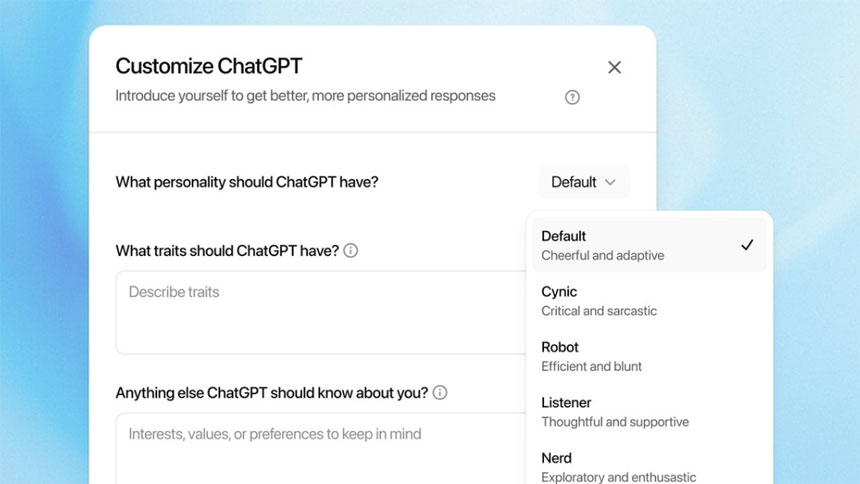
    OpenAI introduced “Study Mode” for ChatGPT, a new way to learn that offers step-by-step guidance instead of quick answers, designed to act more as an always-on tutor and less like a lookup tool. It aims to prevent—or at least discourage—students from taking homework shortcuts.

    The company defined this new feature as “a new learning experience that helps you work through problems step-by-step instead of just getting an answer.”

    This mode transforms the AI from an answer engine into a Socratic tutor, a pedagogical approach, developed after consulting with experts from over 40 institutions, that asks guiding questions to help students work through problems themselves instead of providing direct solutions.

    OpenAI states that it is currently partnering with learning experts from Stanford “to study and share how AI tools, including study mode, influence learning outcomes in areas like K-12 education.”

    The company aims to address educators’ concerns about academic integrity and cheating.

    The feature is available to logged-in users on Free, Plus, Pro, and Team, with availability in ChatGPT Edu in August.

    These are the key features, according to OpenAI:

    Interactive promptsCombines Socratic questioning, hints, and self-reflection prompts to guide understanding and promote active learning, instead of providing answers outright.

    Scaffolded responses: Information is organized into easy-to-follow sections that highlight the key connections between topics, keeping information engaging with just the right amount of context and reducing overwhelm for complex topics.

    Personalized support: Lessons are tailored to the right level for the user, based on questions that assess skill level and memory from previous chats.

    Knowledge checks: Quizzes and open-ended questions, along with personalized feedback to track progress, support knowledge retention, and the ability to apply that knowledge in new contexts.

    Flexibility: Easily toggle study mode on and off during a conversation, giving you the flexibility to adapt to your learning goals in each conversation.

    However, regardless of how engaging ChatGPT’s study mode becomes, it exists just a toggle click away from ChatGPT with direct answers. That could be quite hard to resist for many students.

    In terms of market value, OpenAI’s “Study Mode” intensified the race among tech giants, with Google, Microsoft, and Anthropic each competing to shape the future of education.

  • Columbia University’s Agreement with The White House Sets a Precedent For Other Colleges

    Columbia University’s Agreement with The White House Sets a Precedent For Other Colleges

    IBL News | New York

    The Trump administration’s deal with Columbia University in New York City has put leaders at Ivy League universities and other college campuses nationwide in a tough spot. Institutions are facing the possibility of seeing research funding paused.

    President Donald Trump has made it clear he won’t tolerate a liberal imposition at America’s most prestigious colleges and intends to reshape them accordingly.

    On July 23, Columbia University agreed to pay fines of over $220 million and signed on to a list of other concessions related to admissions, academics, and hiring practices.

    The White House, which has halted billions in research grants to several schools, said it envisions the Columbia deal as the first of many such agreements.

    Education Secretary Linda McMahon called it a blueprint for other institutions to follow.

    “Columbia’s reforms are a roadmap for elite universities that wish to regain the confidence of the American public,” Linda McMahon said in a statement.

    In addition to Columbia University, other Ivy League schools are striking deals with the Trump administration.

    On July 1, the University of Pennsylvania entered into an agreement ending a civil rights investigation brought by the U.S. Department of Education.

    In February, the agency accused Penn of violating Title IX, the primary sex discrimination law governing schools, when it allowed Lia Thomas, a transgender swimmer, to compete in 2022.

    As part of the deal, the White House said it would restore Penn’s research funding. In return, the university apologized to cisgender athletes who swam against Thomas. The university also agreed to ban transgender women from sports.

    This month, President Trump hinted he believes Harvard University may still be open to coming to a deal.

    At Cornell, the government paused more than $1 billion. At Brown, it froze $510 million, and at Princeton, it stopped more than $210 million.

    Of the eight Ivy League schools, only two – Dartmouth College and Yale University – have avoided targeted federal funding freezes.

  • Anthropic Introduced ‘Claude for Financial Services’, With a Tool That Unifies Data

    Anthropic Introduced ‘Claude for Financial Services’, With a Tool That Unifies Data

    IBL News | New York

    Anthropic, the maker of the Claude.ai chatbot, introduced this month Claude for Financial Services, a solution for financial professionals to analyze markets, conduct research, and make investment decisions.

    The so-called Financial Analysis Solution unifies users’ financial data—from market feeds to internal data stored in platforms like Databricks and Snowflake—into a single interface. It allows access to critical data sources with direct hyperlinks to source materials.

    It also comes with pre-built MCP connectors to access financial data providers and enterprise platforms.

    Developers can build custom applications via the company’s API.

    Anthropic said it includes the company’s Claude 4 models, Claude Code, and Claude for Enterprise with expanded usage limits, implementation support, and other features.

    “Claude provides the complete platform for financial AI—from immediate deployment to custom development,” Anthropic said in a release.

    According to Anthropic, these real-time financial data providers include:

    • Box enables secure document management and data room analysis.
    • Daloopa supplies high-quality fundamentals and KPIs from all public filings, disclosures and presentations.
    • FactSet provides comprehensive equity prices, fundamentals, and consensus estimates.
    • Morningstar contributes valuation data and research analytics.
    • Palantir builds AI-driven platforms that help governments and enterprises integrate, analyze, and act on large-scale data to make critical operational decisions.
    • PitchBook delivers industry-leading private capital market data and research, empowering users to source investment and fundraising opportunities, conduct due diligence and benchmark performance, faster and with greater confidence.
    • S&P Global enables access to Capital IQ Financials, earnings call transcripts, and more–essentially your entire research workflow.
    • Databricks offers unified analytics for big data and AI workloads.
    • Snowflake provides an easy, connected, and trusted data and AI platform that allows global enterprises to unlock value across all of their data – including structured, unstructured, and semi-structured.

    The solution is available on AWS Marketplace for streamlined procurement and consolidated billing, while Google Cloud Marketplace availability is coming soon.


    > Mike Dion
    : The 3 Best Ways to Use Claude For Finance

  • OpenAI Debuted ChatGPT Agent, a Tool that Combines ‘Operator’ and ‘Deep Research’

    OpenAI Debuted ChatGPT Agent, a Tool that Combines ‘Operator’ and ‘Deep Research’

    IBL News | New York

    OpenAI debuted ChatGPT Agent yesterday, joining the hyped trend of agents —tools that autonomously complete multi-step tasks and workflows.

    This new agent, still in beta, can perform tasks, following users’ instructions, on its own OpenAI virtual computer by intelligently navigating websites, filtering results, requesting secure logins when needed, running code, conducting analysis, and even delivering editable slideshows and spreadsheets that summarize its findings.

    Some examples of handled requests provided by OpenAI include:

    “Look at my calendar and brief me on upcoming client meetings based on recent news.”
    • “Plan and buy ingredients to make a Japanese breakfast for four.”
    • “Analyze three competitors and create a slide deck.”

    At work, users can automate repetitive tasks, such as converting screenshots or dashboards into presentations composed of editable vector elements, rearranging meetings, planning and booking offsites, and updating spreadsheets with new financial data while maintaining the same formatting. In personal life, users can use it to plan and book travel itineraries, design and book entire dinner parties, or find specialists and schedule appointments.

    ChatGPT Agent is a unified agentic system that combines the strengths of three earlier breakthroughs: the Operator’s ability to interact with websites, deep research’s skill in synthesizing information, and ChatGPT’s intelligence and conversational fluency.

    The agent can also leverage ChatGPT connectors, which enable it to integrate with apps like Gmail and GitHub, allowing ChatGPT to find information relevant to your prompts and utilize it in its responses.

    OpenAI’s Pro, Plus, and Team paid users can activate ChatGPT Agent directly through the tools dropdown by selecting ‘agent mode’. Enterprise and Education users will gain access in the coming weeks. Pro users receive 400 messages per month. In comparison, other paid users are limited to 40 messages monthly, with additional usage available via flexible credit-based options.

    The service isn’t available in the EU and Switzerland.

  • Teachers’ Union Creates a National Academy for AI Instruction With $23M From Microsoft, OpenAI, and Anthropic

    Teachers’ Union Creates a National Academy for AI Instruction With $23M From Microsoft, OpenAI, and Anthropic

    IBL News | New York

    The American Federation of Teachers, the second-largest teachers’ union in the U.S. (representing 1.8 million members), will create a National Academy for AI Instruction, with $23 million in funding from Microsoft, OpenAI, and Anthropic.

    This training hub for educators is planned to open this fall in the union’s headquarters in New York City. It will offer hands-on workshops for teachers on how to use AI tools for instructional tasks safely and ethically.

    The initiative is expected to reach approximately 400,000 educators, that is, roughly one in ten US teachers, by 2030.

    This academy was inspired by other unions, such as the United Brotherhood of Carpenters, which has established high-tech training centers in collaboration with industry partners.

    Microsoft will provide $12.5 million over the next five years. OpenAI will contribute $8 million in funding and $2 million in technical resources. Anthropic will add $500,000 for the first year of the effort.

    In February, California State University, the largest university system in the U.S., announced that it would provide ChatGPT to approximately 460,000 students.

    This spring, Miami-Dade County Public Schools, the third-largest U.S. school district, began rolling out Google’s Gemini AI for 100,000 high schoolers.

    The Trump administration has called on the industry to provide AI education. (IBL News: Sixty-Eight Organizations Support Trump’s Pledge to Educate K-12 Students on AI).

    Some experts have warned that tech firms can use AI deals with schools and the teachers’ union as marketing opportunities to make students lifetime chatbot customers.

    “It’s a long-game investment by companies to turn young people into consumers who identify with a particular brand,” said to The New York Times Dr. Griffey, a vice president of University Council-A.F.T. Local 1474, a union representing University of California librarians and lecturers.

    This month, approximately 200 New York City teachers received a glimpse of what the new national training effort might look like, as reported by The New York Times. A presenter from Microsoft showed an explainer video featuring Minecraft, the popular game owned by Microsoft.

    Additionally, teachers attempted to generate emails and lesson plans using Khanmigo, an AI tool designed for schools, for which Microsoft has provided support. They then experimented with Microsoft Copilot for similar tasks.

    On its side, OpenAI has launched programs like OpenAI Academy, ChatGPT for Education, and the OpenAI forum. The company is also co-sponsoring the AFT AI Symposium on July 24 in Washington, DC.

  • University Endowments Will Be More Heavily Taxed and Student Federal Borrowing Will Be Capped

    University Endowments Will Be More Heavily Taxed and Student Federal Borrowing Will Be Capped

    IBL News | New York

    The approved Trump administration domestic policy bill will expand taxes on endowments that universities often use for financial aid (typically about 5%), cap the federal amount students can borrow for graduate programs, and allow students in short-term work training programs in community colleges to become eligible for Pell Grants.

    Also, the bill would “make college less affordable,” said Lynn Pasquerella, president of the American Association of Colleges and Universities.

    Meanwhile, republicans said that the bill — dubbed “The Big, Beautiful Bill — imposes accountability on a sector that has failed to police itself.

    More heavily taxed university endowments fulfill a Trump campaign promise to target the nation’s wealthiest schools, like Harvard, Columbia, and the University of Pennsylvania, among others. To date, this campaign has resulted in reduced research grants and made it more difficult for international students to enroll.

    Universities like Harvard and Princeton, which have endowments of $2 million or more per student, would face an 8 percent tax on investment income. It’s a smaller amount than the 21 percent proposed initially in the House bill or the 35 percent that Vice President JD Vance suggested in 2023 as a senator.

    The student loan changes are expected to save the government over $300 billion in a decade, according to a Congressional Budget Office estimate. “By reducing borrowing availability, we break the cycle of debt, making higher education more accessible for all Americans,” the Trump administration said in a statement.

    The bill places restrictions on how much money graduate students can borrow from the federal government to pay for school.

    Students won’t be able to take out more than $100,000 for a master’s degree and over $200,000 for doctoral, medical, or professional degrees.

  • OpenAI Aims to Embed Its AI Assistants Into Universities, Following the Footsteps of Google and Microsoft

    OpenAI Aims to Embed Its AI Assistants Into Universities, Following the Footsteps of Google and Microsoft

    Mikel Amigot, IBL News | New York

    OpenAI is selling premium AI services to universities trying to “become part of the core infrastructure of higher education,” said Leah Belsky, OpenAI’s vice president of education and former manager at Coursera, in an interview with The New York Times [in the picture above].

    At the same time, it’s running a marketing campaign targeting students and courting them as future customers — essentially as rivals like Google and Microsoft have been doing for years, pushing their computers and software into schools.

    The startup envisions students graduating with their AI assistants and utilizing them throughout their careers in the workplace, like they do with their school-issued Gmail accounts.

    On their side, Elon Musk’s xAI and Google have been offering free AI services for college students during the exam period.

    Overall, OpenAI aims to embed its AI technology within universities by providing students with AI assistants to help tutor and guide them from orientation through graduation, featuring tools such as chatbots, practice job interview tools, voice model tools, and tools to quiz aloud ahead of a test.

    Meanwhile, faculty members can build custom chatbots for their students by uploading course materials, such as lecture notes, slides, videos, and quizzes, into ChatGPT.

    OpenAI’s sales pitch has been named “AI-native universities.”

    Three of its clients are the University of Maryland, California State University (with 460,000 students across its 23 campuses), and Duke University (through a platform called DukeGPT).

    Millions of college students regularly use AI chatbots for writing essays and term papers, researching, composing code, and generating ideas.

    The San Francisco–based startup service for universities, ChatGPT Edu, offers additional features, including specific privacy protections, compared to the company’s free chatbot. ChatGPT Edu also enables faculty and staff to create custom chatbots for use within the university.

    OpenAI states that it does not utilize the information entered by students, faculty, and administrators into ChatGPT Edu for training its AI.

  • Meta Invests $14.3 Billion in Scale and Hires Its CEO

    Meta Invests $14.3 Billion in Scale and Hires Its CEO

    Mikel Amigot, IBL News | New York

    Mark Zuckerberg’s Meta Platforms Inc. has finalized a $14.3 billion investment in Scale AI — taking a 49% stake — and recruited the company’s CEO, Alexandr Wang, 28, to join its AI team for producing data models.

    Scale offers data services to help companies, including Meta and OpenAI, train and improve their AI systems. It also builds custom AI applications for businesses and governments. The startup generated approximately $870 million in revenue in 2024 and is expected to reach $2 billion in revenue by the end of this year. Its new interim CEO will be Jason Droege.

    Zuckerberg was frustrated with Meta’s progress following the rollout in April of the company’s latest large language model, Llama 4. Not wanting to be left behind, the CEO of Meta took a more hands-on approach, making the recruitment of AI experts and scientists a top priority.

    He has been offering lucrative pay packages to attract top researchers from Alphabet Inc.’s Google and startup Sesame AI Inc. He has been following a playbook similar to Amazon.com Inc., Microsoft Corp., and Google, with arrangements designed to avoid the regulatory scrutiny that comes with significant acquisitions.

    Alphabet’s Google, the largest customer of Scale AI, announced it would cut ties with Scale after rival Meta bought a 49% stake in the AI data-labeling startup.

    Google was paying Scale approximately $200 million this year for the human-labeled training data, which is crucial for developing technology, including the sophisticated AI models that power Gemini, its ChatGPT competitor, one of the sources said.

    Other major customers of Scale, including Microsoft, are also backing away. Elon Musk’s xAI plans are exiting, too, arguing their concern to expose their research priorities and road map to a rival.
  • Web Search, Built on Links, Starts to Shift Away Toward LLM Platforms

    Web Search, Built on Links, Starts to Shift Away Toward LLM Platforms

    Mikel Amigot, IBL News | New York 

    Web search, built on links, started to shift away from traditional browsers toward LLM platforms in 2025, according to a report by Andreessen Horowitz.

    The foundation of the $80 billion+ SEO market just cracked with Apple’s announcement that AI-native search engines like Perplexity and Claude will be built into Safari, said the VC firm. This put Google’s distribution chokehold in question.

    “A new paradigm is emerging, one driven not by page rank, but by language models. We’re entering Act II of search: Generative Engine Optimization (GEO),” stated the report.

    Page ranks are determined by indexing sites based on keyword matching, content depth and breadth, backlinks, and user experience engagement.

    However, today, it’s not about ranking high on the results page. LLMs are the new interface for how people find information. Visibility is obtained by showing up directly in the answers of LLMs like GPT-4, Gemini, and Claude.

    Users’ queries are longer (averaging 23 words vs. 4), sessions are deeper (averaging 6 minutes), and responses provide personalized, multi-source synthesis, remembering and showing reasoning, rather than just relying on keywords.

    Additionally, the business model and incentives have changed. Google monetizes user traffic through ads; users are paid with their data and attention. In contrast, most LLMs are paywalled, subscription-driven services.

    However, an ad market may eventually emerge on top of LLM interfaces, but the rules, incentives, and participants would likely look very different than traditional search.

    New monitoring platforms, such as ProfoundGoodie, and Daydream, enable brands to analyze how they appear in AI-generated responses.

    Tools like Ahrefs’ Brand Radar track brand mentions in AI Overviews, enabling companies to understand how they’re framed and remembered by generative engines. Semrush has a dedicated AI toolkit designed to help brands track perception across generative platforms, optimize content for AI visibility, and respond quickly to emerging mentions in LLM outputs.

  • Google Announced an Initiative to Invest in AI Startups

    Google Announced an Initiative to Invest in AI Startups

    Mikel Amigot, IBL News | New York

    Google announced its AI Futures Fund this month. The fund will invest in startups from seed to late-stage using AI tools developed by DeepMind, the company’s R&D lab.

    Google’s support will also include early access to Google AI models from DeepMind, working with experts from DeepMind and Google Labs, and Cloud credits. Some startups will also have the opportunity to receive direct investment from Google.

    “When we come across companies that align with the fund’s thesis, we may choose to invest,” said a Google representative.

    AI Futures Fund already has some case studies, such as the meme-making platform Viggle and the webtoon app Toonsutra.

    Over the past few months, Google has committed to supporting the next generation of AI talent and scientific breakthroughs.

    • In November 2024, Google.org, the company’s charitable wing, announced a $20 million cash commitment to researchers and scientists working in AI.

    • In September, Google CEO Sundar Pichai announced the company was creating a $120 million Global AI Opportunity fund to help bring AI education and training to more places worldwide.

    • Google.org also launched a $20 million generative AI accelerator program to cut checks to nonprofits developing AI tech.

    • Google for Startups Founders Fund supports founders from an array of industries and backgrounds building companies, including AI companies.