IBL News | New York
The new merged Coursera-Udemy company, announced on December 17, 2025, valued at $2.5 billion, has slid to $1.8 billion.
“This merger of the last two giants standing marks the end of an era in online education,” wrote analyst and founder of Class Central, Dhawal Shah.
“The merger was a desperation. Coursera’s CEO had been on the job for roughly 11 months; Udemy’s, just 9. Even if discussions started three months ago, that implies Udemy’s CEO was looking for a buyer only six months into the role.”
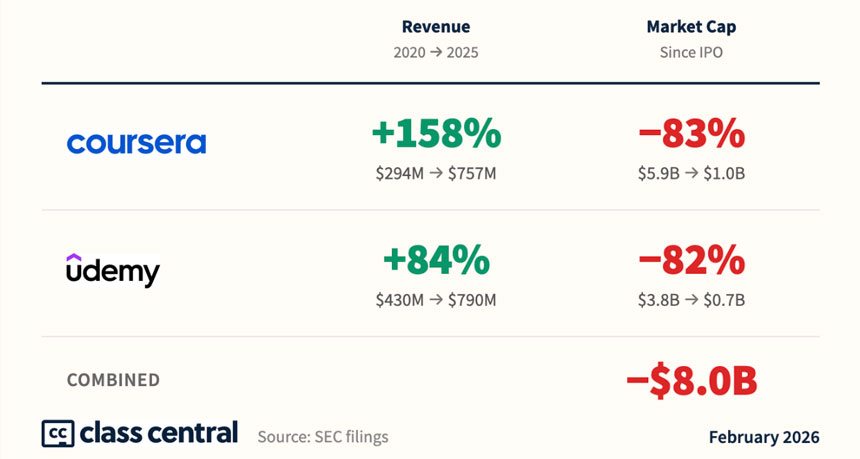
According to Dhawal Shah, since 2020, Coursera and Udemy have generated $7.2 billion in combined revenue. They’ve lost $8 billion in combined market value.
However, these are not failing businesses.
These are not failing businesses. They generate cash flow and have plenty of money in the bank. They aren’t going anywhere.
Udemy brought revenue of $789.8 million in 2025 compared to Coursera’s $757.5 million. Udemy is also profitable, posting $3.8 million in net income. Coursera is still reporting a net loss of $51 million, even though it generated $109 million in cash from operations in 2025.
With a market cap of around $1B, the market is only valuing Coursera’s actual business at roughly $200M.
Duolingo, which is growing faster than both, lost $4B in market cap overnight after one earnings call. It’s now down over $15B from its 2025 peak.
Coursera’s primary growth engine today is professional certificates created by companies like Google, IBM, and Meta.
Google’s certificates — the Google IT Support Certificate was created in 201 — alone contribute more than $100M in revenue to Coursera each year.
In Q4 2025, with 17,000 business customers, Udemy’s enterprise revenue more than doubled Coursera’s: $134.2M to $65.4M. Coursera has around 2,000 business customers.
When it comes to corporate training, businesses prefer content over credentials.
In early 2025, both boards brought in new CEOs, operations-minded outsiders with no connection to education. “They moved fast and broke things. Especially at Coursera, where a decade of stability under Jeff Maggioncalda disappeared almost overnight.”
Starting around 2020, Coursera began adding thousands of courses from companies like Packt, EDUCBA, Board Infinity, and Whizlabs. These aren’t universities or major tech companies. They’re content aggregators and training mills. Coursera even tried letting anyone create courses on the platform, copying Udemy’s model. It shut that down within months.
Udemy now offers 5,000 AI courses with 14 million enrollments and 560 million minutes watched. On Coursera, the most popular come from Google, IBM, and DeepLearning.AI.
By 2022, layoffs hit across the board: 2U, Coursera, Udacity, MasterClass, Pluralsight, and more.
“One by one, the original players lost their independence. Udacity was acquired by Accenture. 2U filed for bankruptcy, taking edX down with it. FutureLearn, Lynda.com, and Codecademy were all absorbed into larger companies. Treehouse collapsed. The brands mostly still exist, but they tend to fade once they lose their independence,” wrote Dhawal Shah.