Author: IBL News

  • The OpenSAP Micro-Learning Free Platform Reaches Five Million Enrollments

    The OpenSAP Micro-Learning Free Platform Reaches Five Million Enrollments

    IBL News | New York

    openSAP announced this month it attracted five million course enrollments and 1.2 million learners on its platform – a free webspace that offers micro-learning and expert-led courses, as well as podcasts. In the last three years, the number of course enrollments doubled.

    Established in 2013, the openSAP platform mostly provides essential knowledge on SAP, such as SAP S/4HANA, and SAP Business Technology Platform, along with topics such as intelligent integration, digital transformation, and machine learning. It includes approximately 250 courses with an average of 20,000 enrollments per class. Gamification and discussion forums are part of the platform.

    “Our goal is to ensure that everyone in our ecosystem – customers, partners, developers, and employees – all have the right skills to thrive in a digital world,” said Maxwell Wessel, EVP, and Chief Learning Officer, SAP.

    Training through micro-learning is the shiny new trend, although the concept started in the mid-1990s. It is quickly becoming a staple of training programs. For example, Deloitte Australia announced a mobile training system with small digital courses for its 10,500 employees.

    The consultancy firm uses the EdApp micro-learning platform, which offers “bite-size learning” downloaded directly to employees’ smartphones. Jennifer Siu, Deloitte’s Manager for Leadership and Learning, explained it in a series of videos.

    Quick, engaging, and entertaining content provides learners with short pieces of information instead of watching hours of monotonous videos. Learning science probes that digestible pieces of content aligned with spaced repetition increase retention.

    Micro-learning and Nano-learning are effective ways to deliver knowledge not only to Generation Z‘s students — who grew up with smartphones and are used to soundbites on YouTube, Tik Tok, and Snapchat — but increasingly to corporate audiences.

    This is forcing many corporations to rethink their learning, credentialing, and assessment approaches.

  • Unizin Makes Its Analytics Platform Available through Google Cloud to All Universities

    Unizin Makes Its Analytics Platform Available through Google Cloud to All Universities

    IBL News | New York

    The Unizin university non-profit consortium made its Data Platform available via the Google Cloud Marketplace to any higher-ed institution beyond its 14 members.

    An example of usage is the University of Minnesota’s NXT GEN MED project, which leverages the work completed by the institution’s technologists and data analytics.

    As a Platform-as-a-Service solution, the Unizin Data Platform (UDP) allows universities and colleges to share and analyze data from LMSs and Student Information Systems, such as video management tools, proctoring tools, and assessment platforms.

    The UDP collects, cleans, models, curates, and stores all teaching and learning data to create a holistic view of each student. It will ultimately allow institutions to deliver more effective and engaging student experiences and improve learners’ achievement and retention.

    The integration is via LTI. The UDP enforces the use of two data interoperability standards: IMS Global Caliper and the Unizin Common Data Model.

    “It’s not easy for higher-learning institutions to aggregate, analyze, and use learning data at scale—nor can many institutions, except for the very largest, operationalize learning data in advising, business intelligence, and machine-learning initiatives,” said Cathy O’Bryan, Unizin’s CEO.

    “The UDP frees up colleges and universities from the technical challenges of integrating, normalizing, and managing data, so they can focus on using data for insights to enable student success during and post-college years.”

    “By partnering with Unizin, Google Cloud helps institutions make a large leap in their digital transformation, helping enable smarter decision-making at scale,” said Steven Butschi, Head of Education for Google Cloud.

    “The data-informed academic mission must play an essential role in helping every student reach their potential. Every week, we see our institutions leveraging the Unizin Data Platform to engage, enrich, and empower their students and instructors with data, analytics, and insights,” explained Etienne Pelaprat, Chief Technology Officer at Unizin.

    Unizin Data Platform Dashboard


  • Notre Dame, First Christian University to Require Mandatory Vaccination for All Students

    Notre Dame, First Christian University to Require Mandatory Vaccination for All Students

    IBL News | New York

    The University of Notre Dame will be the first Catholic Christian higher-ed institution that requires all students — undergraduate, graduate, and professionals — mandatory full vaccination against COVID-19 for the fall 2021 semester.

    Some Catholic groups are against vaccination, dismissing Pope Francis’ statement — echoed by President Biden yesterday — saying that “it was a moral obligation.”

    The university will join the growing list of colleges implementing this requirement. Rutgers University was the first one last week, and Cornell and Brown followed.

    All of them, including Notre Dame, said that they would accommodate medical or religious exemptions.

    To date, almost no protest has emerged among student advocacy groups.

    In the case of Notre Dame, President, Provost, Vice President, and executive officers defended the vaccine requirement in a letter sent to the campus community.

    Father John Jenkins, President of Notre Dame University, said that the vaccine would contribute “to our ability to return to a more vibrant campus environment.”

    The announcement came along with the opening of a clinic on campus with the Pfizer-BioNTech two-dose vaccine.


  • The 2021 Open edX Conference Will Be a Virtual Half-Day Event on May 27

    The 2021 Open edX Conference Will Be a Virtual Half-Day Event on May 27

    IBL News | New York

    The 2021 Open edX Conference will be virtual and structured as a half-day event, from 9 AM to 1 PM (EDT), May 27th.

    The edX organization said in a blog post that “the event will focus on shaping the future of education together.”

    The virtual conference will feature a thought leader keynote, eight practical talks, and unstructured spaces for direct connections among attendees.

    Session topics will combine pedagogy and instructional design with the Open edX platform’s new features, extensions, and integrations.

    Some of the community speakers will include:

    • Anant Agarwal – Founder & CEO – edX
    • Marco Morales – Platform Product Manager – edX
    • Rupinder Kaur Kohli – Chief Solutions Architect – Skill-Up Technologies
    • Eran Raviv – Director – Campus IL
    • Braden MacDonald – CTO – OpenCraft

    The registration rate is $50. The event is sponsored by overseas firms: Three from Latin America and Spain — Aulasneo, eduNEXT, and Graspway —, two from Europe — OpenCraft and Abstract —, and one from Asia, Arbisoft.

  • Getty Images Says that It Won’t Close Its Acquired Unsplash Free Images Platform

    Getty Images Says that It Won’t Close Its Acquired Unsplash Free Images Platform

    IBL News | New York

    Getty Images will close at the end of April its acquisition — for an undisclosed amount — of Unsplash, a popular platform that reports over 100 million freely usable images downloaded per month, directly and through their partners via API. Started in 2013 as a Tumblr blog, Unsplash now offers over 2 million images free of cost.

    With 425 million paid images and videos including the world’s deepest archive of historic photography, Getty Images plans to combine Unsplash with its iStock brand, increasing its dominance on online images’ copyright business.

    According to Getty, “Unsplash will continue to maintain its free content model.” The founders Mikael Cho, Luke Chesser, and Stephanie Liverani will continue leading the company as well, although will report to Craig Peters, CEO at Getty Images.

    “This partnership is an important milestone for Unsplash, but our mission of Photos for Everyone remains unchanged,” ensured Mikael Cho.

    Despite these assurances, some voices expressed their concern that either Unsplash will change its image copyright polity or will be shut down.

  • Cornell and Several More Universities Will Require Students to Be Vaccinated

    Cornell and Several More Universities Will Require Students to Be Vaccinated

    IBL News | New York

    The number of universities mandating the COVID grows every day.

    At least six more universities — Cornell University, Brown University, Nova Southeastern University, Fort Lewis College in Durango, Oakland University, St. Edward’s University, and Roger Williams College in Rhode Island — have joined Rutgers in requiring students to be vaccinated for the upcoming fall term. Students with health issues or religious beliefs will be the only exceptions.

    In the case of Cornell, President Martha E. Pollack and Provost Michael I. Kotlikoff
    announced that it will require vaccination for students returning to Ithaca, Geneva, and Cornell Tech campuses for the fall semester.

    Cornell’s students, faculty, and staff members are required to register their status through the university’s Daily Check portal, adding proof of vaccination.

    The institution is planning for several possibilities for instruction, depending on the level of immunity achieved. With herd immunity, classes would return to in-person modality.

    Nova Southeastern University (NSU) in Florida said that it intends to resume full, in-person classroom learning for the fall 2021 semester. The requirement to be fully vaccinated for COVID-19 will be effective August 1st.

    Fort Lewis College in Durango, Colorado, with 3,500 students enrolled, announced to staff and students Friday that it will require students to get vaccinated, as well. It’s the first Colorado university to initiate a vaccine mandate.

    Yesterday, Oakland University in Rochester, Michigan, announced it will be mandating immunizations for student-residents to fall move on August 27.


  • Soros Pledges $500 Million to Bard College in New York, One of Founders of His University Arm

    Soros Pledges $500 Million to Bard College in New York, One of Founders of His University Arm

    IBL News | New York

    Billionaire investor George Soros pledged last week a $500 million endowment to Bard College, a private liberal arts college in New York.

    The financier explained that “Bard has had an outsized impact, setting the standard in liberal arts education in prisons, in high school age students, and in the arts and in its international work.” 

    Bard College is one of two founding partners of the new Open Society University Network, a global network created with the Central European University in partnership with George Soros’s Open Society Foundations. Soros previously pledged $1 billion to help establish the Open Society University Network. Last summer, he committed $100 million to Bard his Open Society Foundation.

    “This grant to Bard — among the largest ever made to higher education in the United States – facilitates and strengthens Bard’s exemplary educational and social initiatives,” said the school.

    In response to Soros’ donation, Bard announced it has raised an additional $250 million from trustees, alumni, and supporters, and will raise another $250 million over the next five years.

    “This is the most historic moment since the college’s founding in 1860,” said Bard College President Leon Botstein. “When this endowment drive is complete, Bard will have a $1 billion endowment, which will ensure its pioneering mission and its academic excellence for the future.”

    Bard College enrolls 2,200 students at its main campus in New York’s Hudson Valley and the Catskill Mountains. Its tuition costs are roughly $55,000 for a first-year student without room and board.

  • Coursera’s CEO Says that Its Valuation Won’t Drop After the Pandemic Winds Down

    Coursera’s CEO Says that Its Valuation Won’t Drop After the Pandemic Winds Down

    IBL News | New York

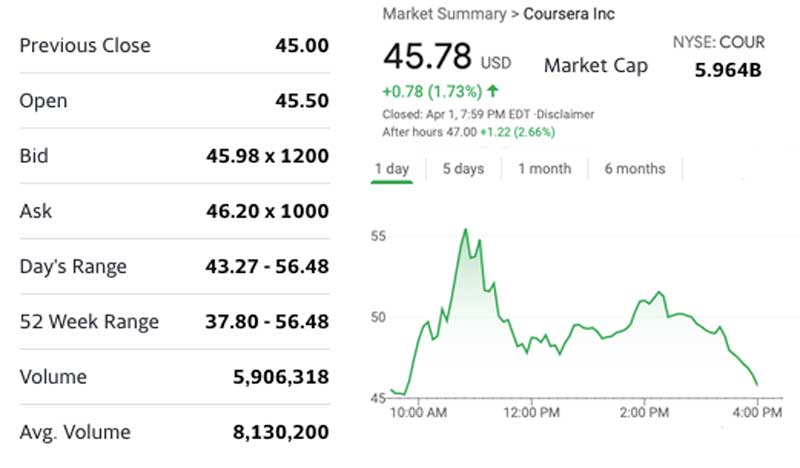
    Coursera (NYSE: COUR) ended up its successful debut in Wall Street with a small gain of 1.73%, closing at $45.78 a share, it hit a high of $56.48 at 11:00 am.

    On Wednesday, the stock rallied 36%, until $45, giving the company a whopping valuation of $5.9 billion.

    On Tuesday, the IPO priced Coursera’s shares at $33, allowing the educational company to raise nearly $520 million.

    The CEO at Coursera, Jeff Maggioncalda, predicted yesterday at Yahoo Finance that the stock price would stay even after the pandemic winds down.

    He said: “The world needs more access to high-quality learning. There will be a new normal that emerges. We don’t know what that will look like either in terms of how we work remotely versus in an office and how we will learn online and also on campus. But it’s pretty clear that the world will never be the same again and that online learning will be a big part of it.”

    “So we really think about the long term, all the structural reasons why people will need to learn continuously through their lives to learn new skills as the world goes more digital,” he added.


  • Higher Ed Sees an Increased Number of Malware Attacks Demanding Payment

    Higher Ed Sees an Increased Number of Malware Attacks Demanding Payment

    IBL News | New York

    The FBI issued a warning about the increase in cyberattacks targeting higher education, K-12 schools, and seminaries in 12 U.S. states and the United Kingdom.

    Cyberattacks have disrupted virtual classes and registrations at a number of institutions amid the pandemic this year.

    Cybercriminals steal sensitive information, block access to essential systems, and demand payment before they return access. Some institutions have already paid those ransoms.

    The average cost of a data breach was $3.9 million in 2020, according to the Ponemon Institute.

    These attacks are identified as PYSA ransomware, also known as Mespinoza. This is malware capable of exfiltrating data and encrypting users’ critical files and data stored on the attacked institutions’ systems.

    Unidentified cyber actors exfiltrate data, encrypt victim’s systems, and use it as leverage in eliciting ransom payments. These criminals use Advanced Port Scanner and Advanced IP Scanner1 to conduct network reconnaissance and proceed to install open-source tools, such as PowerShell Empire2, Koadic3, and Mimikatz4. The cyber actors execute commands to deactivate antivirus capabilities on the victim network prior to deploying the ransomware.

    Upon malware execution, a detailed ransom message is generated and displayed on the victim’s login or lock screen. The ransom message contains information on how to contact the actors via email, displays FAQs, and offers to decrypt the affected files. If the ransom is not met, the actors warn that the information will be uploaded and monetized on the darknet.

    The FBI recommends no to pay ransoms. “Payment does not guarantee files will be recovered. It may also embolden adversaries to target additional organizations, encourage other criminal actors to engage in the distribution of ransomware, and/or fund illicit activities,” says the Bureau.


  • Coursera Rallies 36% on Its Debut, Giving the Company a Whopping Valuation of $5.8 Billion

    Coursera Rallies 36% on Its Debut, Giving the Company a Whopping Valuation of $5.8 Billion

    IBL News | New York

    Coursera stock rose 36% Wednesday, closing at $45 a share, on its first day of trading on the NYSE (New York Stock Exchange).

    This surge gave the online learning platform a whopping market valuation of $5.86 billion, despite the company is still unprofitable.

    On Tuesday, Coursera priced its 15.73 million shares of the IPO at $33 a share, at the high end of Coursera’s expected range of $30 to $33.

    In its offering, the company raised nearly $520 million at an implied $4.3 billion valuation.

    Prior to its debut, Coursera was last valued in the private market at $3.6 billion.

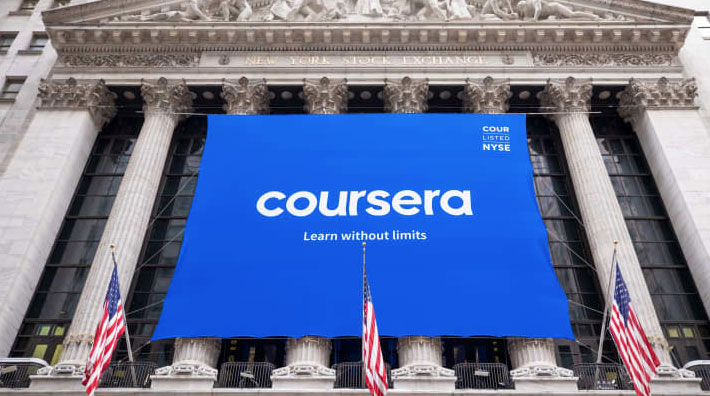
    As shown in the picture above, Coursera’s founders and CEO rang virtually the opening bell of the New York Stock Exchange today, as the whole event was online, due to the pandemic.

    Jeff Maggioncalda, CEO at Coursera said to EdSurge that the new influx of money would be used to build more AI-based teaching.

    “We are always building more AI into the teaching experience and the learning experience,” he said. “On the learning side, that means more personalized learning. On the teaching side, [it means] improved student-success dashboards that predict every student’s grade every day and predict the chance that students stop [out of] the degree program.”

    The stock trades under the ticker symbol “COUR.”


    [Written by Mikel Amigot]

    Coursera CEO on IPO: this was a ‘good time’ for public debut

    News about Coursera at IBL News