Author: IBL News

  • A Report Revealed the Winners and Losers in the New AI Landscape

    A Report Revealed the Winners and Losers in the New AI Landscape

    IBL News | New York

    AI spending surged to $13.8 billion in 2024 from $2.3 billion in 2023 as enterprises embed AI at the core of their business strategies and daily work, according to a study conducted by Menlo Ventures.

    This research, titled “2024 State of Generative AI in the Enterprise Report,” done after surveying 600 U.S. enterprise IT decision-makers, points out that we are still in the early stages of a large-scale transformation.

    This spending will continue: 72% of decision-makers anticipate broader adoption of generative AI tools soon.

    Investments in the LLM foundation model still dominate spending, but the application layer segment to optimize workflows is now growing faster.

    These app layer companies—mostly in highly verticalized sectors—leverage LLM’s capabilities across domains to unlock new efficiencies. Enterprise buyers will invest $4.6 billion in generative AI applications in 2024, an 8x increase from the $600 million invested in 2023.

    The use cases that deliver the most ROI through enhanced productivity or operational efficiency are:

    • Code copilots, such as GitHub Copilot, Cursor, Codeium, Harness, and All Hands.

    • Support knowledge-based chatbots for employees, customers, and contact centers. Aisera, Decagon, Sierra, and Observe AI are some of the examples.

    • Enterprise search, retrieval, data extraction, and transformation to unlock the knowledge hidden within data silos. Solutions like Glean and Sana connect to emails, messengers, and document stores, enabling unified semantic search across systems.

    • Meeting summarization to automate note-taking and takeaways. Examples are Fireflies.ai, Otter.ai, Fathom, and Eleos Health.

    AI-powered autonomous agents capable of managing complex, end-to-end workflow processes are emerging and can transform human-led industries. Forge, Sema4, and Clay are some tools.

    When deciding to build or buy, 47% of solutions are developed in-house, while 53% are sourced from vendors. Often, organizations discover too late that they have underestimated the difficulty of technical integration, scalability, and ongoing support.

    Most customers (64%) prefer buying from established vendors, citing trust.

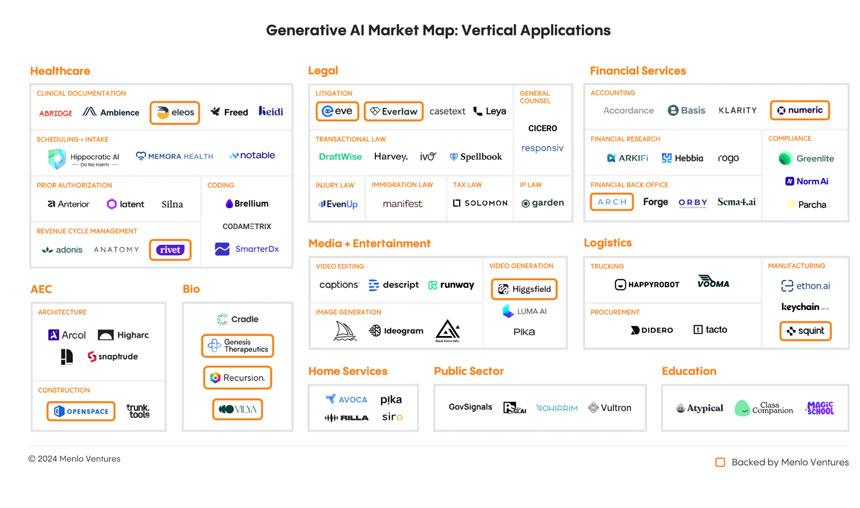
    The leading vertical AI applications are:

    Healthcare, with examples like AbridgeAmbienceHeidi, Eleos Health, Notable, SmarterDxCodametrix, Adonis, and Rivet.

    Legal, with examples like Everlaw, Harvey, Spellbook, EvenUp, Garden, Manifest, and Eve.

    Financial Services, with examples like Numeric, Klarity, Arkifi, Rogo, Arch, Orby, Sema4, Greenlite, and Norm AI.

    Media and entertainment, with examples like Runway, CaptionsDescript, Black Forest LabsHiggsfield, IdeogramMidjourney, and Pika.

    Rather than relying on a single provider, enterprises have adopted a multi-model approach, typically deploying three or more LLM in their AI stacks, routing to different models depending on the use case or results.

    To date, close-source solutions underpin the vast majority of usage, with Meta’s Llama 3 holding at 19%, according to the Menlo Ventures research.

    Regarding architectures for building efficient and scalable AI systems, RAG (retrieval-augmented generation) dominates with 51% adoption, while fine-tuning of production molded is only 9%. Agentic architectures, which debuted this year, power 12% of implementations.

    Databases and data pipelines are needed to power RAG. Traditional databases like Postgres and MongoDB remain common, while AI-native vector databases like Pinecone gain ground.

    Menlo Ventures made three predictions for what lies ahead:

    1. Agentic automation will drive the next wave of transformation, tackling complex, multi-step tasks beyond the current systems of content generation and knowledge retrieval. Examples are platforms like Clay and Forge

    2. More incumbents will fall. Chegg saw 85% of its market cap vanish, while Stack Overflow’s web traffic halved. IT outsourcing firms like Cognizant, legacy automation players like UiPath, and even software giants like Salesforce and Autodesk will face AI-native challengers.

    3. The AI talent drought will intensify. AI-skilled enterprise architects will notably increase their salaries. 

    Squint, Typeface

  • IBM Partnered with Meta to Integrate Llama Into Its AI Platform WatsonX

    IBM Partnered with Meta to Integrate Llama Into Its AI Platform WatsonX

    IBL News | New York

    IBM partnered with Meta to integrate open-source Llama into the WatsonX.ai platform and noticed strong enterprise adoption. One case pertains to Dun & Bradstreet customer operations.

    IBM’s Watsonx.ai provides a next-generation enterprise studio for AI builders worldwide to train, validate, tune, and deploy AI models.

    Other enterprise use cases mentioned are:

    – 𝗕𝘂𝘀𝗶𝗻𝗲𝘀𝘀 𝗗𝗮𝘁𝗮: Dun & Bradstreet generates company summaries, revisiting millions of companies quarterly to enhance data pipelines.

    – 𝗦𝗽𝗼𝗿𝘁𝘀: Sevilla FC’s Scout Advisor identifies and evaluates recruits, integrating scouting data and NLP.

    – 𝗖𝘂𝘀𝘁𝗼𝗺𝗲𝗿 𝗜𝗻𝘁𝗲𝗿𝗮𝗰𝘁𝗶𝗼𝗻: AddAI’s Q&A chatbot, built, reduced unanswered queries by 50%.

    – 𝗚𝗼𝘃𝗲𝗿𝗻𝗺𝗲𝗻𝘁 𝗘𝗳𝗳𝗶𝗰𝗶𝗲𝗻𝗰𝘆: Llama expedites document processing and legal research, reducing case prep time by 50%.

    – 𝗛𝗥 𝗔𝘀𝘀𝗶𝘀𝘁𝗮𝗻𝗰𝗲: Telecom HR assistants achieved a 75% automation rate and multilingual support.

    – 𝗖𝗹𝗮𝗶𝗺𝘀 𝗣𝗿𝗼𝗰𝗲𝘀𝘀𝗶𝗻𝗴: Financial services streamlined call summaries, saving an hour per case and enabling same-day reports.

    – 𝗧𝗿𝗮𝗻𝘀𝗹𝗮𝘁𝗶𝗼𝗻: Local governments developed Q&A assistants with advanced translation capabilities.

    – 𝗦𝗮𝗮𝗦: A SaaS vendor enhanced contract management with watsonx.ai, making AI tools widely accessible.

    – 𝗧𝗮𝗹𝗲𝗻𝘁 𝗔𝗰𝗾𝘂𝗶𝘀𝗶𝘁𝗶𝗼𝗻: AI-driven HR automation cut costs by 90% for a talent firm.

    – 𝗙𝗶𝗻𝗮𝗻𝗰𝗲: Real-time asset valuation and improved transaction monitoring achieved faster insights and analysis.

    – 𝗜𝗻𝗳𝗼𝗿𝗺𝗮𝘁𝗶𝗼𝗻 𝗠𝗮𝗻𝗮𝗴𝗲𝗺𝗲𝗻𝘁: Automated document classification sped up archive digitization and data cataloging.

    – 𝗠𝗲𝗱𝗶𝗮: A press agency automated article reviews, translations, and social media edits, saving editors 95% of their time.

    – 𝗧𝗲𝗰𝗵 𝗮𝗻𝗱 𝗜𝗧: AI assistants reduced support ticket resolution times from hours to minutes, achieving 93% accuracy.

  • Nvidia Introduced an AI Model That Modifies Sounds Simply Using Text and Generates Novel Sound

    Nvidia Introduced an AI Model That Modifies Sounds Simply Using Text and Generates Novel Sound

    IBL News | New York

    On Monday, Nvidia showed a new AI model that understands and generates sound as humans do.

    Called Fugatto (Foundational Generative Audio Transformer Opus 1), this model generates or transforms any mix of music, voices, and sounds described with prompts using any combination of text and audio files.

    However, Santa Clara, California-based Nvidia, the world’s largest supplier of chips and software for AI systems, said it is still debating whether and how to release it publicly.

    For example, Fugatto can create a music snippet based on a text prompt, remove or add instruments from an existing song, change the accent or emotion in a voice, and even let people produce sounds never heard.

    Another case can be an online course spoken by any family member or friend.

    Music producers can use Fugatto to prototype or edit an idea for a song quickly, trying out different styles, voices, and instruments. They could also add effects and enhance the overall audio quality of an existing track.

    “This thing is wild, and the idea that I can create entirely new sounds on the fly in the studio is incredible,” said Ido Zmishlany, a multi-platinum producer and songwriter and cofounder of One Take Audio, a member of the NVIDIA Inception program for cutting-edge startups.

    Fugatto is a foundational generative transformer model that builds on Nvidia’s prior work in speech modeling, vocoding, and understanding.

    The full version uses 2.5 billion parameters and was trained on a bank of NVIDIA DGX systems packing 32 NVIDIA H100 Tensor Core GPUs.

    Other players like Runway and Meta have introduced models that generate audio or video from a text prompt.

  • Anthropic Open Sourced a New Standard for Connecting Assistants to AI Models

    Anthropic Open Sourced a New Standard for Connecting Assistants to AI Models

    IBL News | New York

    Anthropic, the creator of the Claude chatbot, open-sourced yesterday a new standard called Model Context Protocol (MCP) for connecting AI assistants to the systems where data lives. The standard aims to produce better, more relevant responses to queries. MCP works for any model, not just Anthropic’s.

    AI assistants have gained mainstream adoption, but even the most sophisticated models are constrained by their isolation from data—trapped behind information silos and legacy systems. Every new data source requires custom implementation, making truly connected systems challenging to scale.

    Anthropic explained that MCP addresses this challenge by providing a universal, open standard for connecting AI systems with data sources, replacing fragmented integrations with a single protocol. “The result is a simpler, more reliable way for AI systems to access the data they need,” the company said.

    The architecture is straightforward: developers can expose their data through MCP servers or build AI applications (MCP clients) that connect to these servers.

    There are three major components of the Model Context Protocol for developers:

    To help developers start exploring, Anthropic shared pre-built MCP servers for popular enterprise systems like Google Drive, Slack, GitHub, Git, Postgres, and Puppeteer.

    Early adopters like Block and Apollo have integrated MCP into their systems, while development tools companies, including Zed, Replit, Codeium, and Sourcegraph, are working with MCP to enhance their platforms.

    This enables AI agents to retrieve relevant information more effectively, understand the context surrounding a coding task more fully, and produce more nuanced and functional code with fewer attempts.

    “Open technologies like the Model Context Protocol are the bridges that connect AI to real-world applications, ensuring innovation is accessible, transparent, and rooted in collaboration,” said Dhanji R. Prasanna, Chief Technology Officer at Block.

    MCP ostensibly solves this problem through a protocol that enables developers to build two-way connections between data sources and AI-powered chatbots and applications. Developers can expose data through “MCP servers” and create “MCP clients” — for instance, apps and workflows — that connect to those servers on command.

    Rivals like OpenAI prefer that customers and ecosystem partners use their data-connecting approaches and specifications. OpenAI has said it plans to bring the capability, called Work with Apps, to other types of apps.

  • Peter Thiel Backed – Mercor AI, Which Uses AI for Job Interviewing, Valued at $250M

    Peter Thiel Backed – Mercor AI, Which Uses AI for Job Interviewing, Valued at $250M

    IBL News | New York

    Mercor, which uses AI to vet and interview job candidates and then match them to open roles, has conducted more than 100,000 interviews and evaluated 300,000 people in less than two years.

    With a workforce of 15 employees, this AI interviewer start-up is now valued at $250 million, following a $32 million round. The business is profitable and has grown 50% month over month.

    Billionaire investor Peter Thiel, Twitter cofounder Jack Dorsey, two OpenAI board directors, Quora CEO Adam D’Angelo, and former Treasury Secretary Larry Summers also personally invested.

    Mercor’s marketplace now depends on its own LLM, which builds on OpenAI and fine-tunes its proprietary data around its job-seeking process.

    Applicants upload their resumes and take a 20-minute video interview with Mercor’s AI. Half that time is spent discussing the candidate’s experience, and the other half is spent responding to a relevant case study.

    The job seeker’s application is then matched against all possible open jobs on Mercor’s marketplace. For more specialized roles, a second, tailored AI interview might follow.

    Mercor promises to quickly connect with employers’ qualified candidates through contracted hourly, part-time, and full-time commitments.

    Mercor’s largest pool of such talent remains in India.

    The roles include engineering, product development, design, operations, and content.

    Mercor faces competition from well-capitalized talent markets, such as startup unicorn Andela.

  • OpenAI Launched “Realtime API” For Multi-Modal Conversational Experiences

    OpenAI Launched “Realtime API” For Multi-Modal Conversational Experiences

    IBL News | New York

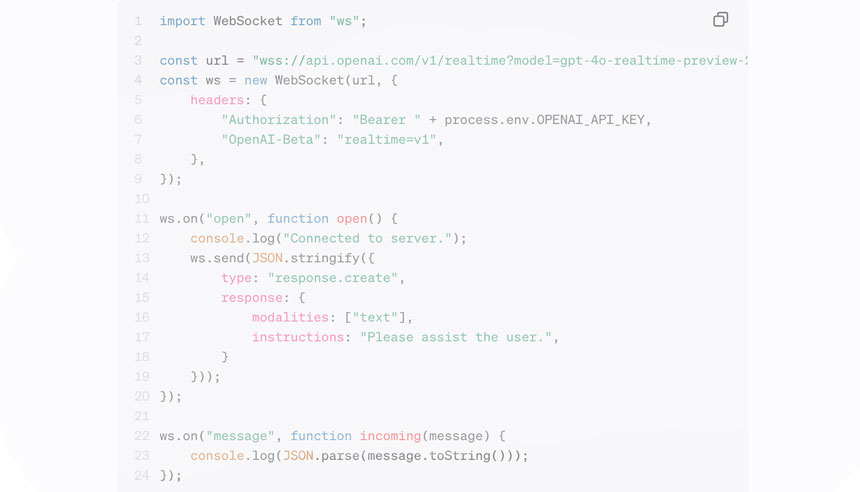
    OpenAI announced several tools this week, including a public beta of its “Realtime API” for building nearly real-time multi-modal conversational and AI-generated voice response apps.

    It currently supports text and audio as input and output, as well as function calling.

    These low-latency responses use only six voices, not third-party voices, to prevent copyright issues.

    This move follows OpenAI’s effort to convince developers to build tools with its AI models at its 2024 DevDay.

    The San Francisco-based research lab said that the company has over 3 million developers building with its AI models.

    OpenAI Chief Product Officer Kevin Weil said the recent departures of CTO Mira Murati and Chief Research Officer Bob McGrew slow innovation.

    As part of its DevDay announcements, OpenAI will help developers improve the performance of GPT-4o for tasks involving visual understanding.

    Also, OpenAI said it won’t release any new AI models during DevDay this year. TechCrunch reported that the video generation model Sora will have to wait a little longer.

  • Linda McMahon Will Send Education Back to the States and Defend Universal School Choice

    Linda McMahon Will Send Education Back to the States and Defend Universal School Choice

    IBL News | New York

    Linda McMahon, President-elect Donald J. Trump’s pick for education secretary, will work on “sending Education back to the states” while reducing or eliminating the federal Department of Education. This was one of Trump’s key education campaign pledges.

    With a slimmer educational résumé than typical of candidates for the Secretary of Education position, she served 16 years on the board of trustees for Sacred Heart University in Fairfield, Connecticut, where a student center is named for her.

    She also spent just over a year on the Connecticut State Board of Education, where she was one of fifteen members overseeing all public education in the state, including its technical high school system. Later, in 2010, she would resign to run as a Republican for a Senate seat.

    Linda McMahon, a leader of President-elect Donald Trump’s transition team, is known for her many years in wrestling as the former chief executive of World Wrestling Entertainment (WWE).

    According to President Trump’s statement, her approach to education is based on advocating for parents’ and families’ rights and universal school choice. This means that money typically flowing to public schools will instead go to families so they can spend it on private education.

    “As Secretary of Education, Linda will fight tirelessly to expand ‘Choice’ to every State in America and empower parents to make the best Education decisions for their families,” Mr. Trump said.

    On Tuesday, Ms. McMahon posted a message on social media praising “apprenticeship programs” and highlighting their examples in Switzerland, which is often cited as a high-performing country whose model the United States should follow.

    She also has backed a House bill to make federal Pell Grants available for those pursuing skills training programs and technical education, not just traditional college degrees.

    The for-profit college sector applauded Ms. McMahon’s selection.

    “Under her leadership, we are confident that the new Department of Education will take a more reasoned and thoughtful approach in addressing many of the overreaching and punitive regulations put forth by the Biden administration, especially those targeting career schools,” Jason Altmire, president of Career Education Colleges and Universities, a trade group that represents the for-profit sector, said in a statement.

    • NYT: How Linda McMahon Might Approach the Dept. of Education — Comments of the audience

  • Trump Names Former Head of Small Business Administration Linda McMahon as His Pick for Education Secretary

    Trump Names Former Head of Small Business Administration Linda McMahon as His Pick for Education Secretary

    IBL News | New York

    On Tuesday, President-elect Donald Trump named Linda McMahon the new Secretary of Education.

    “As Secretary of Education, Linda will fight tirelessly to expand ‘Choice’ to every State in America and empower parents to make the best Education decisions for their families,” Trump said in a statement that described McMahon as a “fierce advocate for Parents’ Rights.”

    McMahon reposted Trump’s announcement. Earlier in the day, she joined Trump and Elon Musk, who was named a co-chair of a new “Department of Government Efficiency,” at the SpaceX Starship launch in Texas.

    McMahon, 76, is a co-chair of Trump’s presidential transition team. She is a former World Wrestling Entertainment (WWE) executive who served in the first Trump administration. She ran the Small Business Administration for much of his first term and is married to former WWE CEO Vince McMahon.

    If the Senate confirms her, McMahon will oversee a department that Trump said he planned to “get rid” of as it currently exists and allow each state to “handle education” individually.

    McMahon was head of the Small Business Administration during his first presidency before she stepped down from the Cabinet-level post in 2019 to lead the pro-Trump America First Action super PAC.

    Before she joined the first Trump administration, McMahon served on the Connecticut State Board of Education in 2009, before she resigned to make unsuccessful bids in 2010 and 2012 for U.S. Senate seats in the state.

    McMahon was one of Trump’s top donors during the 2024 campaign, contributing more than $20 million to the Make America Great Again Inc. super PAC and $937,800 to his campaign and affiliated joint fundraising committees.

  • New Research Suggest How AI Should Be Integrated on Learning Environments, Research, Administrative, and Campus Operations

    New Research Suggest How AI Should Be Integrated on Learning Environments, Research, Administrative, and Campus Operations

    IBL News | New York

    AI’s integration into learning environments, research, administrative functions, and campus operations reshapes how institutions operate, faculty teach, students learn, and staff perform their roles.

    It’s not about blindly accepting AI in higher education or banning its use.

    It is crucial to thoughtfully examine AI’s impact on higher education, specifically on student success, financial sustainability, accountability, and equity.

    This is the main conclusion of researcher Joe Sabado, who shared research titled “AI in Higher Education—Frameworks for Critical Inquiry and Innovation.”

    This document, created using AI, guides institutions through AI’s transformative process, helping them leverage this technology. It provides ten frameworks, offering valuable insights for all stakeholders: educators, administrators, policymakers, students, staff, and journalists.

    AI in Higher Education – Frameworks for Inquiry and Innovation (PDF)

  • Canvas LMS’ Parent Company Sold to Investors for $4.8B and Remove from the NYSE

    Canvas LMS’ Parent Company Sold to Investors for $4.8B and Remove from the NYSE

    IBL News | New York

    Instructure Holdings, Inc., which manages the Canvas LMS, the leading learning platform, announced last week that it completed its sale to two investment firms, KKR and Dragoneer, for $4.8 billion (or $23.60 per share).

    As part of the transaction, Instructure’s common stock was removed from trading on the NYSE (New York Stock Exchange).

    “Having KKR’s support will help us double down on core markets, scale our global reach at a faster pace and unlock new opportunities as we continue to innovate and enhance Canvas and the Instructure Learning Ecosystem,” said Steve Daly, CEO of Instructure.

    According to its data, the company expects to deliver $1B in revenue by 2028 with a platform that hosts 200 million learners from 100 countries and is supported by 1,000 partners. Currently, its annual revenue is below $500 million.

    Instructure has been publicly traded since 2021 after Thoma Bravo, its existing majority owner, briefly took it private for a year in 2020.