Author: IBL News

  • Google Issues Its New Model, ‘Gemini 2.0 Flash’, Along With ‘Multimodal Live API’

    Google Issues Its New Model, ‘Gemini 2.0 Flash’, Along With ‘Multimodal Live API’

    IBL News | New York

    Google announced yesterday its next major model, Gemini 2.0 Flash, which includes new multimodal outputs and can natively generate images, audio, and text. 2.0 Flash can.

    It uses third-party apps and services, allowing it to tap into Google Search, execute code, and more.

    However, the audio and image generation capabilities are launching only for “early access partners,” while the production version of 2.0 Flash will land in January.

    In the meantime, Google is releasing an API, the Multimodal Live API, to help developers build apps with real-time audio and video streaming functionality.

    Google said that using the Multimodal Live API allows developers to create real-time, multimodal apps with audio and video inputs from cameras or screens.

    The API supports the integration of tools to accomplish tasks, and it can handle “natural conversation patterns” such as interruptions along the lines of OpenAI’s Realtime API.

    The Multimodal Live API was generally available as of yesterday.

    In addition, Google released Jules, an experimental AI-powered code agent using Gemini 2.0. for coding tasks with Python and Javascript. Jules creates comprehensive, multi-step plans to address issues, efficiently modifies multiple files, and even prepares to pull requests to land fixes into GitHub directly.

  • ChatGPT-4o’s Canvas, which Allows a Live Editing Workspace, Made Available to All Users

    ChatGPT-4o’s Canvas, which Allows a Live Editing Workspace, Made Available to All Users

    IBL News | New York

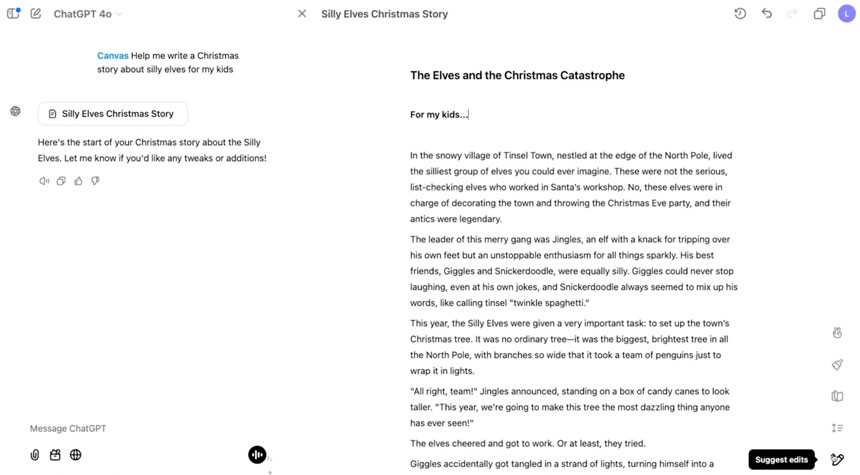
    OpenAI made its collaborative split-screen writing and coding interface, Canvas, available to all users this week. Integrated natively with GPT-4o, this tool has gained new features like Python and direct code execution within the interface, supporting real-time debugging and output visualization.

    Canvas allows users to trigger the interface through prompts rather than manual model selection.

    It features a split-screen layout with the chat on one side, a live editing workspace on the other, editing tools for writing (reading level, length adjustments), and advanced coding tools (code reviews, debugging).

    OpenAI introduced Canvas as an early beta to Plus and Teams users in October. This month, with the full rollout, all accounts now have access.

  • PwC Report Offers a Set of Predictions for 2025 About Generative AI

    PwC Report Offers a Set of Predictions for 2025 About Generative AI

    IBL News | New York

    It is vital to make AI intrinsic to the organization; AI strategies will put any company ahead or make it hard to catch up. Even the internet (invented in 1983) didn’t move so fast.

    This is one of the primary outcomes of the report “2025 AI Business Predictions,” which PwC presented this month. Based on its real-world experience helping clients reinvent their businesses with AI, the company said these predictions indicate what to expect in the next 12 months.

    “Top-performing companies will move from chasing AI use cases to using AI to fulfill business strategy,” said PwC U.S. Chief AI Officer Dan Priest.

    Another key outcome is that workflows will fundamentally change, but humans will still be instrumental in instructing and overseeing AI agents as they automate more straightforward tasks.

    The six key predictions are these:

    1. Your AI strategy will put you ahead — or make it hard to ever catch up
    2. Your workforce could double thanks to AI agents.
    3. ROI for AI depends on Responsible AI
    4. AI will be a value play — and a boon for sustainability
    5. AI will cut product development lifecycles in half
    6. AI will transform industry-level competitive landscapes 


  • OpenAI Avoided Allowing Sora To Upload Photos of Real People

    OpenAI Avoided Allowing Sora To Upload Photos of Real People

    IBL News | New York

    OpenAI avoided allowing its video model Sora—released on Monday and available to ChatGPT Pro and Plus paid users—to upload photos or footage of real people, as many users expected. The company said it would roll out that feature when it is safe.

    Generative video is a powerful and controversial tool due to the growing number of fraud cases related to deepfakes worldwide.

    “Early feedback from artists indicate that this is a powerful creative tool they value, but given the potential for abuse, we are not initially making it available to all users,” OpenAI wrote in a blog post.

    “We know that this will be an ongoing challenge; we’re starting a little conservative,” pointed out Will Peebles, a member of OpenAI’s technical staff and a research lead on Sora, during a livestream presentation on Monday.

    Among other measures from OpenAI to prevent misuse, Sora-generated videos contain metadata to show their provenance that abides by the C2PA technical standard.

    Also, to fend off copyright complaints, OpenAI uses “prompt re-writing,” designed to trigger when a user attempts to generate a video in the style of a living artist.

    Many artists have AI companies, including OpenAI, allegedly training on their works without permission.

    OpenAI said Sora was trained using publicly available datasets, proprietary data accessed through its vendor partnerships, and custom sets developed in-house.

    Early this year, ex-OpenAI CTO Mira Murati didn’t deny that Sora was trained on YouTube clips, violating the Google-owned streaming platform’s usage policy.

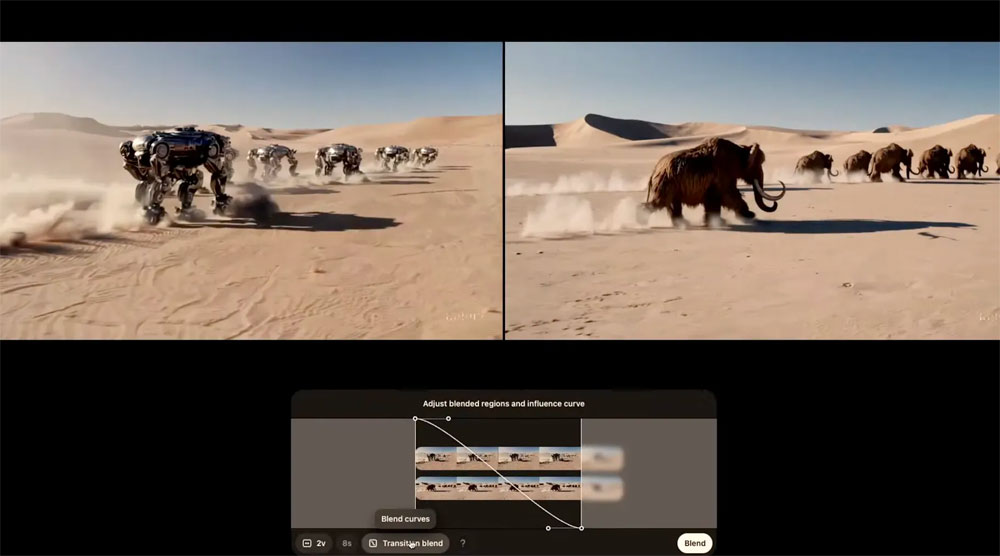
    Sora can create multiple variations of video clips from a text prompt or image and edit existing videos via a Re-mix tool. A Storyboard interface lets users create video sequences; a Blend tool takes two videos and creates a new one that preserves elements of both; and Loop and Re-cut options allow creators to tweak further and edit their videos and scenes.

    Sora is not included with ChatGPT Team, Enterprise, or Edu plans and is unavailable in the European Economic Area, the United Kingdom, or Switzerland.

    Other tech companies working on AI, such as Meta and Microsoft, have also been forced to postpone product releases in the EU due to the continent’s complex data privacy regulations.

    It is also not currently available to people under the age of 18.

    Credits are required to generate videos with Sora. ChatGPT Plus and Pro plans provide 1,000 and 10,000 credits, respectively, which reset monthly.

    480p videos generated with Sora cost 20 to 150 credits, 720p videos cost 30 to 540 credits, and 1080p videos cost 100 to 2,000 credits.

    Credits reset monthly at midnight, don’t roll over, and expire at the end of each billing cycle.

    By default, Sora videos are watermarked with a visual indicator in the lower-right-hand corner.

  • OpenAI Issues Video Generator Sora For Its Paying Users

    OpenAI Issues Video Generator Sora For Its Paying Users

    IBL News | New York

    OpenAI announced yesterday the launch of its video model Sora, an AI tool for creating realistic clips from text. It lets users generate videos up to 20 seconds long. It includes dropping images in as prompts and a timeline editor that allows users to add new prompts at specific moments in a video.

    “We don’t want the world just to be text,” OpenAI CEO Sam Altman said in a live-streamed announcement Monday. “Video is important to our culture,” Altman added.

    The San Francisco-based research lab, backed by Microsoft, said that this current version of Sora, named Sora Turbo, is faster than the model showed in February.

    Sora has been released as a standalone product at Sora.com to ChatGPT Plus and Pro users.


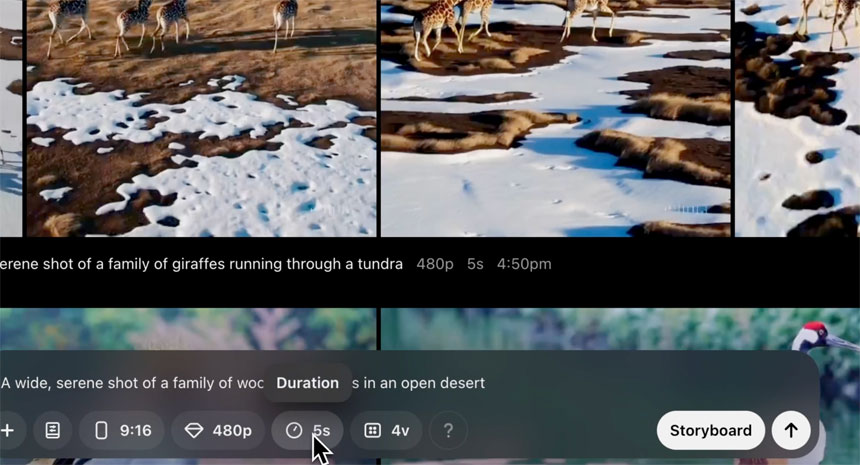
    ChatGPT Plus offers up to 50 videos at up to 480p resolution, up to 20 seconds long, or fewer videos at 720p monthly. These videos are in widescreen, vertical, or square aspect ratios at no additional cost. Users bring their assets to extend, remix, and blend or generate entirely new content from text.

    Meanwhile, ChatGPT Pro offers up to 500 monthly videos at up to 1080p resolution and longer duration.

    OpenAI developed new interfaces to make it easier to prompt Sora with text, images, and videos. Its storyboard tool lets users precisely specify inputs for each frame.

    OpenAI acknowledged that “the version of Sora we are deploying has many limitations, and it often generates unrealistic physics and struggles with complex actions over long durations.” “Although Sora Turbo is much faster than the February preview, we’re still working to make the technology affordable for everyone.”

    The Sora model is blocking particularly damaging forms of abuse, such as child sexual abuse materials and sexual deepfakes.

    Sora could also violate many creators’ rights, experts said.

    Sora features
    Video

  • Anthropic Added a Google Docs Integration to Its Claude.ai Assistant

    Anthropic Added a Google Docs Integration to Its Claude.ai Assistant

    IBL News | New York

    Anthropic added a Google Docs integration to its Claude.ai assistant. This feature allows users to access and reason about a document’s content from Google Docs within their chats and Projects.

    This way, Claude can summarize long Google Docs and reference historical context from the files to inform decision-making or help with strategic planning.

    This integration is available on the Claude Pro, Team, and Enterprise plans.

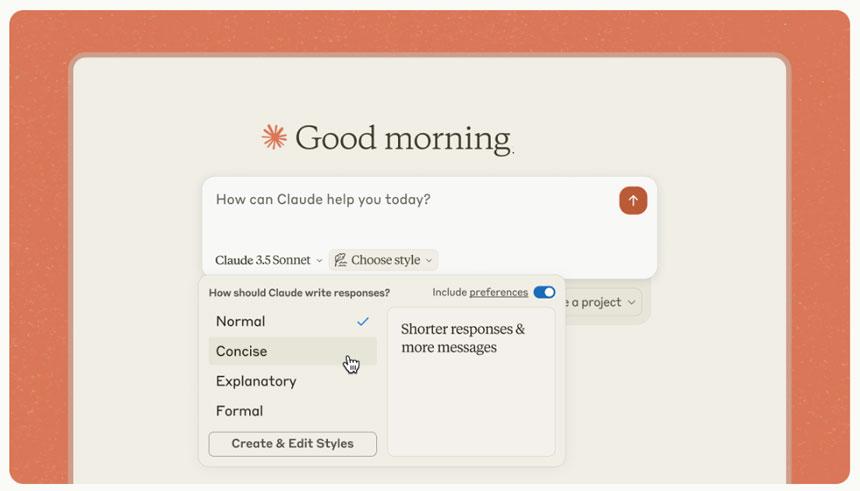
    Another update allows Claude to match users’ communication and preferred way of writing.

    Users can choose from these styles:

    • Formal: clear and polished responses
    • Concise: shorter and more direct responses
    • Explanatory: educational responses for learning new concepts

    Beyond these preset options, Claude can automatically generate custom styles and edit preferences as they evolve.

    OpenAI’s ChatGPT and Google’s Gemini have similar features that allow users to tailor responses based on their writing style and tone. The Writing Tools feature in Apple Intelligence also provides presets with similar styles.

    Creating a custom style is effectively an easy way to automate how you engineer prompts to make responses sound more like your own personal style.
  • OpenAI Released a Course Encouraging K-12 Teachers to Use ChatGPT

    OpenAI Released a Course Encouraging K-12 Teachers to Use ChatGPT

    IBL News | New York

    OpenAI released a free online course titled “ChatGPT Foundations for K-12 Educators,” which encourages teachers to use its tool to create lesson plans, interactive tutorials for students, and other pedagogical practices.

    The course was created in collaboration with the nonprofit organization Common Sense Media. It’s one hour long and has a nine-module program covering the basics of AI and its pedagogical applications.

    OpenAI says the course has already been deployed in “dozens” of schools, including the Agua Fria School District in Arizona, the San Bernardino School District in California, and the charter school system Challenger Schools.

    OpenAI is aggressively going after the education market, which it sees as a critical growth area.

    In September, OpenAI hired former Coursera chief revenue officer Leah Belsky as its first GM of education and charged her with bringing OpenAI’s products to more schools. In the spring, the company launched ChatGPT Edu, a version of ChatGPT that was built for universities.

    According to Allied Market Research, AI in education could be worth $88.2 billion within the next decade.

    However, a poll by the Rand Corporation and the Center on Reinventing Public Education found that just 18% of K-12 educators use AI in their classrooms, reflecting many skeptical pedagogues.

    Late last year, the United Nations Educational, Scientific and Cultural Organization (UNESCO) pushed for governments to regulate the use of AI in education, including implementing age limits for users and guardrails on data protection and user privacy. However, little progress has been made on those fronts, especially on AI policy in general.

  • Perplexity.ai Launched a New AI-Powered Shopping Assistant

    Perplexity.ai Launched a New AI-Powered Shopping Assistant

    IBL News | New York

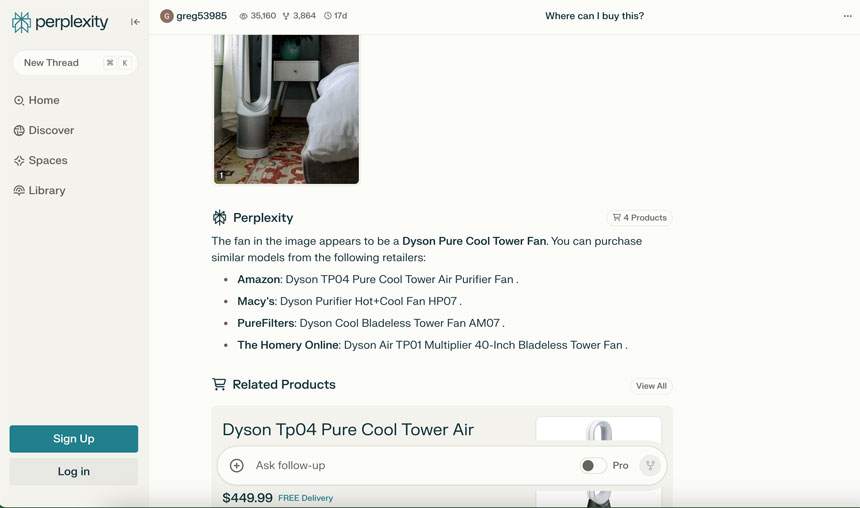
    Perplexity.ai debuted last month a shopping feature that offers recommendations with search results and allows users to place an order without visiting a retailer’s website.

    This feature, called Buy with Pro, allows paid customers in the U.S. to check for products from select merchants right on the Perplexity website or app.

    With the move, Perplexity is taking on Google and Amazon to capture a portion of shopping search results.

    The shopping recommendations aren’t sponsored, appear tailored to the search, and include products across Shopify.

    To scale e-commerce operations, Perplexity launched a free Merchant Program for large retailers. It provides payment integrations and free API access.

    With startups like Daydream, Deft, and Remark, AI-powered shopping searches have become a growing business area. Amazon debuted its AI assistant Rufus earlier this year.

    These companies are betting that AI will help you find an item quickly, and you won’t need to spend much time looking for something.

  • Udacity Released Its 2025 State of AI at Work Report

    Udacity Released Its 2025 State of AI at Work Report

    IBL News | New York

    Udacity, now an Accenture company, released its 2025 State of AI at Work Report this month. The report details how this technology is reshaping workplaces across industries and where there are the most significant opportunities for upskilling.

    These are the main outcomes:

    • Nearly 90% of workers are eager to build their AI skills through additional training and certifications, but only one in three say their organization provides the resources to do so. Over half of workers report that their employers lack clear AI policies or guidelines.

    • More than half (54%) of Millennials believed that AI could increase revenue or income, while only 24% of Generation Z and 16% of Generation X felt this.

    • AI Writing Assistants are a favorite tool for end users at work.
    AI writing assistants: ChatGPT, Claude, Grammarly, and Jasper AI
    AI image generation: Canva AI, MidJourney, Stable Diffusion, and DALL E
    Machine translation: DeepL Translator, Google Translate, and Microsoft
    Translator Data analysis and visualization: Tableau, Power BI, and DataRobot
    Notetaking and transcription: Zoom AI Assistant, Fathom.video, and Otter.ai

    • Most Commonly Used Categories of AI Technology
    AI frameworks and libraries (e.g., PyTorch, TensorFlow)
    AI models and techniques (e.g., Supervised Learning, Transfer Learning)
    AI tools and platforms (e.g., OpenAI API, Google AI Studio)
    AI applications and use cases (e.g., Image Generation, Chatbots)
    AI Infrastructure and operations (e.g., Vector Databases, MLOps tools)

  • NASA Teams with Microsoft to Create an AI Chatbot for Researchers

    NASA Teams with Microsoft to Create an AI Chatbot for Researchers

    IBL News | New York

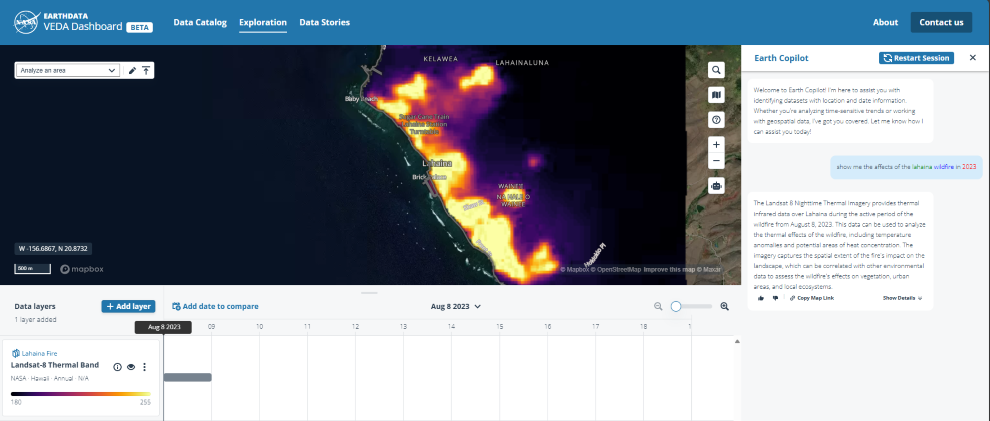
    NASA has teamed up with Microsoft to create an AI chatbot called Earth Copilot.

    NASA’s Earth Copilot, which uses Azure OpenAI Service, has condensed NASA’s vast scientific geospatial information and answers questions about Earth. This data can help drive scientific discoveries, inform policy decisions, and support industries like agriculture, urban planning, and disaster response.

    It lets users interact with NASA’s data repository through plain-language queries. They can ask questions such as “What was the impact of Hurricane Ian on Sanibel Island?” or “How did the COVID-19 pandemic affect air quality in the US? AI will then retrieve relevant datasets, making the process seamless and intuitive.

    An image of NASA’s EARTHDATA VEDA Dashboard.
    NASA’s EARTHDATA VEDA Dashboard.

    The development of this AI prototype aligns with NASA’s Open Science initiative, which aims to make scientific research more transparent, inclusive, and collaborative.

    At the moment, the NASA Earth Copilot is only available to NASA scientists and researchers to explore and test its capabilities.

    After internal evaluations and testing, the NASA IMPACT team said they will explore its integration into the VEDA platform, which already offers access to some of the agency’s data.