Author: IBL News

  • Open edX Released ‘Redwood’, with New Analytics, Content Tags, and a Navigation Sidebar

    Open edX Released ‘Redwood’, with New Analytics, Content Tags, and a Navigation Sidebar

    IBL News | New York

    Axim Collaborative, the organization behind the Open edX platform, announced the launch of its latest release called Redwood.

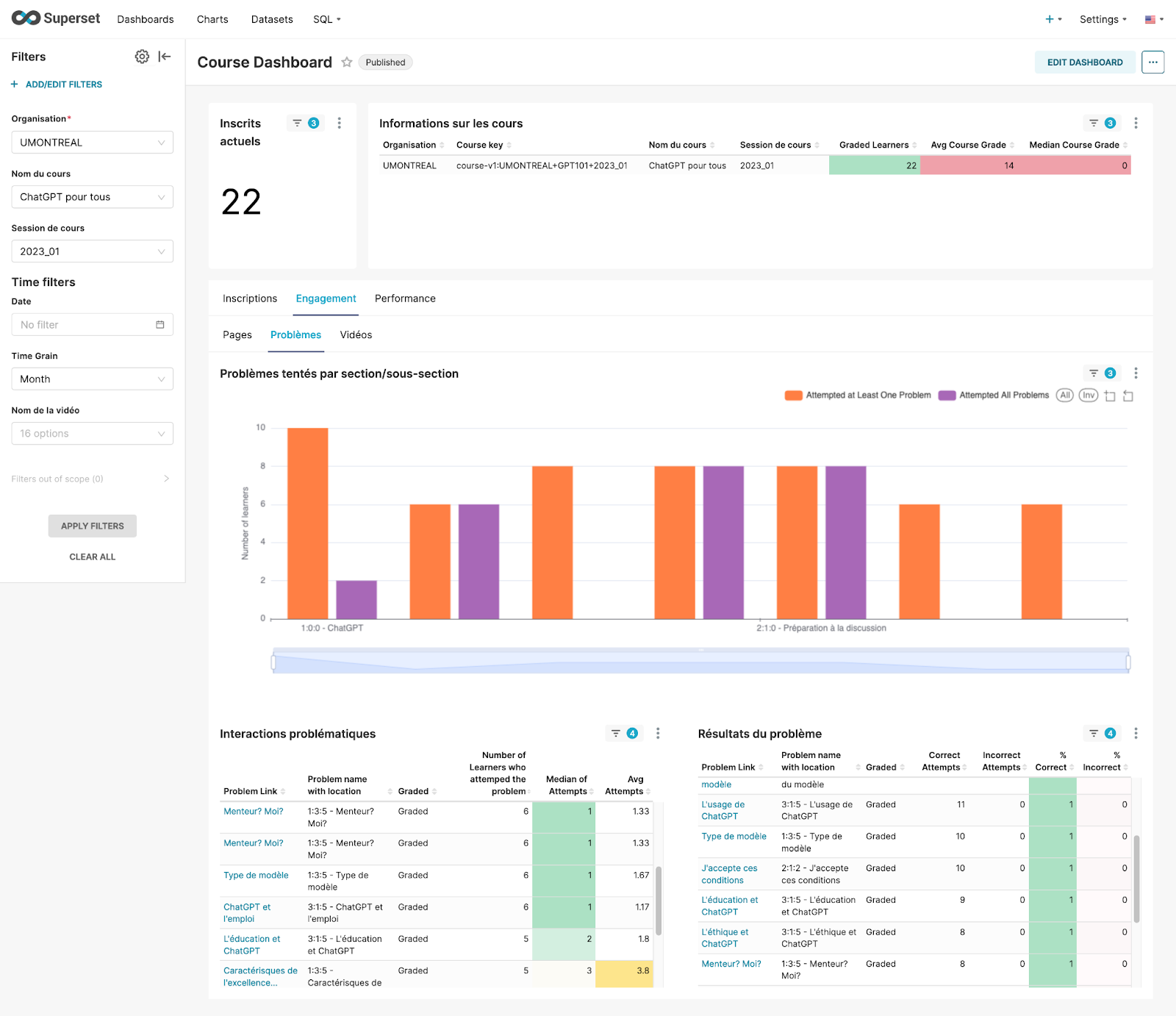
    This new version includes a new data and analytics system called Aspects Reports, which is not currently installed by default. As data visualization tool, it uses Superset.

    It provides access to near real-time course and instance data, tracking progress and success metrics. The course-level dashboard displays enrollment, engagement, and performance information for all learners in a course. There is also an at-risk learner dashboard for students who might not complete the course.

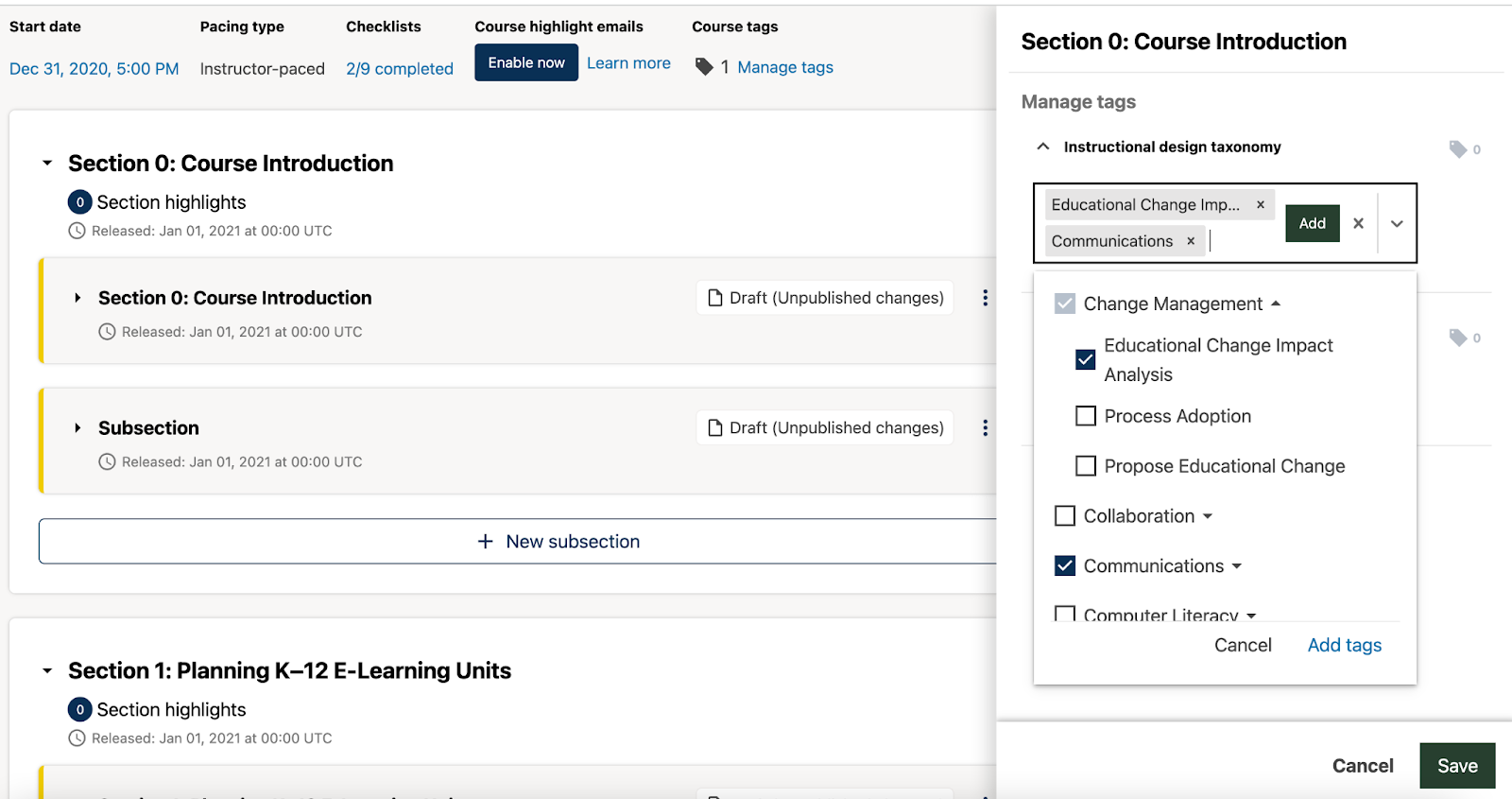
    The new Content Tagging feature on Redwood allows course authors to add tags, such as skills or competencies, to their course content.

    Authors can tag individual course components like videos and problems or full units, sections, and subsections.

    It also supports any third-party taxonomy.

    b
     

    Opens a link in a new tab

    The Studio authoring environment got a facelift with a redesigned, sleeker, modernized UI. Every page in Studio has been converted to the Paragon design system.
    b


    Opens a link in a new tab

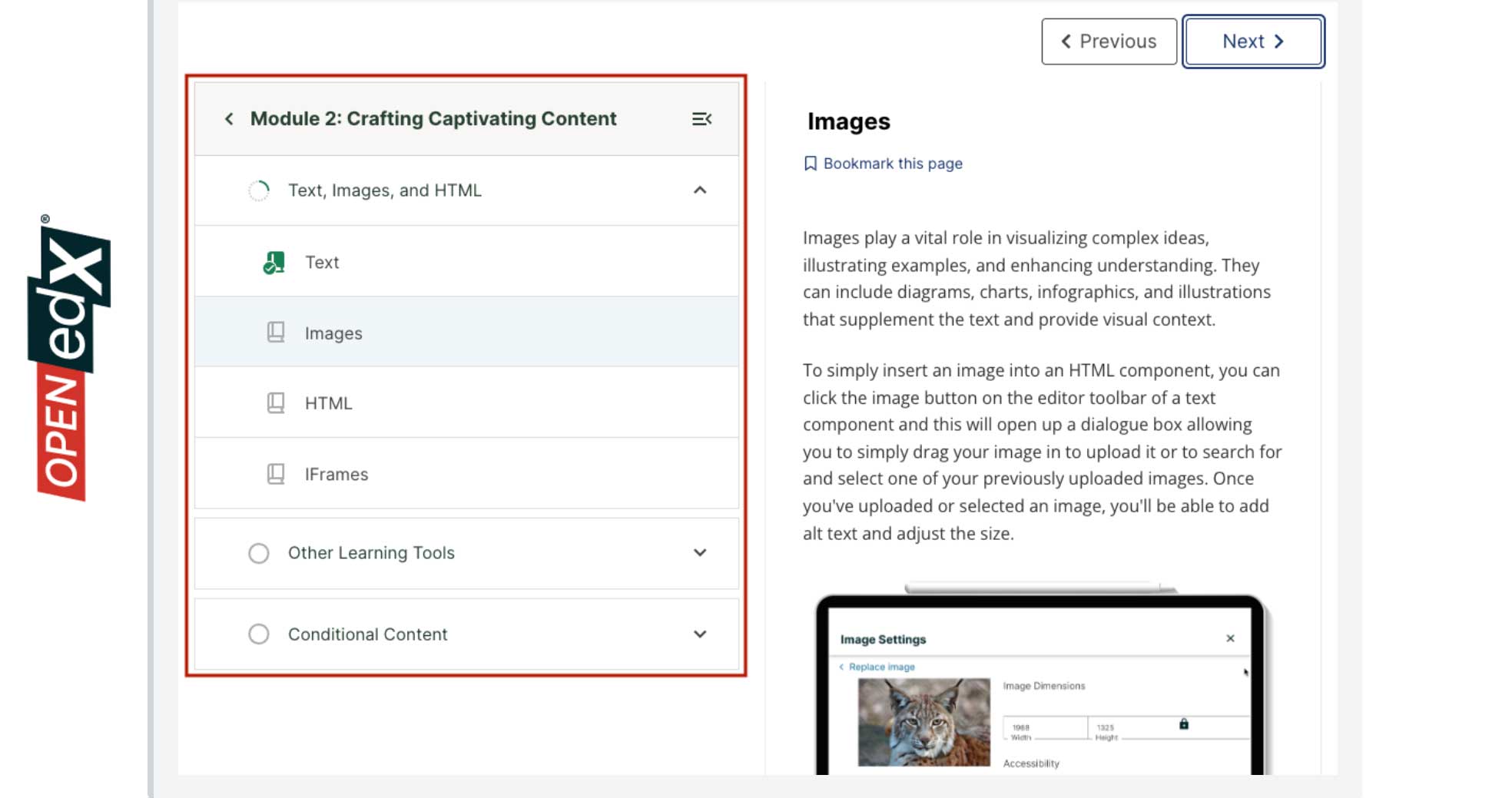
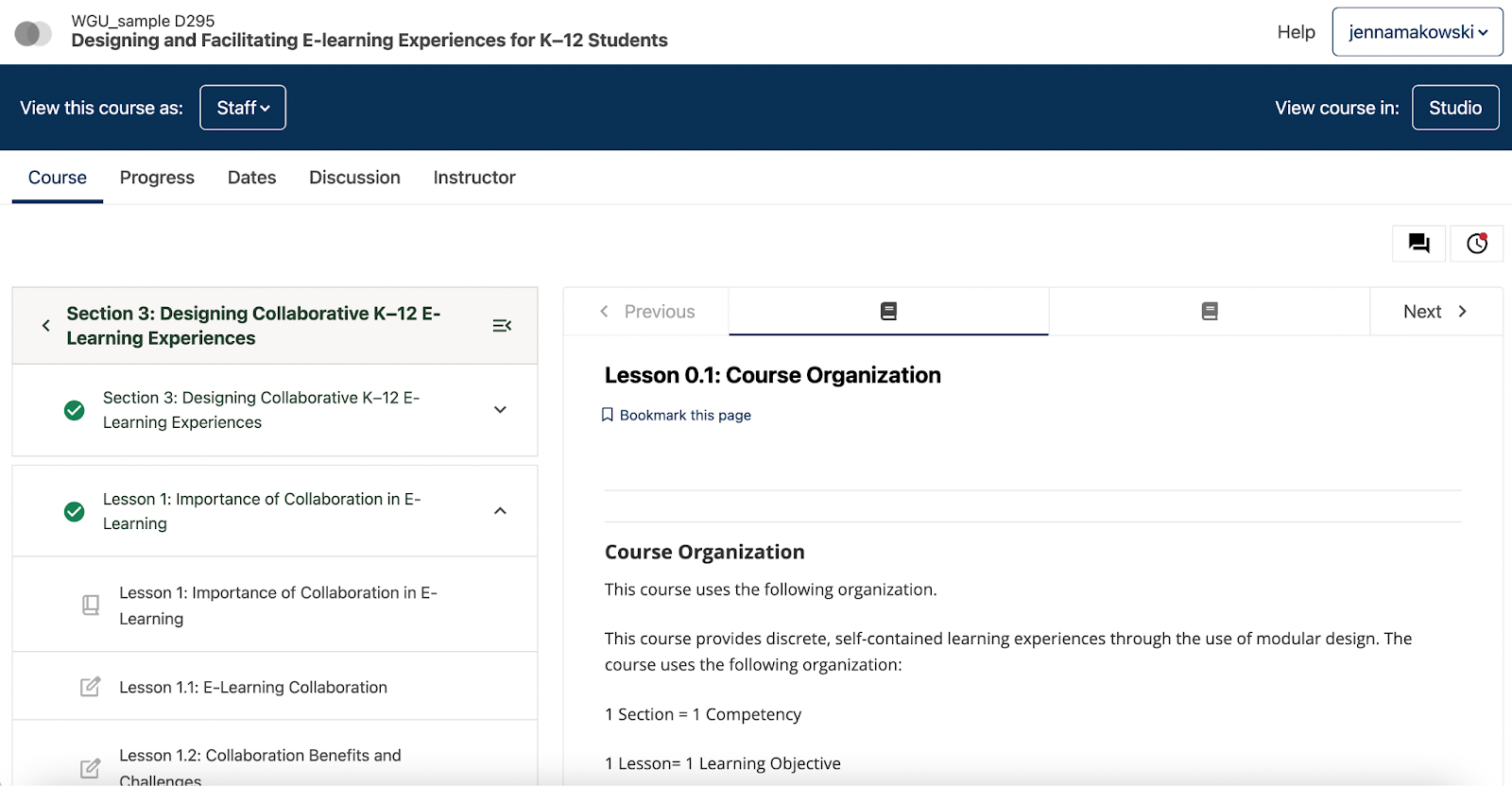
    This release has reintroduced the in-course navigation sidebar, which displays the user’s current course section, subsection, and unit.
     

    a new tab

    Opens a link in a new tab

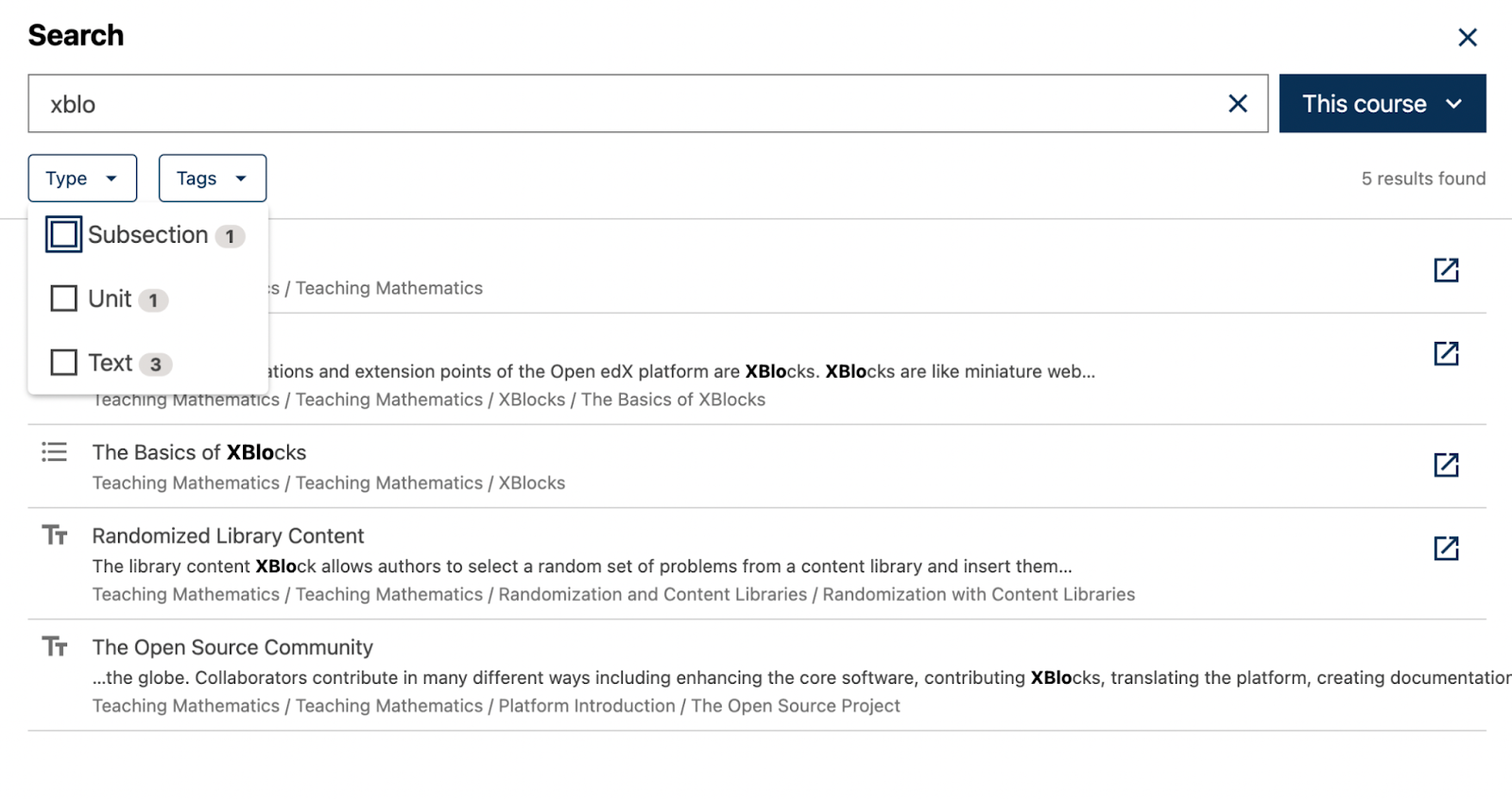
    Redwood now includes a Course Search to find content, making it easier for authors to find content they wish to edit or reuse. Results appear at the block, unit, subsection, and section level and can be filtered by tags and content type.

    When used together, content tagging, course search, and content copy/paste allow course teams to easily find, manage, and reuse content.

    The copy/paste feature enables authors to copy any part of the course and paste it into any other course. Authors can copy individual course components like videos and problems or full units, subsections, and sections.

    Opens a link in a new tab

  • OpenAI Released GPT-4o Mini, Over 60% Cheaper than GPT-3.5 Turbo

    OpenAI Released GPT-4o Mini, Over 60% Cheaper than GPT-3.5 Turbo

    IBL News | New York

    OpenAI released GPT-4o mini yesterday, its latest cost-effective small model. It hosts text and vision in the API, supporting text, image, video, and audio inputs and outputs.

    GPT-4o mini will replace GPT-3.5 Turbo, OpenAI’s smallest model. The model has a context window of 128,000 tokens, roughly the length of a book, supports up to 16K output tokens per request, and a knowledge cutoff of October 2023.

    It is priced over 60% cheaper than GPT-3.5 Turbo, at 15 cents per 1M input tokens and 60 cents per 1M output tokens (roughly the equivalent of 2500 pages in a standard book).

    The company claims that GPT-4o mini outperforms industry-leading small AI models, such as Llama 3 8b, Claude Haiku, and Gemini 1.5 Flash, on text and vision reasoning tasks.

    Small AI models are becoming more popular for developers due to their speed and cost efficiencies compared to larger models, such as GPT-4 Omni or Claude 3.5 Sonnet. They’re a useful option for developers’ high-volume tasks.

  • Groq Releases ‘Groqbook’, an App that Generates Entire Books in Seconds

    Groq Releases ‘Groqbook’, an App that Generates Entire Books in Seconds

    IBL News | New York

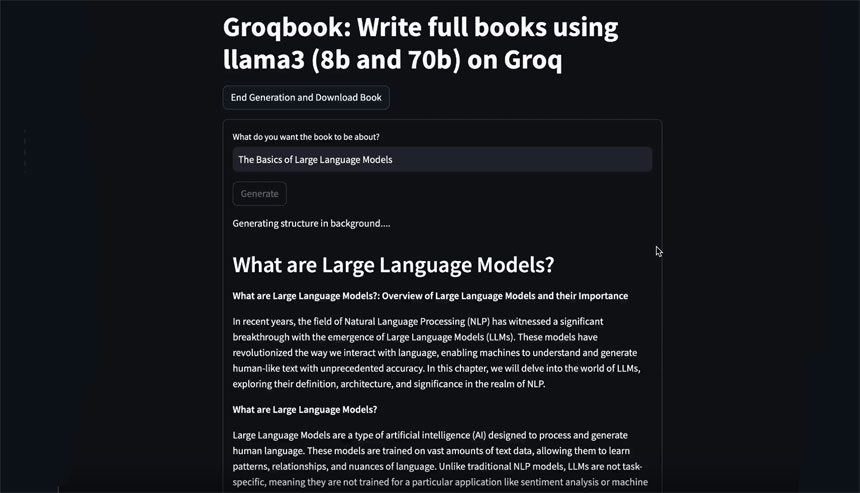
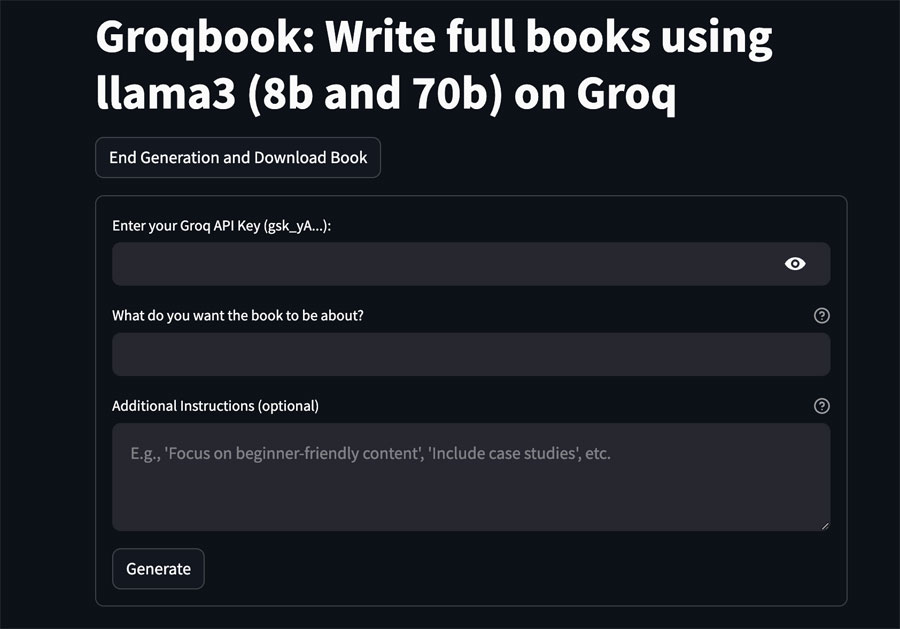
    Groq AI, a startup that develops high-speed processing and low-latency performance chips, released an app called Groqbook this month that generates entire books in seconds from a one-line prompt.

    It works well on nonfiction books and generates each chapter within seconds.

    It uses Llama3 on Groq. Specifically, it mixes Llama3-8b and Llama3-70b, utilizing the larger model to generate the structure and the smaller of the two to create the content.

    Currently, the model only uses the context of the section title to generate the chapter content.

    Groq said that “in the future, this will be expanded to the fuller context of the book to allow Groqbook to generate quality fiction books as well.”

    Groq’s CTO demoed this app last week at New York’s Imagine AI Live Event, which IBL News covered.


  • Top Open Source Apps and Tools for AI

    Top Open Source Apps and Tools for AI

    July 2024

    Groqbook: Generate entire books in seconds using Groq and Llama3 | Story at IBL News

    • Vanderbilt University’s Amplify GenAI platform | Story at IBL News

    LLM models | Story at IBL News | Five Top Open Source LLMs

    Abacus AI Open Source

  • OpenAI Sets Up Five Levels to Track AI’s Progress

    OpenAI Sets Up Five Levels to Track AI’s Progress

    IBL News | New York

    OpenAI set up a five-tiered classification system to track its progress towards AGI, that is, AI software capable of outperforming humans.

    An OpenAI spokesperson told Bloomberg that the San Francisco–based research lab shared this new classification system with employees this month. Later, it will be shared with investors and others outside the organization.

    These are the tiers:

    Level 1: Chatbots, AI that can interact in conversational language with people

    Level 2: Reasoners, human-level problem solving

    Level 3: Agents, systems that can take actions like basic problem-solving tasks and humans with a doctorate-level education

    Level 4: Innovators, AI that can aid in innovation

    Level 5: Organizations, AI that can do the work of an organization

    OpenAI executives told employees that the company believes it is currently on the first level but on the cusp of reaching the second.


  • Claude 3.5 Sonnet Becomes a Favorite AI Productivity Tool

    Claude 3.5 Sonnet Becomes a Favorite AI Productivity Tool

    IBL News | New York

    Anthropic’s assistant Claude 3.5 Sonnet is having a significant impact on the enterprise AI market.

    It’s currently enhancing workflows across industries by improving team collaboration and productivity.

    Essentially, it centralizes knowledge and AI interactions in one accessible space.

    Gen AI practitioners are sharing use cases developed with Claude 3.5’s Sonnet chatbot that weren’t possible with GPT-4o.

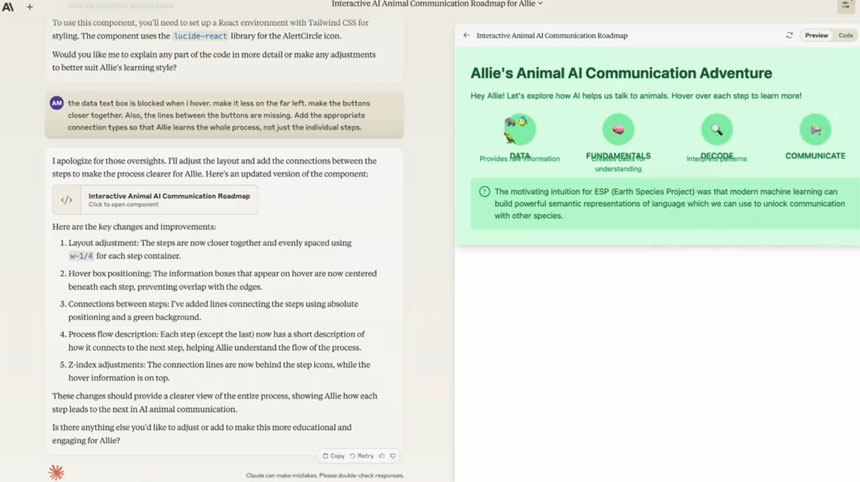
    Also Claude 3.5’s artifacts can help teach.

    Ethan Mollick, author and professor, showed how in a startup financing class created a compelling interactive simulation.

    These are some other cases beyond the classroom:

    • Website creation
    • Sound effects generation
    • Building Google Calendars
    • Creating interactive books for children
    • Simulations and visual demonstrations
    • Creating learning dashboards

  • ElevenLabs.io Launched an AI Voice App that Narrates Text Content On the Go

    ElevenLabs.io Launched an AI Voice App that Narrates Text Content On the Go

    IBL News | New York

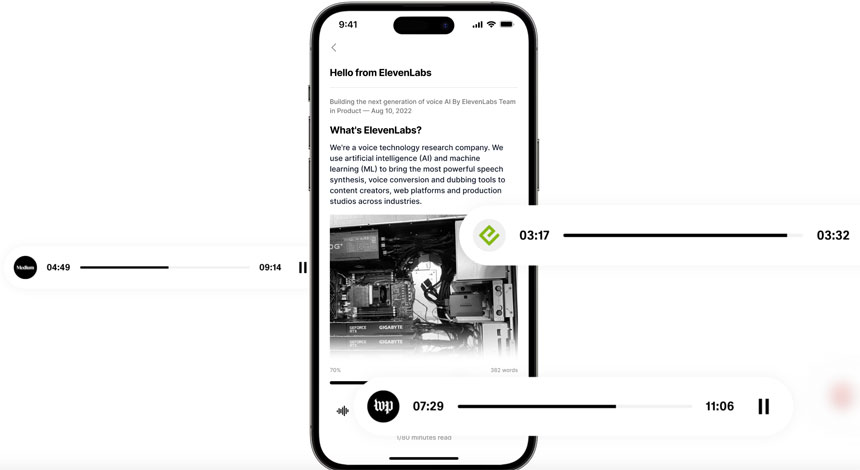
    ElevenLabs.io has launched an iOS app that narrates text content, including books, PDFs, ePub, and docs, for users on the go.

    The ElevenLabs Reader App allows the user to choose a voice.

    This text-to-speech tool is available in English for the U.S., Canada, and the U.K. residents. The company has set a waiting list for Android users.

    Available voices include deceased actors like Judy Garland, James Dean, Burt Reynolds, and Sir Laurence Olivier.

    “Adding them to our growing list of narrators marks a major step forward in our mission of making content accessible in any language and voice,” said the start-up.

    The partnership with the stars’ estates comes two months after ChatGPT-maker OpenAI was criticized for introducing a synthetic voice eerily similar to Scarlett Johansson’s character in “Her.”

    Johansson said she was “shocked, angered and in disbelief” that the company would use her likeliness likeness after she turned down a partnership opportunity with OpenAI.

  • AWS Launched App Studio to Build Internal Enterprise Applications

    AWS Launched App Studio to Build Internal Enterprise Applications

    IBL News | New York

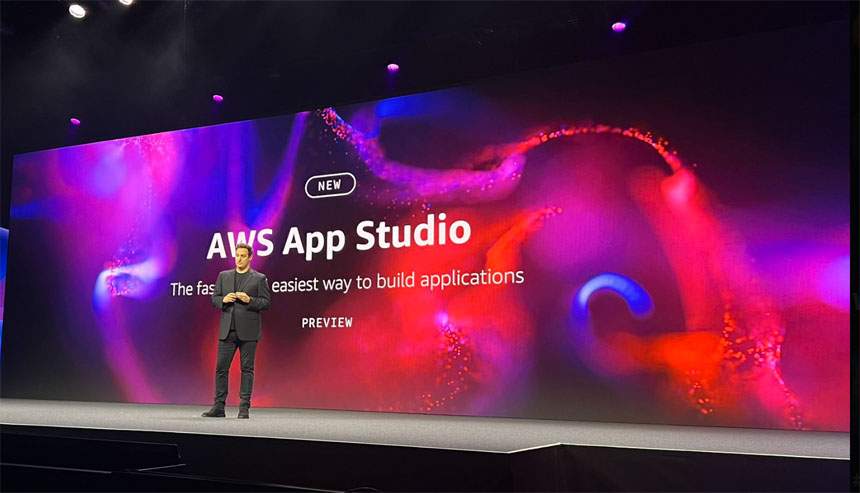
    Amazon Web Services (AWS) announced several product developments during its annual summit in New York, including an App Studio that enables enterprise non-technical users to build internal applications with simple prompts.

    Available under a limited preview, AWS App Studio “opens up application development to an entirely new set of builders,” said Dilip Kumar, vice president of applications at AWS.

    The company claims App Studio is better than most low-code development tools, which do the job but fail to produce fully secure apps that comply with enterprise privacy and security policies.

    It competes with other app creation platforms such as Creatio’s Quantum and Salesforce Platform.

    Currently, enterprise operations depend on data-heavy internal processes and workflows.

  • Anthropic Develops a New Tool to Automate Prompt Engineering

    Anthropic Develops a New Tool to Automate Prompt Engineering

    IBL News | New York

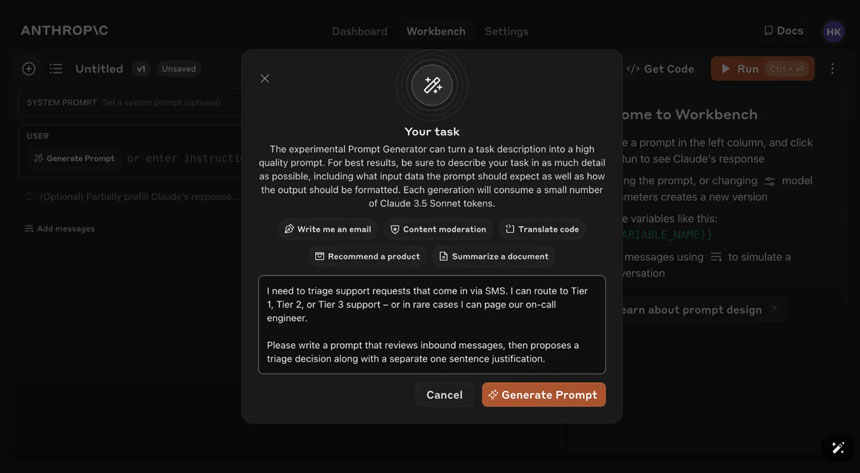
    Anthropic released a new feature on its Claude 3.5 Sonnet console this month, which allows prompts to be generated, tested, and evaluated. It takes a short task description and constructs a much longer, fleshed-out prompt, utilizing Anthropic’s prompt engineering techniques.

    The Claude console offers a built-in prompt generator powered by Claude 3.5 Sonnet. This generator allows users to describe their tasks and generate a high-quality prompt.

    The test case generation feature allows the creation of input variables for the prompt. This means that developers can compare the effectiveness of various prompts side-by-side and rate sample answers on a five-point scale.

    The Anthropic Console is a test kitchen for developers, created to attract businesses looking to build products with Claude.

    It can save developers time and effort, especially with little or no prompt engineering experience.

    Crafting high-quality prompts is challenging. It requires deep knowledge of your application’s needs and expertise with large language models. Prompt engineering has become a highly demanded job in the AI industry.

    “Prompt engineering is one of the most important things for widespread enterprise adoption of generative AI; it sounds simple, but 30 minutes with a prompt engineer can often make an application work when it wasn’t before,” said Anthropic CEO and co-founder Dario Amodei.

  • Microsoft Open-Sourced GraphRAG Python Library to Extract Insights from Text

    Microsoft Open-Sourced GraphRAG Python Library to Extract Insights from Text

    IBL News | New York

    Microsoft Research announced this month that it open-sourced GraphRAG, a valuable Python library that extracts insights from text.

    It uses LLMs to automate the extraction of knowledge graphs from datasets and text documents.

    “GraphRAG is a structured, hierarchical approach to Retrieval Augmented Generation (RAG), as opposed to naive semantic-search approaches using plain text snippets,” explained the company in a blog post.

    Retrieval-augmented generation (RAG) is a technique to improve LLM outputs using real-world information.

    RAG searches for information based on a user query on private datasets, data that the LLM is not trained on and has never seen before, such as an enterprise’s proprietary research, business documents, or communications.