Author: IBL News

  • The FTC Sues Chegg for Exposing Millions of Users’ Social Security Numbers and Other Key Data

    The FTC Sues Chegg for Exposing Millions of Users’ Social Security Numbers and Other Key Data

    IBL News | New York

    The Federal Trade Commission (FTC) sued last week edtech provider Chegg, Inc (NYSE: CHGG) for “its lax security practices that exposed sensitive information about millions of its customers and employees, including Social Security numbers, email addresses, and passwords.”

    “These practices resulted in four separate data breaches in a span of just a few years, leading to the misappropriation of personal information about approximately 40 million consumers,” states the complaint.

    A key component of Chegg’s information technology infrastructure was Simple Storage Service (S3), a cloud storage service offered by Amazon Web Services (AWS) that Chegg used to store a substantial amount of customer and employee data. The FTC alleges that:

    • Chegg allowed employees and third-party contractors to access the S3 databases with a single access key that provided full administrative privileges over all information.
    • Chegg didn’t require multi-factor authentication for account access to the S3 databases.
    • Rather than encrypting the data, Chegg stored users’ and employees’ personal information in plain text.
    • Until at least April 2018, Chegg “protected” passwords with outdated cryptographic hash functions.
    • Until at least April 2020, Chegg failed to provide adequate data security training for employees and contractors.
    • Chegg didn’t have processes in place for inventorying and deleting customers’ and employees’ personal information once there was no longer a business need to maintain it.
    • Chegg failed to monitor its networks adequately for unauthorized attempts to sneak in and illegally transfer sensitive data out of its system.

    In each of the four incidents cited in the complaint, the FTC alleges that Chegg failed to take simple precautionary steps that would have likely helped prevent or detect the threat to consumer and employee data – for example, requiring employees to take data security training on the telltale signs of a phishing attempt.

    The FTC suggests conducting regular in-house security training and provides Cybersecurity for Small Business resources for inspiration.

    Chegg’s Third Quarter 2022 Earnings

    On the other hand, Chegg announced this week its third-quarter earnings, showing a decrease of 4% year-over-year in net revenues, to $164.7 million, a decrease of 4% year-over-year.



  • Google Shuts Down Hangouts, Transferring Users Into a Slack-Like Service

    Google Shuts Down Hangouts, Transferring Users Into a Slack-Like Service

    IBL News | New York

    Google Hangouts — the text, video, and voice chat service app built into Gmail — shut down yesterday eliminating this web service. The iOS and Android apps died in July 2022.

    People using Hangouts saw a prompt message asking them to move to Chat in Gmail or the Chat app, the company’s Slack-style instant messaging app for business.

    Hangouts had a slow death, with Google encouraging users to migrate over to Chat in 2021.

    Most of the messages and contacts will be automatically transferred over, although not all the data. Google said that users should use Google Takeout to download and save a copy of their data. Users will have until January 2023 to keep their Hangouts data.

    Chat provides additional features for group conversations as well as security and collaboration tools like Spaces and editing Docs, Slides, or Sheets side-by-side with other users. Chat users can also send GIFs and use @mentions to notify someone in the group.

    Google says that Chat is a better way for users to connect with others. According to the company, the new integrated view in Gmail makes it easier to use Chat alongside Gmail inbox, Spaces, and Meet.

  • 2U Launches New Boot Camps Under the edX Brand, Retiring the Trilogy Name

    2U Launches New Boot Camps Under the edX Brand, Retiring the Trilogy Name

    IBL News | New York

    2U, Inc. (NASDAQ: TWOU) announced yesterday the launch of 200 Online Boot Camps under the edX brand on its website, retiring the “Trilogy Education Services” name.

    This offering, developed by 50 edX partner universities, will start at the beginning of 2023. It will target 10,000 students annually in high-demand technology fields such as web development, data analytics, UX/UI, cybersecurity, fintech, digital marketing, and project management.

    All Boot Camps will be fully online and include live, virtual classroom sessions led by university-vetted instructors. These programs are part-time (18-24 weeks) and designed for working adults and professionals with a need for a flexible schedule who are ready to invest 20+ hours outside of class for self-study and projects.

    2U/edX also features full-time (12-week) Boot Camps, with classes Monday through Friday, for those seeking a more accelerated learning experience.

    The 2U company started to deliver Boot Camp programs in 2016. Since then, have graduated from these intensive technology training programs, with 31% not having a bachelor’s degree. About 6,700 companies have hired program graduates, including Google, Target, State Farm, H&R Block, Infosys, and others, according to 2U.

    Institutions like the University of Central Florida, University of Denver, University of Oregon, University of Utah Professional Education, Tulsa Community College, and the UK’s University of Birmingham have established partnerships to connect Boot Camp programs with local workforce agencies and corporate, nonprofit, and government funders.

    Struggling Company

    The 2U initiative comes at a very complicated moment for the company, dominated by layoffs and a deep declining stock value, with a loss of over

    The Harvard Crimson, owned by Harvard University — who, along with MIT, sold edX to 2U — published a story highlighting the stock plummeting of 2U since the purchase.

    “In its nine years under Harvard and MIT, edX — founded to make premiere college courses accessible to digital learners everywhere — grew to include more than 3,000 courses, with 39 million participants around the globe. But in the period since the sale was announced, the education technology firm that bought edX for $800 million, 2U Inc., has seen the price of its shares plummet by more than 86 percent and cut 20 percent of its budgeted personnel costs.”

    Anant Agarwal, founder of edX and now a 2U employee, said to The Harvard Crimson that “2U is in a strong financial position,” citing the company’s projection from July that it will make approximately $110 million in profits by the end of this fiscal year.

    “2U made a legally binding commitment to preserve and advance edX’s founding mission” when it acquired the nonprofit, Agarwal wrote, including continuing the free track to audit courses, protecting data privacy for individual edX users, and safeguarding the intellectual property rights of faculty and schools.

    The company’s competitors have also struggled over the past year. Coursera, which went public in the spring of 2021, has seen its stock price drop almost 71% since June 2021. Shares of Udacity fell 50%.

    Since the acquisition, more than 5 million users have joined edX, according to Agarwal, who noted that the company has added many new course offerings.


  • Most Higher Ed CIOs Are Ready to Invest More in Analytics, Says Gartner

    Most Higher Ed CIOs Are Ready to Invest More in Analytics, Says Gartner

    IBL News | Denver, Colorado

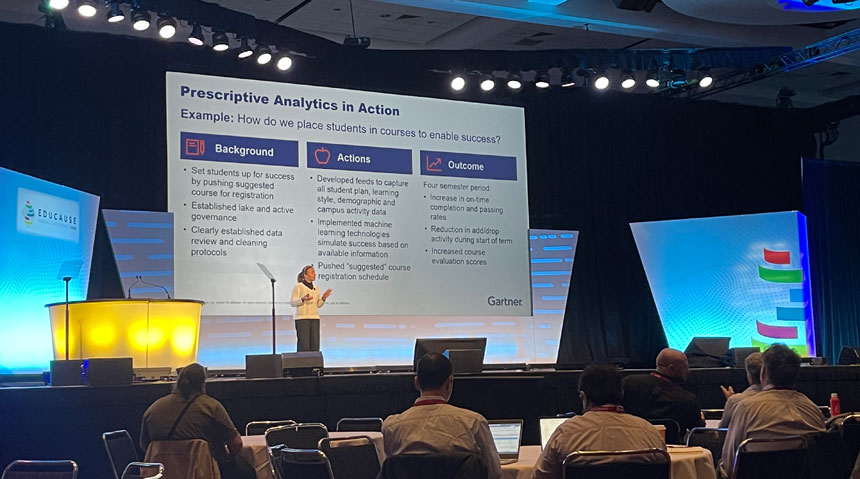
    Experts agree that data and analytics are critical for running today’s educational institutions. In fact, 60% of CIOs in higher education say that they are essential, according to Gartner.

    But these implementations are not taking place. There are several inhibitors, according to Marlena Brown, a Senior Research Analyst at Garner Inc.: Ineffective technology, misalignment of needs, and lack of understanding and trust.

    In an opening talk on the main stage during the 2022 Educause in Denver, Colorado, last Thursday, Marlena Brown [in the pictures above and below], revealed that 42% of higher ed CIOs indicated that they want to increase investment in business intelligence and data analytics, while 16% would grow their expenditure in AI/ML (Artificial Intelligence/Machine Learning).

    In order to put analytics capabilities to work, Garner Associated examined cases ranging from simple descriptive and diagnostic analysis through predictive and prescriptive analyses that enable institutions to identify and bend trend curves.

    Analytics, with the help of AI and Machine Learning, will determine scenarios impacting student success, as several experts indicated to IBL News during the Educause event. Prescriptive analytics will help to increase the retention of students at risk and avoid the high number of dropping learners.

    According to Gartner, these are the four needed stages of analytics:

    • Descriptive — What happened?
    • Diagnostic — Why did it happen?
    • Predictive — What will happen?
    • Prescriptive — What should I do?

    Technologies involved include regression analytics, forecasting, simulation, predictive models, complex event processing, neural networks, recommendation engines, data hub, and data lake, and analytic sandbox.

    Marlena Brown highlighted the importance of establishing a clear vision, outlining what every institution is trying to achieve. “I’d suggest creating an environment for exploration of advanced analytics as well,” she added.


  • “We Need More From Technology,” Says Educause While Presenting the 2022 Top 10 Issues

    “We Need More From Technology,” Says Educause While Presenting the 2022 Top 10 Issues

    IBL News | Denver, Colorado

    The higher ed professional association Educause presented the 2023 Top 10 IT issues during its annual conference yesterday in Denver, Colorado.

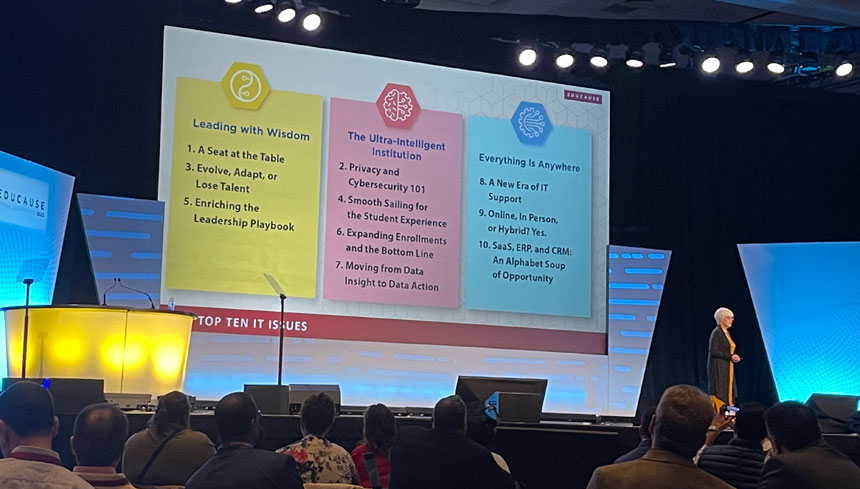
    “Today’s times demand more from technology,” said Susan Grajek, Vice President for Partnership, Communities, and Research at Educause, during the opening keynote address [In the picture above]. “We need new foundation models,” she added.

    Susan Grajek highlighted the idea that “data leads to better decisions.” “The AI (Artificial Intelligence) foundational models can be applied to higher” as “potential value of AI is emerging.”

    Another idea that Educause insisted on in front of thousands of educators and industry leaders gathered for three days (October 25 – 28, 2022) in Denver was the extension of stress and anxiety among students.

    In an exclusive interview with IBL News, John O’Brien, president of Educause, said that 70% of them show or have shown mental health issues in the last post-pandemic months.

    The top 10 IT issues research was divided into three themes: leading with wisdom, ultra-intelligent institutions, and everything is anywhere.

    1. Leadership – Leading with WisdomIssue #1 – A Seat at the Table: ensuring IT leadership is a full partner in institutional strategic planningIssue #3 – Evolve, Adapt, or Lose Talent: creating a workplace that allows for and supports movement up, down, and sideways to accommodate shifts in personal and professional goals and to foster healthier work/life balanceIssue #5 – Enriching the Leadership Playbook: leading with humility and candor to engage, empower, and retain the IT workforce
    2. Data – The Ultra-Intelligent InstitutionIssue #2 – Privacy and Security 101: embedding privacy and security education and awareness in the curriculum and workplaceIssue #4 – Smooth Sailing for the Student Experience: using technology, data, insight, and agility to create a frictionless student experienceIssue #6 – Expanding Enrollments and the Bottom Line: focusing on data and analytics initiatives on identifying academic programs with high potential for recruitment ROI

      Issue #7 – Moving from Data Insight to Data Action: converting data analytics into action plans to power institutional performance, enhance operational efficiency, and improve student success

    3. Work and Learning – Everything is AnywhereIssue #8 – A New Era of IT Support: updating IT services to support remote and hybrid workIssue #9 – Online, In Person, or Hybrid? Yes: developing a learning-first, technology-enabled strategyIssue #10 – SaaS, ERP, and CRM: an alphabet soup of opportunity: managing cost, risk, and value of investments in new ERP solutions

  • CUNY Unveils a $1.6B Plan to Build a Science Park and Research Campus in Manhattan

    CUNY Unveils a $1.6B Plan to Build a Science Park and Research Campus in Manhattan

    IBL News | New York

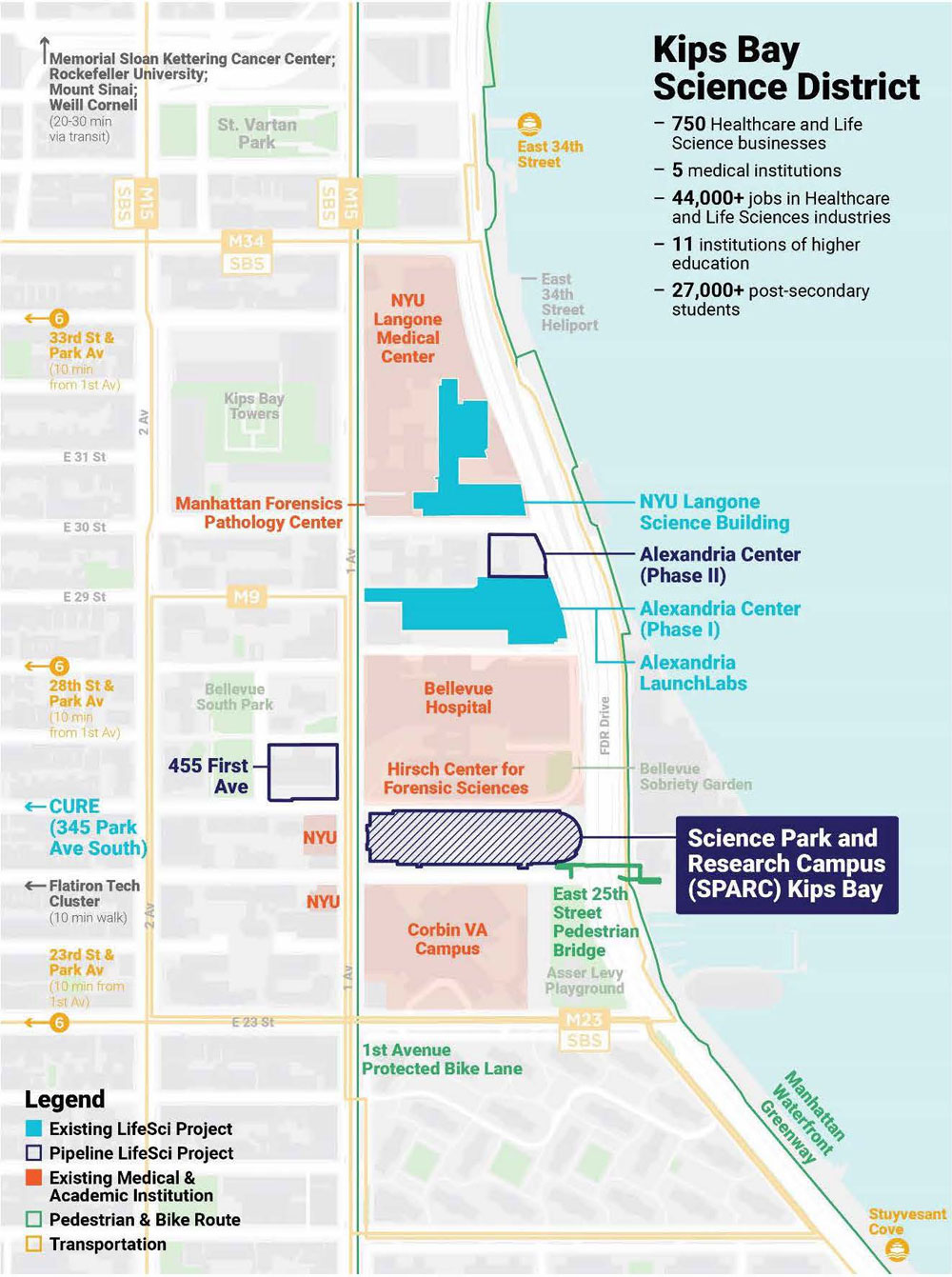
    CUNY (City University of New York) will launch, in partnership with New York City and the State leadership, the Science Park and Research Campus (SPARC) Kips Bay, a $1.6 billion, first-of-its-kind, innovation hub for the life sciences industry in Manhattan in 2031.

    It will include new modern facilities for 4,5000 students from the CUNY Graduate School of Public Health and Health Policy (CUNY SPH), the Hunter College School of Nursing and School of Health Sciences, and the Borough of Manhattan Community College’s multiple healthcare programs.

    This project, spanning 1.5 million square feet in Kips Bay [see maps below], will transform the Brookdale Campus on East 25th Street into new, state-of-the-art teaching and commercial facilities. The initiative will further a career pipeline in life science for local students, in addition to rebuilding a pedestrian bridge that will connect East 25th St. to Manhattan Waterfront Greenway.

    SPARC Kips Bay will be funded jointly by the city and state with additional investment from the private sector in life sciences.

    The project, expected to break ground in 2026 and be completed by the end of 2031, will include additional lab and research space for CUNY SPH and house the school’s library and study centers. The new campus will also include additional classrooms for the school’s planned undergraduate program in public health.

    The project, announced this month, is expected to generate approximately $25 billion in economic impact to the City of New York over the next 30 years, create 10,000 jobs, and create a pipeline from local public schools to careers in the growing and essential fields of life sciences, health care, and public health.

    At a press event on October 19, Governor Kathy Hochul, New York City Mayor Eric Adams, and CUNY Chancellor Félix V. Matos Rodríguez unveiled the plans for the new campus.

    “COVID-19 proved how important New York’s public hospitals, research institutions, and universities are to the survival and the well-being of our beloved city,” said Chancellor Matos Rodríguez. “So it is fitting that the mayor and the governor have teamed up with CUNY to transform this Brookdale Campus into a public health and education hub to better meet the needs of our students’ faculty and of all Yew Yorkers,” he added.


  • Pandemic-Disrupted Teaching and Learning Effects Will Continue for Decades, Stanford Says

    Pandemic-Disrupted Teaching and Learning Effects Will Continue for Decades, Stanford Says

    IBL News | New York

    Reverberations of pandemic-disrupted teaching and learning will likely continue for decades. The seismic changes of the health outbreak in 2020 and 2021 will result in a no return to “normal”.

    This is the main conclusion of a report elaborated by Stanford University Digital Education unit, released this month. This Pandemic Education Report — as it has been titled — gathered stories about how the campus supported academic continuity during the period of emergency remote instruction. Stanford leaders, faculty, staff, and students provided diverse perspectives on the challenges they faced.

    This extensive review will serve as the foundation on which Stanford can design its future digital education strategy, said the institution. “The disruption to teaching and learning, as devastating as it was, also contains gems of opportunity,” stated the authors of the report, as shown in the video below.

    The 87-page report, comprised of interviews with 59 administrators and faculty, as well as a survey of 6,000 students, follows similar reviews elaborated by Harvard University, MIT, and other institutions.

    Regarding the extensive use of Zoom and Canvas, the report points out ideas such as:

    • “The suddenly more prominent role of Zoom and Canvas when emergency remote education began did raise concerns among some faculty and staff. It meant that Stanford’s teaching, learning, and work were conducted in platforms developed by private, for-profit companies whose products were designed to accommodate a wide range of customer needs. Zoom, in particular, is a business meeting tool not designed with education in mind.”
    • “Instructors quickly increased their skill in using Zoom for teaching and thoughtfully reworked their instruction, with help from newly developed resources and training programs rapidly spun up by teams across campus. These innovations, explored in this review, improved student engagement in remote teaching and learning.”
    • “What’s more, because of Stanford’s location in Silicon Valley, it had a strong connection with the company based in nearby San Jose before the pandemic began.” (…) “We already had this highly scalable infrastructure with Zoom and, furthermore, a very tight relationship with their CEO and founder.”
      .


  • The 2023 Open edX Conference Will Take Place March 28 – 31 at MIT

    The 2023 Open edX Conference Will Take Place March 28 – 31 at MIT

    IBL News | New York

    The 2023 Open edX Conference will be celebrated between March 28th and Friday, March 31st, 2023, at the Massachusetts Institute of Technology (MIT) in Cambridge, Massachusetts, according to Harvard’s and MIT’s owned tCRIL (The Center for Reimagining Learning) non-profit organization.

    The event will be focusing on innovative uses and methods of extending the Open edX Platform along with the latest advancements in instructional design.

    In parallel to the announcement, tCRIL — which stewards the Open edX software and community — called for proposals, being the deadline open until January 23rd, 2023.

    The names of keynote speakers and conference presenters have not been determined yet.

    The 2022 conference in Lisbon, Portugal, attracted over two hundred experts on the Open edX platform.
    .

  • Higher Ed Experts Craft Their Vision to Evolve into a Hybrid Learning Scenario

    Higher Ed Experts Craft Their Vision to Evolve into a Hybrid Learning Scenario

    IBL News | New York

    A panel of higher education experts gathered by the non-profit professional association Educause generated a list of actions to evolve and grow into an optimized hybrid learning scenario within ten years.

    Their action plan was described in the 2022 Horizon Report: Teaching and Learning Edition, available in PDF.

    “Everything is hybrid,” asserted the panel. “Instructors think strategically about learning modalities, optimizing in-person instruction for activities that are pedagogically better in a shared physical location. Learners’ needs are met through flexible and efficient pedagogy, often through modular, remote course offerings.” 

    These teaching and learning experts from eight institutions and five from Educause provided sixteen practical action items the industry can employ to make this future a reality, such as:

    • Use research-based methodologies and frameworks for the design of hybrid programs and courses.
    • Make professional development a foundational part of instructors’ jobs. Compensate instructors with time, money, and recognition for participating in professional development.
    • Support international hybrid learning: recruit and train instructors from all over the world.
    • Learn more about students’ comprehensive needs.
    • Include experiential learning in all academic programs. Provide opportunities for all students to engage in experiences such as internships, volunteer work, and study-abroad programs across the continuum of instructional modalities.
    • Expand instructional design capacity. As part of The Great Resignation, higher education institutions are competing with industry for the the best instructional designers.
    • Establish best practices for sustainable technology-enhanced learning spaces.
    • Develop and share best practices for equitable teaching and learning.
    • Define privacy standards for higher education.
    • Develop funding models for expanding technology access across institutions.
    • Develop a nonacademic credit pipeline. Learning can happen anywhere.
    • Establish cross-institutional programs and credentials.
    • Reimagine tenure.
    • Reevaluate the role of the higher education institution in a consumer-driven world.
    • Define state and national standards for hybrid learning. Work with partner institutions, industry, and professional associations.
    • Change federal government funding models. Modify funding models to support what is best for students.

    The expert panel roaster included: Julian Allen (Chief Learning Innovations Officer at Georgia State University), Sean Brown Director (Campus Reimagined at Florida State University), Melody Buckner Associate (Vice Provost of Digital Learning Initiatives and Online Education at University of Arizona), Maddy Kadish (Director, Instructional Design at The George Washington University), Jackie Lamoureux (Faculty Fellow Central at New Mexico Community College), Reba-Anna Lee (Assistant Dean of Distance Learning at Northwestern University), Matt Mooney (Director of Digital Learning Experience at University of Utah), and Paula Roberson (Director, Center for Teaching, Learning, and Innovation Hudson County Community College).


  • A Duke Administrator and Cell Biologist Researcher Named MIT’s 18th President

    A Duke Administrator and Cell Biologist Researcher Named MIT’s 18th President

    IBL News | New York

    Sally A. Kornbluth, 61, a cell biologist on her eight-year tenure as Duke University’s provost, was named MIT’s 18th President. She will assume the MIT presidency on January 1st, 2023, succeeding L. Rafael Reif, who last February announced his intention to step down after ten years leading the Institute.

    Kornbluth’s election came after an eight-month process in which a 20-member presidential search committee generated a list of approximately 250 possible candidates for the presidency.

    This Thursday, October 20th, the MIT Corporation voted for Sally A. Kornbluth after valuing her reputation as a distinguished researcher, brilliant administrator, creative problem-solver, and leading advocate of academic excellence, wrote MIT News.

    Kornbluth is currently the Jo Rae Wright University Professor of Biology at Duke. She has served on the Duke faculty since 1994, first as a member of the Department of Pharmacology and Cancer Biology in the Duke University School of Medicine and then as a member of the Department of Biology in the Trinity College of Arts and Sciences.

    “As Duke’s provost since 2014, Kornbluth has served as the Chief Academic Officer of one of the nation’s leading research universities, with broad responsibility for carrying out Duke’s teaching and research missions; developing its intellectual priorities; and partnering with others to achieve wide-ranging gains for the university’s faculty and students,” said MIT.

    She oversaw Duke’s ten schools and six institutes and held ultimate responsibility for admissions, financial aid, libraries, and all other facets of academic and student life.

    “My greatest joy as a leader has always been in facilitating and amplifying the work of others,” Kornbluth said. “I am eager to meet all the brilliant, entrepreneurial people of MIT, and to champion their research, teaching, and learning.”

    • MIT News: On campus, a warm welcome for MIT’s next president, Sally Kornbluth