Author: IBL News

  • MiriadaX, with 4M Spanish-Language Learners, Continues to Look for a Buyer

    MiriadaX, with 4M Spanish-Language Learners, Continues to Look for a Buyer

    IBL News | New York

    MiríadaX, the largest  Spanish-language MOOC platform, continues to be on sale after its owner, Telefónica, decided to focus on its core telecommunications business.

    According to the digital newspaper El Español, the Spanish telecom giant Telefónica is selling its entire Telefónica Educación Digital (TED) division, a unit specialized on online education and training solutions. Created in 2001, and with a staff of 400 employees spread around Spain, Colombia, Chile, Perú and Brazil, TED reported 10 million euros yearly in revenue.

    Its most known asset, MiriadaX.net was launched in 2013. The platform claims to host over 4 million learners, 690 courses and a network of 105 universities.

    “In a market largely controlled by a handful of providers, the announcement emphasizes the challenges of serving learners outside the English-speaking world,” Dhawal Shah wrote on Class Central.


  • Udacity.com Offers One Free Month Access to Nanodegree Programs

    Udacity.com Offers One Free Month Access to Nanodegree Programs

    IBL News | New York

    Udacity.com is offering one free month on one of the 40 premium Nanodegree programs. The offer is only for the U.S. and Europe and is limited to one Nanodegree program per student.

    The average price for an individual signing up for a nanodegree is about $400 a month. Degrees take anywhere from four to six months to complete, according to the company.

    “If you’ve been laid-off, or stuck working at home, or even have stir-crazy kids that need something to do, we can help,” Stephanie Lager, manager at Udacity wrote in a blog post.

    “We want to help students, small business owners, gig workers, and employees of large companies accelerate their education and career upskilling by offering one free month on any Udacity program,” Gabe Dalporto, CEO at Udacity, said.

    “We know that in some cases this can’t replace lost income or time in class, but it can help provide opportunities to sharpen much-needed skills that are necessary for the future of work,” he added.

    The learning company plans to announce new initiatives over the coming weeks and months.

  • Historic $2.2 Trillion Coronavirus Relief Bill Provides Funding for Higher Ed and Help for Students with Loans

    Historic $2.2 Trillion Coronavirus Relief Bill Provides Funding for Higher Ed and Help for Students with Loans

    IBL News | New York

    As the number of known U.S. cases of coronavirus surpassed 100,000, with more than 1,500 dead, the House of Representatives approved this Friday a $2.2 trillion aid package –the largest in history– to help cope with the economic downturn.

    President Trump quickly signed it into law.

    The massive bill passed the Senate and House of Representatives nearly unanimously. The rare bipartisan action underscored how seriously Republican and Democratic lawmakers are taking the worst pandemic in over 100 years.

    The massive bill also rushes billions of dollars to medical providers on the front lines of the outbreak.

    The measures will pay as much as $1,200 apiece to adults, increase unemployment benefits and provide loans to businesses.

    For higher education, it offers temporary help for those struggling to make their student loan payments. Most federal loan borrowers are excused from making payments for six months, interest is waived on the loans and loan collectors are prevented from garnishing wages, tax returns and Social Security benefits to collect overdue payments.

    The bill provides $14 billion in funding for higher education institutions, half of which must be used for emergency grants to help students affected by the crisis.

    “For institutions of higher learning, it will provide financial relief to colleges and universities and also support grants to displaced students,” Congressman Bobby Scott, the Democratic chairman of the House Education Committee, said this morning before the vote.

    Key Document:
    White House .gov: Details of the Relief Package


  • Facebook Unveils a Virtual Community to Fight Rumors About Covid-19

    Facebook Unveils a Virtual Community to Fight Rumors About Covid-19

    IBL News | New York

    Facebook unveiled yesterday a community for Messenger users to fight coronavirus rumors, by offering reliable information, tips, and other resources.

    Coronavirus Community Hub on Messenger comes weeks after a similar on WhatsApp, its other messaging service, and at a time when users are engaging with these instant communication tools more often than they have ever before.

    “Globally, 70% more people are participating in group video calls and time spent on group video calls has doubled,” wrote Stan Chudnovsky, VP of Messenger.

    The hub on Messenger will additionally also recommend activities such as scheduling a virtual playdate for parents to engage with their kids’ friends, as well as video chats or text groups, Chudnovsky explained.

    “For local community leaders, this could mean organizing group video chats or text groups to support each other when we can’t physically be together,” he added.

    Messenger is used by more than a billion people, according to Facebook.


  • Johns Hopkins University Updates the Coronavirus Map by Adding Local Data

    Johns Hopkins University Updates the Coronavirus Map by Adding Local Data

    IBL News | New York

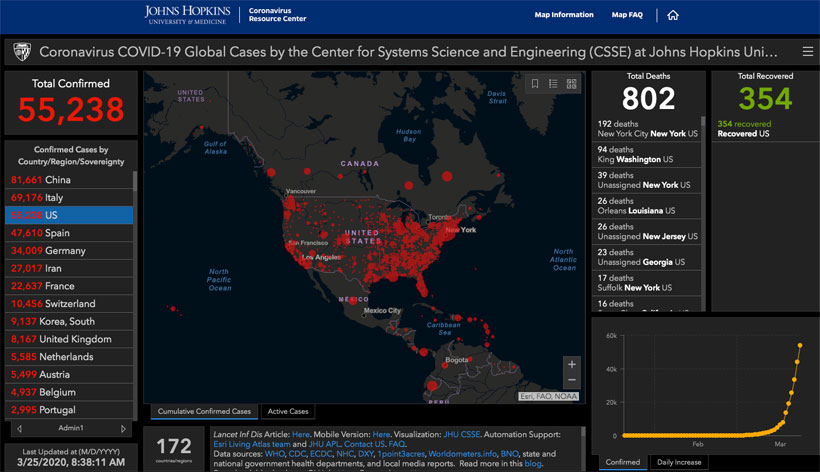
    Johns Hopkins University upgraded its Coronavirus COVID-19 Map to include local data from every city and county in the U.S. The map is maintained in real-time throughout the day.

    Initially, the map followed the naming scheme used by the World Health Organization. It then switched to the names of nations designated by the U.S. State Department.

    The website relies upon publicly available data from multiple sources that do not always agree. More frequent updates to the map, it often results in higher case numbers than what may be available from other sources that are updated less frequently.

    These are the data sources included in the map:

    The dashboard was built by Professor Lauren Gardner, a civil and systems engineering professor at Johns Hopkins University, with her graduate student, Ensheng Dong. It is maintained at the Center for Systems Science and Engineering at the Whiting School of Engineering, with technical support from ESRI and the Johns Hopkins University’s Applied Physics Laboratory.

    All data collected and displayed are made freely available through a GitHub repository

    The map and additional resources are available on Johns Hopkins’ online portal.

    There is an embed code for the dashboard:

    <iframe width=”650″ height=”400″ frameborder=”0″ scrolling=”no” marginheight=”0″ marginwidth=”0″ title=”2019-nCoV” src=”//gisanddata.maps.arcgis.com/apps/Embed/index.html?webmap=14aa9e5660cf42b5b4b546dec6ceec7c&extent=77.3846,11.535,163.5174,52.8632&zoom=true&previewImage=false&scale=true&disable_scroll=true&theme=light”></iframe>

    This is how it looks:


  • Harvard University’s President, Lawrence Bacow, Tests Positive for Coronavirus

    Harvard University’s President, Lawrence Bacow, Tests Positive for Coronavirus

    IBL News | New York

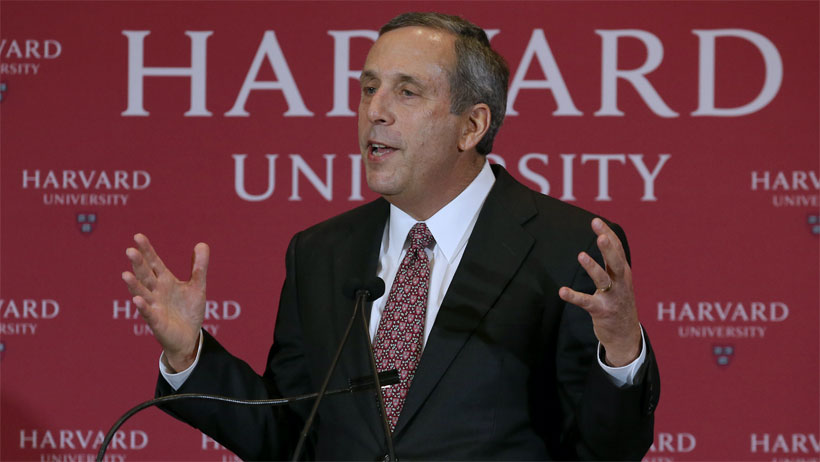
    Lawrence Bacow, President at Harvard University, and his wife, Adele, tested positive for Covid-19, the university announced on Tuesday. They are being treated at home.

    The couple began experiencing symptoms of coronavirus on Sunday— first coughs then fevers, chills, and muscle aches — and contacted doctors on Monday.

    They are unsure how they contracted the virus since they have been working from home and practicing social distancing since March 14.

    “This virus can lay anyone low. We all need to be vigilant and keep following guidelines to limit our contact with others,” Bacow wrote in a letter to the community.

    “I urge you to continue following the guidance of public health experts and the advice and orders of our government officials,” he wrote.

    According to The Harvard Crimson, 18 Harvard affiliates have tested positive for Covid-19, according to Harvard University Health Services.

    Last week, Bacow announced classes would move online and college students were required to vacate their dorms.

    President Bacow is the second president testing positive after John Garveypresident of Catholic University, who has been quarantined since March 13.

    On March 18, University of Washington pathology professor Stephen Schwartz died from the same disease.

  • Thoma Bravo Completes the Acquisition of Instructure and Appoints an Interim, CEO J. Charles Goodman

    Thoma Bravo Completes the Acquisition of Instructure and Appoints an Interim, CEO J. Charles Goodman

    IBL News | New York

    Private equity firm Thoma Bravo finally owns Instructure (NYSE: INST).

    Today, the company announced that it officially completed the acquisition in an all-cash transaction that valued Instructure at an aggregate equity value of approximately $2 billion.

    As a result of it, Instructure’s common stock ceased trading and the company is no longer listed on the New York Stock Exchange.

    “I believe that our shareholders are pleased with the outcome, and I anticipate great things to come in this new chapter for Instructure,” said Josh Coates, Executive Chairman of the Board at Instructure.

    The Salt Lake City-based Edtech company–creator of the Canvas LMS and Bridge, with 30 million users–has become a privately held firm. Any remaining shares of Instructure common stock have been converted into the right to receive an amount in cash.

    The Chicago-based capital firm announced on Monday, March 23rd, that it purchased all of the outstanding shares of Instructure after a cash tender offer, which expired last Friday.

    Thoma Bravo made an offer of $49 per share in cash in mid-February, just before the stock market began to take a sharp decline – with a 25% loss in the past month – due to the coronavirus pandemic.

    “As of expiration, 24,828,913 shares had been validly tendered and not withdrawn from the tender offer, representing approximately 64.4 percent of the aggregate voting power of Instructure’s outstanding shares of common stock,” the company said in a public statement.

    The global Covid-19 crisis, along with the market collapse and the rise of online companies, finally put an end to weeks of ongoing deep discrepancies and disputes among shareholders and activist investors.

    The big next step for Instructure after closing is to appoint a new CEO in place.

    Now the company has an interim CEO, appointed by Thoma Bravo, sources told IBL News. His name is J. Charles Goodman, Operating Partner at Thoma Bravo, and former CEO at Frontline Education, another Thoma Bravo company. [In the picture below]

    Instructure doesn’t anticipate widescale layoffs as it happened earlier this year.

  • How to Protect Yourself From Coronavirus’ Scammers Who Try to Steal Money or Personal Information

    How to Protect Yourself From Coronavirus’ Scammers Who Try to Steal Money or Personal Information

    IBL News | New York

    Scammers are taking advantage of the coronavirus crisis.

    People are more likely to lose money online to a scam when they are socially or physically isolated from others, according to research from the Better Business Bureau (BBB), the FINRA Investor Education Foundation, and the Stanford Center on Longevity.

    “Add increased time spent online and coronavirus creates the ‘perfect storm’ for scammers because all three of these factors have increased dramatically,” said Melissa Lanning Trumpower, executive director of the BBB Institute for Marketplace Trust.

    BBB suggests these steps that everyone can take to protect themselves from losing money and compromising personal information.

    1. Don’t be afraid to contact a friend or a company or organization you trust for advice. 

    2. Before clicking a link or sharing personal information online, stop, pause, and research the company or person. A staggering 81.2 percent of consumers lost money to online purchase scams in 2019.

    3. Beware of job offers that sound too good to be true. Employment scams were the No. 1 riskiest two years in a row. Scammers prey on jobseekers, particularly those seeking remote jobs. 

    4. Learn about scammer tactics to help avoid falling prey to scams and be wary of any offer to “get ahead” that seem too good to be true. 

    Currently, top coronavirus scams to be aware are those emails that impersonate official correspondence from the World Health Organization (WHO).

    Scams claim to provide critical data about the virus in order to get your sensitive personal information. These are scammers are simply after account numbers, Social Security numbers, or your login IDs and passwords.

    One email scam pretends to give COVID-19 drug advice from the WHO and makes it look like the email is from Director-General of the World Health Organization, Dr. Tedros Adhanom Ghebreyesus.

  • Don’t Let Education Fall in the Curve of Covid: An Extensive Resource Website with Tools and Services

    Don’t Let Education Fall in the Curve of Covid: An Extensive Resource Website with Tools and Services

    IBL News | New York

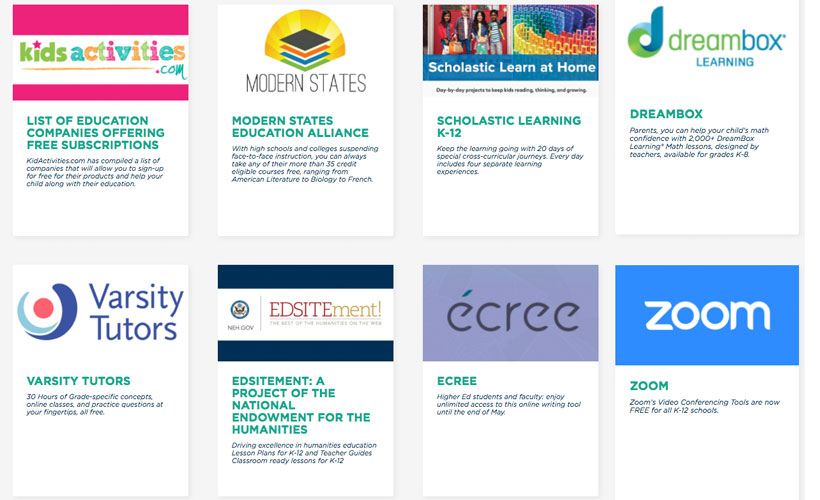
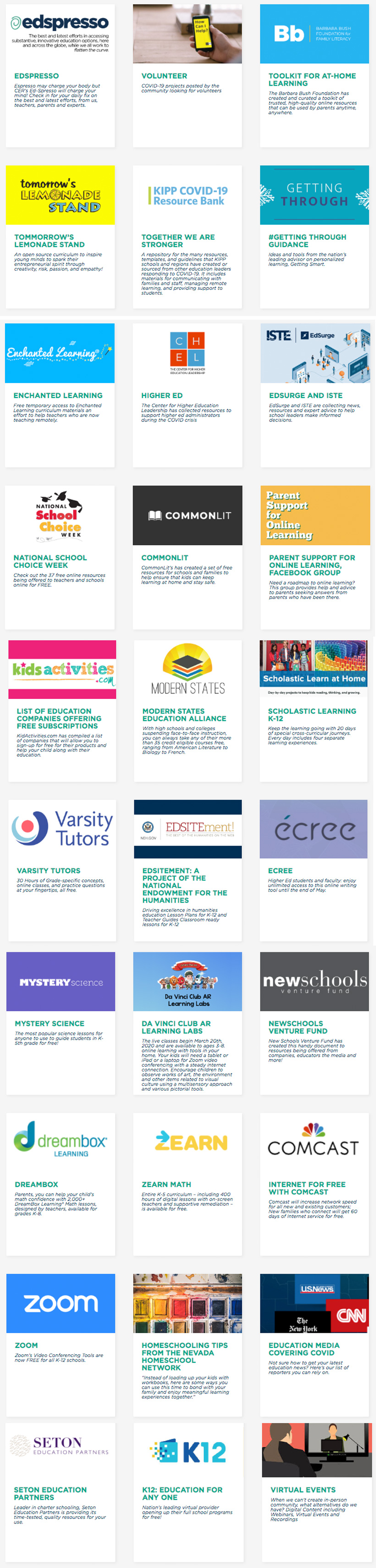
    Under the claim “flatten the curve of Covid and its impact on education,” the Center for Education Reform (CER) –a nonprofit organization in Washington DC– has created an extensive resource website.

    This site includes tools and services available to students, families, and educators.

    “We’ll be keeping tabs on those who are keeping tabs, sharing the best of the aggregators, product providers, media sources and above all — the real people who are doing the real work to fight the virus’ impact on learning,” Jeanne Allen, CEO of the Center for Education Reform, told IBL News.


  • IBM, Microsoft, Harvard, MIT and 40 Universities Join the edX ‘Remote Access’ Program

    IBM, Microsoft, Harvard, MIT and 40 Universities Join the edX ‘Remote Access’ Program

    IBL News | New York

    edX’s recent project providing students from partner universities with free access to courses and programs on its educational portal received an overwhelming response as campuses close impacted by the Covid-19 pandemic.

    As of this week, 40 edX partners joined the initiative, including founding partners Harvard and MIT, along with universities from Europe, Asia, and South America and two corporate partners (IBM and Microsoft).

    “As an educator myself, I am often inspired by the innovations and impact that our partner community displays, but the response to this initiative, in such unprecedented circumstances, is one that reminds me of why we are all working together in the first place,” Anant Agarwal, CEO at edX, wrote on its corporate blog.

    In addition to this Remote Access Program initiative, the edX organization plans to share additional resources and updates to support its learner community.

    “As we continue to face the uncertainty and complexity that surrounds the spread of the coronavirus, it is particularly important that we come together to support and solve what challenges we can,” wrote Agarwal.