Author: IBL News

  • Two Professors from Dartmouth and IMT of France Awarded After their ‘C Programming with Linux’ Course

    Two Professors from Dartmouth and IMT of France Awarded After their ‘C Programming with Linux’ Course

    IBL News | New York

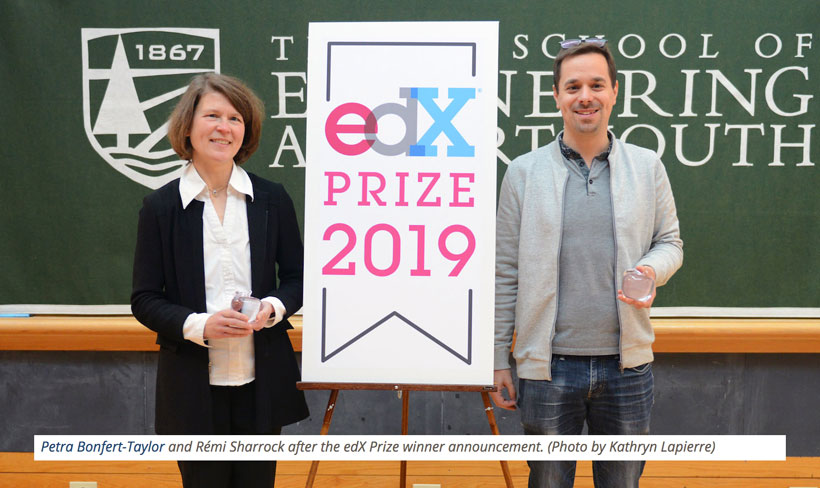
    Dartmouth College Professor Petra Bonfert-Taylor and Institut Mines-Télécom (IMT) of France Professor Rémi Sharrock won the 2019 edX Prize for Exceptional Contributions in Online Teaching and Learning. The announcement was done during a virtual Town Hall, which replaced the annual edX Global Forum (canceled because of the uprising in Hong Kong).

    The winners teach, through a joint partner program, the C Programming with Linux Professional Certificate program. This class has been running on edX.org since June 2018 and will be offered again in March 2020.

    To date, the program has logged over 170,000 enrollments in the seven courses of the series.

    “Both instructors solved how to provide rich, formative feedback to learners in real-time, at scale,” Anant Agarwal, co-CEO at edX, explained in a blog-post. “By using two open-source learning environments, the team was able to remove the most common barriers to beginner coders.”

    The two professors and their team spent a full year intensively working on the design, production, and development in this seven-course sequence.
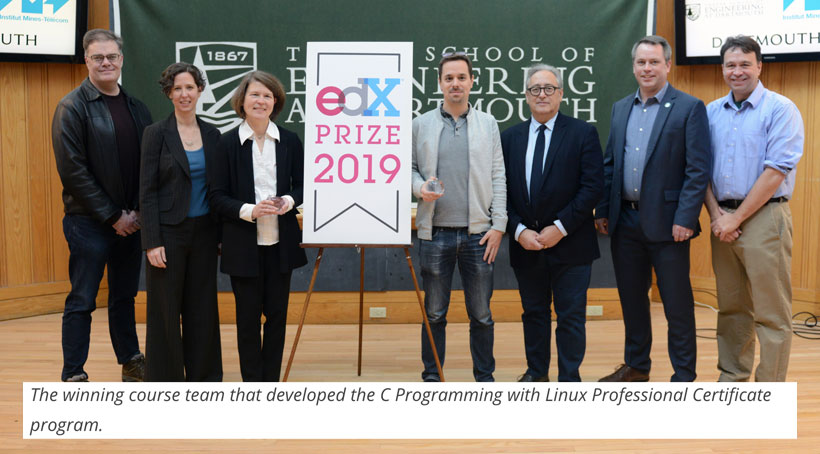
    Part of Bonfert-Taylor and Sharrock’s team were: Joseph Beaudoin, senior video producer at Dartmouth; Michael Goudzwaard, DartmouthX lead; Delphine Lalire, MOOC program manager at IMT; Ella Hamonic, an independent instructional designer commissioned by IMT; and Mathias Hiron, developer at IMT.

    “The world is a better place when knowledge flows freely,” Professor Bonfert-Taylor said. “One of my biggest passions is to transform education through the development of programs that provide accessible and high-quality student-centered learning opportunities across international and socio-economic boundaries.”

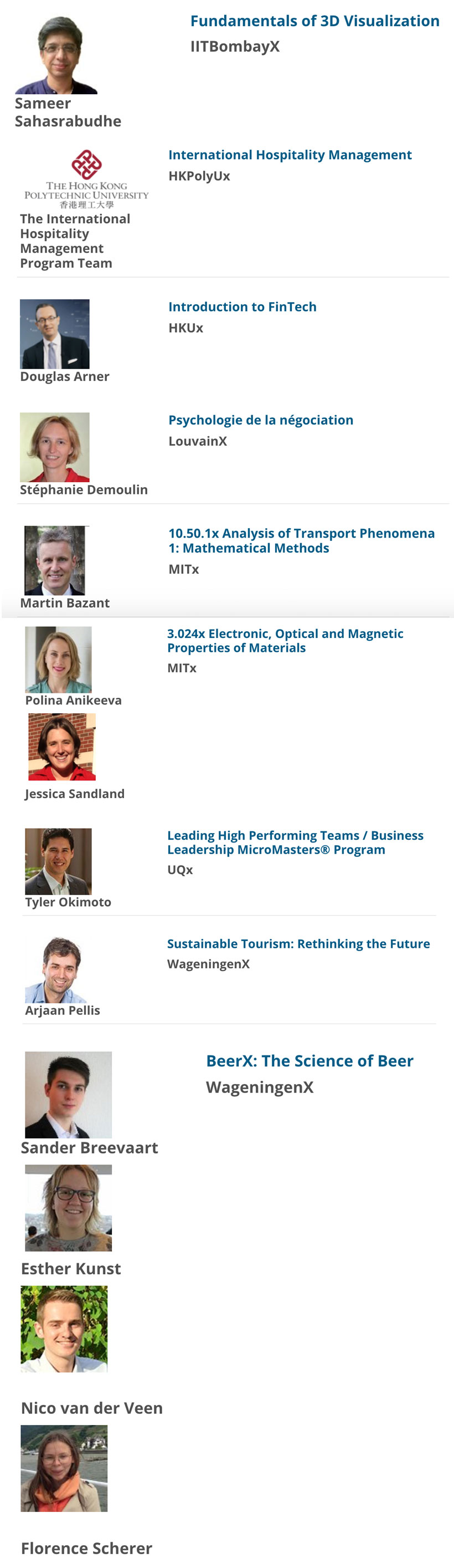
    The two winners of the edX Prize were chosen among more finalists, as shown below.


  • edX & Platforms | November 2019: Python 3, MOOCs, Georgia Tech, IEEE, D2L Brightspace, Cybrary…

    edX & Platforms | November 2019: Python 3, MOOCs, Georgia Tech, IEEE, D2L Brightspace, Cybrary…

    Newsletter format  |  Click here to subscribe ]

    NOVEMBER 2019 – NEWSLETTER #22  |  More breaking news at IBL News  |  Noticias en Español


    edX | Open edX

    • The Open edX Platform Prepares Its Upgrade into Python 3

    Introduction to Java Programming Course Reaches 500K Enrollees

    • The edX Organization Adopts a More Commercial Structure Appointing a New Co-CEO


    MOOCs

    MOOCs Not Following a Revenue Model: GW Is Satisfied with Its Online Massive Courses

    • The New Face of MOOCs: Modular Credentials Stackable Into Degrees from Multiple Universities

    • IEEE Learning With MOOCS 2019 Five Leading Keynotes in Video


    Udacity

    • Udacity’s Achievement with its Nanodegree Program: Over 100,000 Graduates

    • With Intel, Udacity Offers a Scholarship Program for Edge AI Development


    Georgia Tech

    • “Faculty Buy-In Is By Far the Reason Why Georgia Tech’s OMSCS Has Worked So Well”

    • Over 1,000 Students Will Graduate from Georgia Tech’s Online Master in Computer Science


    Platforms

    • Brightspace LMS Retains Its Customers Despite a Massive Transition to the Cloud

    • Cybrary Training Platform on Cybersecurity Gets a New Round of Funding


    2019 Upcoming Events

    • Education Calendar  –  NOVEMBER  |  DECEMBER  |  JAN – JUNE 2020


    This newsletter is created in collaboration with IBL Education, a New York City-based company that has built the IBL Platform. Read the latest IBL Newsletter   |  Archive of Open edX Newsletters

  • Brightspace LMS Retains Its Customers Despite a Massive Transition to the Cloud

    Brightspace LMS Retains Its Customers Despite a Massive Transition to the Cloud

    IBL News | New York

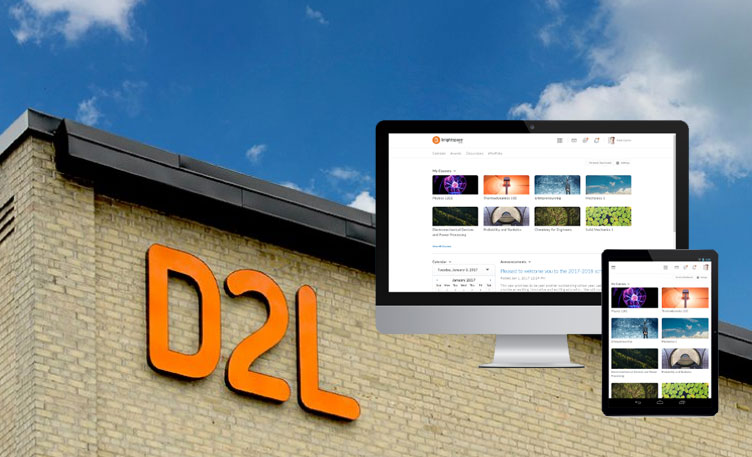
    D2L, whose signature product is the Brightspace LMS, announced yesterday that it completed in moving 100% of its clients to the AWS Cloud, in a modernization effort that took three to five years.

    In addition, DSL – one of the three commercial LMSs, along with Canvas and Blackboard Learn– added other improvements to their core platform.

    The major transition to the cloud has allowed D2L to retain 98% of its education clients, according to its data.

    “We said we’d do it, we did it — and our customers can count on us to deliver,” said D2L CEO John Baker. “We listened closely to our clients to make sure we were doing it right.”

  • IEEE Learning With MOOCS 2019 Keynotes in Video

    IEEE Learning With MOOCS 2019 Keynotes in Video

    IBL News |  New York

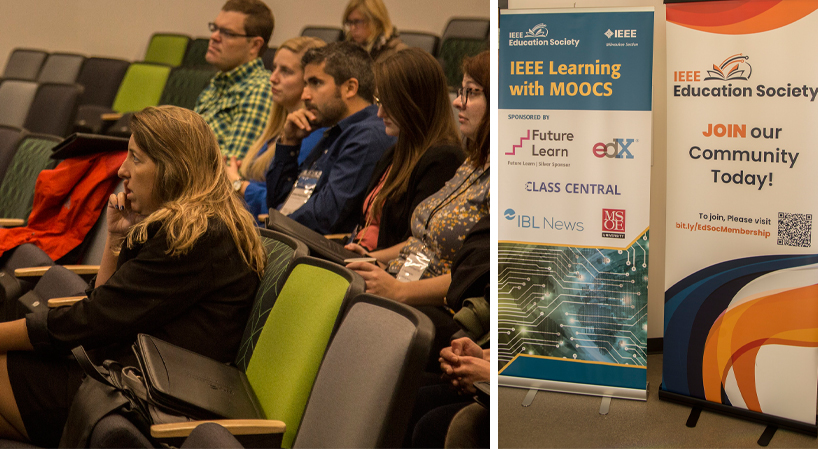
    The IEEE Learning With MOOCS 2019 organization yesterday released the videos of the main keynotes.

    What follows is a summary.

    When the Means Don’t Mean Anything: Findings Insights through Contextualized Evaluation Metrics
    Kerrie Douglas, Assistant Professor, Purdue Universit


    Basic Computer Skills Course MOOC – Creating a MOOC from the Ground Up
    Kristina Wilson and Bonnie Tomlin Learning Developers, Fox Valley Technical College System


    The need for continuous learning and the role of micro-credentials
    K. Holly Shiflett, Director, North American Partnerships, FutureLearn, USA/UK


    A More Adaptive Future for MOOCs

    Zachary A. Pardos, Assistant Professor, UC Berkeley, USA


    The Future Learner 

    Anant Agarwal, CEO, edX, USA


  • MOOCS Not Following a Revenue Model: GW Is Satisfied with Its Online Massive Courses

    MOOCS Not Following a Revenue Model: GW Is Satisfied with Its Online Massive Courses

    IBL News | New York

    Not all schools have turned into the all-for-business MOOC-model. The George Washington University (GW), which hosts four MOOCs, still holds the belief that self-paced classes help disseminate knowledge at no cost.

    In addition, officials at GW said the courses help their schools reach out to thousands of people from around the globe and make learning accessible beyond the GW community for students who can not attend classes full or part-time on-campus or online.

    Ken Schappelle, Director of Marketing and Communications for the School of Nursing, said at GW’s The Hatchet“by the belief that all people deserve quality health care, we aspire to be trusted advocates for the advancement of societal well-being in the clinic, community, and statehouse.”

    The School of Nursing offers two MOOCs, one on healthcare safety launched in May 2016 and one on clinical simulations launched in June.

    These courses have attracted more than 10,000 enrollees from around the world, with especially “strong” representation from Europe and Asia.

    MOOCs at The George Washington University started in 2014, with Dr. Lorena Barba, a professor of mechanical and aerospace engineering in the School of Engineering and Applied Science.

    She established two semester-long MOOCs in computing and aerodynamics in 2014 and 2017.

    More than 10,000 users have enrolled in her Practical Numerical Methods with Python course since its inception in 2014.

    The course teaches users how to work with Python, an online programming language.

    Barba has taken on the responsibility for creating, running and updating the existing courses, which are fully open at openedx.seas.gwu.edu.

    “These are all a ‘one-woman show,’” she explained.

  • The Open edX Platform Prepares Its Upgrade into Python 3

    The Open edX Platform Prepares Its Upgrade into Python 3

    IBL News | New York

    The Open edX platform is immersed in a race against the clock to upgrade to Python 3, as Python 2 will be non-supported and deprecated at the end of 2019. Meaning, if someone finds a security problem in Python 2, it will not have the ability to be easily fixed.

    The Python Software Foundation decided that January 1st of 2020 will be the day that it will sunset Python 2. Python 2 was released in 2000 and today there are improvements that Python 2 can’t handle.

    A part of the upgrade of the Open edX platform corresponds to course authors. In this regard, the edX managing team has urged instructors who use Python Evaluated Input problems to immediately upgrade into Python 3.

    Recently, edX outlined in this document how it plans to scope the problem, migrate the code, and work with the Open edX community to “ensure that the process is as painless as possible, and meets the needs of our stakeholders.”

    The Open edX software is considered a large project, spanning many applications and GitHub repositories, with even more dependencies on third-party libraries.

    “Thanks to helping from the community, we’re making good progress,” Ned Batchelder, Open edX Software Architect said. “The Python test suite for our main repository now runs under both Python 2 and Python 3.”

    Another porting effort ahead points to Django, the framework extensively used on Open edX web applications. The current version 1.11 of Django is coming to its end soon and there is a need to move to Django 2.2.

    Once the platform runs on Python 3 and Django 2.2, the next Open edX release, called Juniper, will get started.


    • OEP-7: Migrating to Python 3

  • An Amazon Marketplace for K-12 Educators Who Want to Sell Their Teaching Materials

    An Amazon Marketplace for K-12 Educators Who Want to Sell Their Teaching Materials

    IBL News | New York

    Amazon launched this week a marketplace for K-12 teachers who usually teaches via lesson plans, printables, classroom games, and other classroom materials to colleagues and parents online.

    This service, called Amazon Ignite, plans to connect educational content creators with Amazon customers.

    The tech giant will take 30% of the sales, plus a transaction fee of 30 cents for products under $2.99.

    To avoid the posting of copyrighted materials, Amazon has made the service accessible with Invitation Only by the instructor creators who own the resources.

    All of the materials in the Ignite program will be in a new Amazon’s Digital Educational Resources store.

    Ignite’s initiative follows similar existing ventures such as Teachers Pay Teachers, founded in 2006.

  • Instructure Announces It Is Exploring to Sell the Company – Estimated to be Worth $2.5B

    Instructure Announces It Is Exploring to Sell the Company – Estimated to be Worth $2.5B

    IBL News | New York

    Instructure (NYSE: INST), the company behind Canvas LMS, publicly announced that it has begun to explore a number of strategic alternatives “to maximize shareholder value”, including a possible sale. Canvas owns about 38% of the LMS market.

    “These alternatives may include continuing as a standalone public company, going private, or being purchased by a strategic partner,” the company said in a statement Thursday.

    Instructure’s board retained J.P. Morgan as its financial advisor and Cooley LLP as its legal advisor.

    The move of the board took place in response to the pressure by activist investors Sachem Head, Praesidium Investment Management and more recently, Jana Partners, who disclosed it had a 1% stake. They called for Instructure to explore a sale, reportedly identifying multiple potential private equity buyers.

    Kevin Oram, Praesidium’s Co-Founder and Managing Partner, said last week that selling Bridge –Instructure’s unprofitable employee development platform– would unlock the value of Canvas, which he estimated to be worth $2.5 billion.

    Phil Hill, consultant and author of Phil on Ed Tech blog, wrote that competitor Blackboard went through a similar process a few years ago, going private in 2011. Blackboard considered a sale in 2015 but didn’t go through with it.

    Instructure’s previously scheduled financial analyst day on December 3 was canceled “to allow management and the board to explore these strategic alternatives for the company,” said the Salt Lake City-based corporation.

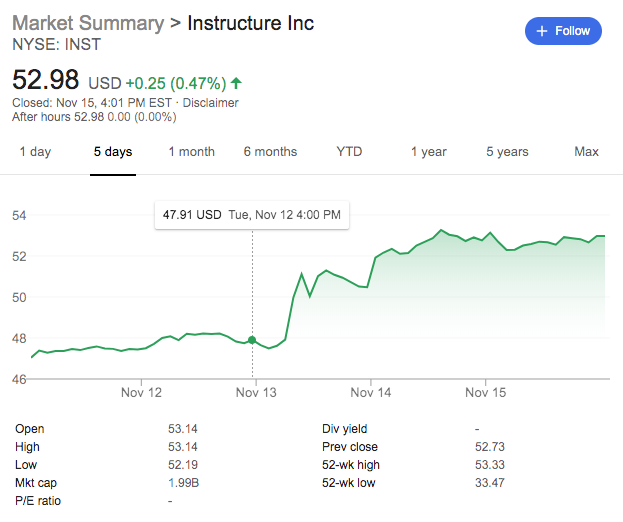
    The stock has gained significant value since activists hedge funds started to call for a sale, especially this week, when it moved from $47.91 on November 13 to $52.98 on November 15.


    IBL News: News about Canvas LMS and Instructure

  • Cybrary Training Platform on Cybersecurity Gets a New Round of Funding

    Cybrary Training Platform on Cybersecurity Gets a New Round of Funding

    IBL News | New York

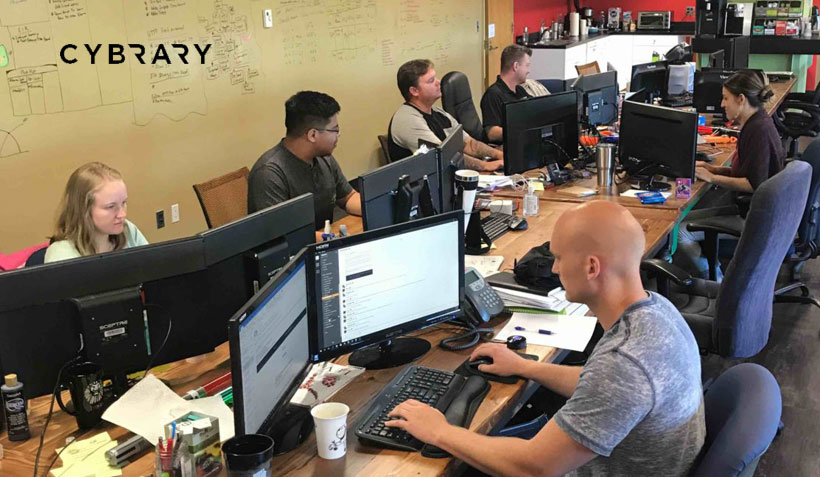
    Cybrary, a web training platform used by nearly 3 million cybersecurity and IT professionals, closed this Wednesday on a $15 million Series B funding round.

    Austin, Texas-based BuildGroup led the funding. Existing investors including Arthur Ventures and Gula Tech Adventures also participated in the round. The round brings the Cybrary’s total capital raised to $23 million.

    Investor BuildGroup highlighted that Cybrary “is solving critical business problems with modern business models powered by network effects”.

    Founded in 2015, and currently, with a staff of the 60-person, the College Park, Maryland-based company hosts cybersecurity training content, allowing individuals and enterprises to close cybersecurity skills gaps and follow career paths. The Cybrary platform provides mostly video-based training and hands-on technical assessments.

    “We have assembled the world’s largest cybersecurity career development network, powered by the industry’s largest network of industry subject matter expert creators,” Ryan Corey, Co-Founder at Cybrary, said. He plans to use the new round toward hiring content creators, subject matter experts, and more employees (including doubling the number of engineers on staff to 24).

    The free version of Cybrary comes with introductory courses, syllabi, assessments, and a live chat to help users. A premium license, which costs $99 per month, gives access to the entire course catalog, live online training, practice exams, scenario-based virtual labs, and a mentor network.

    With a network of 1,700 mentors, the company offers a service to train teams of employees for businesses. Cybrary is not currently profitable.

  • With a Unique Business Model, Guild Hits $1 Billion Valuation After Raising $157 M

    With a Unique Business Model, Guild Hits $1 Billion Valuation After Raising $157 M

    IBL News | New York 

    Denver-based, female-led startup Guild Education yesterday announced the close of a $157 million Series D round, becoming the newest edtech unicorn, with a post-money valuation north of $1 billion.

    The funding round was led by former American Express, CEO Ken Chenault, through the VC firm General Catalyst and was joined by Laurene Powell Jobs’ Emerson Collective, Iconiq Capital and Lead Edge Capital.

    Founded in 2015 by Stanford University graduates Rachel Carlson and Brittany Stich [in the picture above], Guild connects Fortune 1000 companies to 1,6000 online programs offered by nearly a dozen universities—among them, the University of Arizona, Purdue Global, Southern New Hampshire University and the University of Central Florida.

    Universities typically spend between $4,000-$6,000 (mostly on buying ads on Google and Facebook) to acquire a Bachelor’s student and up to $14,000 for a Masters’s degree student. Guild Education gets paid out of the savings universities make on student recruitment services.

    The company also has a team of advisors and support specialists to help students plan, apply for, and finish their programs.

    One of Guild’s major deals was with Chiplote, which now covers the college tuition for employees. Discover Financial, Taco Bell, Walmart, Lowe’s and Walt Disney Co. are customers, too.

    Guild competes with InStride and Pearson is this space.