Author: IBL News

  • With Intel, Udacity Offers a Scholarship Program for Edge AI Development

    With Intel, Udacity Offers a Scholarship Program for Edge AI Development

    IBL News | New York

    Udacity announced yesterday in San Francisco the Intel Edge AI Scholarship Program and the Intel Edge AI for IoT Developers Nanodegree Program.

    The pedagogical goal is to teach developers to accelerate the development and deployment of high-performance computer vision and deep learning solutions using Intel Distribution of OpenVINO toolkit (which allows deploying pre-trained deep learning models.)

    In the first phase of the scholarship program, students will get access to the Intel Edge AI Fundamentals course, the first class of the Intel Edge AI for IoT Developers Nanodegree program.

    Students who successfully complete this course will earn a full scholarship to the Intel Edge AI for IoT Developers Nanodegree program. The number of seats is limited to 750 students.

    “With Udacity, we are training the next generation of AI developers to go where the data is generated in the physical world: at the Edge,” said Jonathan Ballon Intel Vice President and General Manager, Internet of Things Group. “Optimizing the direct deployment of models on edge devices requires knowledge of unique constraints like power, network bandwidth & latency, varying compute architectures and more.”

    The deadline to apply is December 10.



  • 2U Exceeds Wall Street Expectations With Its Third-Quarter Results

    2U Exceeds Wall Street Expectations With Its Third-Quarter Results

    IBL News | New York

    2U (TWOU) reported its third-quarter results yesterday exceeding Wall Street expectations.

    The Lanham, Maryland-based OPM controversial company said it had a loss of $141.1 million in the period.

    The loss per share was $0.41 when the average estimate of seven analysts surveyed by Zacks Investment Research was for a loss of $0.51.

    The posted revenue was $153.8 million, which also beat Wall Street forecasts. Five analysts surveyed by Zacks expected $149.6 million.

    2U expects a full-year loss of $3.89 to $3.79 per share, with revenue in the range of $570 million to $575 million.

    In the final minutes of trading on Tuesday, shares hit $22.69, an increase of 3.94% in the day, and a drop of 56% since the beginning of the year (versus the S&P 500’s gain of 23.1%.)

    What’s next for the educational firm?

    There are no easy answers, and the estimate revision trend is mixed. Only one thing is clear: market expectations have changed lately.

    It is unclear, however, how the stock fluctuation and the notorious hedge fund’s push encouraging 2U to sell the company is impacting on its customer recruitment strategy and overall financial stability.

    Q3 2019 Earnings Call Transcript


  • “Faculty Buy-In Is By Far the Reason Why Georgia Tech’s OMSCS Has Worked So Well”

    “Faculty Buy-In Is By Far the Reason Why Georgia Tech’s OMSCS Has Worked So Well”

    IBL News | New York

    “The reason why OMSCS –Georgia Tech’s signature Computer Science Master’s degree– has worked so well is because faculty bought into the idea and embraced its experimental nature,” explained Dr. David Joyner in a revealing interview with IBL News. [Watch it below].

    David Joyner, Associate Director of Senior Experience at the Online Master’s Science Computer Science and instructor in the program, said that “instructors have the ability to experiment, invent and build things useful for the class”.

    Joyner teaches online versions of CS6460: Educational Technology, CS6750: Human-Computer Interaction, and CS1301: Introduction to Computing.

    This semester, the OMSCS program had 9,000 students; and 2,300 graduates through summer. Another interesting data point is the fact that 75% of students remained in the program.

    In the interview, Joyner also commented on the new role of Georgia Tech’s AI-agent –formerly known as Jill and now named ATA– based on connecting students to other learners in the same class.  “It’s a social TA (Teacher Assistant).”

    As a researcher, David Joyner has focused his studies on online education and learning at scale, especially as they intersect with for-credit offerings at the graduate and undergraduate levels.

  • Udacity’s Achievement with its Nanodegree Program: Over 100,000 Graduates

    Udacity’s Achievement with its Nanodegree Program: Over 100,000 Graduates

    IBL News | New York

    Udacity’s Nanodegree has revealed as the most promising credential in higher education at scale. Today, there are over 100,000 graduates in the Nanodegree program, sources told IBL News. [Update: Five weeks later, Udacity’s CEO confirmed this data.]

    The Nanodegree online program currently includes five schools: Data Science, Artificial Intelligence, Programming, Autonomous Systems, and Cloud Computing.

    Conceived as an industry-oriented credential for career-seeking and job-ready students, Nanodegree was described by Udacity’s founder Sebastian Thrun as the new fourth degree, beyond the three common university degrees — the Bachelor’s, Master’s, and PhD.”

    Sebastian Thrun claims that his company, which has achieved the status of a unicorn of $1 billion, is on the way to becoming the “University of Silicon Valley” –although it’d be an unaccredited university.

    “The Nanodegree program is well on its way to becoming a de-facto standard for hiring and corporate training in the tech industry,” he recently wrote.

    However, Udacity’s newly appointed CEO, Gabriel Dalporto, a former manager at LendingTree, with no experience in education, contradicted the founder’s view, talking about the need to “get more clarity on our long-term vision and strategy” and the more upcoming partnerships with other universities.

    “I do believe that we will be partnering with universities because we can provide the specialization in a lot of areas that universities just aren’t prepared to teach,” he said in an interview at EdSurge last week.

    “We’re a company that is going to help universities and governments around the world retrain the world’s workforce in an extremely cost-effective way.”

    • PitchBook: This day in unicorn history: Udacity and its $1B edtech experiment

  • Virginia Will Invest $1 Billion to Graduate 31,000 Computer Scientists Over the Next 20 Years

    Virginia Will Invest $1 Billion to Graduate 31,000 Computer Scientists Over the Next 20 Years

    IBL News | New York

    The commonwealth of Virginia will produce an additional 31,000 technology graduates over 20 years through funding programs with universities across the state.

    Governor Ralph Northam, who made this announcement last Friday, said, “We are educating a workforce that will fill jobs at hundreds of tech companies, including at Amazon, helping boost our economy and quality of life in Virginia.

    Funding for the program, called the Tech Talent Investment, was approved earlier this year. As a result of it, eleven universities will share a total of $961.5 million over the next two decades for the expansion of their degree programs and construction of new facilities.

    Currently, Virginia’s public universities award approximately 1,300 bachelor’s degrees and 400 master’s degrees in computer science per year.

    The initiative was driven by the imminent arrival of the Amazon’s second headquarters in Arlington County, Va., a move that is expected to create thousands of jobs for cloud computing specialists and other tech skills workers.

    The 11 colleges that received funds in this round, and the degrees over their baseline that they have committed to producing, are:

    • Virginia Tech: 5,911 bachelor’s degrees, 10,324 master’s degrees;
  • Mid-Wage Jobs Will Be Squeezed by AI, Unless They Adapt by Honing Skills

    Mid-Wage Jobs Will Be Squeezed by AI, Unless They Adapt by Honing Skills

    IBL News | New York

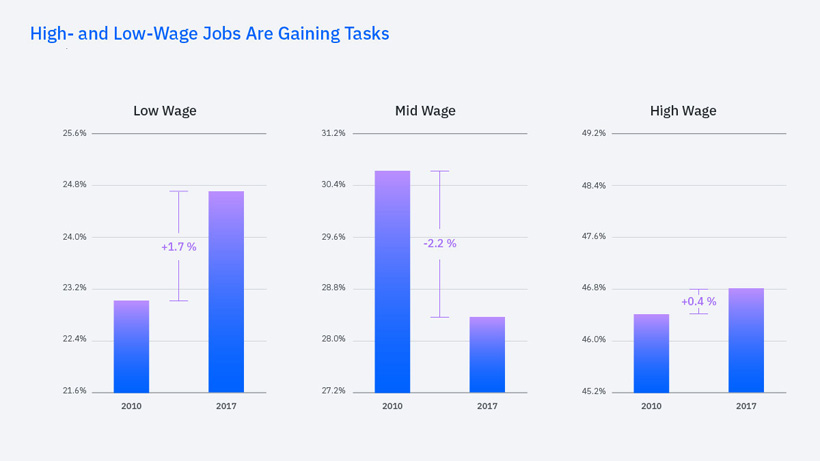
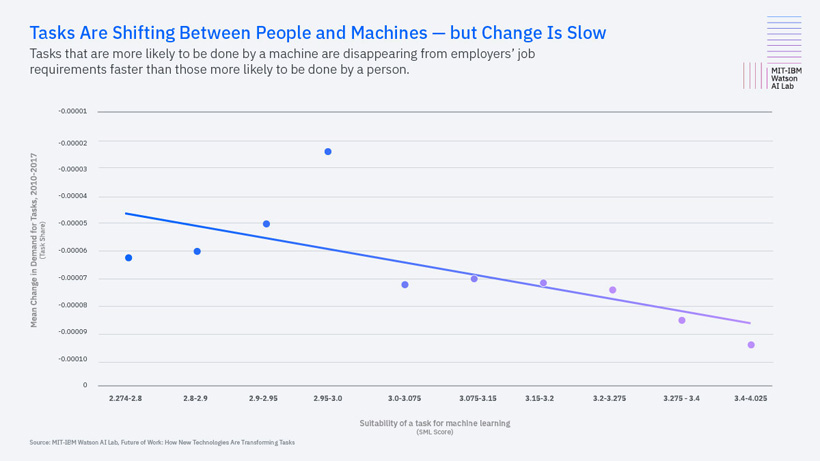
    After analyzing 170 million job posts over seven years, MIT and IBM Watson researchers found that all of the jobs will eventually change slowly due to Artificial Intelligence and new technologies. What will fundamentally change is the way we work. However, few jobs will actually disappear.

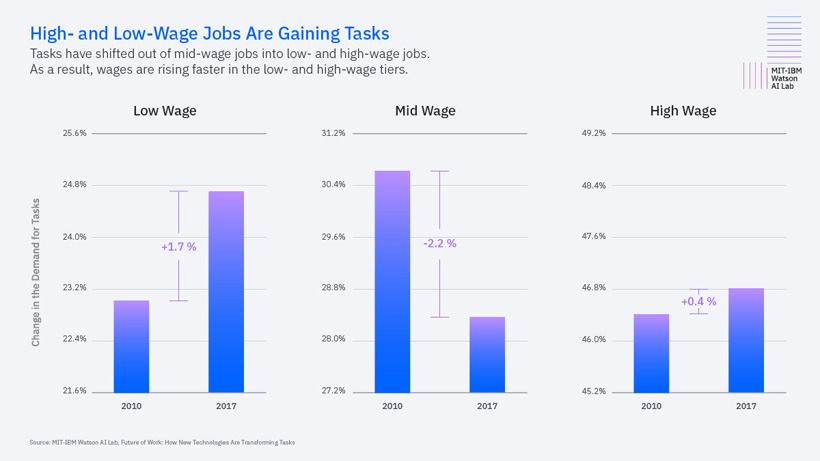
    The research, The Future of Work: How New Technologies Are Transforming Tasks, shows that people in the middle of the wage scale will get squeezed the most in the short-term as tasks shift to both lower and higher-paid workers.

    “Understanding the impact of automation will help governments, companies, and workers prepare, said Martin Fleming, chief economist at IBM and lead author of the report.

    The consensus points to the fact that workers will need to adapt by learning or honing skills that require innovation, creative thinking, or deep insight and experience. Meanwhile, employers across all industries should begin to focus on reskilling their workforces, redesigning job roles and supporting career advancement.

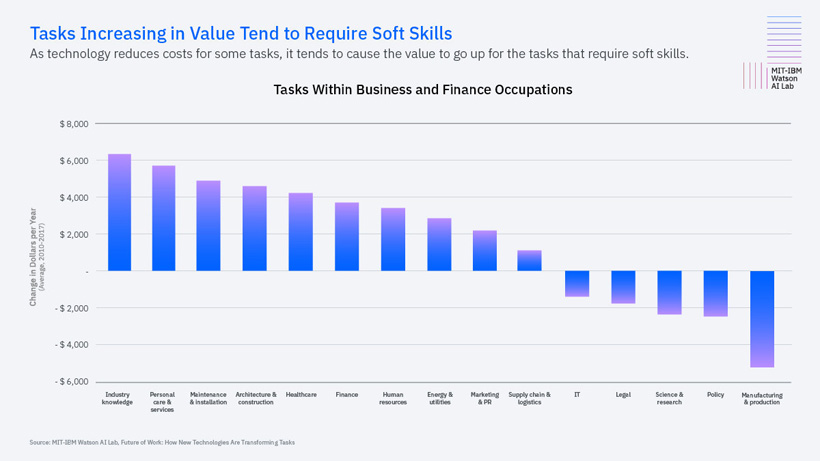
    When looking at the impact of AI and machine learning, another key finding shows that soft skills will be increasingly required.

    “As technology reduces the cost of some tasks, the value of the remaining tasks that make up an occupation increases,” said MIT-IBM Watson AIl Lab researchers. “Tasks that are grounded in intellectual skill and insight as well as require, to some degree, physical flexibility, common sense, judgment, intuition, creativity, and spoken language have tended to increase in value.”

    These findings align with the recent IBM Institute for Business Value (IBV) study, The Enterprise Guide to Closing the Skills Gap, which reported the two top skills sought in 2018 were behavioral skills – time management and willingness to be flexible, agile, and adaptable to change.

    Along with the research, IBM announced several education initiatives to help students, workers, and life-long learners and address the skills gap problem:

    • P-TECH: A public-private partnership among high schools involving more than 75 community college partners and 600 industry partners. Over twenty-three countries — including France, Australia, and Taiwan – have announced the intent to open P-TECHs or have already opened P-TECHs. The goal is to prepare students for “new collar” jobs –such as cloud computing or cybersecurity analysts–which are skilled, technology positions that don’t necessarily require a traditional, four-year college degree;
    • Apprenticeships: In partnership with the U.S. Department of Labor, the 12-24 month program pairs apprentices with an IBM mentor to work on IBM projects, along with traditional classroom learning, in technology’s fastest-growing fields;
    • Returnships: A six-month program created to make rejoining the technology industry easier for people who have been out of the workforce for at least 24 months;
    • SkillsBuild: A new digital learning and education platform that provides job seekers – including those seeking employment, returning to work after leave, veterans, refugees, or those changing professions – with accredited digital learning content, personalized coaching, and practical learning experience to help them re-enter the workforce successfully; and
    • STEM Career Training for Women: Programs around the globe to help girls earn a strong STEM foundation, and initiatives to help women enter the technology sector.
  • Small Business Academy, Amazon’s Latest Ed Initiative to Educate Entrepreneurs

    Small Business Academy, Amazon’s Latest Ed Initiative to Educate Entrepreneurs

    IBL News | New York

    Amazon’s latest educational project is a combination of in-person classes and seminars, community college courses, and online webinars. It includes several programs intended to help small businesses to reach more customers, build their brand, and grow sales. The initiative, announced last week, is called Small Business Academy.

    “Small businesses make up 99.9% of U.S. businesses, employ almost 60 million people, and are the backbone of our economy,”  Nicholas Denissen, Vice President of Small Business at Amazon, said.

    “We’ve heard from many of them that they want help and guidance to take advantage of the power of the internet and digital business, particularly in rural areas,” he added.

    The first Amazon Small Business Academy’s event, featuring guest speaker U.S. Senator Roger F. Wicker, took place last Friday in Southaven, Mississippi near Memphis, Tenn.

    The free seminar provided 100 attendees with insights, best practices, and how-to skills to start and grow a business online or expand an existing business on the internet.

    The company’s next Small Business Academy seminar will be held in December, with more events planned for 2020.

    The Amazon Small Business Academy program also includes a grant to the National Association for Community College Entrepreneurship (NACCE) to help fund curriculum development and instruction of digital business courses in community college classrooms around the country.

    The classes will cover the fundamentals of online business strategies, marketing, merchandising, and inventory management.

    The curriculum will provide sixteen hours of beginner, intermediate and advanced content, created in collaboration with NACCE and the program’s lead schools: Lorain County Community College in Elyria near Cleveland, Ohio and North Idaho College in Coeur d’Alene, Idaho.

    The classes will begin on February 2020 at the lead schools, as well as Bunker Hill Community College in Boston, Mass.; State Center Community College District in partnership with Fresno City College, in Fresno, Calif.; Houston Community College in Houston, Texas; and Red Rocks Community College in Lakewood, Colo.

    The Amazon Small Business Academy program also offers webinars to help current and aspiring small business owners throughout the country gain digital skills. The online seminars will provide best practices for successful selling on Amazon stores and include live Q&A with experts. [Registration]

  • ISTE Conference Organizer Absorbs EdSurge Media – Investors Won’t Be Rewarded

    ISTE Conference Organizer Absorbs EdSurge Media – Investors Won’t Be Rewarded

    Mikel Amigot | IBL News, New York


    ISTE, a 40-year-old nonprofit that annually hosts one of the most influential edtech conferences, acquired EdSurge for an undisclosed amount, in a transaction expected to be finalized by the end of the year. The announcement came yesterday by surprise at the EdSurge’s Fusion conference.

    Burlingame, California-based EdSurge, that provides journalism, research, job offerings, events, and other edtech services, will become a nonprofit media organization by joining ISTE. Its shareholders, including investors such as Reach Capital, GSV Capital, and TAL Education, will not receive any return on their investment, according to Richard Culatta, ISTE’s CEO since 2017.

    EdSurge will keep its brand on news stories, newsletters, and research. Most of its 30 employees will be hired as staff members, although headcount reductions were announced. “Any time when you look at combining teams and roles, there’s always the chance that there are redundancies,” Culatta said.

    “Core to this acquisition, however, is maintaining EdSurge’s journalistic independence,” Betsy Corcoran, CEO at EdSurge, said in an email to readers. “What this arrangement gives us is an opportunity to focus on the work—not just focus on paying the bills, not just focus on survivability,” she added.

    Founded in 2011 as a venture-backed, for-profit news organization, EdSurge raised more than $8 million from a mix of investors and received millions of dollars in grants from nonprofits and foundations, such as the Chan Zuckerberg Initiative, NewSchools Venture Fund, and the Bill and Melinda Gates Foundation.

    With a revenue stream of over $16 million, staff of 60 employees and 25,000 membership educators, the Arlington, Virginia-based ISTE, publishes books and research journals. However, two-thirds of the income came from the annual conference.

    In 2017, its CEO started talks about buying a news-media outlet. He ended up buying EdSurge, although he didn’t write “a big check”, he said. Betsy Corcoran confirmed that the acquisition did not come with a huge price tag.

    Jeffrey R. Young, senior editor at EdSurge, and Stephen Noonoo, K-12 editor in the news site, posted a detailed story about the antecedents of the transaction yesterday.

    Betsy Corcoran’s reflections on the future

  • The New Face of MOOCs: Modular Credentials Stackable Into Degrees from Multiple Universities

    The New Face of MOOCs: Modular Credentials Stackable Into Degrees from Multiple Universities

    IBL News | New York

    “In the past, MOOCs were individual courses; today are sequences of courses that converge into micro-credentials like Certificate or MicroMaster programs,” Anant Agarwal, Co-CEO at edX, said in an interview with IBL News during the Learning With MOOCs 2019 Conference, which took place last week in Milwaukee. [Watch the interview below]

    Modular credentials that stack up into new degrees, offered by different higher education institutions, are an upcoming trend, according to Anant Agarwal. “This is the new face of MOOCs“.

    “Multiple universities will supply modular credentials, and learners will be able to stack them up into full degrees; I see this as the next step“.

    One early example is MicroMasters from MIT that is combined with courses from Arizona State University to become a Master’s degree.

    Prior to the interview, Anant Agarwal highlighted on a keynote the importance of understanding that learners are the new stakeholders. He elaborated on the different types of learners. IBL exclusively recorded his talk:


  • Sachem Head Becomes One of the Top Shareholders of 2U and Advocates for a Sale

    Sachem Head Becomes One of the Top Shareholders of 2U and Advocates for a Sale

    Mikel Amigot | IBL News, New York


    Yesterday, Sachem Head set its sight on 2U Inc., pushing the company to explore a sale. As a result of it, the stock registered its biggest gain since 2016, almost 14% to $21.18.

    With a market value of about $1.3 billion, 2U saw its shares fall more than 70% over the past 12 months and faced numerous class-action lawsuits for allegedly false or misleading statements during the second quarter. The stock dropped 65% on July 31st after a controversial earnings call wherein its CEO and former CFO drastically tempered short-term growth plans.

    The New York-based activist hedge fund has been building a position in OPM 2U (Nasdaq: TWOU), apparently becoming one of the top shareholders, and now saying it’s time to sell. The exact size of its stake is unclear.

    Sachem Head Capital Management LP, founded by Scott Ferguson in 2012, believes that 2U would be an attractive takeover target for private equity firms and other education technology companies, sources told Bloomberg.

    Sachem Head’s positions and views tend to move the stock market. For example, the influential fund, that invests $3.2 billion on behalf of clients, recently called on Whitbread PLC to sell its Costa Coffee business before it was spun off to Coca-Cola Co. It also pushed Eagle Materials Inc to split its core businesses, before the company’s board agreed to spin off its heavy and light materials businesses into two publicly traded entities.

    Last week, Sachem Head announced that it wanted Instructure Inc –whose main product is the leading Canvas LMS platform– to pursue a full sale process, as IBL News reported quoting Reuters.

    Instructure (NYSE: INST), with a similar market cap to 2U, was the second education company that Sachem Head targeted, although that move was not apparently related.

    2U has been making some changes in management lately in an attempt to calm down investors and arrive in better shape to the crucial earnings call on November 12th. Last month it appointed a new CFO –Paul Lalljie, a former Neustar Inc executive– and new CMO –Jennifer Ogden-Reese, a former SeatGeek Inc. executive.

    •  Past reports about 2U at IBL News