Category: Top News

  • The New Trend of ‘Vibecoding’: Non-Programmers Creating Software Tools with AI

    The New Trend of ‘Vibecoding’: Non-Programmers Creating Software Tools with AI

    IBL News | New York

    Nontechnical hobbyists without code knowledge are starting to build fully functional apps and websites by typing prompts into AI-driven text boxes in a trend called vibecoding.The term vibecoding has been popularized by the AI researcher Andrej Karpathy, as he explained in this post.


    An expert explained in The New York Times that these aren’t the kinds of tools that a big tech company would build. “There’s no real market for them; their features are limited, and some of them only sort of work.”

    These creations range from tools that transcribe and summarize long podcasts to searchable web databases or practical organization apps.

    “Building software this way produces a feeling of AI vertigo, similar to what I felt after using ChatGPT for the first time,” wrote technologist reporter Kevin Roose.

    In the last year, new tools, such as CursorReplitBolt, and Lovable, have been built to use more powerful AI models, enabling neophytes to program like pros, as shown in the video above.

    After the user’s prompt, the tool creates a design, decides on the best software packages and programming languages, and builds a working prototype.

    Users can suggest tweaks and revisions and then deploy their new product to the web or run it on their computers. Depending on the project’s complexity, the process takes a few minutes or several hours.

    Most of the products allow limited free use, with paid tiers that unlock better features and the ability to build more things.

    Not all vibecoding experiments have been successful, and occasionally, AI makes mistakes.

    For now, these tools are for hobby projects or even junior programmers, but not essential tasks.

  • Nvidia Presented an Open-Source Humanoid Robot Foundation Model, ‘Isaac GR00T N1’

    Nvidia Presented an Open-Source Humanoid Robot Foundation Model, ‘Isaac GR00T N1’

    IBL News | New York

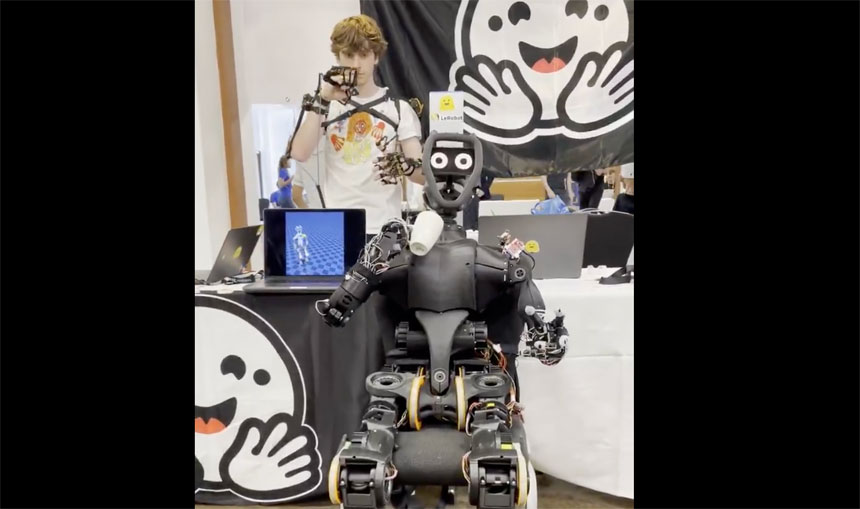
    Nvidia presented an open-source humanoid robot called Isaac GR00T N1 at its annual conference yesterday.

    The company said it was “the world’s first open, fully customizable foundation model for generalized humanoid reasoning and skills.”

    “The age of generalist robotics is here,” said Jensen Huang, founder and CEO of NVIDIA. “With Isaac GR00T N1 and new data-generation and robot-learning frameworks, robotics developers everywhere will open the next frontier in the age of AI.”

     Newton, an open-source physics engine — under development with Google DeepMind and Disney Research — purpose-built for developing robots.

    The GR00T N1 foundation model features a dual-system architecture inspired by human cognition. System 1 is a fast-thinking action model that mirrors human reflexes or intuition, while System 2 is a slow-thinking model for deliberate, methodical decision-making.

    The chip company said GR00T N1 could generalize everyday tasks — such as grasping, moving objects with one or both arms, and transferring items from one arm to another — or perform multistep tasks requiring extended context and combinations of general skills. These capabilities can be applied to material handling, packaging, and inspection cases.

    Developers and researchers can post-train GR00T N1 with real or synthetic data for their specific humanoid robot or task.

    In his GTC keynote, Huang demonstrated 1X’s humanoid robot autonomously performing domestic tidying tasks using a post-trained policy built on GR00T N1. The robot’s autonomous capabilities are the result of an AI training collaboration between 1X and NVIDIA.

    Among the additional leading humanoid developers worldwide with early access to GR00T N1 are Agility RoboticsBoston Dynamics, Mentee Robotics, and NEURA Robotics.

  • The 1EdTech Consortium Released a New Comprehensive Learning Record (CLR) for Digital Credentials

    The 1EdTech Consortium Released a New Comprehensive Learning Record (CLR) for Digital Credentials

    IBL News | New York

    The 1EdTech Consortium (1EdTech) released the CLR Standard 2.0, its latest innovation in digital credential technology, during the organization’s Digital Credentials Summit, which took place this month in Phoenix, Arizona.

    “With CLR Standard 2.0, we are making credentials more secure, portable, and universally verifiable, we are ensuring that every learner has the ability to own and share their achievements with confidence,” said Curtiss Barnes, CEO of 1EdTech.

    The CLR Standard establishes a common way to package credential records in formal and informal learning, regardless of who provides them to the learner.

    CLR 2.0 improves portability and verifiability, giving the earner control of their credentials by using rich human-readable and machine-verifiable metadata.

    CLR 2.0 is also designed as Verifiable Credentials (VCs), as defined by the World Wide Web Consortium (W3C), and aligns with 1EdTech’s Open Badges 3.0 standard, making it even easier to share credentials between wallets.

    According to a new 1EdTech report, “Six Steps for a Successful Credentialing Program: A Case Study Review,” credentialing platforms that adhere to open standards are one of the six steps successful credentialing programs worldwide recommend.

  • Experts Say that The Future of U.S. Research Universities Is at Stake

    Experts Say that The Future of U.S. Research Universities Is at Stake

    IBL News | New York

    Public and private universities have developed a critical portion of the nation’s research and scholarship in the last 75 years since the National Science Foundation (NSF) launch in 1950. Faculty-led researchers and students have spread doctoral education and become innovators and leaders of society and the world’s largest economy.

    Of the over 2,000 research universities in the country, 146 are Carnegie R1 (doctoral universities with very high research intensity).

    Universities collectively spent $97 billion on research, of which $54 billion was federal support. Twenty most prominent universities receive a third of the support.

    But will the American research universities make it to their 100th birthday?

    According to Dr Robert A Brown, President Emeritus and Computing and Data Sciences Professor at Boston University, various forces threaten the viability of U.S. research universities.

    Among those forces, experts note the new political landscape, with the Trump administration’s announcements to cut research funds, the decline of college-age students, massive pedagogical and operational upheavals caused by AI, and the expectation that the cost of education will come down with chatbots and copilots replacing staff.

    Professor Bryan Alexander assembled evidence of the adverse effects felt in the academic world after President Trump took office.

    “Most of the Institute for Education Sciences (IES) unit, a research team that’s part of the National Center for Education Statistics (NCES), have been laid off. Nearly $1 billion in IES research contracts has been cut. More than $330 million was cut from the Center’s Regional Educational Laboratories and Equity Assistance Centers. At least thousands of students have seen internships with the federal government vanish, or at least become unclear if they will happen, due to cuts.”

    Among other cuts, Bryan Alexander noted these:

    • MIT, expecting federal losses of $100 million or more, suspended non-faculty hiring.

    • The University of Louisville has ordered a hiring freeze, apparently across the board, until summer.

    • North Carolina State University is going to implement a total hiring freeze.

    • Columbia University’s medical school announced a hiring freeze.

    • Northwestern University announced a 10% cut to non-personnel expenses.

    The new administration cut $600 million in DEI-related campus grants.

  • Chinese Agentic Platform Manus Faces Doubts About Its Technological Capabilities

    Chinese Agentic Platform Manus Faces Doubts About Its Technological Capabilities

    IBL News | New York

    Chinese AI agentic platform Manus, which has generated much hype, is facing doubts about its technological capabilities. Significantly, few people could test the product after its surge in popularity owing to an apparent shortage of server capacity.

    Manus has gained attention for its claimed ability to handle complex tasks. Investors are hailing it as another breakthrough following the low-cost AI models from DeepSeek.

    The head of product at Hugging Face called Manus “the most impressive AI tool I’ve ever tried.” AI policy researcher Dean Ball described Manus as the “most sophisticated computer using AI.” In just a few days, the official Discord server for Manus grew to over 138,000 members.

    Manus wasn’t developed from scratch. The platform uses a combination of existing and fine-tuned AI models, including Anthropic’s Claude and Alibaba’s Qwen, to perform tasks such as drafting research reports and analyzing financial filings.

    On its website, Butterfly Effect — the Chinese startup behind Manus — gives a few wild examples of what the platform can accomplish, from buying real estate to programming video games.

    Also, this month, Manus announced a partnership with the team behind tech giant Alibaba’s Qwen AI models, a move that could bolster the AI start-up.

    Manus AI, which has offices in Beijing and Wuhan, has marketed its product by completing dozens of tasks for users on X for free. Its launch quickly went viral on Chinese social media, as many drew parallels with the Hangzhou-based chatbot DeepSeek.

    However, the AI agent remains accessible by invitation only, and the company’s website struggles with increasing malfunctions, it admitted on X.

    Forbes: China’s Autonomous Agent, Manus, Changes Everything

  • Johns Hopkins University Will Eliminate 2,000 Jobs After Losing $800 Million in Federal Funding

    Johns Hopkins University Will Eliminate 2,000 Jobs After Losing $800 Million in Federal Funding

    IBL News | New York

    Johns Hopkins University said on Thursday that it would eliminate more than 2,000 jobs in the U.S. and abroad after it lost $800 million in federal funding from USAID for its international programs due to the Trump administration’s steep cuts.

    Johns Hopkins appears to be the most profoundly affected of the major research institutions, reeling from cuts to federal money that their faculties depend on to conduct research studies and run labs.

    The layoffs—the largest in the university’s history—will involve 247 domestic workers for the university based in Baltimore and an affiliated center.

    The cuts will affect the university’s Bloomberg School of Public Health Medical School and an affiliated nonprofit, Jhpiego, which focuses on maternal health and disease prevention. Another 1,975 positions will be cut in 44 countries.

    These layoffs come as President Donald Trump continues his efforts to reshape the federal government, including gutting USAID. Secretary of State Marco Rubio announced earlier this week that the Trump administration is canceling 83% of the agency’s programs and intends to fold its remaining programs under the State Department.

    Last week, the Trump administration pulled $400 million from Columbia University, canceling grants and contracts.

    Higher education institutions nationwide are uneasy about the future of federal funding in the second Trump Administration.

  • OpenAI Releases ‘Responses API’ to Help Businesses Build AI Agents

    OpenAI Releases ‘Responses API’ to Help Businesses Build AI Agents

    IBL News | New York

    OpenAI released yesterday new tools designed to help developers build custom AI agents that can perform web searches, scan through company files, and navigate websites, similar to Operator.

    The tools are part of OpenAI’s new Responses API, which effectively replaces its Assistants API.

    This launch occurs amid the agent hype phenomenon, with a new agent platform called Manus developed by a Chinese startup called Butterfly Effect.

    Earlier this year, OpenAI introduced two AI agents in ChatGPT: Operator, which navigates websites on your behalf, and Deep Research, which compiles research reports. Both tools offered a glimpse at what agentic technology can achieve.

    The Responses API also includes a file search utility that can quickly scan across files in a company’s databases to retrieve information. In addition, the model generates mouse and keyboard actions, allowing developers to automate computer use tasks like data entry and app workflows.

    Alongside the Responses API, OpenAI is releasing an open-source toolkit called the Agents SDK. This toolkit offers developers free tools to integrate models with their internal systems, implement safeguards, and monitor AI agent activities for debugging and optimization purposes. The Agents SDK is a follow-up to OpenAI’s Swarm, a framework for multi-agent orchestration that the company released late last year.

    In sum, OpenAI’s new set of APIs and tools for agentic applications are:
  • The Department of Education Fires 1,300 Workers, as a First Step to Shutting Down the Agency

    The Department of Education Fires 1,300 Workers, as a First Step to Shutting Down the Agency

    IBL News | New York

    The Department of Education initiated mass layoffs yesterday, reducing its workforce by nearly 50% to over 1,315 workers. Linda McMahon, the Education Secretary, said this is the first step to shutting down the whole department. [Video with the statement]

    The fired staff will be placed on administrative leave starting March 21 and receive full pay and benefits until June 9.

    Currently, the Department of Education manages federal loans for college, tracks student achievement, and enforces civil rights laws in schools.

    In addition to these laid-off workers, 572 accepted separation packages offered recently, and 63 probationary workers were terminated last month.

    The cuts were considered an additional move by President Trump, who announced it would dismantle the department soon, even though it could not be closed without Congress’s approval.

    “Today’s reduction in force reflects the Department of Education’s commitment to efficiency, accountability, and ensuring that resources are directed where they matter most: to students, parents, and teachers,” Linda McMahon, the Education Secretary, said in a statement.

    She explained the changes would not affect student loans, Pell Grants, funding for special needs students, or competitive grantmaking.

    Project 2025, a conservative blueprint for the second Trump term, laid out a detailed plan for eliminating the department and moving much of the agency’s work to other arms of the federal government. Student aid, for example, would be handled by the Treasury Department, vocational education by the Labor Department, and disability education by the Department of Health and Human Services.

    Sheria Smith, President of American Federation of Government Employees Local 252, representing more than 2,800 workers at the Education Department, said the Trump Administration had “no respect for the thousands of workers who have dedicated their careers to serving their fellow Americans” and vowed to fight the cuts.

    Becky Pringle, President of the National Education Association, the nation’s largest teachers union, said the changes would drain job training programs and increase costs of higher education.

  • OpenAI Will Bring ChatGPT to 500,00 Students and Faculty at The California State University

    OpenAI Will Bring ChatGPT to 500,00 Students and Faculty at The California State University

    IBL News | New York

    OpenAI will bring ChatGPT to 500,00 students and faculty at The California State University (CSU).

    The San Francisco-based research lab said that this is the largest organizational rollout of ChatGPT in the world.

    This setup will allow students to enrich their learning experience, acquire practical skills, and gain hands-on experience with AI.

    Meanwhile, faculty will be able to streamline administrative tasks, freeing up more time to focus on teaching, mentoring, and research.

    “We’re in the middle of a critical transition — one where broad access to AI is essential infrastructure for education,” said the institution.

  • The Trump Administration Cancels $400 million In Grants and Contracts to Columbia University

    The Trump Administration Cancels $400 million In Grants and Contracts to Columbia University

    IBL News | New York

    The Trump administration announced on Friday that it had canceled $400 million in federal grants and contracts to Columbia University.

    The White House justified its decision by blaming the university’s failure to protect Jewish students from harassment during protests last year over the war in Gaza.

    The announcement escalated the administration’s targeting of Columbia, where pro-Palestinian protests last year over the war in Gaza set off a nationwide debate over free speech, campus policing, and antisemitism and led to similar demonstrations at schools nationwide.

    The move also represents the latest response by the Trump Administration to elite higher educational institutions. It follows last year’s congressional hearings that resulted in the departure of Harvard and the University of Pennsylvania presidents. It comes after recent executive orders barring diversity, equity, inclusion, and woke programs at educational institutions that receive federal funds.

    On Monday, Linda McMahon, the newly confirmed secretary of education, issued a warning that the administration had its sights set on Columbia. Ms. McMahon warned that Columbia would face the loss of federal funding, the lifeblood of major research universities, if it did not take additional action to combat antisemitism on campus.

    Student Loans

    On the other hand, yesterday, speaking from the Oval Office, President Trump said he would soon sign an executive order directing the Education Department to modify the Public Service Loan Forgiveness Program, which forgives a portion of federal student loan debt for people who work in public sector jobs, including at nonprofit organizations.

    Trump alleges that some qualifying nonprofit organizations may “engage in illegal, or what we would consider to be improper activities.”