Category: Top News

  • Dogwood RC2 Is Here!

    dogwood

    edX released this week the first pre-release of Dogwood, the next Open edX version after Cypress.

    Dogwood RC2 is available for download and for fresh installations, but not for upgrading from Cypress. The RC1 wasn’t released, and the next RC3 is scheduled for January 6th, when upgrade scripts will become available.

    Installation instructions have been posted at this wiki page from edX. Meanwhile, the edX Release Notes page gives a sense of what is new.

    IBL provided the first Dogwood installation to the community as a testing platform.

  • Dogwood, the Fourth Open edX Named Release, Scheduled for January 26, 2016

    dogwood

    The next Open edX release called Dogwood will be available for the code developers’ community on January 26, 2016.

    Dogwood will be the fourth named release of the Open edX software, after Aspen (September 2014), Birch (March 2015) and Cypress (July 2015).

    Ned Batchelder, software architect at edX, disclosed the following planned dates for Dogwood:

    • December 21: RC1 tag in repos based on the edx.org release of December 16th.
    • December 22: RC1 Vagrant boxes are available for download. No upgrade scripts will be available yet.
    • December 29: draft release notes available
    • January 6: RC2, with upgrade scripts, available
    • January 26: Final Dogwood release available
    Dogwood will include a Django upgrade from 1.4 to 1.8, Student Notes, Badging, Otto ecommerce as well as other services that are being discussed now.
  • EdX Begins to Charge for Access to Graded Assessments

    EdX Begins to Charge for Access to Graded Assessments

    The edX organization has implemented a new revenue model on its catalog, based on charging to access graded problems. Anant Agarwal, CEO at edX, made the announcement today on the official edX blog.

    Audit learners (free learners) will continue to access the core course content, including videos, resources, discussion forum, and practice problems, but they will need to upgrade to the “verified learner status” and pay a fee (usually $50 to $100) to unlock graded assessments.

    Additionally, after the free course ends, users won’t be able to access content unless they upgrade into the paid option. This time limit feature will be set on most of the existing courses.  “Existing audit track enrollments will not be affected. Learners will be able to access all content in any course(s) they enrolled in prior to December 17, 2018,” edX explained.

    With this model, edX expects to generate a 30% increase in its overall revenue, which will be split with partners, as sources told IBL News.

    This change, aligned with the business practices of Coursera, Udacity and other competitors, comes after several months of exploring different revenue models and is part of edX’s strategy to become sustainable. Particularly, edX’s paywall will be similar to FutureLearn’s upgrading feature. Coursera was the first to charge for graded assignments three years ago.

    During the testing time prior to the implementation, edX claimed that it didn’t receive negative feedback from learners, although some university partners complained about it during the last Global Forum conference in Boston last month.

    “We have decided on a model that we feel will best drive edX forward while staying true to our mission,” explained Anant Agarwal. “We wanted to strike a balance of moving edX towards financial sustainability while maintaining a robust level of free access.”

    Also, MITx shared his view. “We support edX in its mission and path. We are working to ensure we maintain the integrity of the learning experience for all learners under this updated model. Materials for over 2,600 MIT courses will continue to be available for free to all learners on MIT OpenCourseWare (OCW).”

    Dhawal Shah, founder of Class Central, said “that edX’s paywall will now be higher than Coursera’s, especially since Coursera has born the brunt of criticism about restricting access to MOOCs, which many attributed to pressure from Coursera’s VC investors.”  “Strangely enough, with this change to edX, Coursera is now the MOOC platform that allows free users to go furthest before hitting a paywall.”

    • edX Blog: Updates To Our Platform: Achieving Long-Term Sustainability
    • Inside Higher Ed: EdX’s Struggle for Sustainability

  • Improve your Employability by Learning to Code in Python, Java, Scratch, C# at edX.org

    csonedx
    In today’s technology-driven world, there is a significant job/student gap within computer science. Clearly, a background in computer science improves employability and opens up many career opportunities.

    There are currently 600,000 open computing jobs throughout the U.S. By 2020 it is projected that there will be 1 million more computer science jobs than students learning computer science.

    Because of the Computer Science Education Week and Hour of Code, edX.org pulled together a list of free computer science courses to help teachers, students and professionals learn programming skills.

    code

    code2

    Useful Resources


  • edX Removes Free Certificates and Adds Verified and XSeries Credentials – Udacity Leads the Way

    verifiededx
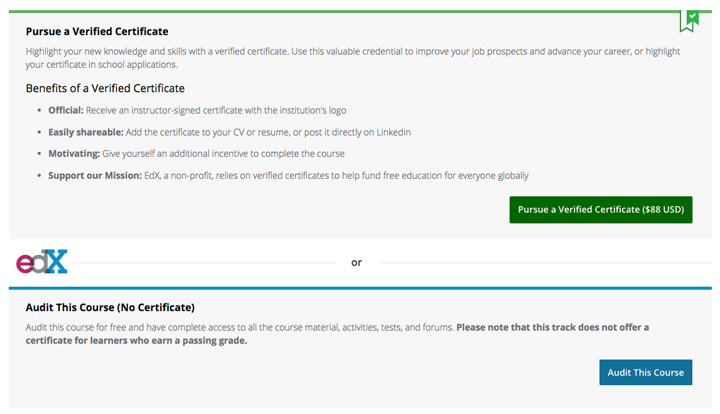
    edX has discontinued the free honor code certificates, although the old ones will remain valid. Instead, learners will be able to audit courses without a fee and have the option to apply for financial assistance to help cover 90% of  the cost of verified certificates.

    New courses on edx.org now offer two types of certificates: Verified and XSeries.

    “It seems that the top two MOOC providers in the world, Coursera and edX, are going along a similar path as they too strive to achieve sustainability. Both have made announcements to the effect that they will remove a key component of the MOOC experience,” writes Dhawal Shah in Class-Central.com this week.

    Before edX and Coursera, Udacity pioneered this formula by stopping free certificates, making graded assignments a paid feature and creating their own type of credential (Nanodegree). This way Udacity reached profitability.

    In this fight to generate revenue, some universities are doing well.


  • edX's All-New iPhone and Android Apps Allow to Watch Course Content and Basic Assessments

    iphonegwopenedxapp

    edX launched on December 7 an improved version of its app for iPhones and Android devices. It provides a much more complete course experience for learners.

    In addition to downloading and watching videos without an Internet connection, learners are able to view course content (HTML and text components), as well as complete basic assessments (checkbox, dropdown, multiple choice, and text or numerical input problems).

    There is currently a free edX mobile app for iPhones on the Apple App Store and another for Android on the Google Play Store. For iPads and Android tablets it’s not available yet.

    • See the Mobile App chapter in edX Learner’s Guide.

    [Disclosure: IBL has launched the first service of fully functioning iPhone/Android apps for independent Open edX platforms. GW SEAS’s prototype app is pictured above].


  • CharterOak State Online College Offers a Pathway to Earn College Credit through edX's Courses

    charteroak

    Another cost-effective option for students to earn affordable college credit on edX. This is the fourth initiative on university credit related to edX released this year, after the Global Freshman Academy with Arizona State University, MIT’s MicroMaster’s credential and ACE Alternative Credit Project. Currently, there are eight credit-eligible courses on edX.org.

    CharterOak State College, a Connecticut-based public online college offering bachelor’s and associate’s degree programs, will now award college credit for select edX courses –two of them for now:  MITx Introduction to Computer Science and Programming Using Python and UC BerkeleyX Engineering Software as a Service (SaaS) Part 2. Additional courses will be included in the program in the coming weeks.

    This credit will follow a “pay-when-you-pass model”. Students enroll in an edX course, successfully complete and pass the course (with an 80% grade of higher), and then decide to pay for Charter Oak credit ($100 per credit hour). This credit can be applied to credentials, continuing ed credits and completion of a college degree.

    “EdX learners around the world will now be able to earn credit for their hard work and success in MOOCs, offering an opportunity to many learners who would otherwise never have access to high-quality education and credit,” explained Anant Agarwal, CEO at edX.

    “A variety of edX partners are enthusiastic about working with us on innovative credit offerings. We look forward to announcing more credit opportunities and pathways for our learners in the coming months,” he added.


  • EdX Begins to Search a New Vice President of Product

    joeledX has begun an executive search for a new Vice President of Product, after Beth Porter decided to leave this organization on December 11.

    “Our commitment to open source and the Open edX community remains strong, and these changes will not significantly impact our resource allocation or collaborations“, has said Wendy Cebula, President and CCO.

    During this transition, Joel Barciauskas (in the picture) will continue to lead the Open edX community and manage the Open edX engineering team.


    Dec 8, 2015 – Posted in the Open edX Portal: Upcoming Change in edX Leadership

  • Proversity.org Open edX MOOC Provider Raises $1.6 Million

    proversity
    Proversity.org, a London-based MOOC provider and early adopter of the Open edX system, has raised $1.6M (£1 million) from the venture capital firm RSBC Financial Services, according to the company. Funding will be used to recruit managers on sales, digital production and software engineering.

    With a network in London, Santiago, Boston and Cape Town, Proversity has worked on training and professional development projects for clients such as the Bank of England, the British Army, Lloyds Bank and Family Mosaic.

  • Learning Analytics Is a Must-Have Feature 

    analytics


    “Analytics are no longer a nice-to-have feature”, stated Dr. Linda Baer during the first Open edX Universities Symposium, celebrated last month at The George Washington University in DC.

    Baer presented a graphic forecasting the evolution of the analytics technology, from descriptive and diagnostic to predictive and prescriptive analytics, where educators will be able to advance what will happen and how can they make it happen.

    Currently, learning analytics technology is just on the first stage of the graphic.

    INSIGHTS ANALYTICS ON OPEN EDX

    The edX organization offers the Insights Analytics server to their paid partners –all of the universities and known brands that belong to the xConsortium.

    Last week, IBL was able to complete the first installation of the last version of Insights Analytics –including Video Insights– on the Open edX community. GW Engineering’s Open edX platform is currently taking advantage of this service.

    analyticsonopenedx