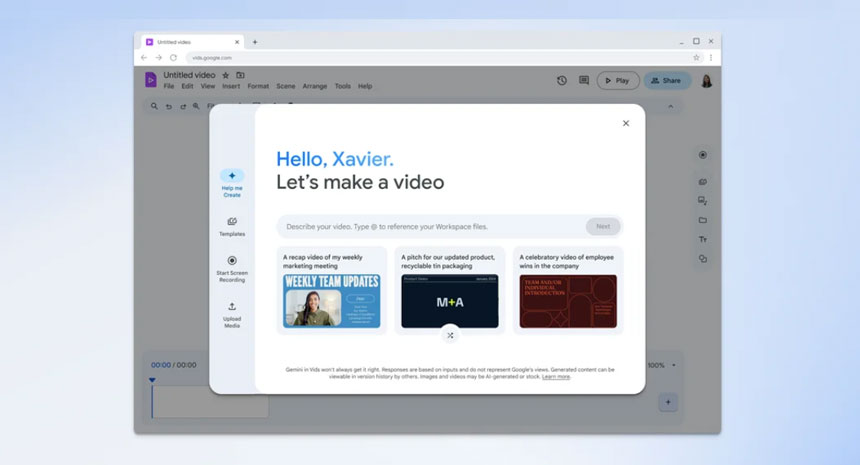
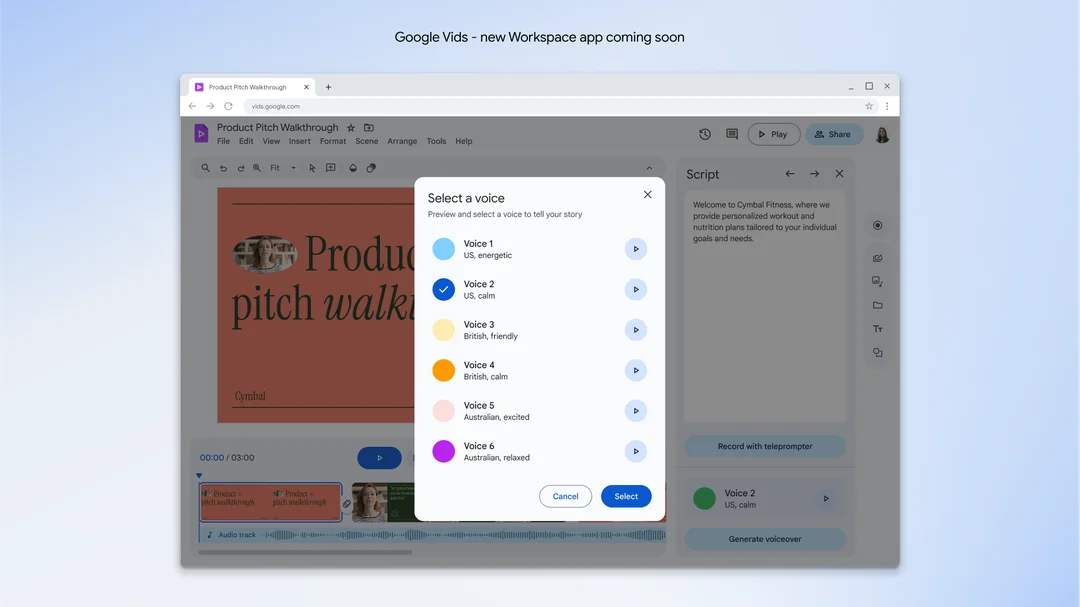
Google will release in June a new Workspace AI-powered app for video creation that generates easily-editable storyboards.
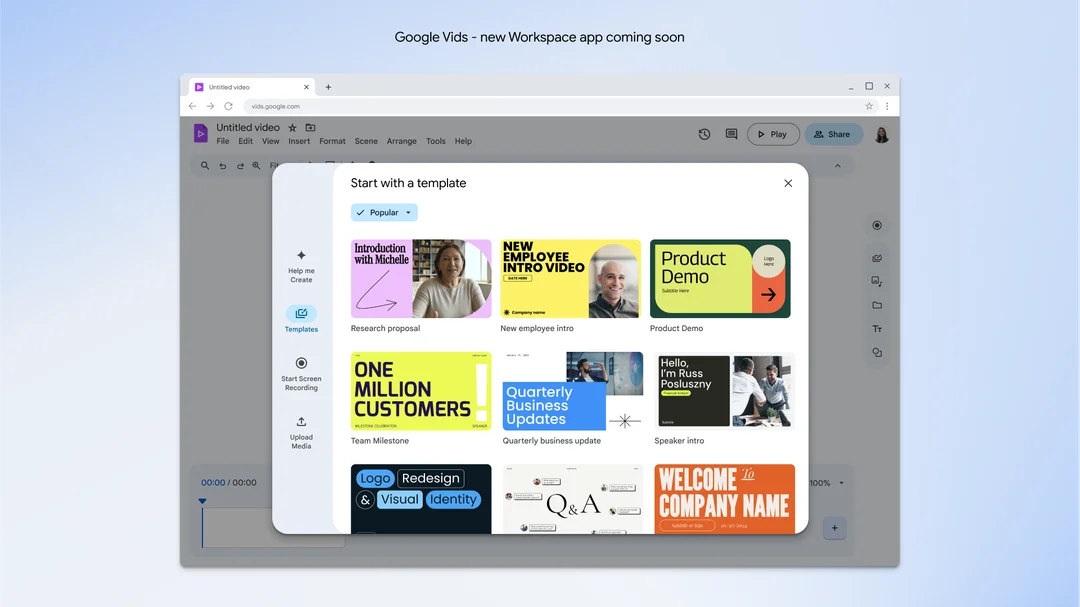
The user chooses then a style from a variety of templates in Google Vids and pieces together a draft with suggested scenes from stock videos, images, background music, and voice-over —the user’s own or one from a pre-set catalog.
“Google Vids is your video, writing, production, and editing assistant all in one,” said the company.
However, Google Vids, which sits alongside Google Docs, Sheets, and Slides, is meant more for things people do at work like making a pitch, updating the team, and explaining a complicated concept.
This is not a Hollywood production, it’s a work product, to use at work.
It’s a kind of tool that transforms Google Slides into a video app after collecting files from Drive and elsewhere, or by prompting on Gemini AI. Then the finished product in Slides gets converted into a video.
There are lots of tools aiming for videos from messaging tools like Loom, Descript, ClickUp, or even Vimeo.
.
There is no date for public availability yet, as OpenAI says “it is taking a cautious and informed approach to a broader release due to the potential for synthetic voice misuse.”
“Any broad deployment of synthetic voice technology should be accompanied by voice authentication experiences that verify that the original speaker is knowingly adding their voice to the service and a no-go voice list that detects and prevents the creation of voices that are too similar to prominent figures,” stated the company.
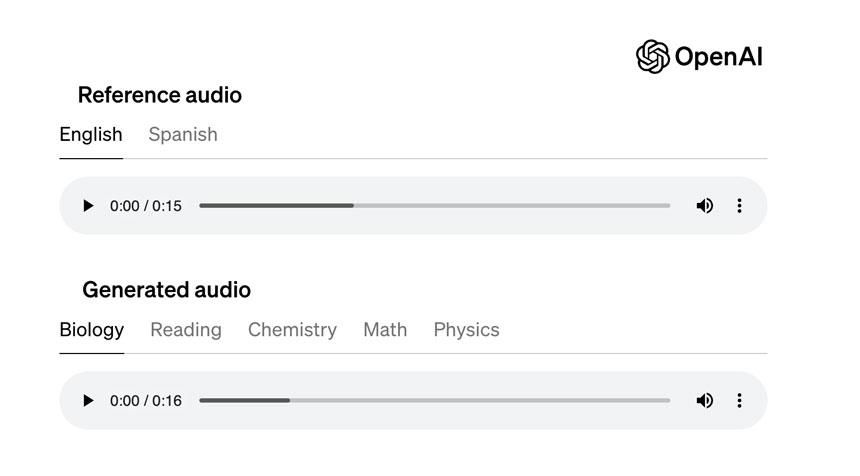
Under development for about two years, this tool works like an expansion of the company’s existing text-to-speech API.
OpenAI has been testing this tool with a small group of partners, thinking about how it can be used for good across various industries.
The San Francisco-based research lab shared a few early examples, including providing real-time, personalized responses and reading assistance to non-readers and children through natural-sounding.
Another use is helping patients who suffer from sudden or degenerative speech conditions to recover their voice. The Norman Prince Neurosciences Institute at Lifespan was exploring the use of AI in clinical contexts.
One early adopter is HeyGen. It uses Voice Engine to translate a video speaker’s voice into multiple languages, preserving the native accent of the original user.
.
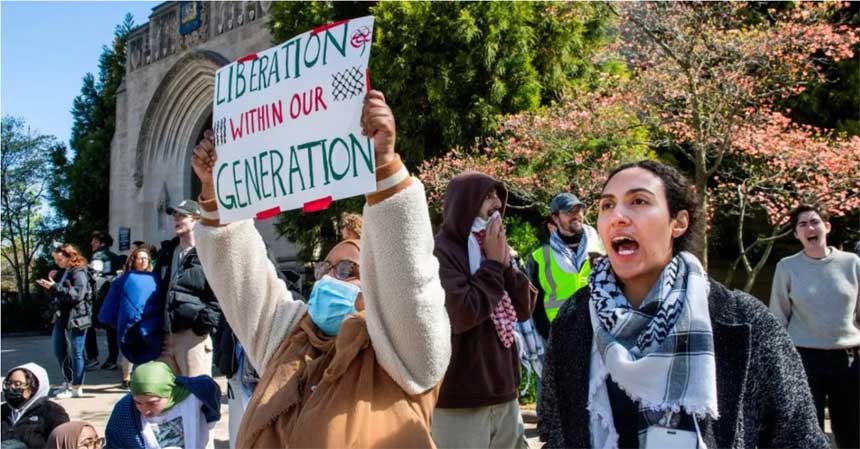
Clashes between police and students protesting the Israel-Hamas war on campuses nationwide intensified yesterday across campuses in the U.S.
Students gathered on campuses in Austin, Los Angeles, Boston, Rhode Island, Pittsburgh, San Antonio, and New York, in some cases, facing off with the police.
Meanwhile, as new protests were emerging, college administrators moved to prevent pro-Palestinian encampments from taking hold as they had at Columbia University. They called for police deployment in tense new confrontations that have already led to dozens of arrests.
• At the University of Texas at Austin, police violently took two dozen demonstrators into custody after refusing to disperse.
• At Brown University in Rhode Island, scores of students pitched tents on the campus’s Main Green, promising to stay until they were forced off.
• Two students were arrested at Ohio State University,school officials said, during an on-campus protest that had since dispersed.
• At the University of Southern California (U.S.C.), protestors started being detained as helicopters buzzed overhead.
Protesters formed a circle with locked arms in the center of campus, in defiance of an earlier warning that they would be arrested by the Los Angeles Police Department. Police in riot gear, holding batons, surrounded the group before arresting individuals one by one.
Many U.S.C. students were angered at the cancellation of a commencement address by the valedictorian Asna Tabassum, who is Muslim.
Also, yesterday, the speaker of the House of Representatives, Mike Johnson, visited the Columbia campus in New York, where university officials were seeking to negotiate with protest leaders to end the encampment of around 80 tents on a central campus lawn.
Mike Johnson said the school’s president, Nemat Shafik, should resign if she could not immediately get the situation under control, calling her an “inept leader” who had failed to guarantee the safety of Jewish students.
The speaker said there could be an appropriate time for the National Guard to be called in, and that Congress should consider revoking federal funding if universities could not keep the protests under control.
Republican lawmakers have accused university administrators for months of not doing enough to protect Jewish students on college campuses, seizing on an issue that has sharply divided Democrats.
The demonstrations spread overseas as well, with students on campuses in Cairo, Paris and Sydney, Australia, gathering to voice support for Palestinians and opposition to the war.
.
Pro-Palestinian protests sweep U.S. college campuses following dozens of students arrested at Columbia, NYU, and Yale on Monday night due to alleged antisemitic messages. Meanwhile, Columbia University canceled in-person classes. [Photos: See scenes of protests.]
Protests over the war in Gaza at a handful of elite American universities had officials scramble to defuse demonstrations.
In addition to rallies, encampments have been set up at the University of California at Berkeley, MIT, the University of Michigan, Emerson College, and Tufts.
“We stand with Palestine and we stand with the liberation of all people,” one protester said. Others were likening the rallies to historic demonstrations over the Vietnam War and apartheid in South Africa.
Recent videos posted online have appeared to show some protesters near Columbia expressing support for the unprecedented Hamas attack on Israel. Democratic Congresswoman Kathy Manning, who toured Columbia on Monday, said she had seen protesters there calling for Israel’s destruction.
The wave of demos has been marred by alleged antisemitic incidents, which the White House has condemned.
When asked about the rallies on Monday, President Joe Biden said he condemned both “the antisemitic protests” as well as “those who don’t understand what’s going on with the Palestinians”.
Students on both sides say there has been a rise in both antisemitic and Islamophobic incidents since Israel’s campaign in Gaza.
The NYU protesters were calling on their institution to disclose and divest its “finances and endowments from weapons manufacturers and companies with an interest in the Israeli occupation”.
The attack on southern Israel on 7 October saw about 1,200 Israelis and foreigners, mostly civilians, killed and 253 others taken back to Gaza as hostages. Israel responded by launching its most intense-ever war in Gaza, intending to destroy Hamas and free the hostages. More than 34,000 Palestinians in Gaza, most of them children and women, have been killed in the conflict.
.
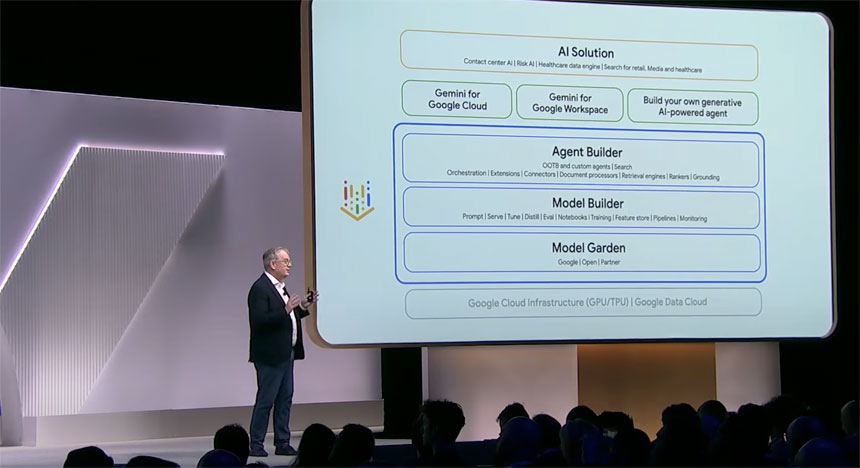
Google launched this month, during its Cloud Next 2024 event, Vertex AI Agent Builder, a no-code console for developers to create production-grade AI agents using natural language.
It uses open-source frameworks like LangChain on Vertex AI. Developers create agents by defining the goal, providing step-by-step instructions, and sharing conversational examples.
They can stitch together multiple agents, with one agent functioning as the main agent and others as subagents for complex goals. Agents can call functions or connect to applications to perform tasks for the user.
Vertex AI Agent Builder can improve accuracy and user experience by grounding model outputs using vector search or Google Search to build custom embeddings-based RAG systems.
“Vertex AI Agent Builder allows people to very easily and quickly build conversational agents,” said Google Cloud CEO Thomas Kurian [video].
During the same event, Google also announced Gemini 1.5 Pro, which can process up to 1 million tokens, around four times the amount of data that Anthropic’s Claude 3 model can handle and eight times as much as OpenAI’s GPT-4 Turbo.
This allows tasks like analyzing code libraries, reasoning across lengthy documents, and holding long conversations.
Google has made Gemini 1.5 Pro available in a public preview via the Gemini API in Google AI Studio.
Meanwhile, Google’s Vertex AI Model Garden is expanding the variety of available open-source models, currently providing developers with over 130 curated models.
.
The next big breakthrough in AI is AI Agents. This is when AI goes from being used as an assistant to chat with, to using AI to accomplish complete tasks that a human might otherwise have to perform. This moves AI from being a "read-only" operation to fundamentally a "read/write"…
The 2024 annual ASU+GSV Summit drew over 7,000 learning leaders in an event that took place on April 14–17, 2024 at the Manchester Grand Hyatt San Diego under the theme ‘Here Comes the Sun.’
This ASU+GSV Summit, which celebrated its 15th year, featured groundbreaking discussions, mostly related to generative AI, that are shaping the future of education. [Watch video talks.]
In addition, about 15,000 attendees participated in a special AIR Show on AI revolution in education on April 13–15 at the San Diego Convention Center.
This new event was free, while the regular access to the ASU+GSV Summit was priced at $5,000. It featured more than 400 speakers and showcased academic and commercial initiatives on generative AI for K-12, higher ed, and the workforce. It also held live concerts and performances.
The two conferences highlighted the idea of the impact and fast widespread adoption of generative AI in education, at a speed faster than any other technology has reached in the past 50 years.
The ASU+GSV Summit, co-founded by Michael Moe and Deborah Quazzo, began in 2010 with acollaboration between venture capital firm Global Silicon Valley (GSV) and Arizona State University (ASU).
“Obstacles create opportunities” – Michael Moe (Founder & CEO, GSV).
Meta released this week Llama 3, with two models: Llama 3 8B, which contains 8 billion parameters, and Llama 3 70B, with 70 billion parameters. (The higher-parameter-count models are more capable than lower-parameter-count models.)
Llama 3 models are now available for download and experience at meta.ai. They will soon be hosted in managed form across a wide range of cloud platforms, including AWS, Databricks, Google Cloud, Hugging Face, Kaggle, IBM’s WatsonX, Microsoft Azure, Nvidia’s NIM, and Snowflake. In the future, versions of the models optimized for hardware from AMD, AWS, Dell, Intel, Nvidia, and Qualcomm will also be made available.
Llama 3 models power Meta’s Meta AI assistant on Facebook, Instagram, WhatsApp, Messenger, and the web.
“Our goal in the near future is to make Llama 3 multilingual and multimodal, have longer context, and continue to improve overall performance across core [large language model] capabilities such as reasoning and coding,” Meta wrote in a blog post.
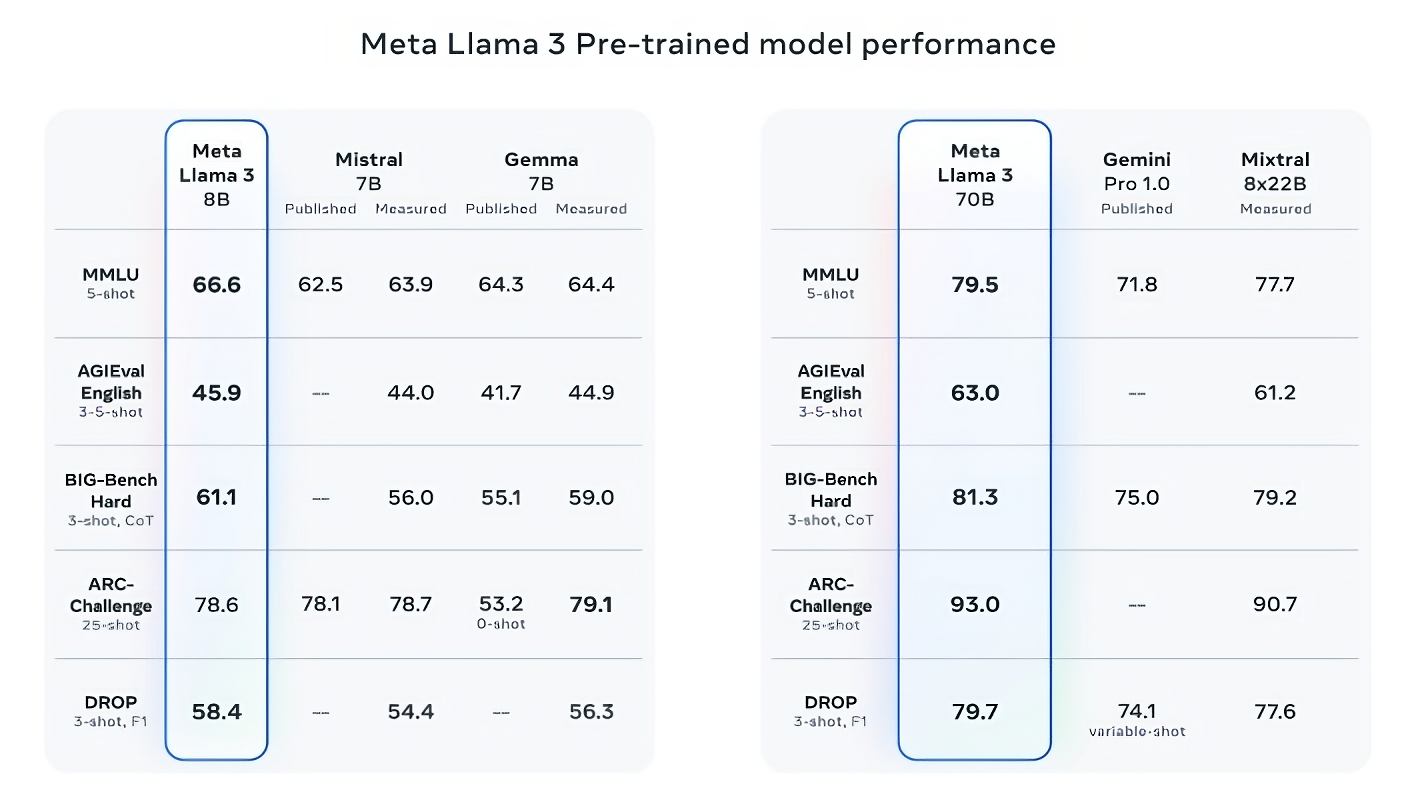
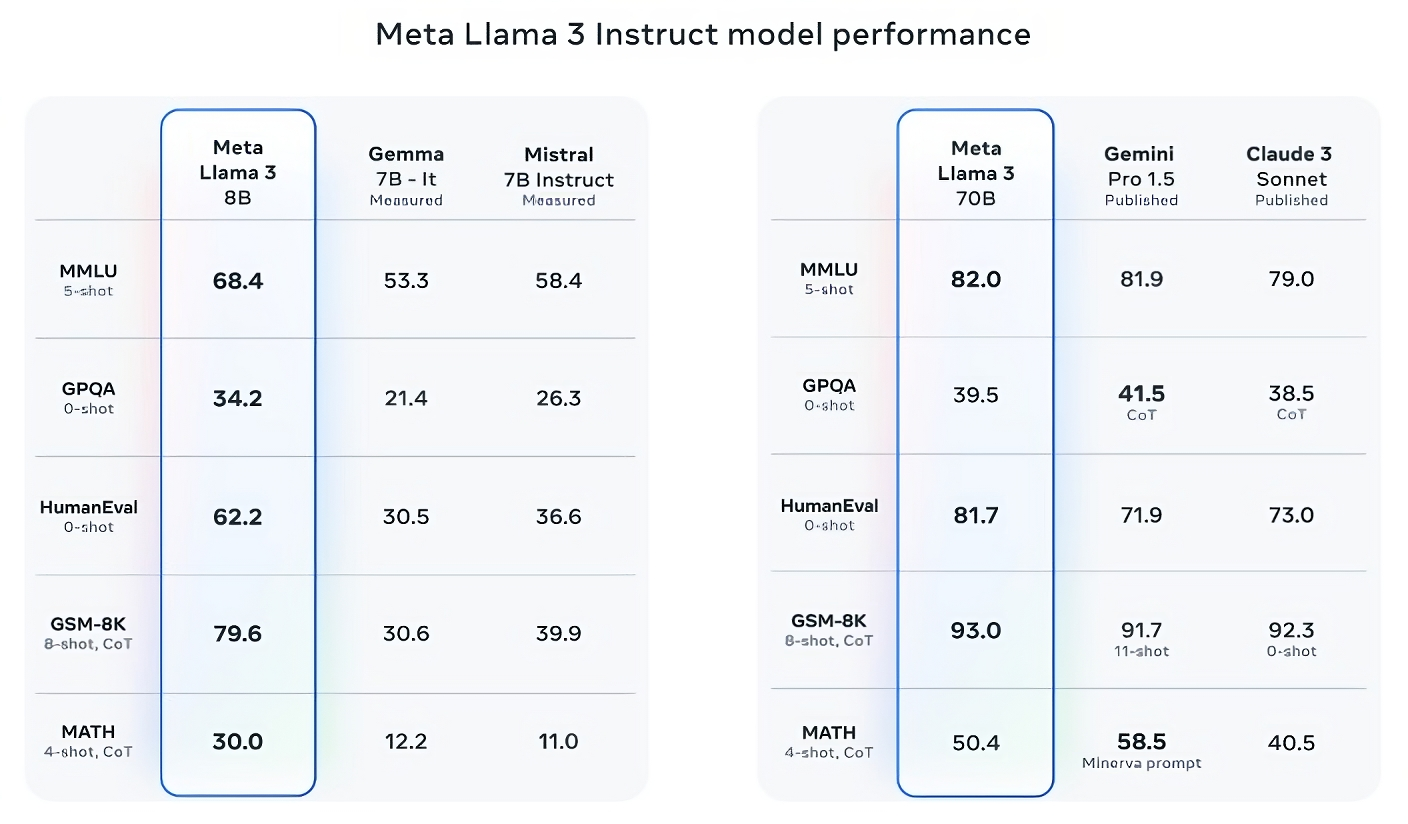
The company said that these two 8B and 70B models, trained on two custom-built 24,000 GPU clusters, are among the best-performing generative AI models available today. To support this claim, Meta pointed to the scores on popular AI benchmarks like MMLU (which attempts to measure knowledge), ARC (which attempts to measure skill acquisition), and DROP (which tests a model’s reasoning over chunks of text).
Llama 3 8B bests other open models such as Mistral’s Mistral 7B and Google’s Gemma 7B, both of which contain 7 billion parameters, on at least nine benchmarks: MMLU, ARC, DROP, GPQA (a set of biology-, physics- and chemistry-related questions), HumanEval (a code generation test), GSM-8K (math word problems), MATH (another mathematics benchmark), AGIEval (a problem-solving test set) and BIG-Bench Hard (a commonsense reasoning evaluation).
Llama 3 70B beats Gemini 1.5 Pro on MMLU, HumanEval, and GSM-8K, and — while it doesn’t rival Anthropic’s most performant model, Claude 3 Opus — Llama 3 70B scores better than the second-weakest model in the Claude 3 series, Claude 3 Sonnet, on five benchmarks (MMLU, GPQA, HumanEval, GSM-8K and MATH).
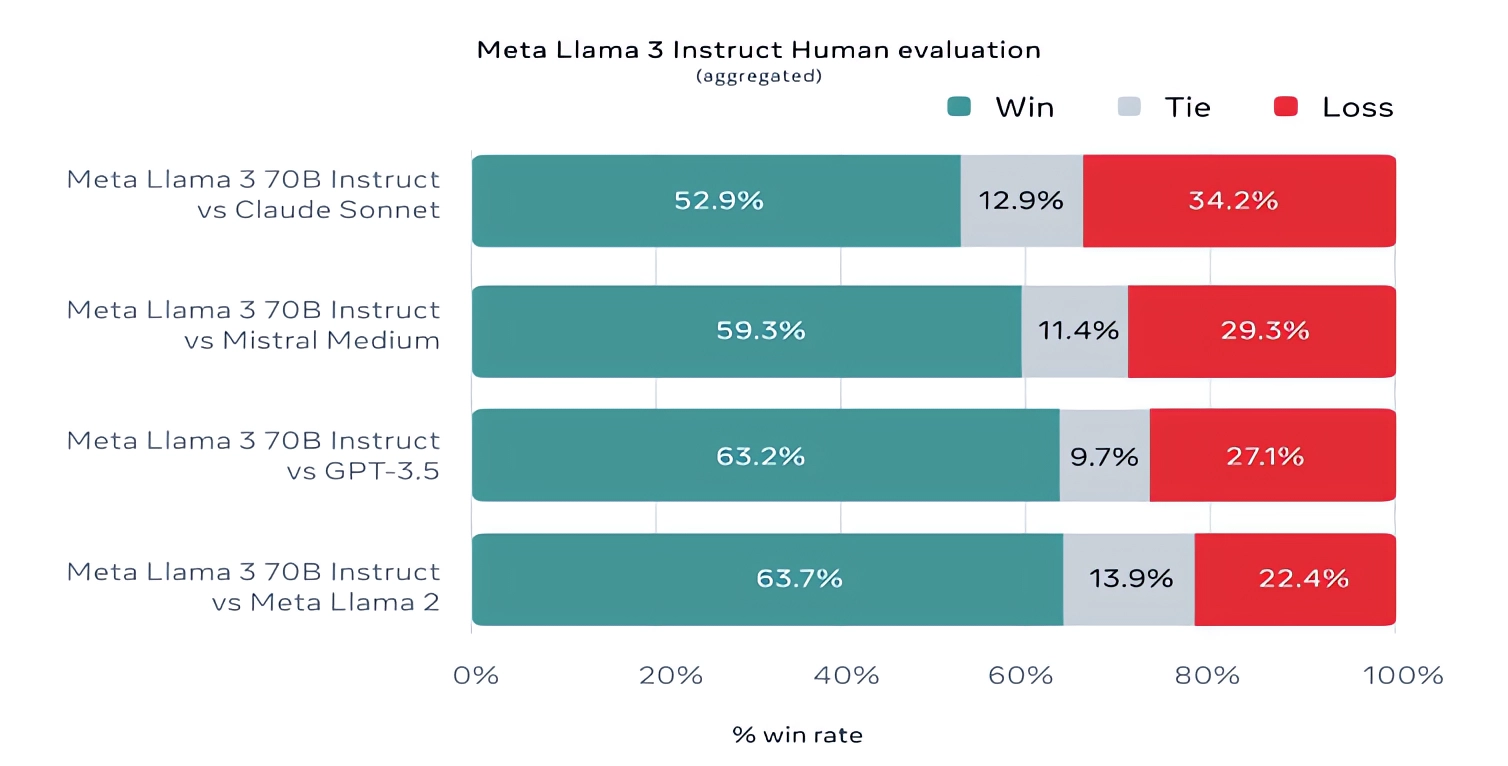
Meta also developed its own test set covering use cases ranging from coding and creative writing to reasoning to summarization. Llama 3 70B came out on top against Mistral’s Mistral Medium model, OpenAI’s GPT-3.5, and Claude Sonnet.
.
Meta Llama 3 is very good, especially for such a small model. We can put in a multi-page prompt like our negotiation simulator (https://t.co/j6BcWh4zFb) & it is able to follow the complexity reasonably well. It doesn’t have the “smarts” of GPT-4 class, but impressive nonetheless. pic.twitter.com/qMaRtwogqA
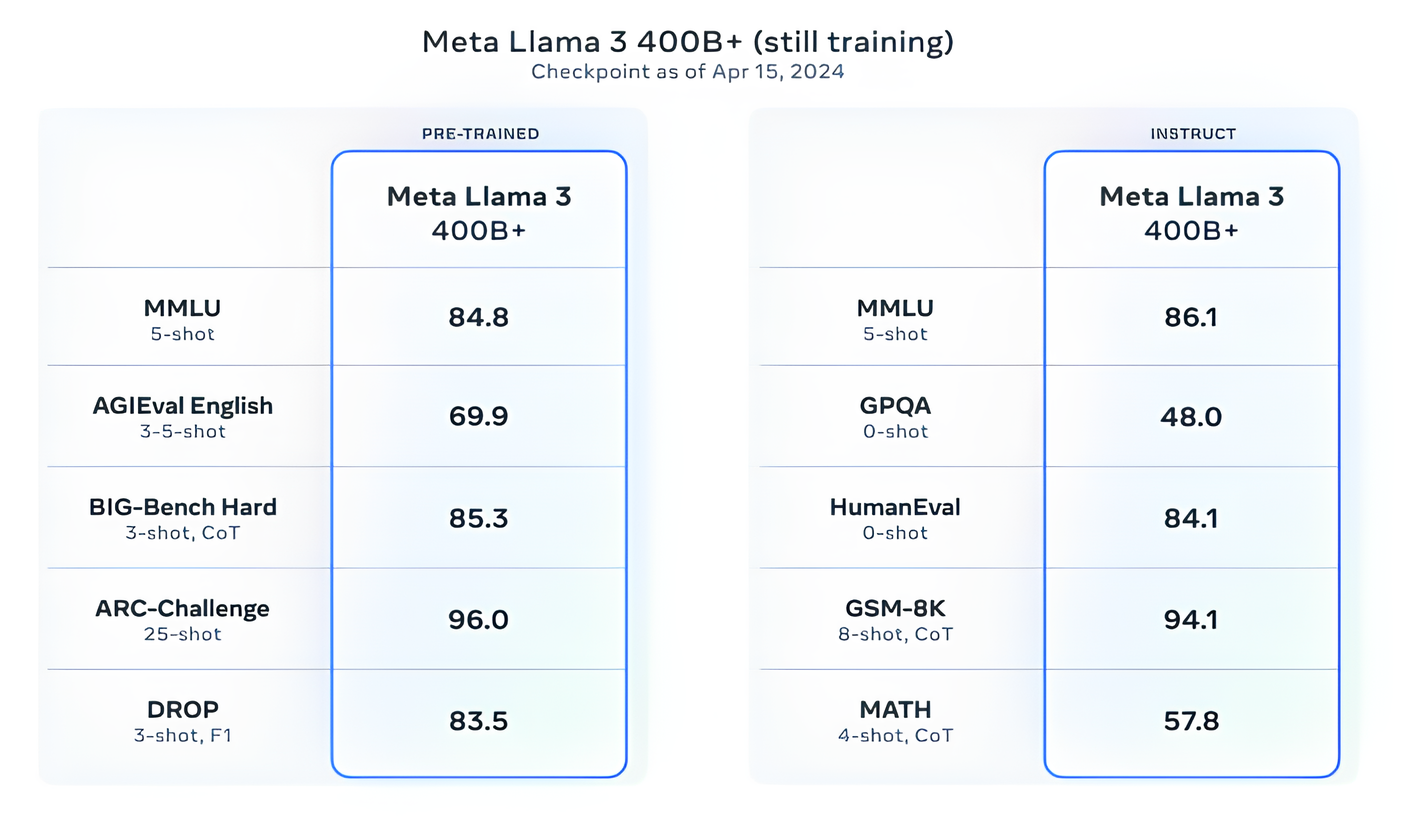
The more I use Llama 3 the more I think that Zuck may have just killed OpenAI and all other large proprietary AI vendors. The gap between latest GPT4 and Llama 70b is virtually non existent. Even if OpenAI releases GPT5 now, 400b Llama 3 is still training and will most likely be…
Both college professors and students are increasingly automating some tasks through AI to free up time and avoid fatigue or boredom, allowing them more personalized instruction — despite issues such as accuracy, plagiarism, and ethical integrity.
A report by Tyton Partners and Turnitin found half of college students used AI tools in Fall 2023. The percentage of faculty members grew to 22% in the fall of 2023.
A variety of AI tools and platforms — such as ChatGPT, Writable, Grammarly, and EssayGrader — can assist teachers in grading papers faster and more accurately, writing feedback, developing lesson plans, and creating assignments, quizzes, polls, videos, and interactives pieces for the classroom.
Students, on the other hand, are mostly using ChatGPT and Microsoft CoPilot — which is built into Word, PowerPoint, and other products.
Schools have formed policies for students but many do not have guidelines for teachers, said CNN in a report.
Grading should remain personalized so teachers can provide more specific feedback and get to know a student’s work, and, therefore, progress over time.
In terms of grading, experts suggest using AI to look at certain metrics — such as structure, language use, and grammar — and give a numerical score on those figures. However, teachers should then grade students’ work themselves when looking for novelty, creativity, and depth of insight.
An example of a lack of integrity can be uploading a student’s work to ChatGPT as well as a potential breach of their intellectual property.
AI tools like ChatGPT use such entries to train their algorithms on everything from patterns of speech to how to make sentences to facts and figures.
Some teachers lean on Houghton Mifflin Harcourt’s Writable which uses ChatGPT to help grade papers but is “tokenized,” so essays do not include any personal information, and it’s not shared directly with the system.
.
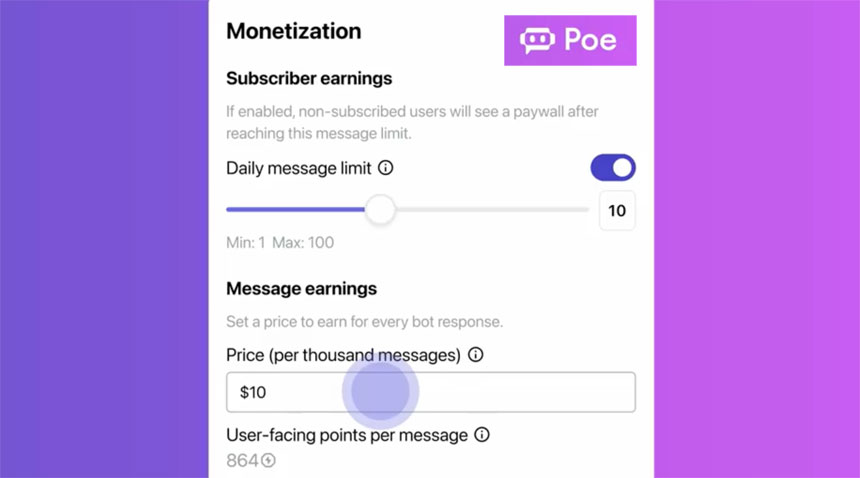
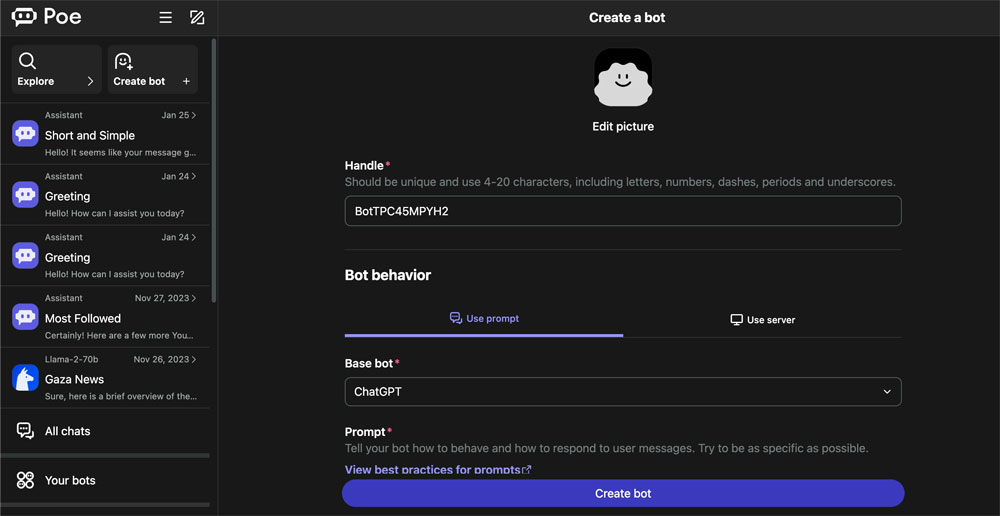
The Quora-owned AI chatbot Poe introduced this month a new revenue model based on setting a per-message price. This way, creators and developers will generate income every time a user messages them.
The new model follows the revenue-sharing program released on October 2023, which gave bot creators a cut of earnings when their users subscribe to Poe’s premium product.
Today we’re introducing a new way for model developers and bot creators to generate revenue on @poe_platform: price per message! Creators can now set a per-message price for their bots and generate revenue every time a user messages them. Thread 👇 pic.twitter.com/yx5mKgGoSQ
Poe offers users to choose from OpenAI’s ChatGPT, Anthropic’s Claude, Google’s Gemini, and other LLMs.
“This pricing mechanism is important for developers with a substantial model inference or API costs,” Adam D’Angelo noted in a post on X. “Our goal is to enable a thriving ecosystem of model developers and bot creators who build on top of models and covering these operational costs is a key part of that, in areas like tutoring, knowledge, assistants, analysis, storytelling, and image generation,” he added.
Alongside the per-message revenue model, Poe also launched an enhanced analytics dashboard that displays bot usage and revenue earnings for creators across paywalls, subscriptions, and messages.
.



![The 2024 ASU+GSV Summit Multiplied Its Audience with the AIR Show [Videos]](https://cms.iblnews.org/wp-content/uploads/2024/04/asugsv.jpg)