Category: Platforms

  • Morehouse College Launched An Innovative Pilot to Integrate AI Mentors and Avatars

    Morehouse College Launched An Innovative Pilot to Integrate AI Mentors and Avatars

    IBL News | New York

    Morehouse College launched an innovative pilot initiative in the spring 2025 semester that will allow faculty to integrate AI mentors and avatars into Computer Science, Philosophy and Religion, Education, Business, and Online courses.

    The initiative is named the “Artificial Intelligence – Pedagogical Innovative Leaders of Technology (AI-PiLOT) Fellows Program! 🚀

    “With the help of cutting-edge tools from ibl.ai integrated into the Canvas LMS, five faculty fellows will work together to develop AI-enhanced course modules using novel AI pedagogical tools with their own AI avatars and AI mentors,” Juana Mendenhall, Ph.D., Vice Provost at Morehouse College’s Walter E. Massey wrote in her LinkedIn account.

    Morehouse College’s goal is to lead the way in establishing how to use AI tools in Liberal Arts education while remaining human-centered.

    LinkedIn. ibl.ai and Morehouse College: 2025 AI Initiative

  • Western Governors University Will Provide Engineering and Guidance to the Open edX Platform Organization

    Western Governors University Will Provide Engineering and Guidance to the Open edX Platform Organization

    IBL News | New York

    Open edX, a leading open-source platform and global community stewarded by Axim Collaborative has established a new category of institution-level partnerships called Mission Aligned Organization (MAO). This category is dedicated to accelerating the development of the Open edX platform.

    The first organization to join the project is Western Governors University (WGU), the largest nonprofit university in the U.S.

    This institution has committed to providing a dedicated team of ten engineers, guidance from senior WGU leaders, and product management services.

    “Open edX is a highly scalable, open-source technology platform that has enabled innovation and fast technology implementation that is crucial for our students’ learning outcomes,” said David Morales, senior vice president for technology and CIO at WGU.

    “We are committed to supporting WGU students with high-quality learning experiences and are also pleased to support thousands of other organizations embracing competency-based learning, student-first approaches, and solutions for documenting skills and credentials through our contributions to the Open edX project,” he added.

    Morales will join the Technical Oversight Committee to support strategy, including platform architecture design, tech stack, and design templates.

    The immediate priorities for the WGU engineers on the project include building a roles and permissions framework, creating better facilities for extracting data, setting up libraries of atomic learning units, and improving the upgrade experience for developers.

    Axim Collaborative said, “With WGU’s participation, the Open edX project expects to deepen its ability to support competency-based education, which measures skills and learning rather than time spent in a classroom.”

    “Students earn competency units (the equivalent of credit hours) when they demonstrate skill proficiency through completing performance and objective assessments. As a result, students progress through courses as they prove mastery of the material rather than advancing only when a semester or term ends.”

    The Open edX platform is a leader in learning science and instructional design and pioneered massive open online courses (MOOCs). Since its founding in 2012, the platform has evolved into one of the top learning solutions worldwide, supporting high-quality, high-scale online learning in higher education, enterprise, and government organizations.

    Supported by developers, researchers, and users, the Open edX platform empowers anyone to design or enhance courses and programs.

    WGU adopted the Open edX platform in 2022 to deliver course content to its students. As part of this new collaboration, WGU will help develop additional features and capabilities of the platform, driving innovation that benefits the Open edX ecosystem.

    “WGU’s contributions will help extend the Open edX platform to support better competency-based learning pathways, mastery learning, and microcredentials,” said Edward Zarecor, vice president of engineering for the Open edX platform, Axim Collaborative.

    “We are delighted to see mission-driven organizations collaborate to accelerate innovation around high-impact solutions. WGU’s significant contribution will help all organizations leveraging the platform and continue to grow the Open edX ecosystem of contributors,” said Ferdi Alimadhi, Chief Technology Officer of Open Learning, MIT, and member of the Technical Oversight Committee.


    • Blog: WGU & the Open edX Project: Scaling Solutions to Accelerate Access to Competency-Based Learning

  • Facing the advances of AI, Software Engineers Will Evolve But Not Suffer Extinction

    Facing the advances of AI, Software Engineers Will Evolve But Not Suffer Extinction

    IBL News | New York

    Software engineers are leading the charge in adopting AI agents as coding assistants.

    According to a survey by Evans Data, a research firm, nearly two-thirds of software developers already use AI coding tools. Experts say these AI agents improve developers’ daily productivity by between 10 percent and 30 percent.

    These tools suggest lines of code, identify bugs, run basic tests, translate old software into modern programming language, and generate explanatory documentation. However, they still make mistakes.

    The dire warnings that AI could soon automate away millions of software engineering jobs are not shared by experienced developers, industry analysts, and academics.

    The New York Times summarized in an article that the outlook for software developers is more likely to be evolution than extinction.

    The dominant thinking is that better tools have automated some coding tasks for decades, but the demand for software and the people who make it has only increased.

    According to this view, AI will accelerate that trend by leveling up the art and craft of software design and hyper-charging productivity.

    “The skills software developers need will change significantly, but AI will not eliminate the need for them,” said Arnal Dayaratna, an analyst at IDC, a technology research firm. “Not anytime soon anyway.”

    The uncertainty is how fast the technology will improve and how far it can go.

    Mark Zuckerberg, Meta’s CEO, has predicted that sometime this year, AI will effectively match the performance of a midlevel software engineer.

    To be relevant in the future workforce, entry-level developers are taking training programs starting with AI fundamentals courses and getting hands-on experience using AI assistants to write software applications.

    To be more effective, they will need to learn how to manage AI tools and cultivate creativity, critical thinking, problem-solving, communication, and empathy.

    A wealth of high-quality data used to train them fuels the progress—online software portfolios, coding question-and-answer websites, and documentation and problem-solving ideas posted by developers.

    Major business software firms like Microsoft, IBM, and Salesforce have jumped in to offer AI-assisted coding programs. Microsoft’s GitHub Copilot, launched in 2021, is the early commercial leader.

    According to PitchBook, which tracks start-ups, investment in coding assistants reached nearly $1.6 billion in 2024, triple the previous year.

    Blog: New Junior Developers Can’t Actually Code

  • Google’s White Paper Explains How GenAI Is Building the Campus of Tomorrow

    Google’s White Paper Explains How GenAI Is Building the Campus of Tomorrow

    IBL News | New York

    More than half of colleges and universities are focused on staying ahead in the generative AI race by harnessing their data.

    A white paper from Google Cloud, released by the Chronicle of Higher Education, highlights that campuses are demonstrating remarkable resilience and creativity by using GenAI and multimodal models for personalized learning and other uses.

    “With the right approach and a trusted platform, GenAI can help your institution personalize content across every medium, gain valuable insights from student data, and achieve measurable ROI —all with enterprise-grade security and scalability,” says the report.

    Roy Daiany, Industry Director for Education and Careers at Google, explained, A university’s first-party data is its competitive differentiator. By effectively harnessing that data and combining it with AI, institutions are able to lower costs and increase efficiency.”

    Download the Report (PDF)

    [Disclosure: ibl.ai, the parent company of iblnews.org, is a partner of Google Cloud]

  • PwC Report Offers a Set of Predictions for 2025 About Generative AI

    PwC Report Offers a Set of Predictions for 2025 About Generative AI

    IBL News | New York

    It is vital to make AI intrinsic to the organization; AI strategies will put any company ahead or make it hard to catch up. Even the internet (invented in 1983) didn’t move so fast.

    This is one of the primary outcomes of the report “2025 AI Business Predictions,” which PwC presented this month. Based on its real-world experience helping clients reinvent their businesses with AI, the company said these predictions indicate what to expect in the next 12 months.

    “Top-performing companies will move from chasing AI use cases to using AI to fulfill business strategy,” said PwC U.S. Chief AI Officer Dan Priest.

    Another key outcome is that workflows will fundamentally change, but humans will still be instrumental in instructing and overseeing AI agents as they automate more straightforward tasks.

    The six key predictions are these:

    1. Your AI strategy will put you ahead — or make it hard to ever catch up
    2. Your workforce could double thanks to AI agents.
    3. ROI for AI depends on Responsible AI
    4. AI will be a value play — and a boon for sustainability
    5. AI will cut product development lifecycles in half
    6. AI will transform industry-level competitive landscapes 


  • OpenAI Released a Course Encouraging K-12 Teachers to Use ChatGPT

    OpenAI Released a Course Encouraging K-12 Teachers to Use ChatGPT

    IBL News | New York

    OpenAI released a free online course titled “ChatGPT Foundations for K-12 Educators,” which encourages teachers to use its tool to create lesson plans, interactive tutorials for students, and other pedagogical practices.

    The course was created in collaboration with the nonprofit organization Common Sense Media. It’s one hour long and has a nine-module program covering the basics of AI and its pedagogical applications.

    OpenAI says the course has already been deployed in “dozens” of schools, including the Agua Fria School District in Arizona, the San Bernardino School District in California, and the charter school system Challenger Schools.

    OpenAI is aggressively going after the education market, which it sees as a critical growth area.

    In September, OpenAI hired former Coursera chief revenue officer Leah Belsky as its first GM of education and charged her with bringing OpenAI’s products to more schools. In the spring, the company launched ChatGPT Edu, a version of ChatGPT that was built for universities.

    According to Allied Market Research, AI in education could be worth $88.2 billion within the next decade.

    However, a poll by the Rand Corporation and the Center on Reinventing Public Education found that just 18% of K-12 educators use AI in their classrooms, reflecting many skeptical pedagogues.

    Late last year, the United Nations Educational, Scientific and Cultural Organization (UNESCO) pushed for governments to regulate the use of AI in education, including implementing age limits for users and guardrails on data protection and user privacy. However, little progress has been made on those fronts, especially on AI policy in general.

  • Udacity Released Its 2025 State of AI at Work Report

    Udacity Released Its 2025 State of AI at Work Report

    IBL News | New York

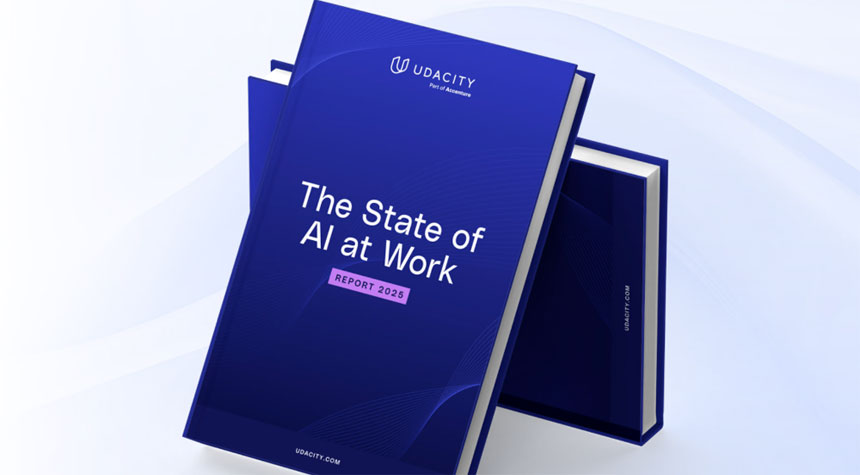
    Udacity, now an Accenture company, released its 2025 State of AI at Work Report this month. The report details how this technology is reshaping workplaces across industries and where there are the most significant opportunities for upskilling.

    These are the main outcomes:

    • Nearly 90% of workers are eager to build their AI skills through additional training and certifications, but only one in three say their organization provides the resources to do so. Over half of workers report that their employers lack clear AI policies or guidelines.

    • More than half (54%) of Millennials believed that AI could increase revenue or income, while only 24% of Generation Z and 16% of Generation X felt this.

    • AI Writing Assistants are a favorite tool for end users at work.
    AI writing assistants: ChatGPT, Claude, Grammarly, and Jasper AI
    AI image generation: Canva AI, MidJourney, Stable Diffusion, and DALL E
    Machine translation: DeepL Translator, Google Translate, and Microsoft
    Translator Data analysis and visualization: Tableau, Power BI, and DataRobot
    Notetaking and transcription: Zoom AI Assistant, Fathom.video, and Otter.ai

    • Most Commonly Used Categories of AI Technology
    AI frameworks and libraries (e.g., PyTorch, TensorFlow)
    AI models and techniques (e.g., Supervised Learning, Transfer Learning)
    AI tools and platforms (e.g., OpenAI API, Google AI Studio)
    AI applications and use cases (e.g., Image Generation, Chatbots)
    AI Infrastructure and operations (e.g., Vector Databases, MLOps tools)

  • A Report Revealed the Winners and Losers in the New AI Landscape

    A Report Revealed the Winners and Losers in the New AI Landscape

    IBL News | New York

    AI spending surged to $13.8 billion in 2024 from $2.3 billion in 2023 as enterprises embed AI at the core of their business strategies and daily work, according to a study conducted by Menlo Ventures.

    This research, titled “2024 State of Generative AI in the Enterprise Report,” done after surveying 600 U.S. enterprise IT decision-makers, points out that we are still in the early stages of a large-scale transformation.

    This spending will continue: 72% of decision-makers anticipate broader adoption of generative AI tools soon.

    Investments in the LLM foundation model still dominate spending, but the application layer segment to optimize workflows is now growing faster.

    These app layer companies—mostly in highly verticalized sectors—leverage LLM’s capabilities across domains to unlock new efficiencies. Enterprise buyers will invest $4.6 billion in generative AI applications in 2024, an 8x increase from the $600 million invested in 2023.

    The use cases that deliver the most ROI through enhanced productivity or operational efficiency are:

    • Code copilots, such as GitHub Copilot, Cursor, Codeium, Harness, and All Hands.

    • Support knowledge-based chatbots for employees, customers, and contact centers. Aisera, Decagon, Sierra, and Observe AI are some of the examples.

    • Enterprise search, retrieval, data extraction, and transformation to unlock the knowledge hidden within data silos. Solutions like Glean and Sana connect to emails, messengers, and document stores, enabling unified semantic search across systems.

    • Meeting summarization to automate note-taking and takeaways. Examples are Fireflies.ai, Otter.ai, Fathom, and Eleos Health.

    AI-powered autonomous agents capable of managing complex, end-to-end workflow processes are emerging and can transform human-led industries. Forge, Sema4, and Clay are some tools.

    When deciding to build or buy, 47% of solutions are developed in-house, while 53% are sourced from vendors. Often, organizations discover too late that they have underestimated the difficulty of technical integration, scalability, and ongoing support.

    Most customers (64%) prefer buying from established vendors, citing trust.

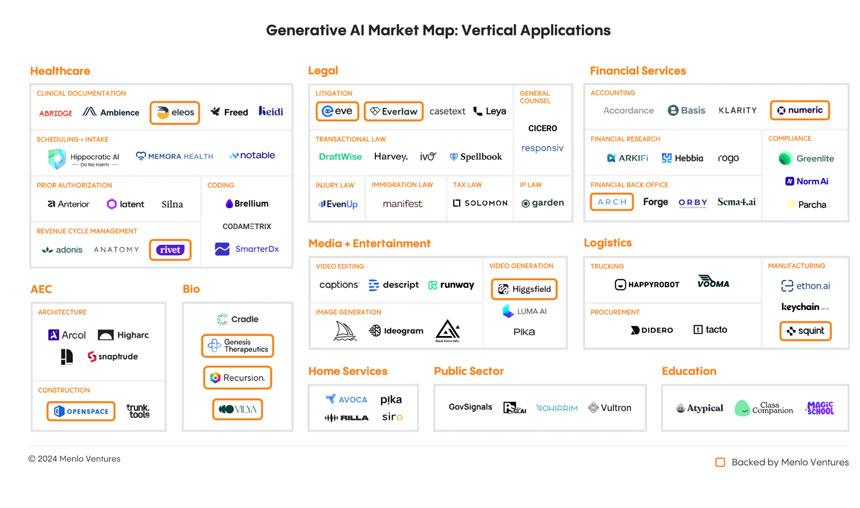
    The leading vertical AI applications are:

    Healthcare, with examples like AbridgeAmbienceHeidi, Eleos Health, Notable, SmarterDxCodametrix, Adonis, and Rivet.

    Legal, with examples like Everlaw, Harvey, Spellbook, EvenUp, Garden, Manifest, and Eve.

    Financial Services, with examples like Numeric, Klarity, Arkifi, Rogo, Arch, Orby, Sema4, Greenlite, and Norm AI.

    Media and entertainment, with examples like Runway, CaptionsDescript, Black Forest LabsHiggsfield, IdeogramMidjourney, and Pika.

    Rather than relying on a single provider, enterprises have adopted a multi-model approach, typically deploying three or more LLM in their AI stacks, routing to different models depending on the use case or results.

    To date, close-source solutions underpin the vast majority of usage, with Meta’s Llama 3 holding at 19%, according to the Menlo Ventures research.

    Regarding architectures for building efficient and scalable AI systems, RAG (retrieval-augmented generation) dominates with 51% adoption, while fine-tuning of production molded is only 9%. Agentic architectures, which debuted this year, power 12% of implementations.

    Databases and data pipelines are needed to power RAG. Traditional databases like Postgres and MongoDB remain common, while AI-native vector databases like Pinecone gain ground.

    Menlo Ventures made three predictions for what lies ahead:

    1. Agentic automation will drive the next wave of transformation, tackling complex, multi-step tasks beyond the current systems of content generation and knowledge retrieval. Examples are platforms like Clay and Forge

    2. More incumbents will fall. Chegg saw 85% of its market cap vanish, while Stack Overflow’s web traffic halved. IT outsourcing firms like Cognizant, legacy automation players like UiPath, and even software giants like Salesforce and Autodesk will face AI-native challengers.

    3. The AI talent drought will intensify. AI-skilled enterprise architects will notably increase their salaries. 

    Squint, Typeface

  • New Research Suggest How AI Should Be Integrated on Learning Environments, Research, Administrative, and Campus Operations

    New Research Suggest How AI Should Be Integrated on Learning Environments, Research, Administrative, and Campus Operations

    IBL News | New York

    AI’s integration into learning environments, research, administrative functions, and campus operations reshapes how institutions operate, faculty teach, students learn, and staff perform their roles.

    It’s not about blindly accepting AI in higher education or banning its use.

    It is crucial to thoughtfully examine AI’s impact on higher education, specifically on student success, financial sustainability, accountability, and equity.

    This is the main conclusion of researcher Joe Sabado, who shared research titled “AI in Higher Education—Frameworks for Critical Inquiry and Innovation.”

    This document, created using AI, guides institutions through AI’s transformative process, helping them leverage this technology. It provides ten frameworks, offering valuable insights for all stakeholders: educators, administrators, policymakers, students, staff, and journalists.

    AI in Higher Education – Frameworks for Inquiry and Innovation (PDF)

  • Open Courses on AI

    Open Courses on AI

    IBL News | New York

    • Microsoft Generative AI for Beginners

    00
    Course Setup

    01
    Introduction to Generative AI and LLMs

    02
    Exploring and comparing different LLMs

    03
    Using Generative AI Responsibly

    04
    Understanding Prompt Engineering Fundamentals

    05
    Creating Advanced Prompts

    06
    Building Text Generation Applications

    07
    Building Chat Applications

    08
    Building Search Apps Vector Databases

    09
    Building Image Generation Applications

    10
    Building Low Code AI Applications

    11
    Integrating External Applications with Function Calling

    12
    Designing UX for AI Applications

    13
    Securing Your Generative AI Applications

    14
    The Generative AI Application Lifecycle

    15
    Retrieval Augmented Generation (RAG) and Vector Databases

    16
    Open Source Models and Hugging Face

    17
    AI Agents

    18
    Fine-Tuning LLMs

    • Anthropic Courses: API fundamentals and Prompt engineering

    • J.P. Morgan Chase: Training on Python