Google created this $49 a month program in early 2018. It was designed to take beginner learners to job readiness in about eight months.
There are 215,000 unfilled IT support staff roles nationwide, Google estimates. The average annual starting salary for these entry-level IT jobs is $52,000, federal data shows.
Around 70 percent of enrollees come from underrepresented populations in tech, including women, Latinos, African-Americans, veterans and learners without a college education.
Employers that are recruiting from the Google IT Support Certificate program include Bank of America, General Electric, Walmart, Wyndham Hotels, Sprint, Home Depot, H&R Block, Infosys, Intel and Cognizant.
Community colleges with a strong track record in workforce development are also successfully offering the certificate to their students with additional support and in-person instruction. Google partnered with an initial group of 25 community colleges in 2018 but intends to grow that number to 100.
The Internet giant provided a grant that allows community colleges to offer the program for free.
Some colleges are offering the course for credit as part of a degree program. Others are including it as part of their continuing-education programs.
“The IT support role, which involves troubleshooting and solving technical issues, typically doesn’t require a four-year college degree, so it should be a strong entry point for nontraditional talent,” Natalie Van Kleef Conley, Product Manager for Grow with Google, said in Inside of Higher Education.
Moving forward, Google wants to expand partnerships and move into new areas of tech training.
Job automation has already started. Stats indicate that 10% of American jobs will be automated in 2019. An upsetting forecast indicates that up to 73 million U.S. jobs will be automated by 2030.
But there is hope. First: nearly 2 million new non-routine jobs which machines cannot easily perform are being created every year in the United States. Second: an increasing number of colleges and universities understand the challenge and are starting to prepare students who demand jobs which won’t be automated.
Foundry College is one of them. Its Founder, Dr. Stephen Kosslyn, addressed the issue yesterday during the Eduventures Summit in Boston with a physician example. “Diagnosis of illness will soon be accomplished well by machines. But sitting with the family to discuss treatment options will be difficult to automate.”
At least two skills are automation resistant: “Recognizing and responding to emotion when communicating and making decisions. And taking context into account when analyzing situations, creatively solving problems, and prioritizing goals,” Stephen Kosslyn said.
Foundry College, which is focused on what’s difficult to automate, has listed five key underpinnings:
Critical thinking
Creative problem solving
Clear communication
Constructive personal interactions
Good judgment
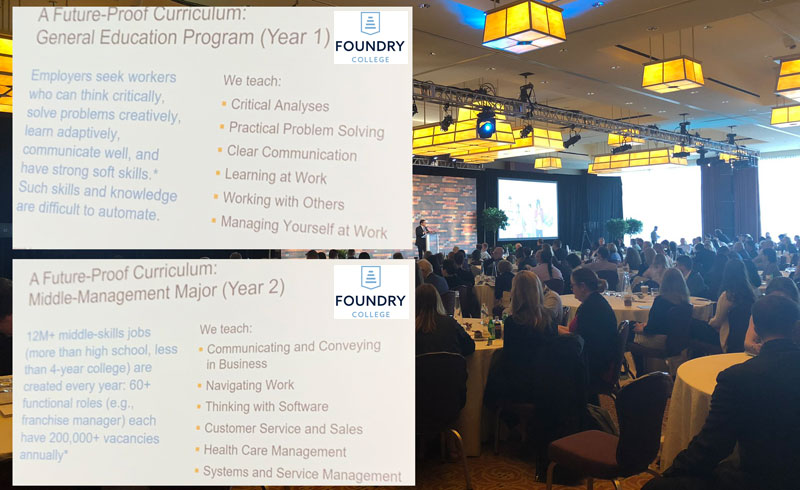
To pair these essential skills, this institution has reimagined a future-proof, two-year curriculum. On the first year, Foundry teaches:
Critical Analyses
Practical Problem Solving
Clear Communication
Learning at Work
Working with Others
Managing Yourself at Work
On the second year:
Communicating and Conveying in Business
Navigating Work
Thinking with Software
Customer Service and Sales
Health Care Management
System and Service Management
Stephen Kosslyn shares how https://t.co/9xGjOM5I3q is reimagining a two-year education that’s future-proofed and focused. It’s all about application of ideas to work situations but also lays a framework that goes beyond vocational training. #EVSummit19pic.twitter.com/TtkSCdxlDr
A refined and revised version of Georgia Tech’s first AI-based teacher assistant will be introduced this summer as a way to enhance some of the syllabi at the school. This virtual agent, known as Jill Watson and developed by Professor Ashok Goel, will turn three years old.
Yakut Gazi, Associate Dean of Learning Systems at Georgia Tech, highlighted during the 2019 Learning Impact Leadership Institute conference, last week in San Diego, the fact that her institution “is leading efforts in Artificial Intelligence’s development”. “Many students of the OMSC degree didn’t know that an AI agent was responding their questions until the end of the semester,” she added.
Jill Watson is the result of the work of Prof. Goel [in the picture] with a team of graduate students in his Design & Intelligence Laboratory (DILAB). This team created this chatbot to answer routine, frequently asked questions in the forum for his online Knowledge-Based Artificial Intelligence (KBAI) class.
The original intent was to free up time for the course TAs (Teacher Assistants), so they could concentrate on more creative and less repetitive tasks. But an expected outcome arose: more learner engagement. Before Jill Watson, students averaged 32 comments per semester; after Jill Watson, each student averaged 38 comments per semester.
In the spring of 2016, once this AI-agent’s identity was revealed, the reaction was overwhelmingly positive.
One student wanted to nominate Jill for the Outstanding TA award, and not one student complained.
National news outlets such as the Wall Street Journal and Washington Post ran stories on her. Ashok Goel gave a TEDxTalk on Jill, and he was invited by the Gates Foundation in January 2018 to participate in a brainstorming session on the future of AI in education.
Georgia Tech’s motto is affordability, accessibility, and applicability, and Jill Watson can help human teachers deliver education at scale.
Stanford University has launched this spring a new online, free course on Beethoven, his music and development as a composer.
The class, led by music historian Stephen Hinton, is designed for any level of musical literacy, with the aim of enhancing people’s understanding of Beethoven’s music through the study of his string quartets –a genre of music involving two violins, a viola, and a cello. It features performances by and discussions with the St. Lawrence String Quartet, Stanford’s ensemble-in-residence.
“His last five string quartets are widely considered to be the pinnacle of Western art music,” said Professor Stephen Hinton.
Defining the String Quartet II: Beethoven, a seven-week course, now open for enrollment, has attracted nearly 800 participants so far. Many of them share their interpretation and experience with Beethoven’s music in the course’s online forums. Students who successfully complete the full course can receive a statement of accomplishment that reflects their level of participation and achievement. After June 11, the class will reopen on a self-paced modality.
Chatbot–based customer services are increasingly in demand. Advancements in AI technology, natural language processing, neural networks and speech recognition are making chatbots more effective and affordable. However, they are still in an early phase of development.
These revolutionary applications – which allow users to engage in interactive conversations using text or natural voice – have the potential to save businesses a fortune – over 8 billion annually by 2020 according to Juniper.
Artificial Intelligence Chatbot technology is not ready to replace top customers agents when assisting customers yet, but is advancing rapidly. A well-performed human experience is unbeatable.
Trying to trick customers by making them think that an AI chatbot is a real person only speaks poorly about that company. Customers get easily annoyed if they are asked the same information repeatedly. If they feel that an algorithm is in the works trying to match the best response, they will inevitably feel played.
Antonio Cangiano, an IBM manager who teaches a class on chatbots on edX, highlights that these tools “augment humans, not replace them.” Despite being imperfect, they represent a growing business opportunity.
The mentioned course helps to build, analyze, and deploy chatbots powered by IBM’s Watson. In addition, it teaches how to make money by selling chatbot services to clients, even by deploying them in WordPress sites.
When we create courses, we follow the latest pedagogical innovations along with Backwards design rules, and this seems to be the right approach. The problem arises when our online courses get few enrollments and the economics of the course put our project in danger.
What we are doing wrong? What needs to be fixed?
As instructional designers, we forget what motivates enrollment and purchase’s decisions.
Learners want real outcomes. How the online class they are enrolling in is going to change their life.
It is all about career advancement. It is all about a direct impact on their earnings, income, and job promotion.
If the promised transformation is not convincing, we won’t attract enough students to make the course or the program sustainable.
A second requirement: we need to establish trust.
Our instructor, or staff or instructors, need to prove that they are the right fit for the job. They should be authorities in that instructional field. They must be committed to teach you and deliver a transformational experience, too.A welcome trailer will prove all of it. Additionally, video testimonials from learners will be helpful.
Third, we need to avoidunnecessary material and present a compelling, content outline. We will feature only the lessons required to achieve the goal. Long programs usually discourage learners.
To make sure, it’s key we collect continuous feedback from reviewers prior to the launch, in order to validate the concept and the outline. Redo what needs to be redone, including videos and animations, and remove whatever seems redundant.
Refining the course will ensure a great performance when it goes public.
Let’s follow all of these ideas when we engineer a program!
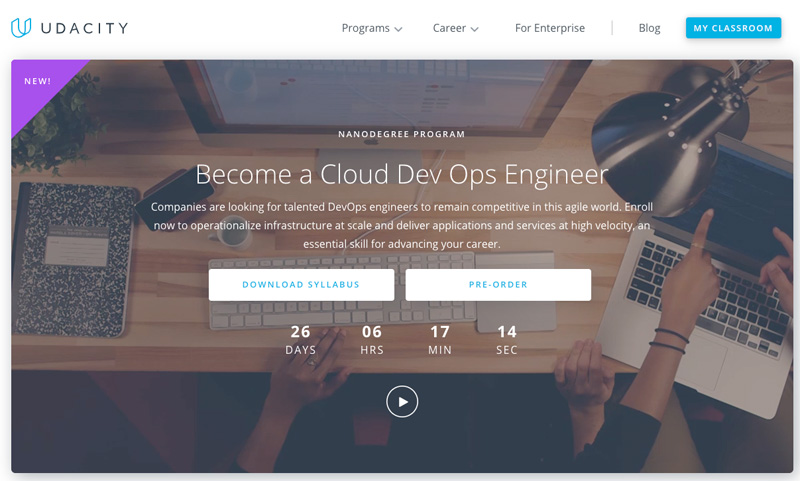
Udacity.com introduced this week its School of Cloud Computing, which will be focused on two training programs offering learners to become cloud developers and DevOps engineers on AWS (Amazon Web Services). The two courses (4-month, 10 hours/week) will start on June 11 and cost $1,436 per course.
Developers in this field are in high demand. There are over 50,000 jobs available in the US with a median salary of $146K, according to Forbes. Cloud tech services, which allow companies to innovate at a faster pace and reduce costs, are projected to grow to $206 billion in 2019, an increase of 17.3%, according to Gartner.
“The cloud brings unlimited access to computing power, security, storage, networking, messaging, and management services to large organizations and everyday builders. When you no longer need to maintain data centers, your engineers can focus on that which differentiates your business from the competition. The cloud provides high availability, on-demand scalability and elasticity, and you pay only for what you use,” explained Kesha Williams, Software Engineering Manager, at Chick-fil-A and Udacity Cloud Computing Instructor.
Udacity.com, a MOOC-platform that competes with Coursera, edX, and FutureLearn, highlights the employability of its programs (called Nanodegrees), offering them at a significantly higher price than rivals, at $1,436 per course. This platform prefers to produce their own online courses and feature industry experts as instructors rather than rely on college professors.
“We are taking a huge step towards becoming the University of Silicon Valley (…) Going forward, Udacity will now provide one-on-one technical mentorship, along with expert feedback to student projects and individual career coaching to help students advance their careers (…) Our team of expert reviewers is available to give individual constructive feedback to every student project, with a median turnaround time of just 3.9 hours,”recently announced Sebastian Thrun, Founder at Udacity.
“With more than 75,000 Nanodegree program graduates and over 200 industry partners, the Nanodegree program is well on its way to becoming a de-facto standard for hiring and corporate training in the tech industry,” he claimed.
Using open educational resources such as Jupyter and Open edX to teach STEM will transform teaching and learning and result in an engaging active experience in the classroom.
This was the central idea of a faculty workshop conducted by Professor Lorena A. Barba, from The George Washington University (GW), at the University at Buffalo this weekend.
During this hands-on seminar, participants reviewed some of the education research underpinning design decisions and discovered practices of open education.
Also, it included an introduction to the Jupyter toolbox for teaching and learning.
“Jupyter is a killer app, it provides a medium for expression using computing as part of the learning,” said Professor Lorena Barba who has been using Jupyter for over six years.
“Using the Open edX course platform, you can construct learning pathways using content pulled dynamically from a public Jupyter notebook (e.g., on GitHub), with the Jupyter Viewer Xblock.”
GW, along with IBL Education, contributed two XBlocks to build edX-style courses based on Jupyter: the Viewer, and a Jupyter Grader for auto-graded student assignments.
Jupyter-based courses can be written using an open development model (like any open-source software project), collaboratively and under version control. Once the material is ready, instructors can build a MOOC-style course on Open edX, pulling the content from the notebooks without duplication in the course platform.
Instructors can interleave short videos and graded sub-sections using the built-in problem types, or using the Graded Jupyter XBlock.
“Our course development workflow is the product of several years of refinement and applies evidence-based instructional design. Combined with modern pedagogies used in the classroom, like active learning via live coding, you can create learning experiences that are effective on campus and online,” explained Prof. Barba.
Watch the interview with Professor Lorena A. Barba in the video below.
Dr. Charles Severance, Clinical Professor at the University of Michigan School of Information, discussed with IBL News the success of his world-renowned python course and where he sees his future in online education.
While Severance did not have the first python course online, he has the world’s most popular course which has reached over 4 million students. “Across all the platforms it exists on (Coursera, edX, and others), I have probably graduated about 200,000 students.”
“What I’ve found is a very unique niche… computer science professors actually don’t know how to teach an introductory computer science course. They know how to teach [this] to someone who has been programming for several years. I specialize in actually teaching introduction to programming, which is a prerequisite to introduction to computer science.”
With Severance’s course, students were able to get the fundamental skills in programming that they necessitate to succeed in other introductory computer science courses. “I became, over the last 5 years, the de facto prerequisite for literally everything python.”
As the need for programmers is expanding, Dr. Severance’s courses offer a possibility to students who have no background in the computer sciences. Right now “you could learn python, you could work an entire 50-year career, and never learn another programming language. And in the future, python is going to further dominate.”
Primarily, his courses were offered on Coursera, but as of January 2019, Severance’s courses are available on edX.
“I knew that edX was missing a course that was a beginning programming course, and if I could just give that as a gift to the entire edX community, then edX would be better.”
“That is python for everybody, everywhere. And that is my joy, my joy is everywhere. No matter what country, what language, everyone has a chance to get a decent technical job that can take care of their families and give them a life and a future, and give them a step into education.”
The “Django for Everybody” Course Will Start In the First Quarter of 2020
With the most successful online introductory programming courses in the world, everyone is excited about new releases from Dr. Severance.
His “Django for Everybody” course, he says, will be started in the first quarter of 2020, after teaching it once more on campus. He aims to alter the course into a MOOC to be offered on Coursera or edX but will be available on his own website by January 2020.
Severance’s main goal is to adequately prepare students to fully succeed within computer science curricula. “I think there are many good degrees in computer science… My goal in life is to get as many people ready to go into a real degree with 40 or 50 faculty members.”
Speaking at the Open edX conference, Severance says that while he is attending “partly as a happy and satisfied faculty member successfully teaching on edX,” he is also aware that online learning is bound to change, and he also attended to see how “the next generation of LMS’s might take benefit from all of the wonderful experience that the edX software base [has provided].”
“I think the greatest mistake that we can make is that just because products are successful in the marketplace does not mean they cannot be replaced by the next generation. If there has been anything in the last 15 years of education technology, it’s that there is always a new generation… and a wheel of progress.”
“I believe that there’s going to be a transformation…and the next LMS generation is going to be based on the next generation of standards — learning tools interoperability LTI advantage is just coming out.”
Watch the first part of the interview with Dr. Chuck Severance in the two videos below.
Launched as an online offering in 2012, this course was derived from a campus-based and Open CourseWare subject at MIT developed and originally taught by John Guttag, the Dugald C. Jackson Professor of Computer Science and Electrical Engineering. It was initially developed as a 13-week course, but in 2014 it was separated into two courses, 6.00.1x and 6.00.2x.
Also, it was one of the very first MOOCs offered by MIT on the edX platform.
“This course is about teaching students to use computation, in this case described by Python, to build models and explore broader questions of what can be done with computation to understand the world,” said John Guttag.
“It is designed to help students begin to think like a computer scientist,” says Grimson. “By the end of it, the student should feel very confident that given a problem, whether it’s something from work or their personal life, they could use computation to solve that problem.”
“At its core, the 6.00 series teaches computational thinking,” adds Bell. “It does this using the Python programming language, but the course also teaches programming concepts that can be applied in any other programming language.”