Category: Views

  • Edmodo.com Will Shut Down Its Platform and Service on September 22

    Edmodo.com Will Shut Down Its Platform and Service on September 22

    IBL News | New York

    The popular collaboration tool for 12-K instructors, Edmodo.com, with 100 million users, announced this month that it will shut down its free platform and service, including the mobile apps, on September 22, 2022. Seen as a competitor to Schoology and Google Classroom, Edmodo social platform has been operating for 15 years.

    The accounts of teachers, students, and parents are expected to be permanently deleted after the platform is shut down. ​​”You can be assured that your personal data will not be shared, transferred, or sold to any 3rd party and, in fact, once permanently deleted, it will not be accessible or recoverable even by Edmodo,” said the owner of the company, China-based, publicly-traded NetDragon Websoft, that paid $137.5 million for Edmodo in 2018.

    Users will need to manually export their files and information to a personal device or drive before the Edmodo platform shuts down.

    “After more than a decade of ensuring Edmodo can stay a free tool for all, we have found that it is no longer viable for us to maintain the level of service you deserve and that we can take pride in ourselves,” explained the parent owner company, the Hong Kong-based NetDragon Websoft Holdings Limited.

    This Asian company — which established China’s first online gaming portal, 17173.com, and China’s influential smartphone app store platform, 91 Wireless — said that the Edmodo platform will be offered in some countries outside the U.S. “The Company expects to realize substantial savings in operating cost, which will accelerate the path to reaching operating profitability of its education business.”

  • 2U Inc. Receives an Offer of $1 Billion with a Premium of 50%

    2U Inc. Receives an Offer of $1 Billion with a Premium of 50%

    IBL News | New York

    Indian virtual education conglomerate Byju’s submitted a buyout offer worth $1 billion in a cash deal, or about $15 per share, to 2U (NASDAQ: TWOU), according to Bloomberg. As a result, shares of 2U Inc. went up 17.42% to $10.92. This is not the first time rumors surfaced regarding a 2U buyout.

    The offer, made to 2U’s board last week, represents a 61% premium to 2U’s closing price of $9.30 on the Nasdaq on Tuesday, June 21. It gives the Lanham, Maryland-based and edX owner company an enterprise value of about $2 billion, despite having a current market cap of $841 million, and about $1 billion in debt and other liabilities.

    According to Bloomberg, the talks with 2U could still fall apart, and a deal may not materialize. 2U’s board has not taken a position yet.

    After having secured $2.4 billion for international expansion, Byju’s is trying to make a big acquisition. The Indian company — which has a valuation of $22 billion and 115 million students using its platform — is also bidding for Chegg Inc.

    With the shares of 2U having declined 80% since a peak of $55.55 in early 2021, assets acquisition looks attractive in the market, said the experts.

    2U paid $800 million to acquire edX in July 2021.

    News about 2U on IBL News

  • Web3 Learning and Talent UK’s Neol Attracts $5.2 Million from Investors

    Web3 Learning and Talent UK’s Neol Attracts $5.2 Million from Investors

    IBL News | New York

    The Web3 phenomenon, featured as the next big wave in crypto is gaining traction.  Experts say that marketers will use public, virtual wallet information to target users. NFTs, governed by smart contracts, will reward users registered with a credential of their choice for engaging with ads — with token drops or other on-chain benefits.

    As this new marketing ecosystem begins to pop up, some start-ups are reshaping the Web3 networks with user experience as a central tenet.

    Last week, London-based Neol announced it raised $5.2 million in a seed round to build out a Web3-enabled, decentralized, and tokenized cohort-powered learning and talent platform. [Neol’s founders, in the picture above].

    It’s similar to On Deck, although instead of targeting founders and start-up operators, it will be aiming mostly at design and creative freelance professionals. For example, if a global fashion brand wants to reimagine its packaging or supply chain to be more sustainable, it can put the call out to Neol’s community for solutions.

    A decentralized and tokenized platform community of members build their own cohorts and create a token or a kind of Neol currency, sharing this way the wealth vision that’s core to Web3 companies.

    It’s like a tokenized, Web3 university with teachers that are rewarded financially, beyond their salary, for building a richer learners community rather than just supporting the school’s brand.

    Similarly, it might happen in the e-learning environment for freelancers. This market is expected to grow roughly 24% annually until 2028.

    Neol’s financing round was led by Kyu Collective Japan’s ad agency and VC firm Global Ventures. Other participating investors were Tony Xu, CEO of DoorDash, LearnStart, FJ Labs, and Paribu Ventures.

    Neol claims to have run eight cohorts with over 600 learners and 200 customers.

  • “Digital Skills Are the Language of the Modern Economy,” Says Coursera in Its 2022 Global Report

    “Digital Skills Are the Language of the Modern Economy,” Says Coursera in Its 2022 Global Report

    IBL News | New York

    Jeff Maggioncalda, CEO at Coursera, announced yesterday its Global Skills Report 2022, a global survey on skills proficiency and trends in business, technology, and data science, that uses data from over 100 million learners across 100 countries.

    The report features digital and human skills that are critical for growth and innovation and maps out career training pathways for employees to stay competitive. It provides skills proficiency per country, as shown in the graphics below.

    “With global instability and inflation on the rise, workers are increasingly looking to employers to provide job security and long-term career growth,” said Jeff Maggioncalda.

    “The ‘Great Resignation’ is also the ‘Great Reskilling’ with many learners now seeking career-building skills needed to start new careers in high-demand roles like IT, digital marketing, and data analysis,” he added.

    In the last year, the most popular skills in business, technology, and data science were leadership and management, probability and statistics, and theoretical computer science. However, according to the outcome of a recent survey, “not every worker needs to learn how to code, but adding digital skills to supplement foundational human and technical skills enables workers to maintain relevance as skills demands evolve.”

    In the same report, three-quarters of workers said they felt unprepared for jobs in the digital-first economy — where “digital skills are the shared language of the modern economy and are essential for economic success.”

    Other interesting outcomes are:

    • Lower levels of Internet access mean lower levels of skills proficiency. Countries with the lowest 25% of learner performance had lower access rates, around 54%.
    • Courses in human skills had more learners from developed countries. “People invest in human skills to effectively and ethically make use of digital skills, while digital skills provide a gateway to employment,” said Coursera.
    • Europe leads the world in skills proficiency. The Old Continent can be the model for global education, employment, and workforce leadership.
    • In the US, learners focused on human skills like project management, decision making, and planning.
    • Skills development drives opportunity and equity.

  • Harvard University’s President Will Step Down in June 2023

    Harvard University’s President Will Step Down in June 2023

    IBL News | New York

    Lawrence S. Bacow announced yesterday that he will step down as Harvard University’s president in June 2023.

    During his tenure, Bacow, a lifelong academic, fought a COVID infection himself, steered the institution through the pandemic, and dealt with an attack on its admission policies, one that will face a Supreme Court test later this year.

    This spring, Harvard University committed $100 million to make amends for its historical ties to slavery. “Enslaved people worked on our campus supporting our students, faculty, and staff, including several Harvard presidents,” he wrote.

    “There is never a good time to leave a job like this one, but now seems right to me,” he said in a statement. “Adele [his wife] and I are looking forward to spending more time with my children and grandchildren.”

    His five-year tenure as Harvard president is brief compared to that of his predecessor, Drew Gilpin Faust, who served 12 years.

    Bacow spent over fifty years studying, teaching at, and presiding over three major universities in the Boston area, including seven previous years as a member of the Harvard Corporation, the university’s governing organization.

    Before being appointed Harvard’s president, Bacow spent ten years as president of Tufts University in Medford, Massachusetts, and 24 years as a faculty member and administrator at MIT.

    Son of immigrants who escaped Nazi persecution, he attended college at MIT and then earned three degrees from Harvard, including a Ph.D. in public policy.

    The news on The Harvard Gazette

  • The Biden-Harris Administration Will Forgive $5.8B in Federal Loans to Students of Corinthian Colleges

    The Biden-Harris Administration Will Forgive $5.8B in Federal Loans to Students of Corinthian Colleges

    IBL News | New York

    The Biden administration said this week that it will forgive all of the loans held by 560,000 students who attended the defunct Corinthian Colleges, one of the nation’s largest for-profit college chains, before it collapsed in 2015 after it was found guilty of defrauding students.

    This debt amounts to $5.8 billion and is the largest single debt cancellation ever by the Federal Government. This Corinthian College discharge is twenty times larger than the Marinello Schools of Beauty, a predatory for-profit organization that deceived 28,000 students.

    “For far too long, Corinthian engaged in the wholesale financial exploitation of students, misleading them into taking on more and more debt to pay for promises they would never keep,” said Education Secretary Miguel Cardona. Corinthian Colleges mislead students about job placement prospects after graduation.

    Vice President Kamala Harris announced the group discharge yesterday.

    In 2013, Kamala Harris, at the time California’s Attorney General, sued Corinthian for using fraudulent advertising and other predatory practices.

    At its peak, Corinthian had more than 110,000 at 100 campuses across the country.

    In 2015, the Education Department joined the investigation and fined the organization $30 million. This event made Corinthian sink into bankruptcy, closing its 28 campuses with 16,000 students.

    Later, over 1,000 students went on strike, refusing to pay back their student loans.

    Today, the Biden administration will automatically forgive students’ debts. Borrowers will even be refunded on past payments if they still have an outstanding balance. However, borrowers who have fully paid off their loans will not be refunded.

    Borrowers and their advocates celebrated the Corinthian decision as a watershed moment.

    However, former Education Secretary Bill Bennett called the debt forgiveness “regressive” and a “mistake.” “Now, Corinthian Colleges were a scam, and they were putting a scam on a lot of students. They deserve some punishment and some accountability, but that does not mean the taxpayers have to pay for that, which is what we are doing here,” he added.


  • Bentley University Becomes One of the First Colleges Accepting Crypto for Tuition Payments

    Bentley University Becomes One of the First Colleges Accepting Crypto for Tuition Payments

    IBL News | New York

    The adoption of cryptocurrency and digital assets is arriving in higher education.

    A small college in the Boston area, Bentley University has become one of the first educational institutions in the U.S. to accept tuition fee payments made in Bitcoin (BTC), Ethereum (ETH), and the stablecoin USD Coin (USDC), the university announced on May 3.

    The university is partnering with the crypto exchange Coinbase to accept those three cryptocurrencies.

    “The move highlights Bentley’s long-standing commitment to leading the way in the early adoption of technologies changing the business world,” said the university in a blog post.

    LaBrent Chrite, President of the university stated, “We’re proud to embrace this technology that our students are learning about, which will soon transform the global business landscape they’re about to enter.”

    Last year, Bentley, located in Waltham, MA, used NFTs — non-fungible tokens or digital collectibles bought and sold with cryptocurrency on blockchains — to commemorate former women’s basketball coach Barbara Stevens’ induction into the Naismith Memorial Basketball Hall of Fame. Bentley was one of the first universities in the world to issue NFTs.

    More than 41 million Americans – 16 percent of U.S. adults — have invested in, traded, or used cryptocurrency, according to the Pew Research Center. The global cryptocurrency market is projected to more than double, from $910.3 million in 2021 to $1.9 billion in 2028, according to Fortune Business Insights.


  • Coursera Launches a Collection of Short Videos and Lessons Intended for Skills Development

    Coursera Launches a Collection of Short Videos and Lessons Intended for Skills Development

    IBL News | New York

    Coursera, Inc. (NYSE: COUR) introduced Clips, a collection of bite-size, 5-10 minute videos and lessons, intended to teach skills training to employees on job-relevant topics — mostly business, tech, data, leadership, and human abilities. The product will be available for Coursera’s corporate clients, starting in June.

    Clips will be available to Coursera for Business customers starting in June. To learn more, contact Coursera here.

    Currently, Coursera offers 10,000 short educational videos. The learning company announced that it will scale its offering to 200,000 videos by the end of the year.

    A Coursera survey noted that 60% of employees spend less than one hour on learning per sitting.

    “We are enabling employees to quickly develop the role-based skills and human skills needed to do their job successfully,” said Leah Belsky, Chief Enterprise Officer at Coursera.

    The Clips product doesn’t require signing up for any course. “This feature provides employees with a clear path to deeper skills development when they are ready to enroll,” explained Belsky.

    The new Clips offering features short content across businesses, tech, data, leadership, and human skills. These are some examples:


  • Three Spanish Universities Will Fund the Transformation of Open edX into an On-Campus LMS

    Three Spanish Universities Will Fund the Transformation of Open edX into an On-Campus LMS

    IBL News | Lisbon, Portugal

    The three Spanish organization members of the edX Consortium — U3CM, UPV, and UAM — have attracted Government funding to expand the Open edX platform into a Canvas-style on-campus LMS. These developments are part of a new Spanish project to further digitalize their public universities.

    This program, called Uni Digital, is funded with the equivalent of $152.6 million. “Our plan is to make the Open edX platform the LMS of choice for on-campus teaching,” said IBL News Ignacio Despujol, Professor at the UPV (Universidad Politécnica de Valencia).

    Along with Carlos Delgado Kloos and Carlos Alario, professors at the Universidad Carlos III de Madrid (U3CM), and German Montoro, Professor at Universidad Autónoma de Madrid (UAM), he introduced the project at the 2022 Open edX Conference in Lisbon, Portugal, last week.

    Their talk, titled “Transforming the Open edX platform into the next on-campus LMS,” highlighted the main missing pieces of the platform, such as advanced analytics for students, instructors, and researchers; integration with SIS (Student Information Systems), improvements in interface and usability, gamification, voice assistants, and a Turnitin integration.

    The Government of Spain, advised by the three mentioned universities, plans to issue a Request for Proposal (RFP) this summer. The amount dedicated to this project will be below half a million euros.

    The features to be developed will all be open-sourced. The goal of the three Spanish universities is to merge the new code into Open edX repositories on GitHub.

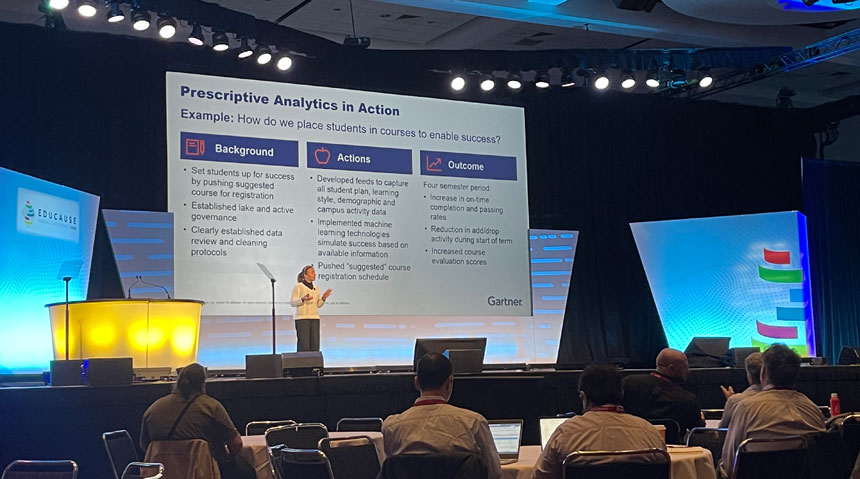
    Professor Ignacio Despujol was recently appointed as one of the nine members of the Technical Oversight Committee (TOC) that leads the governance of the Open edX platform. [In the picture during the talk.]

  • The 2023 Open edX Conference will take place at MIT in Cambridge, MA

    The 2023 Open edX Conference will take place at MIT in Cambridge, MA

    IBL News | Lisbon, Portugal

    The 2023 Open edX Conference will take place at MIT in Cambridge, Massachusetts. Ed Zarecor, Vice President of Engineering, disclosed the location on the final day of the event. [In the picture above during the announcement.]

    The 2022 conference in Lisbon, Portugal, attracted over two hundred experts on the Open edX platform.

    2U Inc., the parent company of edX, introduced its vision for the platform, highlighting the need for new features, such as program pathways, customized nudging and in-course support, messages, learner intent data capture, catalog recommendation, discovery into gamification, and administrator analytics.

    2U, who brought a staff of 35 people to the event, made a call to collaborate with developers. Ashley Bradford, Senior Vice President of Learning Technology at 2U, led the team on the ground.

    The nonprofit stewarding the Open edX software and community, called tCRIL (the Center for Reimagining Learning), detailed its roadmap as well. A team of nine staffers — all of whom attended the conference — will handle the day-to-day operations, while promoting new ideas. “There will be several experiments, but not a silver bullet,” said Ed Zarecor.

    The destination of the staggering $800 million received by the temporarily named tCRIL, controlled by MIT and Harvard, was not disclosed. Sources told IBL News that it has not even been decided yet.

    That amount makes Open edX project the most well-funded open source project ever, on paper. “The hope is that tCRIL will invest this huge budget,” said Anant Agarwal, Founder of edX and now Chief Open Education at 2U Inc.

    Tobie Langel, an expert on open source governance and currently principal at his consultancy, Unlock, also stressed tCRIL‘s opportunity for massive innovation.

    He also suggested having three or four large organizations invest heavily in the Open edX platform. Today, the main expected contributor is 2U.

    Another story that emerged from the event was the departure of Marco Morales, a veteran edX engineer who moved to 2U. Marco Morales himself broke the news by posting on his LinkedIn account.