IBL News | New York
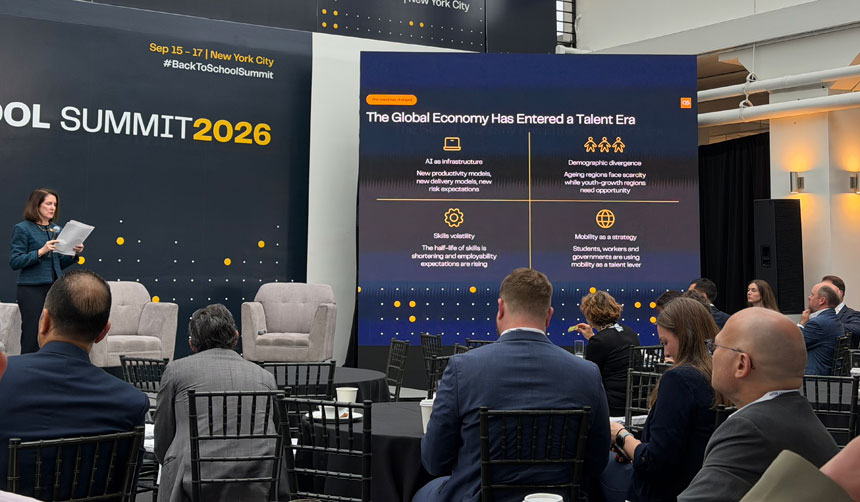
At the opening plenary of the 25th Annual “Back to School” Summit — the world’s longest-running leadership conference for senior education executives, held every September in New York since 2001 — QS Quacquarelli Symonds’ CEO Jessica Turner told a room of 600 university presidents, venture capitalists, federal policymakers, and philanthropists that the global talent economy is changing, and education is being reshaped whether institutions are ready or not.
She addressed the audience — gathered last week inside a rooftop venue overlooking lower Manhattan — plainly saying: “Higher education is under growing pressure to demonstrate its value, and the usual framing treats broad access and strong student outcomes as competing goals — but a growing set of institutions is showing they aren’t.”
That tension between the old prestige model and the emerging demand for measurable outcomes defined the three days of fireside chats, private roundtables, workshops, and panels at Tribeca Rooftop + 360°.
By the time the final session wrapped on September 17, attendees arrived at something closer to a diagnosis than a celebration. The closing panel wasn’t called “The Future of Higher Education.” It was called “The Great Higher Education Reset — Is College Worth It?”
Jeff Selingo, the higher-education author and commentator, sat down on Day Two for a fireside chat with Dr. Ann Kirschner titled “Redefining Value in Higher Education.”
Selingo stressed that only 56 percent of American families now see college as a good investment — down from 85 percent just a decade ago. At least 16 schools now charge over $100,000 per year when all costs are included.
“Families are no longer willing to take the value of college on faith,” Selingo said. “The traditional ‘public good’ perception of college has diminished. It is now often viewed as a product from which consumers expect a clear return on investment.”
He argued that more than half of college graduates start their careers underemployed, and nearly half remain so a decade later. His diagnosis was blunt: “Higher education doesn’t have an enrollment problem. It has a product problem.”
The Carnegie Foundation workshop was the counterargument. On the summit floor, Mushtaq Gunja of the American Council on Education, Alicia Alvero of The City University of New York, Lauren Asher of the Carnegie Foundation for the Advancement of Teaching, and Tonya Smith-Jackson of Rutgers University–Newark led an interactive session on the Carnegie Foundation’s new Opportunity Colleges and Universities framework about reforming the existing system discussing the idea of reforming the existing system.
Scott Pulsipher, President of Western Governors University — the nation’s largest nonprofit, competency-based university, serving over 170,000 students, most of them working adults — participated in a fireside conversation about the shifting value of education and credentials. He detailed how WGU’s model entirely decouples seat time from learning outcomes. Students advance by demonstrating competency, not by sitting in a classroom for a prescribed number of hours. Named one of the Top 100 Influencers in EdTech, Pulsipher defended that the credential crisis isn’t about better marketing, but about fundamentally redesigning how institutions operate.
Dr. Dwaun J. Warmack, President of Claflin University, joined QS CEO Jessica Turner and fellow university presidents in a high-level panel titled “Universities as Engines of Skills and Growth: Leadership for a Changing Economy.” The panel explored how universities can adapt to serve diverse learners, forge local and global partnerships, and communicate their value to government, industry, and society.
Warmack brought the perspective of historically Black colleges and universities, institutions that have always had to prove their worth in ways that elite schools never have. HBCUs have operated for decades under the constraints that the rest of higher education is only now confronting: limited resources, skeptical funders, and an institutional model that demands demonstrable outcomes rather than trading on brand.
In a summit dominated by the question “does education work?”, the HBCU answer has always been: it does, and here’s the evidence. The question is whether the sector is finally willing to listen.
The Workforce Pell, reflecting the recent policy earthquake, loomed over every policy discussion in the “Back to School” Summit.
On July 1, 2026, the federal government’s most significant higher-education policy shift in years went live. For the first time, Pell Grant funding now covers short-term, workforce-oriented training programs lasting as few as eight weeks. Iowa Central Community College became the first institution in the country to receive approval, days before the summit.
Two sessions addressed the implications directly. In “Workforce Policy in Transition,” Amanda Winters, Executive Director of Workforce at the US Chamber of Commerce Foundation, examined whether the system has the institutional capacity to deliver on the program’s promise. In “Higher Ed Policy Outlook,” Ted Eismeier, Noah Sudow, and Alex Davis of Whiteboard Advisors unpacked what has moved on funding and accountability — and what hasn’t.
For the first time, states play a formal administrative role in federal student aid within the Pell Grant program — a structural change whose implications are still being parsed.
Meanwhile, on the other side of the access equation, Wil Del Pilar of EdTrust and Sarah Brown of the Chronicle of Higher Education led a session titled “Access Denied: Pell Grants, Affordability, and Equity in Higher Ed,” examining what proposed funding changes could mean for the millions of students who rely on traditional Pell Grants to enroll, persist, and complete. EdTrust has called Pell Grants a “lifeline” for students from low-income backgrounds and is pushing for the Pell Grant Preservation and Expansion Act to double the maximum award.
One of the disquieting sessions for university leaders was “The New Talent Playbook: Workplace Learning in the Age of AI.”
Professor Mitchell Stevens of Stanford, Susan Youngblood of Bessemer Venture Partners, and Brian Maygers of the Stanford Social Innovation Review explored a trend that universities can no longer ignore: companies are giving up on buying talent and are starting to build it from within.
The QS framing was pointed: “What happens as degrees lose ground to skills and adaptability, and what can higher education learn from companies now building talent rather than buying it?”
The panel examined how skills and adaptability are altering the signals employers seek in candidates, what continuous learning looks like when integrated into the workflow, and how AI is reshaping development, mobility, and career pathways.
The session most explicitly about institutional survival was “Education at an Inflection Point,” moderated by Brad Wolverton, editor of The Chronicle of Higher Education — the closest thing the sector has to a paper of record.
His panelists: Philip Moyer of McGraw Hill, Dr. Bridget Burns of the University Innovation Alliance, and Chike Aguh of the Kapor Center. Burns leads a consortium of large public universities focused on increasing the number and diversity of college graduates. Aguh brings an innovation and equity lens. Moyer represents the content and technology side.
The conversation confronted a set of forces hitting simultaneously: AI disruption, demographic decline, political polarization over higher education’s role, and employer impatience with the pace of institutional change. Whether “inflection point” is the right term depends on everyone’s vantage point. For some institutions, it’s an inflection. For others, it may already be a decline.
By deliberate design, AI did not have its own dedicated track at the 2026 summit. Instead, it underpinned discussions across every session — a signal that AI has moved from novelty to infrastructure.
In “From Principles to Practice,” QS Responsible AI Consortium members and institutional leaders broke into working groups on governance and implementation, moving beyond ethics statements to operational frameworks for admissions, student services, and classroom use.
In “Screens and Schools,” UNICEF’s Juliette Norrmén-Smith, InnovateEDU CEO Erin Mote, and FEM Digital’s Donatella Solda tackled the techlash head-on — what happens to edtech adoption when the evidence on screens is thin and parent-teacher pushback is growing. The session acknowledged that while Google now gives students worldwide a free one-year Gemini AI Pro plan and the National University of Singapore has partnered with OpenAI, the University of Chicago has simultaneously extended its ban on AI across more courses. The sector is expanding and restricting AI access at the same time.
And in “The Human Advantage: Who You Are, Not What You Know,” the summit took on the paradox that AI has made more urgent than ever: as machines handle more technical and routine work, the skills traditionally associated with arts and humanities — creativity, critical thinking, communication, ethical judgment — are becoming the competitive differentiator. The question is whether universities recognize this quickly enough to stop cutting those programs.
The QS organizers framed it by concluding, “Answers are easier than ever to get — right ones and wrong ones — but judgment isn’t, and neither is knowing which question is worth asking, reading a situation, or deciding what should be built even if it can be.”
Two sessions mapped the financial landscape underpinning everything else.
Jeff Silber of BMO Capital Markets delivered the Capital Markets and Education Update — his annual read on how institutional investors are evaluating the sector. With multiple university mergers underway (Kent and Greenwich in the UK; Elon and Queens in the US), Kaplan selling Dublin Business School to China’s Chunlai Education Group for $127.5 million, and traditional venture capital pulling back from edtech, the capital picture is shifting from growth investment to structural consolidation.
In “New Capital Models,” Miriam Altman-Reyes (Brass Ring Ventures), Amit Patel (Owl Ventures), Geo Kane (CapitalizEd), and John Soleanicov (EdTechnical Ventures) confronted the question directly: where is the money coming from now that venture has retreated? The answer — impact investing, philanthropy, corporate partnerships, government programs — represents a different kind of capital with different expectations, different timelines, and different definitions of success.
Underpinning the summit’s conversations was the QS World Future Skills Index, which covered 89 economies across four pillars: Skills Alignment, Academic Readiness, Economic Transformation, and Future of Work.
The QS Global Employer Survey 2026 found that teamwork, problem-solving, and communication are the most important graduate skills worldwide — not coding, not AI proficiency, not data science.
Even the United States, ranked first globally, shows critical gaps in the human skills employers say they need to maximize AI’s benefits: the world’s strongest higher-education system is still not producing graduates with the capabilities employers say they most need.
The 26th Annual “Back to School” Summit is expected to return to New York in September 2027.