Author: IBL News

  • Uncensored and Unmoderated Chatbots Are Widely Adopted

    Uncensored and Unmoderated Chatbots Are Widely Adopted

    IBL News | New York

    A new wave of uncensored and unmoderated chatbots is coming online without many ethical guardrails against misinformation, false and hate content, and pornography, The New York Times described in an article.

    Names like GPT4All, FreedomGPT, and WizardLM-Uncensored were created for little or no money by independent programmers or teams of volunteers.

    Users can download an unrestricted chatbot on their own computers, and train it on private messages, personal emails, or secret documents without risking a privacy breach.

    Volunteer programmers can develop clever new add-ons, moving faster than large companies.

    Dozens of independent and open-source A.I. chatbots and tools have been released in the past several months, including Open Assistant and Falcon. HuggingFace, a large repository of open-source A.I.s, hosts more than 240,000 open-source models.

    Released in April and widely adopted today, Open Assistant was developed with help from 13,500 volunteers, using existing language models, including one model that Meta first released.
  • AWS Launches a Free “Generative AI for Executives” at Its Skills Platform

    AWS Launches a Free “Generative AI for Executives” at Its Skills Platform

    IBL News | New York

    AWS launched a free course about Generative AI aimed at executives this month. It’s available on the AWS Skill Builder platform and its YouTube channel.

    The course includes five videos that cover the foundational elements, historical context, and use cases of the technology.

    It also offers executives insights into training and reskilling needed for successful implementation.

    As the vendor AI push continues, some of the top tech giants are providing courses to help address a key adoption roadblock: in-house skills.

    In May and June, Google and Microsoft released no-cost AI training courses

    According to a Gartner survey, seven in ten companies are investigating or exploring generative AI, while 19% are advancing pilots or are in production.

  • KPMG Will Invest $2 Billion in AI, Following Accenture, PwC, and McKinsey

    KPMG Will Invest $2 Billion in AI, Following Accenture, PwC, and McKinsey

    IBL News | New York

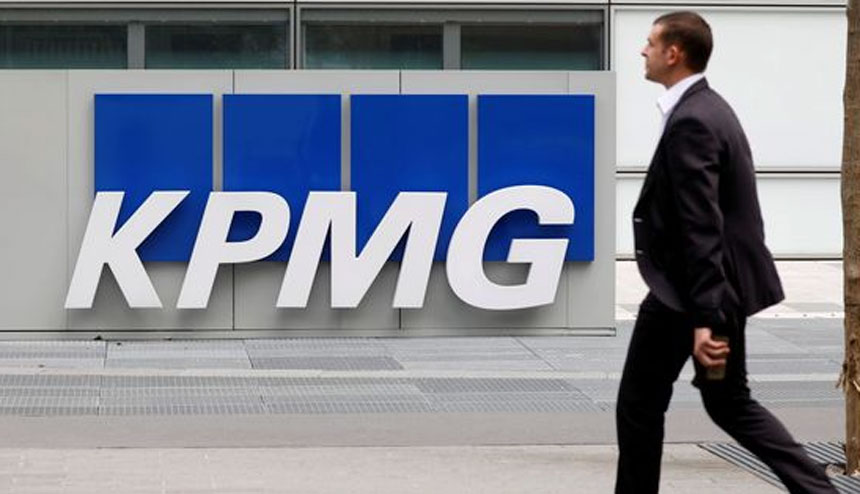
    This month, accounting giant KPMG said it plans to invest $2 billion in AI and cloud services across its business lines, automatizing aspects of its tax, audit, and consultancy services over the next five years.

    The investment will be conducted through an expanded partnership with Microsoft, which KPMG expects will bring in over $12 billion in revenue over five years, as the firm helps companies integrate AI into their operations.

    This amount would represent about 7% of the company’s global revenue, which totaled about $34.64 billion in the year.

    KPMG’s Chief Executive, Bill Thomas, said in an interview with The Wall Street Journal that the company isn’t looking to use technology to eliminate jobs, but rather to reskill and enhance its workforce of 265,000 employees with AI skills—for example, by moving people to new roles or offering them training.

    Its U.S. unit in June laid off almost 2,000 employees, four months after cutting nearly 700 in its consulting division.

    Accenture earlier this year pledged to invest $3 billion in AI over the next three years, with the bulk to be put toward staffing. The company plans to double its AI-focused army of consultants to 80,000 through a mix of hiring, acquisitions, and training.

    PwC said it would spend $1 billion on AI over the same time frame to expand and scale its AI offerings. As part of the push, PwC will partner with Microsoft to create offerings using OpenAI’s GPT-4 and ChatGPT alongside Microsoft’s Azure OpenAI Service.

    McKinsey estimated that generative AI could add $4.4 trillion annually to the global economy, almost the economic equivalent of adding an entirely new country the size and productivity of the U.K. ($3.1 trillion GDP in 2021) to the world.

  • Top AI Companies Promise the White House They Will Protect Users

    Top AI Companies Promise the White House They Will Protect Users

    IBL News | New York

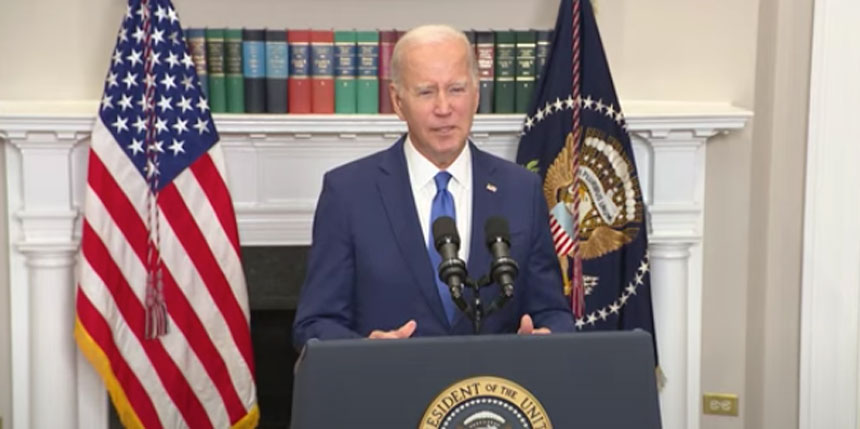
    Seven top companies on AI —Amazon, Anthropic, Google, Inflection, Meta, Microsoft, and OpenAI — voluntarily agreed to a series of asks from the White House to protect users from the risks posed by the artificial intelligence technology.

    The promises, adopted after a meeting at the White House last week, consist of investments in cybersecurity, discrimination research, and a new watermarking system informing users when content is AI-generated.

    Companies are expected to work on implementing these commitments immediately, although there are no consequences if they fail to live up to their promises.

    However, the Biden administration is currently working on an executive order to address some of the risks posed by AI, which would take action across federal agencies and departments.

    Over the last few months, the Biden administration has met with tech executives and labor and civil rights leaders to discuss AI.

    Lawmakers on both sides of the aisle have introduced legislation to regulate the tech. Some new rules limit how the Defense Department could use generative AI.

    “AI could be our most spectacular innovation yet, a force that could ignite a new era of technological advancement, scientific discovery, and industrial might,” Senate Majority Leader Chuck Schumer (D-NY) said.
    .

  • Adobe’s Firefly AI Art Generation Tool Has Generated a Billion Images

    Adobe’s Firefly AI Art Generation Tool Has Generated a Billion Images

    IBL News | New York

    Adobe’s Firefly web service has generated a billion images and text effects on the web and in Photoshop since its launch in March, the company claimed.

    The company, which is making this AI art creation tool available in twenty languages, said it was one of its most successful betas ever.

    With Firefly, Adobe got into the generative AI lucrative market.

    One of the key factors of the success is the fact that Adobe ensures that the images businesses create with Firefly are commercially safe because it’s trained on a corpus of images that are part of its stock imagery service.

    Adobe even wrote an indemnity clause stating it will pay any copyright claims related to works generated in Adobe Firefly.

    In a statement about the clause, the company specifically refers to these enterprise customers:

    “With Firefly, Adobe will also be offering enterprise customers an IP indemnity, which means that Adobe would protect customers from third-party IP claims about Firefly-generated outputs.”

    That means the company is prepared to pay out any claims should a customer lose a lawsuit over the use of Firefly-generated content.
    .

  • Apple Tests Its Own Chatbot, But It Doesn’t Plan to Release It This Year

    Apple Tests Its Own Chatbot, But It Doesn’t Plan to Release It This Year

    IBL News  | New York

    Apple Inc. is quietly testing AI tools that could challenge OpenAI, Google, and Microsoft.

    According to a report from Bloomberg, Apple has built its own framework, named “Ajax”, to create large language models that include a chatbot service that some engineers call “Apple GPT.”

    Apple has yet to determine a strategy for releasing the technology to consumers but is reportedly aiming to make a significant AI-related announcement next year.

    Apple’s Ajax runs on Google Cloud and was built with Google JAX, the search giant’s machine learning framework, according to Bloomberg.

    Apple is leveraging Ajax to create large language models and serve as the foundation for the internal ChatGPT-style tool.

    Apple did not immediately respond to a request for comment.


  • ChatGPT Will Keep Users’ Preferences in Mind for Future Conversations

    ChatGPT Will Keep Users’ Preferences in Mind for Future Conversations

    IBL News | New York

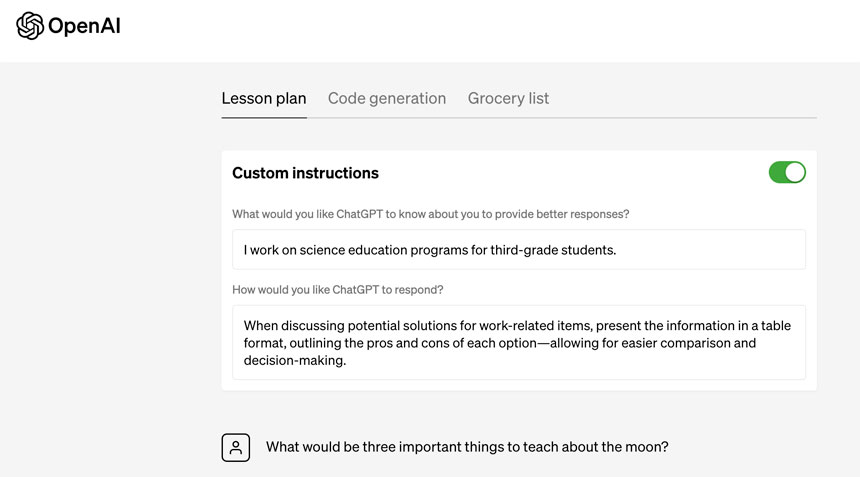
    OpenAI started to roll out the ability for paid ChatGPT users to add preferences or requirements they’d like the chatbot to consider when generating its responses. This way, users won’t have to repeat their preferences or information in every conversation.

    For example, a teacher crafting a lesson plan no longer has to repeat that they’re teaching 3rd-grade science.

    Or a developer preferring efficient code in a language that’s not Python – they can say it once, and it’s understood.

    “Through our conversations with users across 22 countries, we’ve deepened our understanding of the essential role steerability plays in enabling our models to effectively reflect the diverse contexts and unique needs of each person,” said OpenAI in a blog post.

  • Microsoft Announced Bing Chat Enterprise and Microsoft 365 Pricing at $30 User/Mo.

    Microsoft Announced Bing Chat Enterprise and Microsoft 365 Pricing at $30 User/Mo.

    IBL News | New York

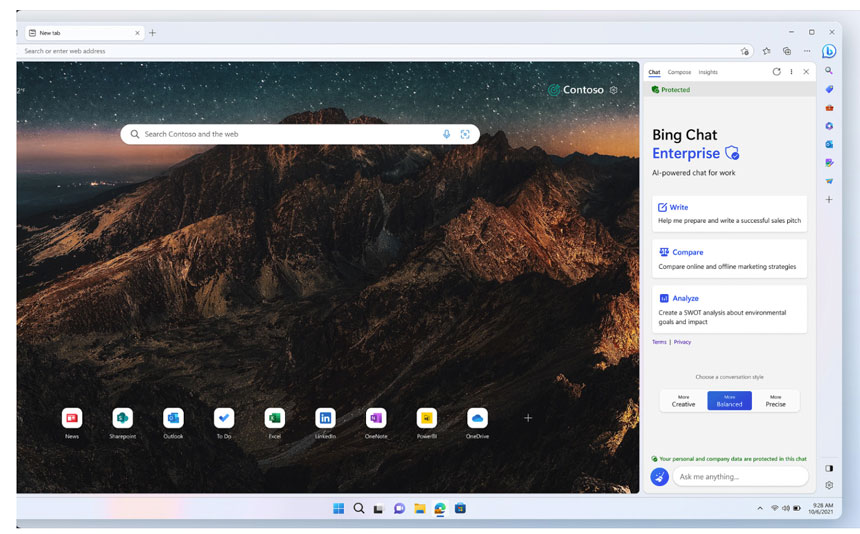
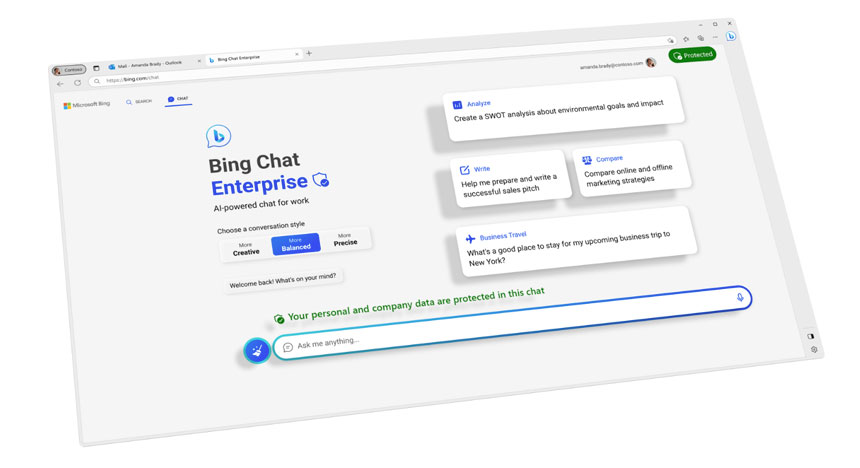
    This week, Microsoft announced a business-friendly version of Bing Chat with built-in privacy and security features.

    It means that, according to Microsoft, chat data within Bing won’t be saved nor used to train its models.

    In its announcement, Microsoft also disclosed the pricing for Copilot — its AI-powered tool that’s integrated across Word, Excel, PowerPoint, Outlook, and Teams — for commercial customers, at $30 a month per user.

    That’s on top of the existing Microsoft 365 subscription.

    Copilot can summarize meetings, create presentations, and help tackle the email inbox, among other functionalities.

    In addition, Microsoft announced that it is rolling out multimodal capabilities via Visual Search in Chat by leveraging OpenAI’s GPT-4 model.

    It means that users can upload images and prompt to search the web for related content.

    Bing can understand the context of an image, interpret it, and answer questions about it.

  • Meta Announced CM3LEON, An Advanced AI Model for Text and Images

    Meta Announced CM3LEON, An Advanced AI Model for Text and Images

    IBL News | New York

    Meta announced last week a Generative AI model named CM3LEON that the company claims achieves state-of-the-art performance for text-to-image generation in high resolution. The company didn’t say whether — or when — it plans to release CM3Leon.

    CM3LEON is also one of the first image generators capable of generating captions for images, laying the groundwork for more capable image-understanding models going forward, Meta says.

    “What sets CM3LEON apart is its robust multimodal architecture and training. By leveraging large-scale datasets that encompass diverse textual and visual data, CM3LEON has acquired a deep understanding of the intricate relationship between words and images. This comprehensive training enables CM3LEON to generate and manipulate images with remarkable coherence and fidelity,” added the company.

    Image generators like OpenAI’s DALL-E 2, Google’s Imagen, and Stable Diffusion rely on a process called diffusion to create art. In diffusion, a model learns how to gradually subtract noise from a starting image made entirely of noise — moving it closer step by step to the target prompt.

    Beyond image generation and editing, CM3LEON has the ability in text tasks of summarization, translation, and sentiment analysis for a given image.

    Experts forecast a near future where AI systems will seamlessly navigate the realms of comprehension, editing, and generation across various mediums, including images, videos, and text.

    Meta’s image generator. Image Credits: MetaMeta image generator

    The DALL-E 2 results. Image Credits: DALL-E 2

    DALL-E 2

  • Meta Open-Sourced Llama 2, Its Newest Generative AI Model

    Meta Open-Sourced Llama 2, Its Newest Generative AI Model

    IBL News | New York

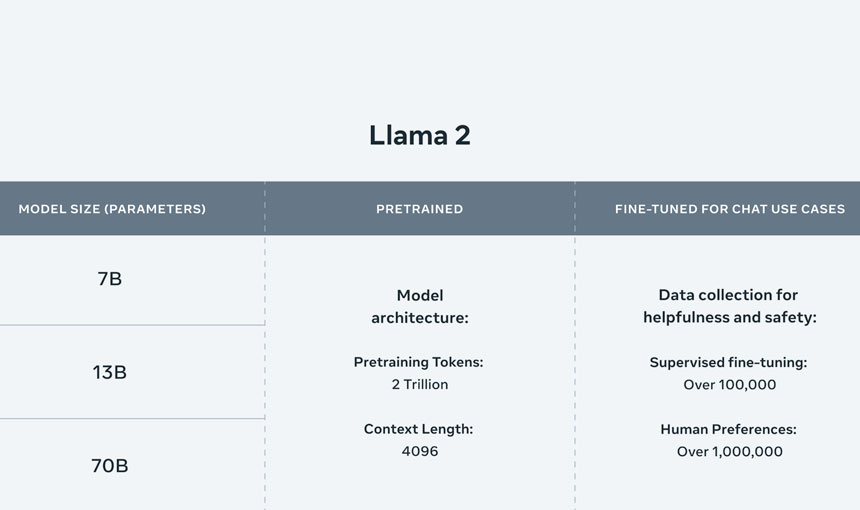
    Meta, in partnership with Microsoft, this week announced it is open-sourcing the Llama 2 generative AI model and making it available free of charge for research and commercial use.

    The company is including model weights and starting code for the pre-trained model and conversational fine-tuned versions too.

    Starting this week, Llama 2 is available in the Azure AI model catalog, enabling developers using Microsoft Azure to build with it. It is also available through Amazon Web Services (AWS), Hugging Face, and other providers.

    Llama 2 is optimized to run locally on Windows.

    Among other joined initiatives, Meta and Microsoft already collaborated to scale the adoption of PyTorch —which is now the leading framework for AI — on Azure.

    The Llama 2 model has been fine-tuned and red-teamed — tested for safety — through internal and external efforts.

    The team, which worked to generate adversarial prompts to facilitate model fine-tuning, plans to release updated fine-tuned models.

    Meta created this guide as a resource to support developers with best practices for development and safety evaluations.

    In addition, the company launched a new partnership program for academic researchers that aims to deepen its understanding of the responsible development and sharing of large language models. Researchers may apply to join a community of practitioners to share learnings on this important topic, and the community will form a research agenda to pursue going forward.
    .