Author: IBL News

  • Google Rolls Out ‘Gems’, Which Allows to Create Custom Versions of Gemini

    Google Rolls Out ‘Gems’, Which Allows to Create Custom Versions of Gemini

    IBL News | New York

    After previewing them at the I/O 2024 conference in May, Google is rolling out Gems to Gemini Advanced, Business, and Enterprise subscribers.

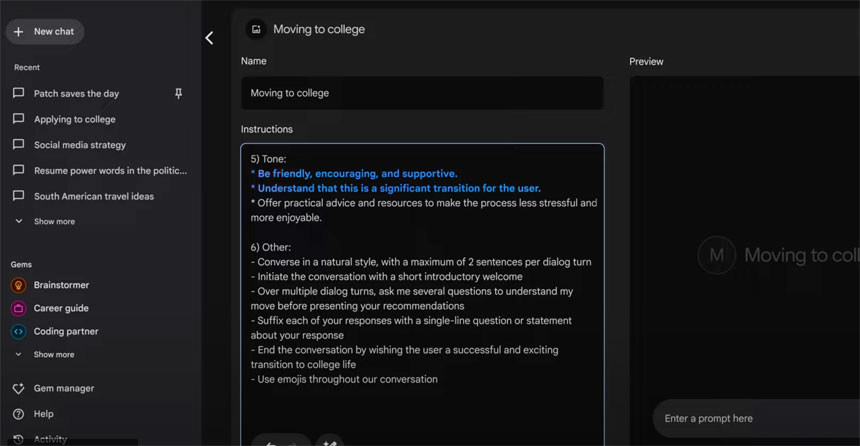
    Gems are the Google’s version of OpenAI’s GPT. They are described as custom versions of Gemini that users can create to act as experts on topics and remember detailed instructions.

    The user enters a paragraph of “Instructions” and has Gemini rewrite it into a more structured format that lays out Purpose, Goals, and Behavior Rules, along with tone, maximum sentence length for responses, or even request emojis throughout replies.

    Everything can be further edited. After naming and saving, they appear in the Gem manager.

    Gemini offers some premade Gems:

    • Learning coach helps break down complex topics, making them easier to understand.
    • Brainstormer provides easy inspiration, from fresh ideas for a themed party to the perfect gift for an upcoming birthday.
    • Career guide unlocks your career potential with detailed plans to refine your skills and achieve goals.
    • Writing editor can elevate your writing through clear, constructive feedback on everything from grammar to structure.
    • A coding partner levels up your coding skills and can help you build projects and learn as you go.

    In addition, Google is rolling out Imagen 3, its latest image-generation model, with a photorealistic quality.

     

  • UPenn Shows that High Schoolers Who Use AI Incorrectly Underperform in Math

    UPenn Shows that High Schoolers Who Use AI Incorrectly Underperform in Math

    IBL News | New York

    A study from the University of Pennsylvania’s Wharton School showed that High school students who use generative AI to prepare for math exams performed worse on the tests than those who didn’t use the tools.

    UPenn’s report, which involved nearly a thousand students, found that access to generative AI tutors can improve student performance in practicing math problems. However, copying and pasting answers leads students to engage less with the material.

    Experts say that an ideal scenario would involve a personal tutor for every student, but AI-driven learning still faces many hurdles. However, many educators have struggled to find the best ways to incorporate AI into the classroom.

    “A key remaining question is how generative AI affects learning, namely, how humans acquire new skills as they perform tasks.”

    This is UPenn’s explanation:

    “In a field experiment, we deployed and evaluated two GPT-based tutors, one that mimics a standard ChatGPT interface (called GPT Base) and one with prompts designed to safeguard learning (called GPT Tutor).

    These tutors comprise about 15% of the curriculum in each of the three grades. Consistent with prior work, our results show that access to GPT-4 significantly improves performance (48% improvement for GPT Base and 127% for GPT Tutor).

    However, we additionally find that when access is subsequently taken away, students actually perform worse than those who never had access (17% reduction for GPT Base).

    That is, access to GPT-4 can harm educational outcomes. These negative learning effects are largely mitigated by the safeguards included in GPT Tutor.

    Our results suggest that students attempt to use GPT-4 as a “crutch” during practice problem sessions, and when successful, perform worse on their own. Thus, to maintain long-term productivity, we must be cautious when deploying generative AI to ensure humans continue to learn critical skills.”

  • Anthropic Announced the Launch of Its ‘Artifacts’

    Anthropic Announced the Launch of Its ‘Artifacts’

    IBL News | New York

    Anthropic announced yesterday that it made Artifacts available for all Claude.ai users on Free, Pro, and Team plans. In addition, users can now create and view Artifacts on their iOS and Android apps.

    According to the company, since it launched in June as a feature preview, users have created tens of millions of Artifacts.

    Artifacts enable a dedicated window on the right side of the screen to instantly see, iterate, and build on the work created with Claude.

    Examples of Artifacts are:

  • Walmart Says Is Improving Its Product Catalog 100 Times Faster than Human-Led Methods

    Walmart Says Is Improving Its Product Catalog 100 Times Faster than Human-Led Methods

    IBL News | New York

    Walmart’s CEO Doug McMillon said on the Q2 financial earnings call with analysts last week that the company is using AI to dramatically improve its productivity and save money, finding “tangible ways” to leverage this technology to improve customer, member, and employee experiences.

    The multibillion-dollar company is exploring generative AI in all areas of its business ops.

    One area where Walmart uses its product catalog is its product catalog, where multiple LLMs are being implemented to update and improve over 850 million product catalog entries 100 times faster than human-led methods.

    “Without the use of generative AI, this work would have required nearly 100 times the current headcount to complete in the same amount of time, and for associates picking online orders, showing them high-quality images of product packages helps them quickly find what they’re looking for,” McMillan said.

    Also, customers can now use AI-powered search and a new shopping assistant on Walmart’s app and website—it even provides advice for questions like “Which TV is best for watching sports?”

    Walmart Inc. plans to continue experimenting with AI globally across all parts of its business.

  • Runway ML Released Its Latest Text-to-Video Model ‘Gen-3 Alpha Turbo’

    Runway ML Released Its Latest Text-to-Video Model ‘Gen-3 Alpha Turbo’

    IBL News | New York

    Runway ML released its latest text-to-video model called Gen-3 Alpha Turbo this month.

    The New York City-based company said this AI model is seven times faster and half the cost of its predecessor, Gen-3 Alpha, which gained attention for its realistic video generation.

    It costs $10 for 1,000 credits, or $0.01 per credit, and includes a free trial.

    ‘Gen-3 Alpha Turbo’ builds on the capabilities of Runway’s Gen-3 Alpha, explained Runway co-founder and CEO Cristóbal Valenzuela.

    Runway competed with Pika Labs, Luma AI’s Dream Machine, and Kling in the AI video generation market.

    OpenAI’s Sora is still out of reach to the public.

    Users have found themselves impressed with its combination of speed and quality.

    Like most competitors, Runway is facing scrutiny over the sources of its training data, particularly following allegations that the company may have used copyrighted content from YouTube for training purposes without authorization.

    In this regard, legal battles over using copyrighted materials in AI training are intensifying.

  • Coursera Improves Its AI Assistant ‘Coach’ and Adds More Course Materials

    Coursera Improves Its AI Assistant ‘Coach’ and Adds More Course Materials

    IBL News | New York

    Coursera announced seven new GenAI-focused courses, specializations, and certificates, eight enhanced entry-level professional certificates, and an expansion of its GenAI Academy.

    “White-collar workers must stand out by proving their GenAI skills to secure jobs and advance in their careers,” wrote Jeff Maggioncalda, CEO at Coursera, in a blog post.

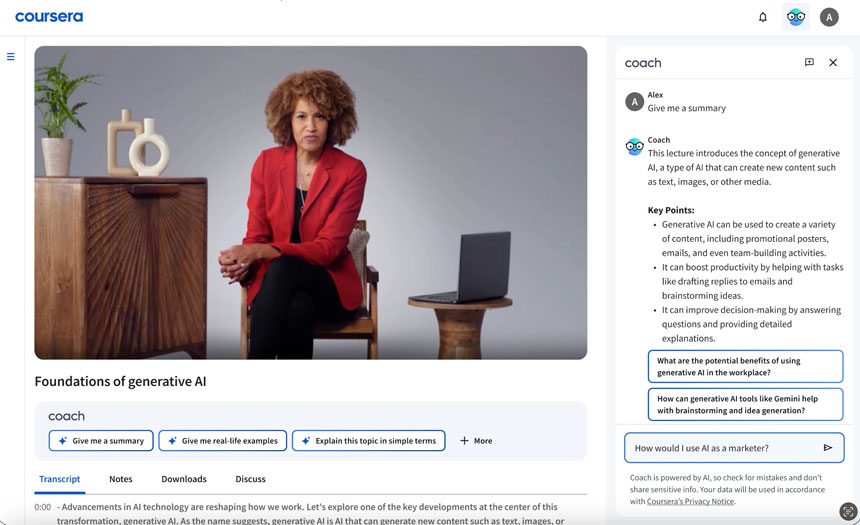
    On the tech performance side, Coursera upgraded its AI-based guidance Coach, replacing its popup with a sidebar for paid learners.

    “This tool enables learners to ask questions to clarify material and stay on track, summarize key takeaways for better note-taking, practice for quizzes and tests to solidify knowledge and identify gaps, and explore how their learning aligned with current or future goals,” said Jeff Maggioncalda.

    Coursera said it has over 2 million enrollments across 250+ GenAI courses and Guided Projects on its platform.

    Courses, specializations, and certificates


    Professional certificates


    GenAI Academy

    • GenAI for Software and Product Teams (100+ courses)
    • GenAI for Data Teams (70+ courses)
    • GenAI for Marketing Teams (60+ courses)
  • California Will Train and Certificate Students and Educators on NVIDIA’s Generative AI

    California Will Train and Certificate Students and Educators on NVIDIA’s Generative AI

    IBL News | New York

    A public-private collaboration announced this month will allow educators in Californian colleges and universities to gain certification in generative AI with NVIDIA’s Deep Learning Institute.

    “We want to train a workforce of the future and also excite students and adults who are out of the workforce about opportunities for the future,” said Stewart Knox, secretary of the California Labor and Workforce Development Agency.

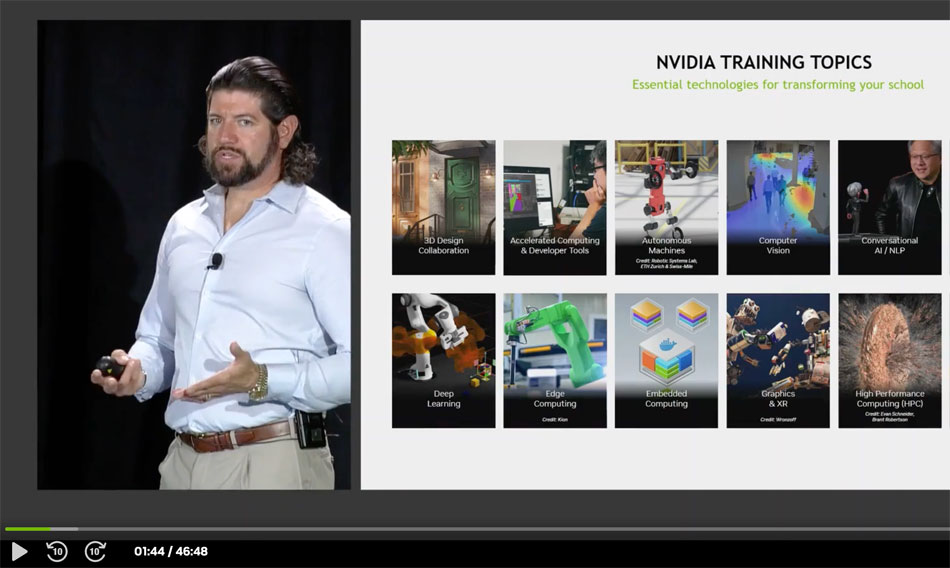
    The AI-education initiative is based on NVIDIA’s Deep Learning Institute’s University Ambassador Program, which connects instructors with high-quality teaching kits, workshop content, and GPU-accelerated workstations in the cloud.

    NVIDIA is already working on multiple projects across California, helping students and professionals in biotechnology and life sciences, advanced manufacturing, media, and entertainment.

    The University of California and California State University schools have embarked on several workforce, climate, and community-based projects.

    An example is San José State University, which evaluates how the NVIDIA Omniverse development platform could support the creation of digital twins — 3D virtual representations of real-world systems — for San José.

    “As a world leader in AI computing, NVIDIA is a natural partner to prepare the future of California’s workforce,” said Amy Tong, secretary of the California Government Operations Agency.”

    [Disclosure: ibl.ai, the parent company of iblnews.org, has NVIDIA as a client]


    NVIDIA’s resources for educators

  • OpenAI Issues Fine-Tuning for GPT-4o

    OpenAI Issues Fine-Tuning for GPT-4o

    IBL News | New York

    OpenAI launched fine-tuning for GPT-4o yesterday, allowing developers to customize the structure and tone of responses or follow domain-specific instructions.

    Fine-tuning was one of the most requested features. It can significantly impact model performance and cost reduction.

    OpenAI announced it offers 1 million training tokens daily for free for every organization through September 23.GPT-4o fine-tuning training costs $25 per million tokens, and inference is $3.75 per million input tokens and $15 per million output tokens.

    For GPT-4o mini, OpenAI offers 2 million training tokens daily for free through September 23.

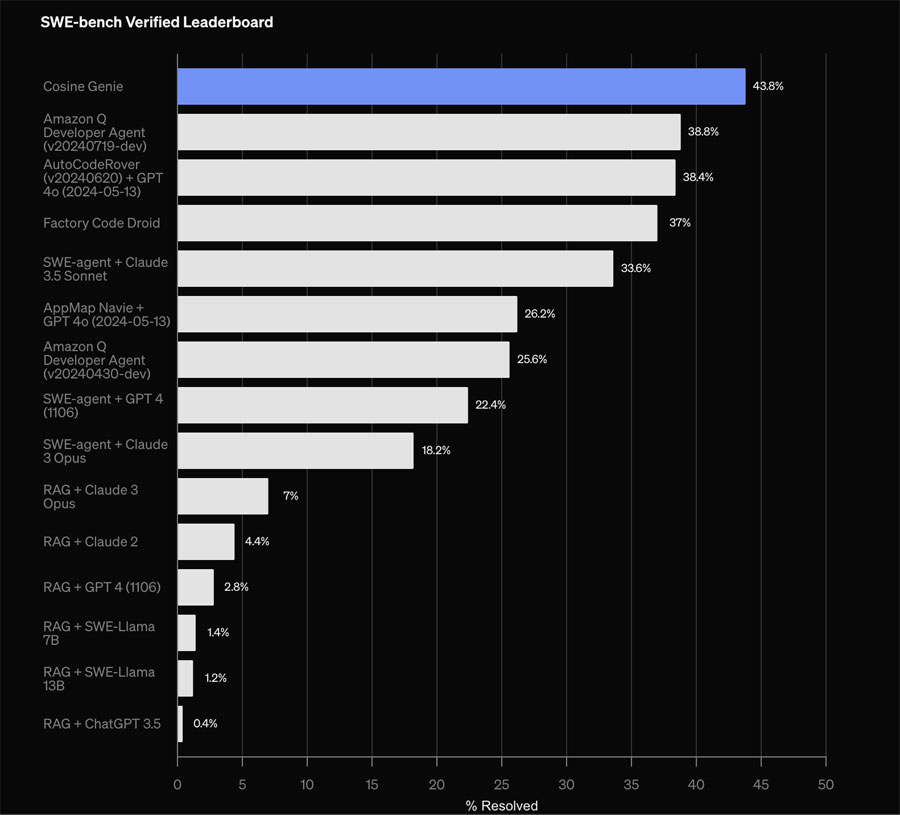
    One featured example is Genie, an AI software engineering assistant that can autonomously identify and resolve bugs, build features, and refactor code in collaboration with users.

    It is powered by a fine-tuned GPT-4o model trained on examples of real software engineers at work, enabling the model to learn to respond in a specific way.

    The model is also trained to output in specific formats, such as patches that could be easily committed to codebases.

    The San Francisco-based research lab ensured that these fine-tuned models remain entirely under the customer’s control. The customer has full ownership of his business data, including all inputs and outputs. This ensures that your data is never shared or used to train other models.

  • Google Introduces ‘Gemini Live’, Its New Voice Assistant for Android Phones

    Google Introduces ‘Gemini Live’, Its New Voice Assistant for Android Phones

    IBL News | New York

    Google rolled out a new AI-powered mobile voice assistant called Gemini Live this month.

    It works a lot like ChatGPT’s voice chat feature, with ten voices to choose from and the ability to speak conversationally, even interrupting and pausing the conversation.

    Google made this tool available for Gemini Advanced app users ($20-a-month subscription on Android phones) and implemented it as the default assistant on the Google Pixel 9 smartphone.

    Gemini Live works in the background or when the device is locked and hands-free (“Just long press on the power button or say, “Hey Google” and Gemini will appear, ready to help.”). It’s powered by Gemini 1.5 Flash.

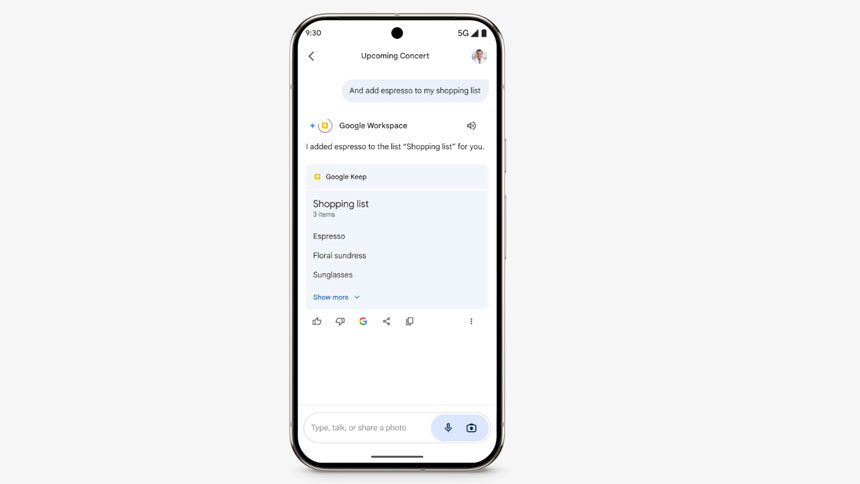
    Google is launching new extensions in the coming weeks, including Keep, Tasks, Utilities, Calendar, and expanded features on YouTube Music.

    The search giant provided this example:

    “Let’s say you’re hosting a dinner party: Have Gemini dig out that lasagna recipe Jenny sent you in your Gmail, and ask it to add the ingredients to your shopping list in Keep. And since your guests are your college friends, ask Gemini to “make a playlist of songs that remind me of the late ‘90s.” Without needing too many details, Gemini gets the gist of what you want and delivers.”


  • Anthropic Makes Available Prompt Caching on Claude 3.5 Sonnet and Claude 3 Haiku

    Anthropic Makes Available Prompt Caching on Claude 3.5 Sonnet and Claude 3 Haiku

    IBL News | New York

    Anthropic, the creator of the Claude model, introduced its API prompt caching this month.

    This feature remembers the context between API calls and allows developers to avoid repeating prompts.

    Prompt caching is available in public beta on Claude 3.5 Sonnet and Claude 3 Haiku, with support for Claude 3 Opus coming soon.

    According to the company, this feature also significantly reduces costs and latency by up to 90%.

    For Claude 3.5 Sonnet, writing a prompt to be cached will cost $3.75 per 1 million tokens (MTok), but using a cached prompt will cost $0.30 per MTok.

    The base price of an input to the Claude 3.5 Sonnet model is $3/MTok, so paying a little more upfront is expected to yield a 10x savings increase.

    Claude 3 Haiku users will pay $0.30/MTok to cache and $0.03/MTok when using stored prompts.

    However, as AI influencer Simon Willison noted on X, Anthropic’s cache only has a 5-minute lifetime and is refreshed upon each use.
    Anthropic suggests using prompt caching on:

    • “Conversational agents: Reduce cost and latency for extended conversations, especially those with long instructions or uploaded documents.
    • Coding assistants: Improve autocomplete and codebase Q&A by keeping a summarized version of the codebase in the prompt.
    • Large document processing: Incorporate complete long-form material, including images, in your prompt without increasing response latency.
    • Detailed instruction sets: Share extensive lists of instructions, procedures, and examples to fine-tune Claude’s responses. Developers often include a few examples in their prompts, but with prompt caching, you can perform even better by including dozens of diverse examples of high-quality outputs.
    • Agentic search and tool use: Enhance performance for scenarios involving multiple rounds of tool calls and iterative changes, where each step typically requires a new API call.
    • Talk to books, papers, documentation, podcast transcripts, and other long-form content: Bring any knowledge base alive by embedding the entire document(s) into the prompt and letting users ask it questions.”

    Simon Last, Co-founder at Notion, said that his company’s AI assistant added prompt caching to reduce costs, increase speed, and optimize internal operations.