A new school year has started; kids are sharpening pencils and breaking in backpacks. Many are also getting used to another new tool: Artificial Intelligence.
Source: Youtube

A new school year has started; kids are sharpening pencils and breaking in backpacks. Many are also getting used to another new tool: Artificial Intelligence.
Source: Youtube

Artificial Intelligence (AI) is quickly becoming part of daily life. Wednesday, Augusta University hosted a panel on AI in higher education.
Source: Youtube

IBL News | New York
Wiley issued new AI tools on its zyBooks courseware platform to improve learning outcomes and academic integrity, among other functions.
The released tools are:
Wiley has developed four new tools for its zyBook courseware platform designed to improve instruction, learning outcomes, and academic integrity in college STEM courses. Available at no extra charge to ZyBooks users this fall, the tools are: ZyLabs AI Hints; Generate with AI for ZyLabs; ZyBooks Assessments; and Student Behavior Insights.
• ZyLabs AI Hints: An AI tutor for coding labs that provides feedback to students who have hit a barrier in their work.
Rather than provide students with answers, it offers hints and tips on where they may have gone wrong. The tool can be enabled or disabled by the instructor for a specific lab and/or course.
Generate with AI. It’s an AI tool for creating assignments that can be tailored to instructors’ courses and students’ needs.
• ZyBooks Assessments: It enables instructors to create their own course tests within the platform. They can import content directly from course materials into their tests, and test results are presented along with all other reading content, interactive questions, assignments, labs, and homework.
• Student Behavior Insights: It’s a tool that allows instructors to view students’ coursework, analyze their progress, and identify areas where they may need help. It also detects when students paste AI-generated answers into assignments, helping to monitor academic integrity.
“Wiley is dedicated to taking a deliberate, research-driven approach to developing AI tools to ensure that they address real challenges faced by our customers,” said Lyssa Vanderbeek, Wiley group vice president for courseware, in a statement.

YouTube introduced a suite of AI-powered tools designed to help video creators streamline production and boost creativity.
Source: Youtube

It sounds like something from a super spy novel, or sci-fi movie.
Source: Youtube

Is AI the golden ticket for education—or a fast track to unintended consequences?
Source: Youtube

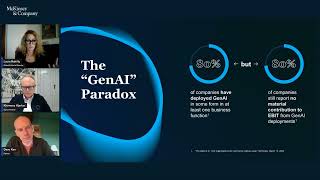
Struggling to turn AI promises into measurable business results?
Source: Youtube

AI can provide answers, but only humans can ask the questions that truly matter.
Source: Youtube

Inquisite is agentic AI. It doesn’t just give you answers, it performs tasks. It can scour research and medical journals faster than a human being, looking for breakthroughs humans can apply.
Source: Youtube

IBL News | New York
The 24th Annual ‘Back to School’ Summit, hosted successfully by HolonIQ and QS September 10-11, 2025, in New York City, brought together around 500 CEO’s and influential leaders from leading companies, major institutional investors, and global foundations. Continuing a tradition started in 2001, senior education leaders met in New York the week after Labor Day to share ideas, new insights, and forge connections.
For two days, top executives participated in roundtables, fireside chats, panels, networking sessions, and networking receptions in one of the world’s leading conferences for global education.
The agenda covered topics such as the impact of AI, funding for outcomes-driven education, digital transformation in higher education, and the latest in education technology.
About the impact of artificial intelligence, Jamie Candee, CEO at Edmentum, said, “AI is not happening at scale in the U.S.,” while Julie Lammers, President and CEO of American Student Assistance, pointed out, “We need to be adaptable to uncertain times.” Julie Lammers revealed that “innovation is mostly happening in rural communities.”
During the same panel dubbed “From Vision to Action: Navigating the Next Decade of Learning,” Jessica Turner, CEO at AQ Quacquarelli Symonds, explained that the adoption will depend on “how the institutions reinvent themselves.” “Education is a social enterprise and activity, and it will be least automated.”
Regarding investments in the EdTech industry, at one of the most crowded panels on the subject, Jeffrey Silber, manager at BMO Capital Markets, highlighted that “investors are shifting from growth to profitability.”
One of the main sponsors, Western Governors University (WGU), demoed its brand new credentialing platform, mywguwallet.org.
Patrick Brothers, Co-Founder at HolonIQ & Executive Director at QS, showcased the company’s new analytics workforce platform, which includes a skills and occupations map and benchmarks nations against one another.
John Colborn, Executive Director of Apprenticeship for America, emphasized the positive outcome of the apprenticeship approach for the job seekers and the workforce alike. He notes that “entry-level workers are declining by double digits because of AI.”
On the second day of the summit, Matt Sigelman, President of The Burning Glass Institute, defended “the urgent need for lifelong learning ecosystems that support workforce transitions, re-skilling, and real-world outcomes,” especially aiming at “future-proof economies.”
As a practical approach, Sigelman said that “community colleges are the perfect scenario for innovation.”
James Moore, Director of Online Learning at DePaul University’s Driehaus College of Business and professor of Internet marketing, elaborated on the new scenario of LLMs as the new traffic generators since traditional SEO searching is increasingly less effective.
Panelists agreed on the idea of investing in skills and lifelong learning strategies to grow productivity, as skills and lifelong learning will determine the readiness of the workforce and ultimately national competitiveness.
During the event, organizers announced that the next Global Skills Week will take place on March 24 – 28, 2026, in Washington, DC.