Category: Top News

  • Microsoft Releases a Course About Azure Stack

    Microsoft Releases a Course About Azure Stack

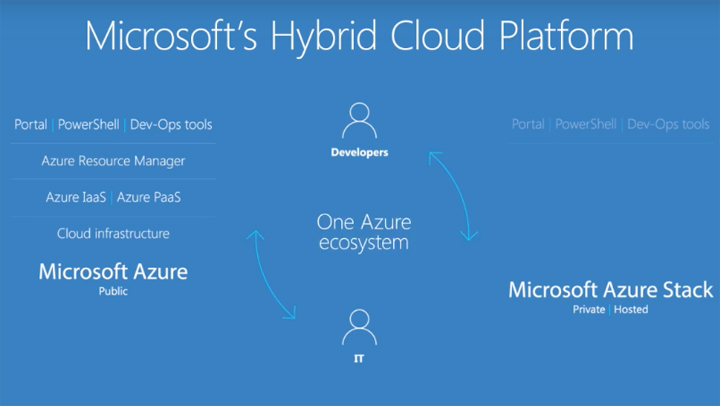
    Azure Stack is an extension of Azure, which enables a hybrid cloud platform.

    Intending to educate IT Professionals and Enterprise Architects about it, Microsoft has launched the free “Configuring and Operating Microsoft Azure Stack” online course through its Open edX-based platform.

    It’s a 30 to 35 hours, nine modules, self-paced course, ending on March 22, 2019, which provides in-depth discussiosn and practical hands-on training of Microsoft Azure Stack, including Azure Virtual Machines, Storage, Virtual Networking, and deployment options.

    In addition, students participate in several assessment checkpoints to help them gauge their level of understanding.

    The course includes nine labs:

    • Connecting to Microsoft Azure Stack using Azure PowerShell
    • Configuring Delegation Using the Azure Stack Administrator Portal
    • Add a Windows Server 2016 Image to Azure Stack using Azure PowerShell (Disconnected Scenario)
    • Add a Linux Image to Azure Stack using Azure PowerShell (Disconnected Scenario)
    • Create a Custom Marketplace Items using the Marketplace Toolkit
    • Validating ARM Templates with Azure Stack
     

  • EdX Launches a Promotional Website About its Open Source Platform

    EdX Launches a Promotional Website About its Open Source Platform

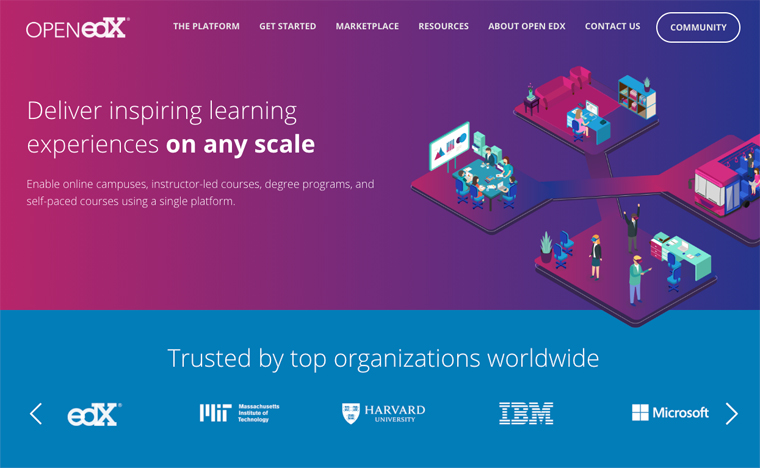
    The edX organization launched today a new marketing-oriented website about the open source software called Open edX, which powers its educational portal and is freely available on GitHub.

    This website, open.edx.org, highlights the fact that the Open edX software is trusted and used by top organizations, such as edX, MIT, Harvard, IBM, Microsoft, XuetangX, and Global Knowledge, among others. Overall, there are over 20,000 courses built on the Open edX software and over 40 million learners.

    The confusion in the industry between edX and Open edX is handled on the home page. “edX is the online learning destination co-founded by Harvard and MIT. Open edX is the learner-centric, massively scalable learning platform behind it,” edX explains.

    This promotional site, created with an investment of $30K, open to enterprise donations and engineered with WordPress technology, has been developed under the direction of Berkay Baykal, a manager in charge of the Open edX business area. [Update: Berkay Baykal is not part anymore of the edX team.]

  • Coursera Opens its Data Science Academy

    Coursera Opens its Data Science Academy

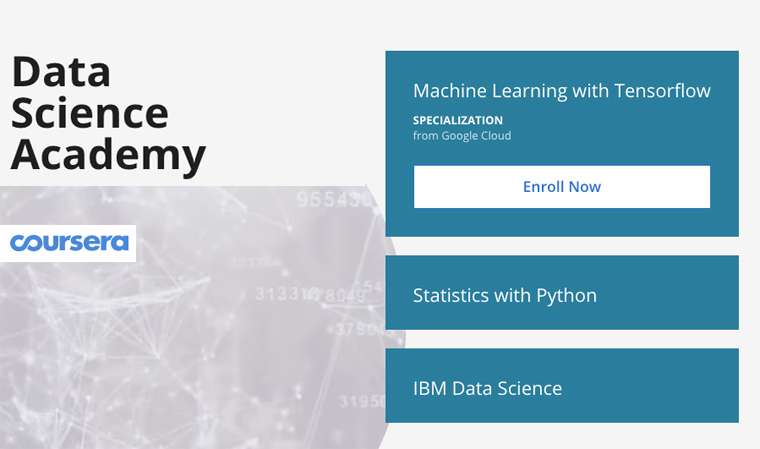
    Coursera launched this month a new vertical called Data Science Academy to help professionals find data science-related courses on R, Python, SQL, SAS, Java, and other skills.

    “Over the last decade, data has become one of the world’s most valuable resources. As data transform nearly every industry and function, top companies are prioritizing job candidates with data skills,” states in a blog post.

    Related careers include data scientist, data analyst, machine learning engineer, and data engineer. Statistics show that 110,000 new jobs are projected in this area by 2020 in the U.S.

    This Coursera Academy offers learners a quiz intended to offer directions.

    Beyond short programs and courses, Coursera hosts two Master’s degrees: the Master in Computer Science in Data Science from the University of Illinois or the Master of Applied Data Science from the University of Michigan.

    Meanwhile, edX offers the Master’s Degree in Analytics from the Georgia Institute of Technology and the Master’s Degree in Data Science from the University of California, San Diego.

  • View: Master’s Degrees Are Increasingly Online

    View: Master’s Degrees Are Increasingly Online

    By Mikel Amigot

    Master’s degree programs are increasingly offered online.

    Over 31 percent of students enrolled in master’s degrees took them entirely online, while 21 percent took some, but not all, classes online, according to an analysis from the Urban Institute.

    Digital education fits particularly well for these students because they tend to be proactive and self-directed learners. This segment tends to achieve better outcomes as they are more likely to be employed.

    For every five taken bachelor’s there were two master’s degrees during the 2015-16 academic year. In total, about 785,000 master’s degrees were awarded in the U.S.

    In terms of pricing, tuition and fees for full-time master’s rose by 79 percent during the last 20 years, compared to a 47 percent increase for full-time bachelor’s programs.

         Mikel Amigot is CEO at IBL Education        

  • The Open edX Platform Faces a Huge Upgrade into Python 3

    The Open edX Platform Faces a Huge Upgrade into Python 3

    With nearly a million lines written in Python, mostly on the 2.7 version, the Open edX platform, has a large task ahead: convert its code to run on Python 3 by the end of this year.

    Python 2 is coming to its end; there won’t be more bug fixes after January 1, 2020, and Python 3 is not backward-compatible with Python 2.

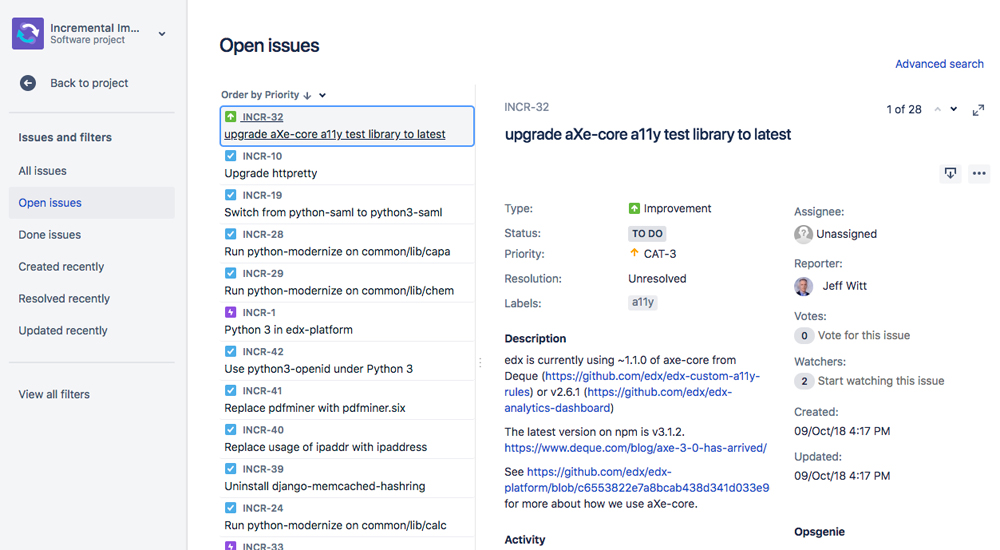
    “Much of the work is not hard, it’s just extensive, and can’t all be done automatically.  To help organize the effort, we’ve created the Incremental Improvements JIRA board: INCR,” explained in a blog post Ned Batchelder, edX Architect.

    At the same time, this engineer encouraged other developers to participate in this development.

    • Open edX Blog: Python 2 is ending, we need to move to Python 3


  • Duke University Ditches Open edX and Moves to Sakai

    Duke University Ditches Open edX and Moves to Sakai

    Why not use WordPress or Drupal instead of Open edX?

    Duke University has decided to shut down its Open edX platform, which empowered the Duke Extend service, arguing precisely this.

    Michael Greene, Associate Director of Learning Technology Services and Strategy, states: “If you don’t need the assessment features and just want to share your content with a wider audience, why not use a content management system like WordPress or Drupal?”

    In terms of engagement, this is Duke’s reasoning: “If you want highly engaged discussion, why not use Slack or Microsoft Teams?”

    “By using the online.duke.edu catalog as our communication and marketing platform, we are now free to choose the most appropriate technology for delivering a Duke Extend learning experience.”

    “We are very excited about the possibilities this change opens up for Learning Innovation and our partners,” wrote Mr. Greene.

    For now, all active Duke Extend courses have been moved to Sakai. “The new look for Extend has a clean, streamlined design that will allow us to create a more guided learning experience for students,” literally said Heather Hans, Learning Experience Designer.

    See the layout above.

    “Duke Extends lives on multiple technology platforms. (…) We want to help high schoolers before they get to Duke, offer any current student the ability to level up with co-curricular learning, help graduate and professional schools expand their online education, and serve alumni in their lifelong learning needs,” said Michael Greene.

    “As a department, we’ve rebranded and restructured ourselves to help achieve those goals. We also need technology infrastructure to facilitate them.”

    The Open edX technology, universally used by top universities and consortiums, won’t be part of the equation.

    Duke Learning Innovation: Duke Extend Is Dead. Long Live Duke Extend.


  • MOOCs Will Evolve Into Online Degrees

    MOOCs Will Evolve Into Online Degrees

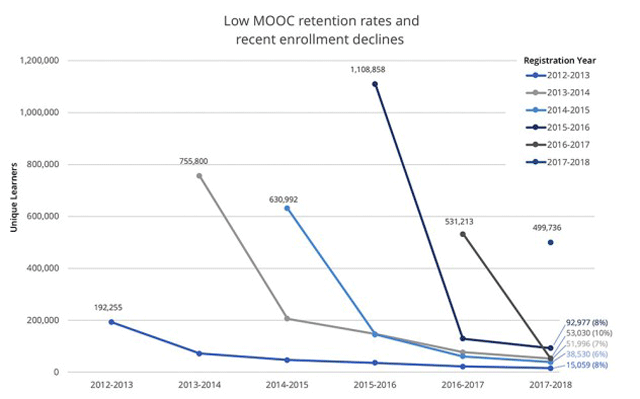
    Low student retention and enrollment decline showed that MOOCs didn’t work in the way they were conceived.

    “MOOCs will not transform higher education and probably will not disappear entirely either,” said researchers Justin Reich and José Ruipérez-Valiente after analyzing data provided by HarvardX and MITx—edX’s founding partners—from their courses offered from 2012 to May 2018.

    The best use of MOOCs may be in providing instruction that leads to online master’s degrees for professionals, researchers stated in a forum titled “The MOOC Pivot” published on the January 11 issue of Science.

    Their prediction seems to strike a blow at the heart of edX’s mission: to ensure access to quality education for learners around the world.

    Anant Agarwal, CEO of edX, argued that the study misses the continuing growth in the edX platform overall, with 2,400 courses and 20 million learners. Today, edX addresses the professional degrees, and offers programs directly to businesses.

  • HBX Removes its “X” and Rebrands as Harvard Business School

    HBX Removes its “X” and Rebrands as Harvard Business School

    The letter “X” became synonymous with online learning in the last eight years, with edX, MITx, HarvardX, MichiganX, IsraelX, and many more universities and initiatives.

    Founded in 1908, Harvard Business School launched its digital initiative HBX in 2014. Since then, its online course offerings have significantly expanded.

    Last week, HBX announced that it has rebranded as “Harvard Business School Online”. Its goal is to “raise awareness of its online courses.”

    “Harvard Business School Online has allowed us to extend the reach of the School to people wherever they are in the world,” said Nitin Nohria, dean of Harvard Business School.

    “We were founded five years ago by Harvard Business School to bring the HBS case method experience to the online world,” explained Patrick Mullane, executive director of Harvard Business School Online. “Today, nearly 40,000 students from around the world have completed a course with us. What’s most exciting is our participants say we have helped them achieve greater career success and, perhaps more importantly, greater satisfaction in life.”

    In an interview with Inside Higher Education, Mr. Mullane noted that the name X was no longer working, and, additionally, some prospective students assumed HBX was connected to edX.

  • EdX Starts the Process to Release “Ironwood”, the Next Version of its Open Source Platform

    EdX Starts the Process to Release “Ironwood”, the Next Version of its Open Source Platform

    After the existing Hawthorn release, the upcoming version of the Open edX platform will be Ironwood. The release date is scheduled for March, by the 2019 Open edX Conference (March 26-29, San Diego).

    The first step will be to create the master branches in the appropriate repos – edX Architect, Ned Batchelder announced. This task is expected for January 18th.

    “Anything merged by that date will be part of Ironwood; anything merged after that date will have to wait for the next release. A week or two after the branches are created, we will have a beta for everyone to test.  Then after a few weeks of community testing, Ironwood will be officially released,” Mr. Batchelder explained.

    Ironwood will be the ninth release of the Open edX platform, and will include improvements over the current Hawthorn.2 version.

  • edX’s Tax Returns Form Shows an Increase in Directors’ Salaries

    edX’s Tax Returns Form Shows an Increase in Directors’ Salaries

    edX’s recently implanted paywall continues to be controversial. This time, because of the compensation of some directors.

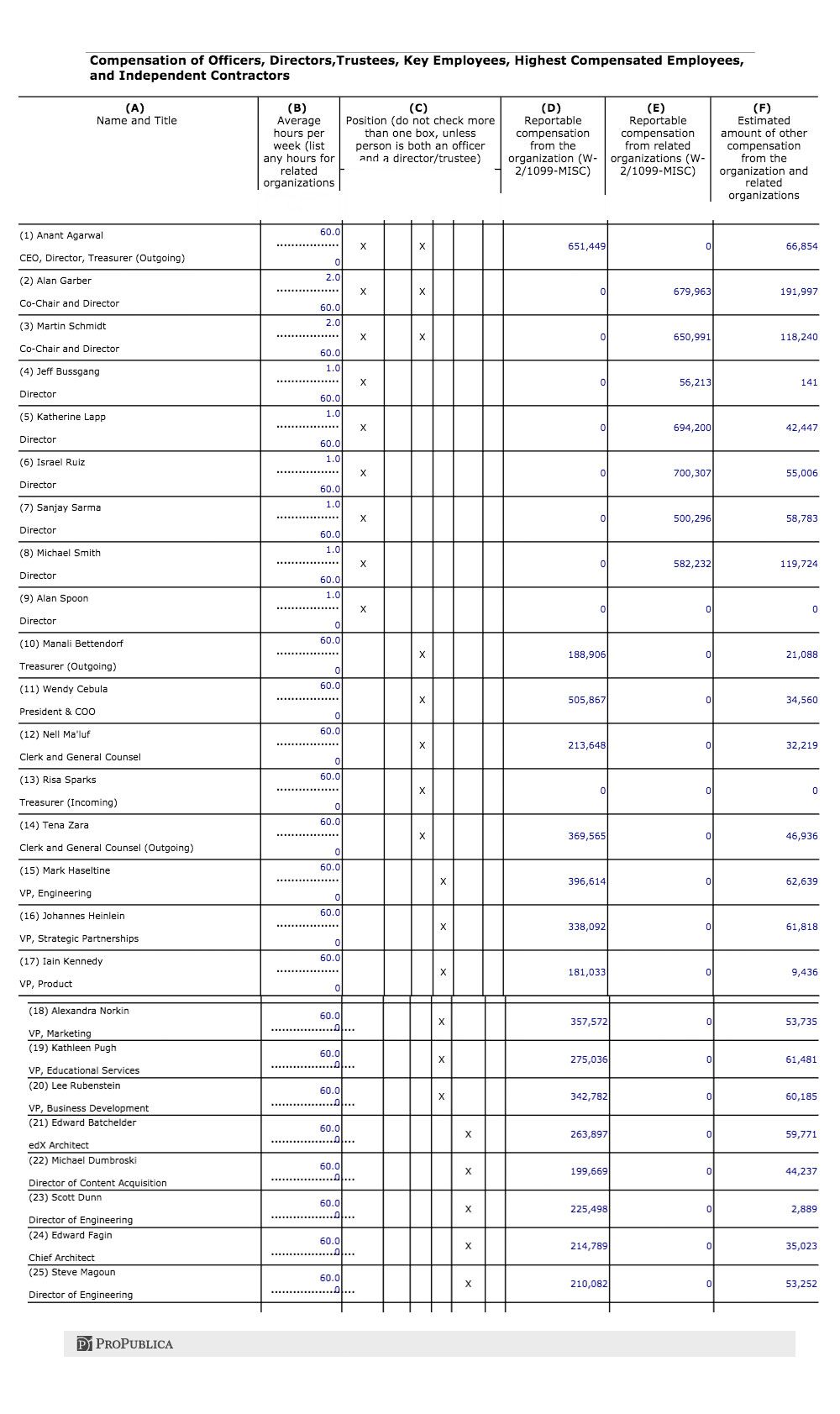
    Elearning Inside news service took a look at edX’s expenses, publicly available, and “wondered how necessary these measures may be”, given that some officers and directors “went from a volunteer position to making six figures”“edX has also been spending more and more on their less-essential employees as well,” writes the magazine.

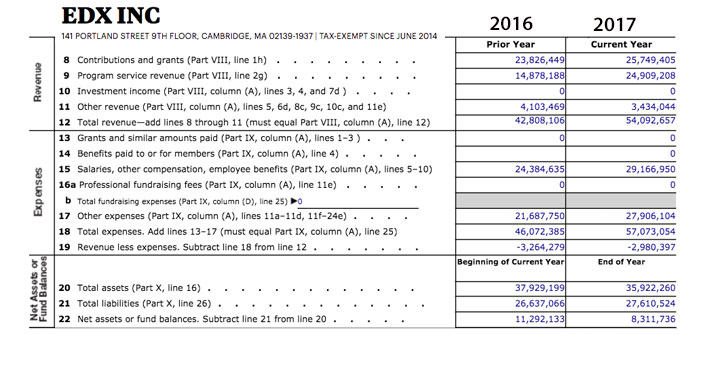
    In 2017, the total expenses at edX were $57,073,054, with a loss of $2,980,397, signaling an improvement from the prior year ($46,072,385 and $3,264,279, respectively). This data corresponds to edX’s tax returns for the fiscal year ending June 2017.

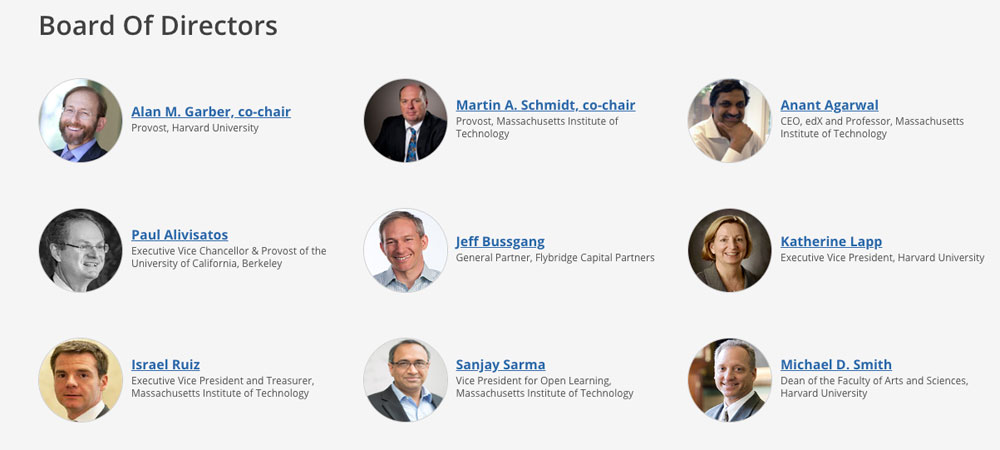
    In terms of salaries, six officers who belong to the Board of Directors but are not involved in the day-to-day operations at edX, made over $700,000 in salary, when in the previous year they hadn’t received any compensation, according to data displayed by ProPublica.

    Professor Lorena Barba, a well-known advocate of open education, criticized those salaries on her Twitter account: “I wonder if all the universities partnering with and contributing content realize they are feeding $700k-salaries for MIT and Harvard Provosts and Vice-Presidents, who just sit on the Board”.