Category: Top News

  • A Two-Track Economy: Only Infrastructure and Chips Are Booming

    A Two-Track Economy: Only Infrastructure and Chips Are Booming

    IBL News | New York

    Data centers the size of theme parks are sprouting around the country, and developers and chipmakers are raking in hundreds of billions of dollars in investments.

    The US economy in 2025 is split into two: Everything tied to artificial intelligence is booming. Just about everything else is not, an analysis in The New York Times says.

    Investments in computer equipment and software accounted for more than 90 percent of growth in gross domestic product in the first half of the year, with the AI gold rush explaining the economy’s surprising resilience this year.

    U.S. companies spent more than $60 billion on computer equipment in the second quarter, up 45 percent from a year earlier. They spent another $10 billion on data center construction, up 35% from the previous year. Artificial intelligence probably accounts for most of that growth, economists and industry experts say.

    “Unemployment has risen, hiring has slowed, and industries including manufacturing and home building are cutting jobs. Consumer sentiment has slumped amid high prices. The public sector has been weighed down by budget cuts and federal layoffs. Tariffs, and the uncertainty surrounding them, have been a drag on international trade and led to slower investment by many companies.”

    In the stock market, seven companies, including Amazon, Microsoft, and Alphabet, the parent company of Google, now account for well over a third of the S&P 500 index’s value. Just one of the so-called Magnificent Seven, Nvidia, which makes the chips that power many of the most advanced large language models, recently, though briefly, topped $5 trillion in market value.

    Such valuations are predicated on assumptions that recent rapid growth will continue for years.

  • OpenAI Unveils Group Chats to Bring People Into the Same Conversation

    OpenAI Unveils Group Chats to Bring People Into the Same Conversation

    IBL News | New York

    OpenAI is rolling out the group chats feature globally, allowing people to collaborate with ChatGPT in a single shared conversation. Up to 20 people can participate in a group chat.

    The company’s goal is to make ChatGPT more social by turning it into a shared space for collaboration and interaction with others.

    Friends, family members, and co-workers can share space to plan, make decisions, or work through ideas and content together. Group chats are separate from private conversations, and users’ personal ChatGPT memory is not shared.

    To start a group chat, the user taps the people icon in the top right corner of any new or existing chat. When adding someone to an existing chat, ChatGPT creates a copy of the conversation as a new group chat, keeping the original conversation separate.

    Users can invite others by sharing a link with one to twenty people, and anyone in the group can share that link to bring others in.

    Responses are powered by GPT‑5.1 Auto. ChatGPT follows the flow of the conversation and decides when to respond and when to stay quiet based on the context of the group conversation.

    Search, image, and file upload, image generation, and dictation are enabled.

    In September, OpenAI launched a social app called Sora, where users can generate videos of themselves and their friends to share on a TikTok-style algorithmic feed.

    • OpenAI’s Help Center⁠

  • Genespark, a Startup that Offers AI Workplace Agents, Reaches a Unicorn Valuation

    Genespark, a Startup that Offers AI Workplace Agents, Reaches a Unicorn Valuation

    IBL News | New York

    AI startup Genspark closed a $275 million Series B round, bringing its valuation to the unicorn territory with $1.25 billion.

    This round was backed by Emergence Capital Partners, SBI Investment, LG Technology Ventures, UpHonest Capital, and Pavilion Capital, a subsidiary of Singapore’s state-owned investor Temasek.

    Palo Alto-based Genspark.ai offers a suite of AI workplace agents to automate everyday tasks, from creating slide decks to researching meeting attendees to recording meeting notes from an Apple Watch.

    Its single, integrated platform has attracted users over the complexity of other productivity tools, reaching $50 million in annualized revenue.

    The startup’s founder, Eric Jing, is a Microsoft veteran who built an early voice assistant valued at over $5 billion, according to his LinkedIn profile.

    The CEO and cofounder, Wen Sang, is an MIT PhD who founded and sold Smarking, an enterprise software company backed by Y Combinator and Khosla Ventures.

  • OpenAI Releases ChatGPT for Teachers, Providing Them Free Access Until June 2027

    OpenAI Releases ChatGPT for Teachers, Providing Them Free Access Until June 2027

    IBL News | New York

    OpenAI launched ChatGPT for Teachers this Wednesday, providing a free K-12 workspace across the U.S. until June 2027.
    This work builds on the company’s partnership with the American Federation of Teachers⁠. Today, three in five teachers use an AI tool, mostly to save working hours.

    This ChatGPT for Teachers, a version of ChatGPT designed for K-12 educators and school districts, not for students, also includes administrative controls for managers. It supports FERPA requirements.

    OpenAI requires verification to set up a free workspace for teachers and staff at U.S. K–12 schools or districts.

    OpenAI is initially launching ChatGPT for Teachers with a cohort of districts that represent 150,000 educators. The startup also released an AI Literacy Blueprint.

    Leah Belsky, vice president of education at OpenAI, ensured that student data would be protected and that anything shared within ChatGPT for Teachers would not be used to train OpenAI models.

    This month marks the third anniversary of the launch of its generic ChatGPT chatbot in November 2022.

    Since then, many teachers and parents have argued that students can use the tool to cheat and avoid engaging in critical thinking.

    In July, OpenAI released a feature in ChatGPT called “study mode,” built for college-age students and aimed at helping them work through problems step by step before arriving at an answer.

    According to the company, “ChatGPT for Teachers brings the main tools in ChatGPT —unlimited messages with GPT‑5.1 Auto, search, file uploads, connectors, and image generation—into a workspace where teachers can securely work with classroom materials and student information, collaborate with colleagues, and learn from other educators.

    • Education-grade security & compliance: Anything you share with ChatGPT for Teachers is not used to train our models by default, and the workspace is built to protect student data and help schools meet FERPA requirements.
    • Personalized teaching support: Tell ChatGPT to remember details like your grade level, curriculum, and preferred format so responses feel tailored to your teaching style and classroom. You’re in control of your settings.
    • Connected to your tools: Build presentations with Canva in ChatGPT, and bring in lesson plans and files from Google Drive or Microsoft 365 so every chat starts with your classroom context, saving you time on prep.
    • Examples from real teachers: Discover ready-to-use ideas and prompts from teachers already using ChatGPT, directly under the message composer in your workspace.
    • Collaboration: Use custom GPTs to create templates with other teachers at your school or district, or co-plan lessons and presentations together in shared projects.
    • Admin controls: School and district leaders can claim their domain to bring educators into one workspace with role-based access controls, and secure accounts with SAML SSO.”

  • Only One-Third of Business Organizations Have Scaled AI Beyond Pilot Projects

    Only One-Third of Business Organizations Have Scaled AI Beyond Pilot Projects

    IBL News | New York

    The AI revolution is reaching almost every company, but only a handful know how to utilize it effectively.

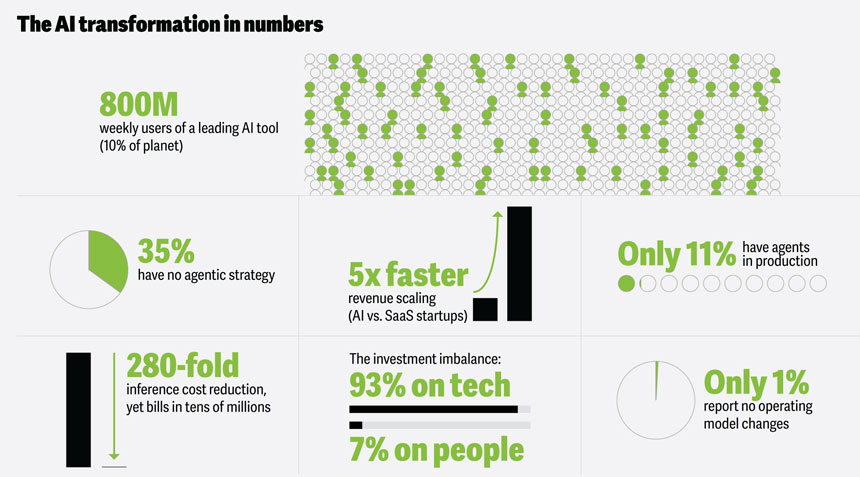
    A McKinsey’s new State of AI 2025 report, done after surveying around 2,000, states that
    Most organizations are still in the experimentation or pilot phase with AI, having not yet begun to scale AI across the enterprise.

    Sixty-two percent of survey respondents report that their organizations are at least experimenting with AI agents, also indicating that AI is enabling their innovation.

    In other words, most companies remain stuck in pilot mode, testing ideas rather than transforming operations, with an overall modest business impact.

    The McKinsey report notes how redesigning workflows is a key success factor among companies. In this regard, half of those AI high performers intend to use AI to transform their businesses.

    In terms of jobs, roughly 32 percent of firms expect job cuts of three percent or more next year, while only 13 percent foresee hiring growth.

  • Google Released Gemini 3, Its Most Advanced Model

    Google Released Gemini 3, Its Most Advanced Model

    IBL News | New York

    Google released yesterday Gemini 3, its most advanced model, with better reasoning capabilities and improved context, requiring less prompting from the user. It is also integrated in AI Mode in Search.

    ”We continue to push the frontiers of intelligence, agents, and personalization to make AI truly helpful for everyone,” said Sundar Pichai, CEO at Google.

    In the recent history of Google’s AI developments, Gemini 1 started with native multimodality and long context window, expanding the kinds of information that could be processed.

    Meanwhile, Gemini 2 laid the foundation for agentic capabilities and pushed the frontiers on reasoning and thinking, leading to Gemini 2.5 Pro.

  • Enterprises Move From Experimentation to Measurable ROI On AI, Says Wharton School

    Enterprises Move From Experimentation to Measurable ROI On AI, Says Wharton School

    IBL News | New York

    Enterprises are rapidly transitioning from experimentation to proving measurable ROI, said a research study conducted by The Wharton School of the University of Pennsylvania. “Gen AI is becoming deeply integrated into modern work.”

    The report examines how generative AI technology is being adopted in mainstream enterprises, highlighting the ROI.

    The shift is moving from exploration to pilots to more disciplined, enterprise-level adoption, according to the study, which concludes that “the next phase is not about adoption; it is about advantage.”

    • 82% of enterprises used Gen AI at least weekly, and 46% used it daily, with 89% agreeing that Gen AI enhances employees’ skills.

    • A total of 72% of organizations formally measured the ROI of Gen AI, focusing on productivity gains and incremental profit.

    • Three out of four leaders see positive returns on Gen AI investments.

    The Wharton School predicted that approximately one-third of Gen AI technology budgets will be allocated to internal R&D, indicating that many enterprises are building custom capabilities for the future.

    “Training, hiring, and rollout approaches are key human capital aspects that need to be addressed to increase chances of success.”

    Download the Executive Summary
    Download the 2025 Report

  • OpenAI Releases GPT-5.1 On Its API Platform

    OpenAI Releases GPT-5.1 On Its API Platform

    IBL News | New York

    OpenAI released GPT-5.1 on its API platform last week.

    This model adapts the time spent thinking to the complexity of the task. It also features a “no reasoning” mode to respond faster to tasks that don’t require deep thinking.
    GPT-5.1 features extended prompt caching for up to 24 hours of cache retention, enabling faster follow-up questions at a lower cost.
    On coding, OpenAI said it has worked closely with Cursor, Cognition, Augment Code, Factory, and Warp to make GPT‑5.1 more intuitive and communicative.
  • Anthropic Expects to Break Even In 2028 and OpenAI In 2030

    Anthropic Expects to Break Even In 2028 and OpenAI In 2030

    IBL News | New York

    Anthropic, maker of Claude, expects to break even in 2028, The Wall Street Journal reported yesterday.

    By contrast, OpenAI forecasts operating losses of $74 billion, or roughly three-fourths of revenue at that year, expecting to turn a profit in 2030.

    The maker of OpenAI expects to burn 14 times as much cash as Anthropic.

    With the goal of becoming a trillion-dollar company, OpenAI, which is always in constant fundraising mode, says it is investing significantly more in chips and data centers, and doling out more stock-based compensation to attract top researchers.

    “Demand for AI exceeds available compute supply today,” an OpenAI spokesman said.

    Recently, OpenAI, valued at $500 billion, signed a string of new computing deals with cloud and chip giants. Altman said on X that the deals put OpenAI on the hook for up to $1.4 trillion in commitments over the next eight years.

    Anthropic, valued at $183 billion, is focused on increasing sales among corporate customers, which account for about 80% of revenue. It avoids OpenAI’s costly forays into image and video generation, which require significantly more computing power. Anthropic’s AI models have also taken off among coders.

    Founded four years ago by Dario Amodei [in the picture, on the right side], a former Google researcher who left OpenAI, Anthropic is centered on selling its Claude chatbot to businesses.

    Microsoft is OpenAI’s largest cloud provider, while Amazon and Google are for Anthropic.

  • OpenAI Launches a New GPT‑5.1 Model, Improved on Intelligence and Communication Style

    OpenAI Launches a New GPT‑5.1 Model, Improved on Intelligence and Communication Style

    IBL News | New York

    OpenAI yesterday announced an upgrade to the GPT-5 series with the release of an enhanced GPT‑5.1 Instant, “warmer, more intelligent, and better at following instructions and conversations,” and a new GPT‑5.1 Thinking, “easier to understand and faster on simple tasks, more persistent on complex ones.”

    “GPT‑5.1 improves meaningfully on both intelligence and communication style,” said the company.

    “We’ve also improved instruction following, so the model more reliably answers the question you actually asked.”

    These personality settings will be applied across all models. The original Cynical (formerly Cynic) and Nerdy (formerly Nerd) options introduced earlier this year will remain available unchanged under the same dropdown in personalization settings.

    Updates made in personalization settings will take effect across all chats, including ongoing conversations.