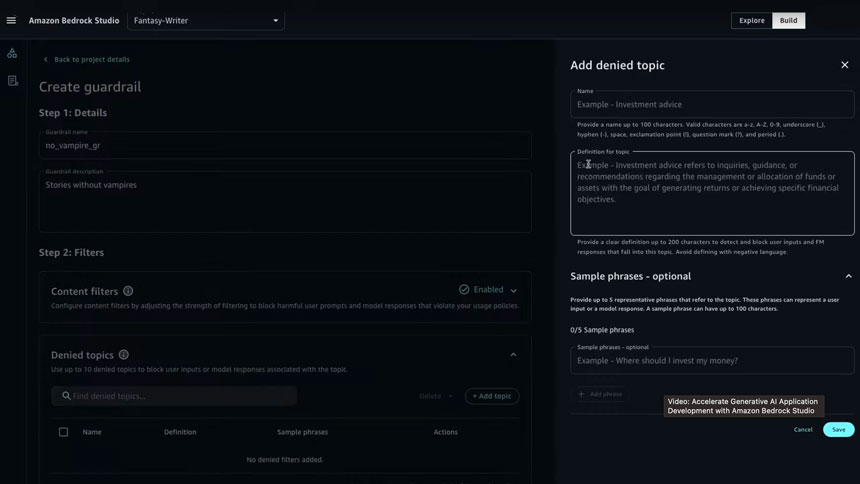
AWS launched Bedrock Studio, a new tool intended to simplify generative AI-powered application development.
Available in public preview for AWS administrators, the web-based Amazon Bedrock Studio provides a “rapid” prototyping environment, said the company.
Bedrock Studio guides developers through the steps to evaluate, analyze, fine-tune, and share generative AI models from Anthropic, Cohere, Mistral, Meta, and other Bedrock partners.
It also tests different model settings and guardrails and integrates outside data sources and APIs.
Amazon’s AWS is up against generative AI development platforms from Google Cloud, Microsoft Azure, and OpenAI, among others.
.
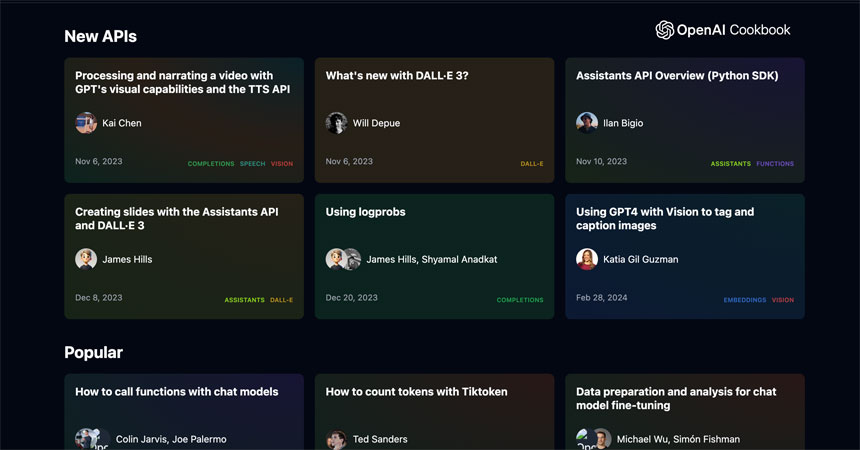
OpenAI released on GitHub a tutorial with example code, tips, and guides for accomplishing common tasks with its API and craft-elaborated prompts.
This resource, called OpenAI Cookbook, gives access to prompting libraries, tools, and papers on advanced prompting to improve reasoning.
One of the techniques is Chain of Thoughts, which makes the LLM think before providing the final answer.
Another interesting one is the Tree of Thoughts, which generates tree-like structures of ideas, with every idea representing a step toward solving a problem.
Most code examples are in Python, though the concepts can be applied in any language.
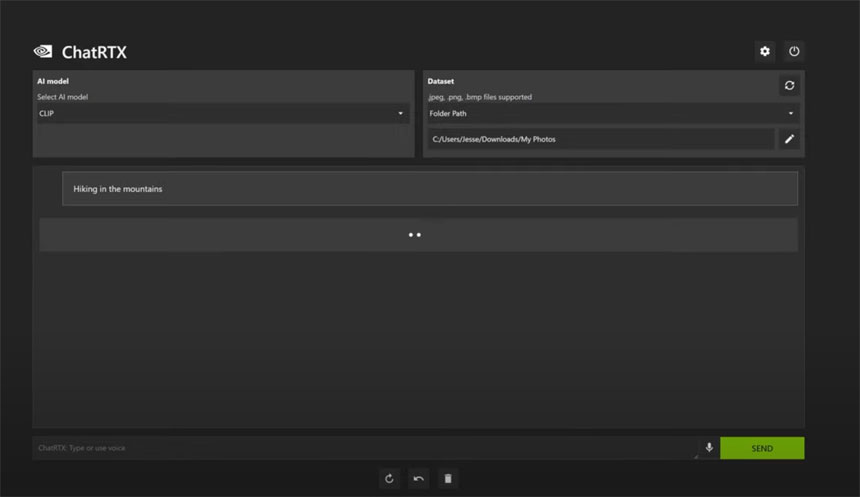
NVIDIA updated this month its experimental ChatRTX chatbot app, which creates a local chatbot server that users can access from a browser and feed with docs, notes, images, YouTube videos, or other data, in order to get summaries and answers to questions.
The update expands the power of NVIDIA’s RTX-accelerated chatbot with additional features like video and photo/image search, as well as support for new models.
The chatbot, which runs locally on a Windows PC workstation, supports a growing list of AI models that include Google’s Gemma, ChatGLM3, and OpenAI’s CLIP, intended to search and interact with local photo data.
It comes with an integrated Whisper, an AI speech recognition system that let users search data using their voice.
Available as a 36GB download from Nvidia’s website, ChatRTX also now supports ChatGLM3, an open bilingual (English and Chinese) large language model.
.
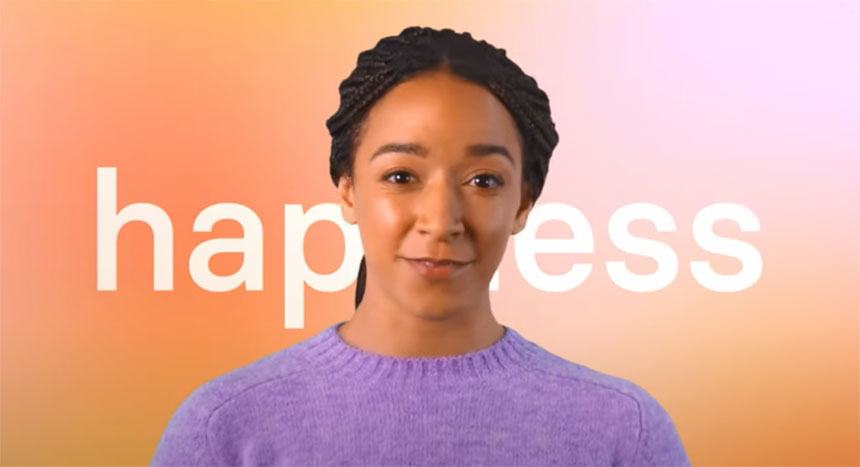
Microsoft researchers presented VASA-1, a framework for generating hyper-realistic talking video with facial behavior, precise lip-audio sync, and naturalistic head motion produced in real time. It all contributes to the perception of authenticity and liveliness.
This AI model takes a single portrait static photo and speech audio clip and produces videos of virtual characters with appealing visual affective skills (VAS) of 512×512 resolution at up to 40 FPS.
“Our method significantly outperforms previous methods and it paves the way for real-time engagements with lifelike avatars that emulate human conversational behaviors,” said Microsoft.
The company made clear that VASA-1 was only a research demonstration without a product or API release plan.
.
The First AI-Generated Video That Looks Super Real
Microsoft Research announced VASA-1.
It takes a single portrait photo and speech audio and produces a hyper-realistic talking face video with precise lip-audio sync, lifelike facial behavior, and naturalistic head movements… pic.twitter.com/6bxd4mEgFR
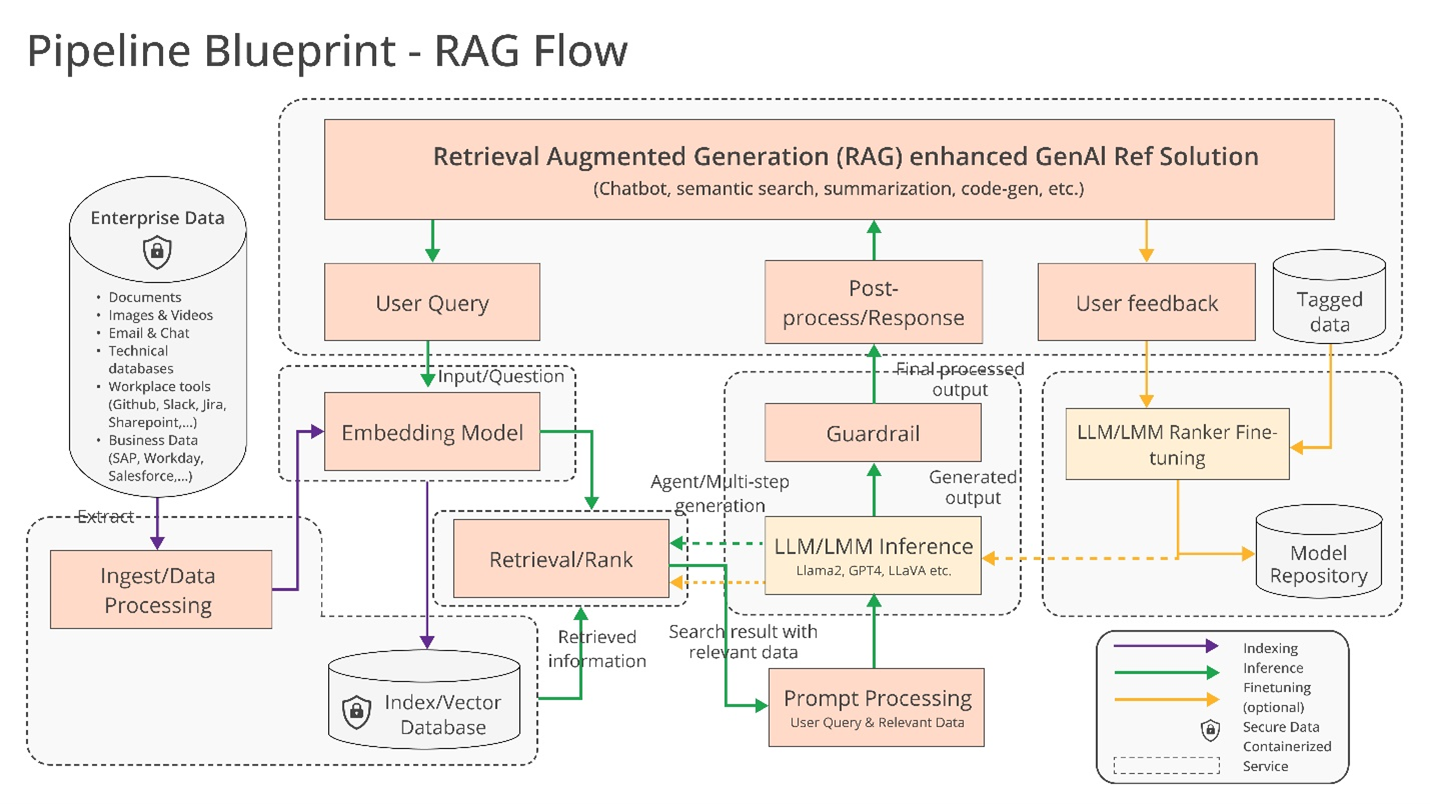
The Linux Foundation (LF) — a nonprofit organization that supports open-source initiatives — announced last month the launch of the Open Platform for Enterprise AI (OPEA), a project to foster the development of open-source, multi-provider, and composable, and modular generative AI systems.
In this initiative, industry leaders like Intel, Hugging Face, Cloudera, Datstax, Red Hat, SAS, Yellowbrick Data, Domino Data Lab, MariaDB, and VMware, among others, participate.
“On this foundation, enterprises can accelerate containerized AI integration and delivery, as well as new unique vertical use cases,” said Ibrahim Haddad, Executive Director at LF AI & Data.
OPEA intends to address the issue of the fragmentation of tools, techniques, and solutions in generative AI by collaborating with the industry to standardize components.
“Intel is at the forefront of incubating open source development to build trusted, scalable open infrastructure that enables heterogeneity and provides a platform for developer innovation,” added Melissa Evers, Vice President of Software Engineering Group and General Manager of Strategy to Execution, Intel.
OPEA plans to address critical pain points of RAG adoption. Most generative AI models’ answers and actions are limited to the data on which they’re trained. However, with RAG, a model’s knowledge base can be extended to info outside the original training data.
.
AI video startup Synthesia announced Expressive Avatars, powered by its EXPRESS-1 model for realistic avatar performance, with an improved tone of voice, body language, and lip sync, “like a real actor would,” the company said.
“We’re introducing digital actors. Our technology brings a level of sophistication and realism to digital avatars that blur the line between the virtual and the real,” Synthesia explained.
The EXPRESS-1 model understands the context of whether the conversation is cheerful or somber, and avatars adjust their performance accordingly, displaying a level of empathy and understanding that was once the sole domain of human actors.
According to the company, 200,000 people have used Synthesia’s 225 avatars to create over 18 million video presentations and published them in over 130 languages.
.
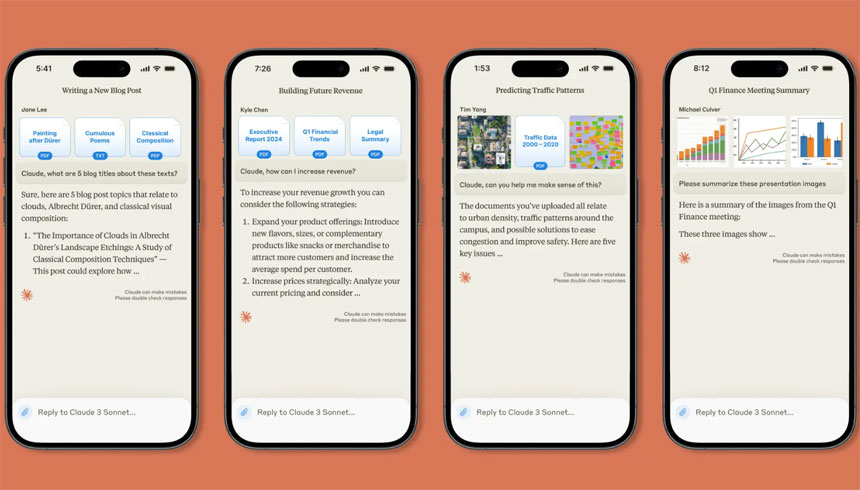
Amazon, Google, and Salesforce-backed Anthropic announced a free iOS app as well as its first enterprise offering called Team, which offers access to its Claude 3 Opus, Sonnet, and Haiku models for $30 per user per month.
The new Team plan features a 200K context window, enabling businesses to process long documents (e.g., research papers, legal contracts), discuss complex topics (e.g., financial forecasting, product road mapping), and maintain multi-step conversations (e.g., customer support inquiries, project planning discussions), helping individuals and teams gain deeper insights from their data.
The Claude iOS app offers the same experience on mobile web, including syncing chat history, and support for taking and uploading photos and files from a smartphone.
“Early testers report that the Claude app is exceptional for brainstorming ideas on the go, getting quick answers to questions, or analyzing scenes and images from the real world,” said the start-up firm.
Anthropic, the company behind the chatbot Claude, founded by ex-OpenAI research executives, has closed five different funding deals totaling about $7.3 billion.
The company has said the most capable of the new models, Claude 3 Opus, outperformed OpenAI’s GPT-4 and Google’s Gemini Ultra on industry benchmark tests, such as undergraduate-level knowledge, graduate-level reasoning, and basic mathematics.
This is also the first time Anthropic has offered multimodal support: users can upload photos, charts, documents, and other types of unstructured data for analysis and answers.
.
N.Y.P.D. officers in riot gear arrested dozens of pro-Palestinian demonstrators at Columbia University in New York City on Tuesday night and cleared the Hamilton Hall building that protesters had seized 20 hours earlier.
The police arrested more than 100 protesters who had set up tents on Columbia’s campus two weeks ago.
Also, yesterday, demonstrators and agitators were arrested at City College of New York in Harlem.
Other arrests were made on campuses nationwide. Over 1,000 protesters have been taken into custody on U.S. campuses since the original roundup at Columbia on April 18.
Meanwhile, the University of California, Los Angeles, declared a pro-Palestinian encampment illegal for the first time.
The Columbia University occupation escalated a crisis that has ignited protests on dozens of campuses nationwide.
Columbia University’s administrators said it had called the police to campus after the Hamilton Hall building was vandalized and blockaded.
The university’s president, Nemat Shafik, asked the N.Y.P.D. to maintain a presence on campus through at least May 17 to prevent further encampments or occupations.
.
OpenAI enabled this week in the U.S. the “Memory” feature for all ChatGPT Plus users, the company announced via X.
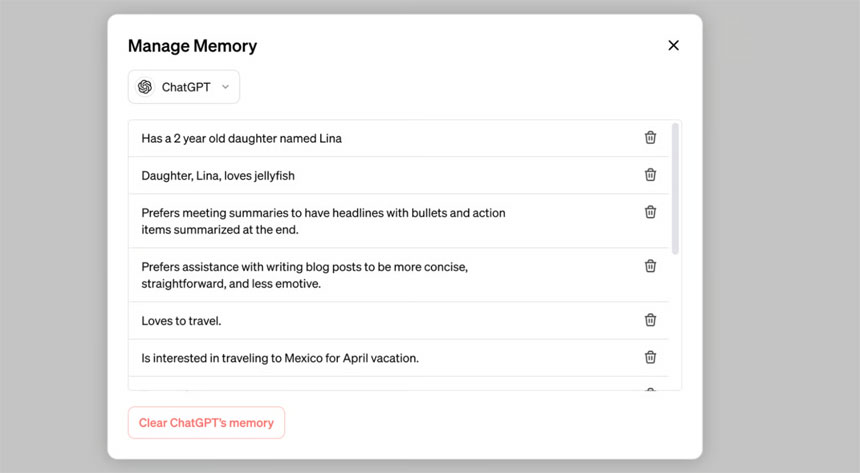
“Memory”, which can be turned on or off in settings, allows users to tell ChatGPT anything they’d like to remember across chats.
This feature extends ChatGPT capabilities by allowing the model to retain the context of previous conversations. It’s part of OpenAI’s strategy to evolve ChatGPT into a personal assistant.
Until now, each new chat started a new conversation without any prior knowledge.
Plans for wider availability will be announced at a later date.
OpenAI is reportedly working on two agents for different use cases, as well as on networked GPTs.
According to OpenAI, the memory feature allows ChatGPT to learn the user’s preferences and style, which should further increase efficiency at work.
For example, ChatGPT can now remember users’ preferred general tone, language, or format for blog posts; the preferred programming language and frameworks for coding; or the preferred charts for monthly business meetings.
OpenAI didn’t specify how ChatGPT’s memory works. According to experts, it might use text mining to create a database of facts from previous conversations, which are automatically extracted and incorporated into new responses that match the user’s prompts. This would make it like an extended, automated form of the already available “Custom Instructions”.
.
Memory is now available to all ChatGPT Plus users. Using Memory is easy: just start a new chat and tell ChatGPT anything you’d like it to remember.
Memory can be turned on or off in settings and is not currently available in Europe or Korea. Team, Enterprise, and GPTs to come. pic.twitter.com/mlt9vyYeMK
We're updating our data controls for ChatGPT Free and Plus users.
Now, you can access your chat history regardless of whether you’re opted into training for model improvement. If you’ve previously opted out, your choice will remain. Available on web today, and mobile soon. pic.twitter.com/KHqF2aTCYB
The protests, which started at Columbia University last week, spread to universities and colleges across over eight states in the U.S., with more than 800 arrests.
Police officers and university administrators clashed with pro-Palestinian protesters, arresting students, removing encampments, and threatening academic consequences.
The wave of student activism against the war in Gaza was sparked by the arrests at Columbia University.
The protests, nearly seven months after the Israel-Hamas war began, emerged as the latest flashpoint in the internal Democratic debate over the war.
These demonstrations are exposing political tensions over how to balance free speech protections and support for Gazans with concerns that some Jewish Americans are raising about antisemitism.
The New York Times made a list of where arrests have been reported as the authorities attempt to break up protests or encampments:
Columbia University: The New York City Police Department arrested 108 demonstrators while clearing an encampment at the Manhattan campus on April 18.
Yale University in New Haven, Conn.: The police arrested 60 people on Monday, including 47 Yale students, after they refused to leave an encampment on campus.
New York University in Manhattan: Officers made dozens of arrests late Monday after students occupied a plaza on campus.
University of Minnesota in Minneapolis: Nine people were taken into custody after they erected an encampment on Tuesday. All of those affiliated with the university were allowed back on campus and civil trespass warnings were “set aside.”
University of South Carolina in Columbia: Two students were arrested after a protest on Tuesday, according to a police report.
University of Southern California in Los Angeles: The police arrested 93 people at a demonstration on Wednesday afternoon.
University of Texas at Austin: The police arrested 57 protesters on Wednesday. A spokeswoman for the county attorney’s office said charges against many had been dropped after the office found legal “deficiencies” in their arrests.
Emerson College in Boston: The police arrested 118 people as an encampment was cleared on Wednesday night, the authorities said.
Ohio State University in Columbus: A university official said that 36 people, including 16 students, were arrested on Thursday. Earlier in the week, two students were arrested during an on-campus demonstration, university officials said.
Emory University in Atlanta: At least 28 people were arrested on Thursday morning, an Emory official said; 20 had ties to the school.
Indiana UniversityBloomington: On Thursday, the university police said 33 people were removed from an encampment and taken to jail. There were 23 more arrests on Saturday, the police said.
Princeton University in New Jersey: Two graduate students were arrested after pitching tents on Thursday.
University of Connecticut in Storrs: Campus police officers removed at least one tent from a rally on Thursday and took at least one person into custody, a university official said.
California State Polytechnic University, Humboldt: Protesters have occupied two buildings on the campus in Arcata, Calif., university officials said. Three people were arrested there this week.
Auraria Campus in Denver: About 40 people were arrested on Friday at a campus that houses facilities for the University of Colorado Denver, the Metropolitan State University of Denver and the Community College of Denver, the campus police said.
University of Illinois in Urbana-Champaign: Social media posts on Friday showed police officers detaining at least one person and taking down an encampment.
Arizona State University in Tempe: A university official said 69 people were arrested early Saturday after protesters set up an encampment. Three people were also arrested on Friday.
Northeastern University in Boston: The Massachusetts State Police said that 102 protesters were arrested on Saturday. Earlier in the day, the university said that among those who were detained, students who showed their university IDs were released.
Washington University in St. Louis: On Saturday, 100 arrests were made and the campus was locked down, according to a university statement. The presidential candidate Jill Stein was among the arrests.
University of Mary Washington in Fredericksburg, Va.: The university president’s office said that 12 people, including nine students, were arrested on Saturday evening.
Some media outlets reported that Jewish left-leaning billionaire George Soros and associations funded by him were reportedly funding the anti-Israel protests at college campuses across the US.
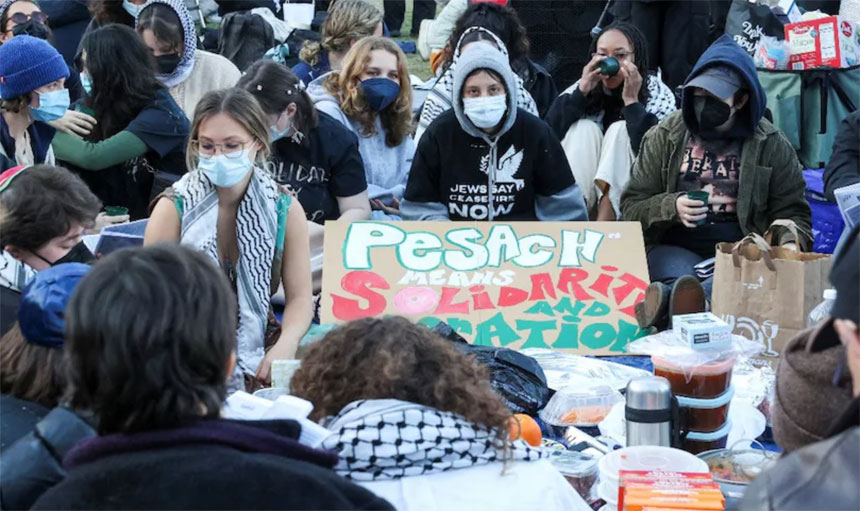
At Columbia University, three groups set up the tent city last Wednesday. These groups are Students for Justice in Palestine (SJP), Jewish Voice for Peace (JVP), and Within Our Lifetime.
Tent cities called the ‘Liberated Zones’, also set in Harvard, Yale, and Berkeley in California as well as the Ohio State University and Emory in Georgia, have reportedly been organized by the student branches of the Soros-backed SJP.
.