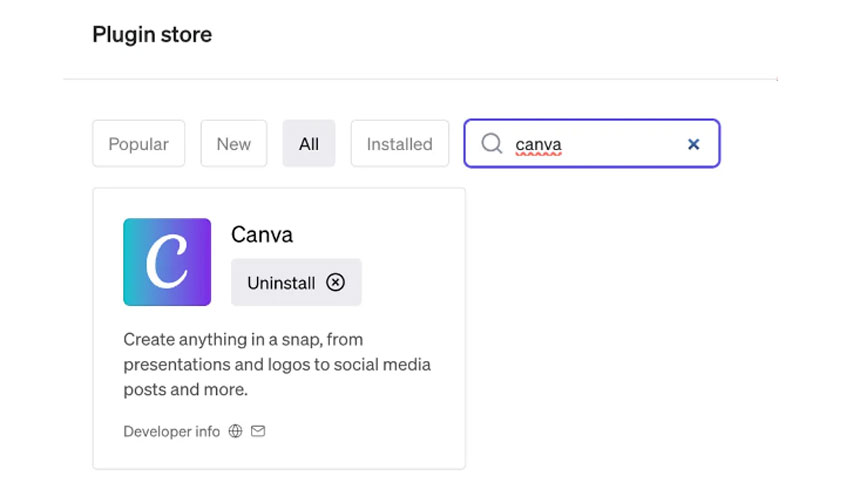
OpenAI this month introduced the Canva plugin on the ChatGPT store, letting paid users create visuals like logos and banners.
This integration is currently exclusive to ChatGPT Plus subscribers, who are charged a monthly fee of $20.
These users can use Canva with ChatGPT, but the process requires a lengthy process with many clicks.
In the chatbot’s prompt box, ChatGPT’s customers describe the visuals they want to generate. For example: “I am a smartphone enthusiast active on Facebook. Create a banner.”
Users will then be taken to Canva, where they can edit and download the AI-generated visual by tapping on the ‘Share’ button and choosing the ‘Download’ option.
.
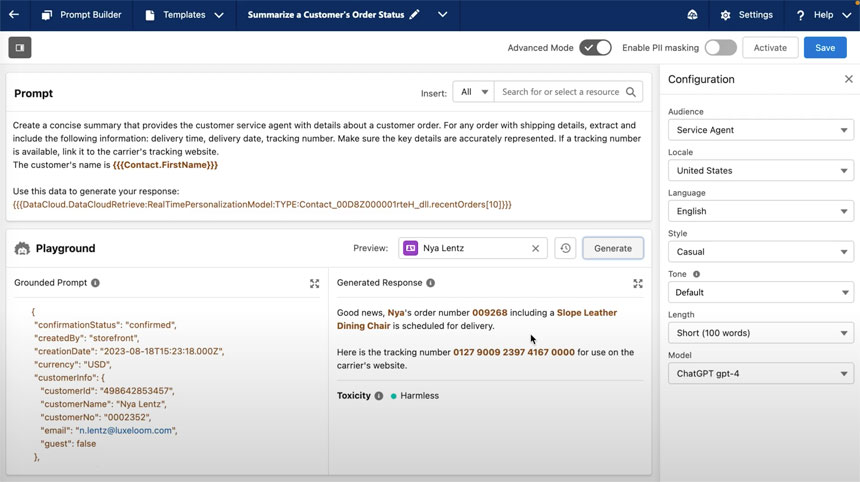
At its Dreamforce customer conference in San Francisco this week, Salesforce.com announced Einstein Copilot Studio, a tool that consists of three elements to build custom generative AI applications with low-code knowledge: prompt builder, skills builder, and model builder. It will be available as a pilot this fall, according to the company.
The prompt builder allows customizing and creating templates for clients’ product or brand offerings that aren’t available out of the box with Einstein GPT or Einstein Copilot.
The skills builder enables companies to add actions to prompts. Some examples include running a competitor analysis or objection handling.
The model builder lets enterprise companies bring their model or use one of the supported third-party offerings like Anthropic, Cohere, Databricks, Google Cloud’s Vertex AI, and OpenAI.
Einstein Copilot Studio says that it makes accessible all the components from across the Salesforce platforms.
To deal with hallucinations — when a model makes up an answer or provides inappropriate responses — and help companies manage security, governance, and data privacy, Salesforce is building a system called “the Einstein Trust Layer.”
.
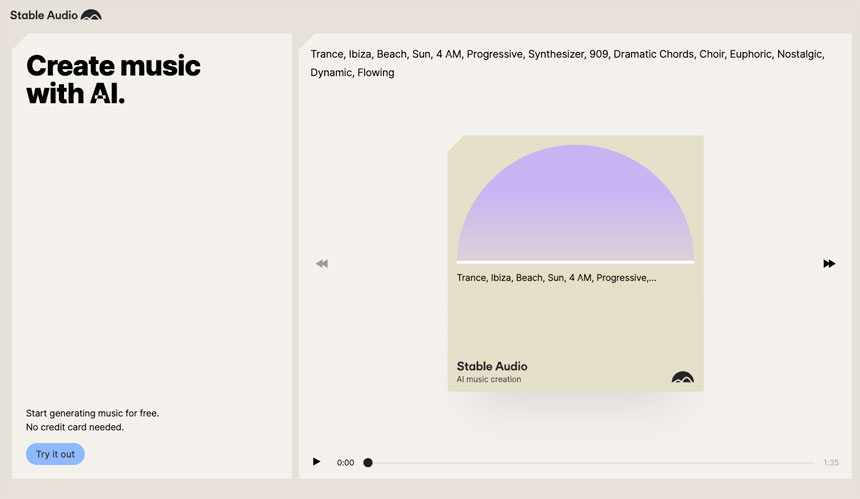
Stability AI announced the launch of Stable Audio, a model that uses generative AI techniques to deliver music and sound effects via a web interface, this week.
Audio tracks, songs, and sound effects, at high-quality 44.1 kHz, are generated by the user by writing a text with a descriptive prompt and the desired length of audio.
The underlying model was trained using music and metadata from AudioSparx, a leading music library. It was trained on 800,000+ tracks and effects.
For instance, “Post-Rock, Guitars, Drum Kit, Bass, Strings, Euphoric, Up-Lifting, Moody, Flowing, Raw, Epic, Sentimental, 125 BPM” can be entered with a request for a 95-second track, and it would deliver this track:
The company provided more samples of generated tracks on its announcement page.
Stable Audio’s free version offers to create and download tracks of up to 45 seconds, while the ‘Pro’ subscription – at $12 per month — delivers 90-second tracks that are downloadable for commercial projects. Users can try the model at www.stableaudio.com.
According to Techcrunch, in the Stable Audio terms of service agreement, customers agree to indemnify Stability in the event intellectual property claims are made against songs created with Stable Audio.
This London–based company has raised $125 million and achieved a valuation of $1 billion.
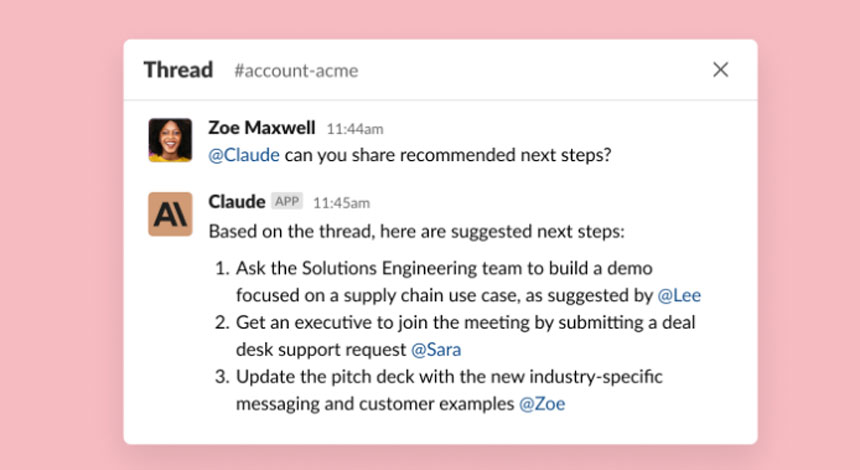
Slack will introduce this winter its AI tool which will instantly generate highlights and summaries of the conversations. These new generative AI capabilities were announced by the parent company, Salesforce, this month.
AI-generated summaries will also list the next steps users can take based on concerns, comments, and suggestions posted by people in the conversation.
In addition, Slack AI will produce elaborate answers when people search for information on the platform.
At the moment, searching on Slack can only bring up messages, files, and channels with the keyword.
Users will be able to integrate their AI language model of choice, using partner-built apps from OpenAI’s ChatGPT or Anthropic’s Claude.
Only 27% of companies are currently using AI tools, according to the latest State of Work research.
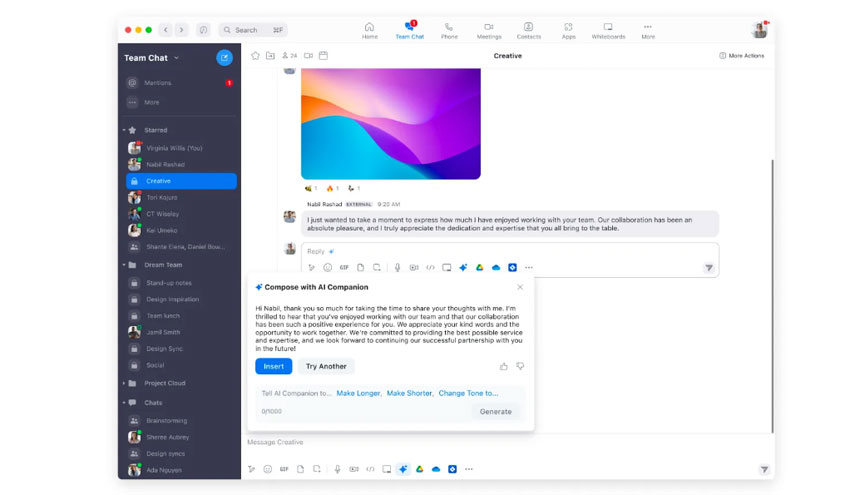
Video conferencing leader Zoom this month announced an update on its AI-powered assistant, formerly known as Zoom IQ and now rebranded as AI Companion.
Powered by Zoom’s in-house generative AI along with AI models from Meta’s Llama 2, OpenAI, and Anthropic, the tool now has a wider reach. It expands to more corners of the Zoom ecosystem, including Zoom Whiteboard, Zoom Team Chat, and Zoom Mail. This tool is part of the paid Zoom account, with no additional cost.
For example, users will be able to catch up on key points during a meeting along with querying for the status of projects, pulling on transcribed meetings, chats, whiteboards, emails, documents, and even third-party apps.
After the meeting, AI Companion smart recordings can automatically divide cloud recordings into chapters for review, highlight important information, and create the next steps to take action.
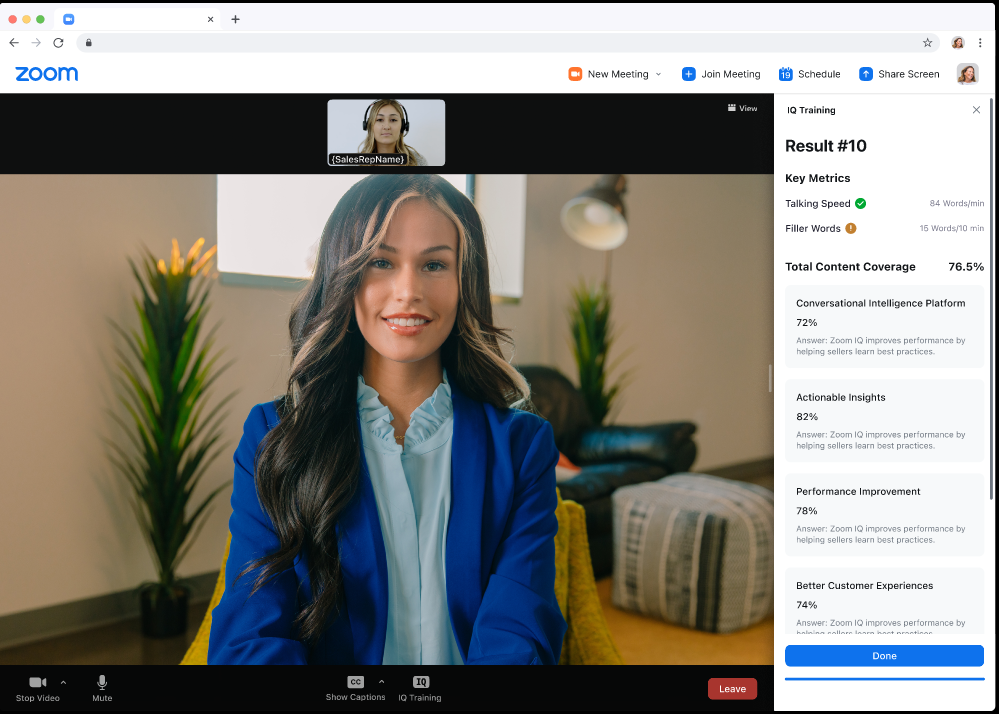
Also starting next year, the AI Companion will give real-time feedback on people’s presence in meetings plus coaching on their conversational and presentation skills.
Earlier, within a few weeks, in Zoom Team Chat, Zoom’s messaging app, users will soon gain the option to summarize chat threads through the AI Companion.
In Zoom’s second rebranding, Zoom’s sales assistant tool Zoom IQ for Sales became Zoom’s Revenue Accelerator.
This virtual coach can assess salespeople’s performance in pitching products using various sales methodologies, similar to other AI-powered sales training platforms on the market.
Repetitive tasks like these can take up 62% of the workday, according to Asana.
Roblox announced last week a new conversational AI assistant at its 2023 Roblox Developers Conference (RDC), which will be available in Roblox Studio and Creator Hub at the end of this year or early next year.
This tool, named Assistant, empowers creators to code and build virtual environments faster.
Roblox Assistant will build on the existing use of generative AI on Roblox, which lowers the barrier to entry for new or less experienced creators and enables more established creators to automate tedious, repetitive tasks.
For example, if someone types in “I want to make a game set in ancient ruins,” Roblox drops in some stones, moss-covered columns, and other architectural elements. It might grab assets from either its marketplace or users’ visual asset library.
Earlier this year, Roblox released Code Assist and Material Generator, seeing the amount of code generated double compared to their previous autocomplete solution.
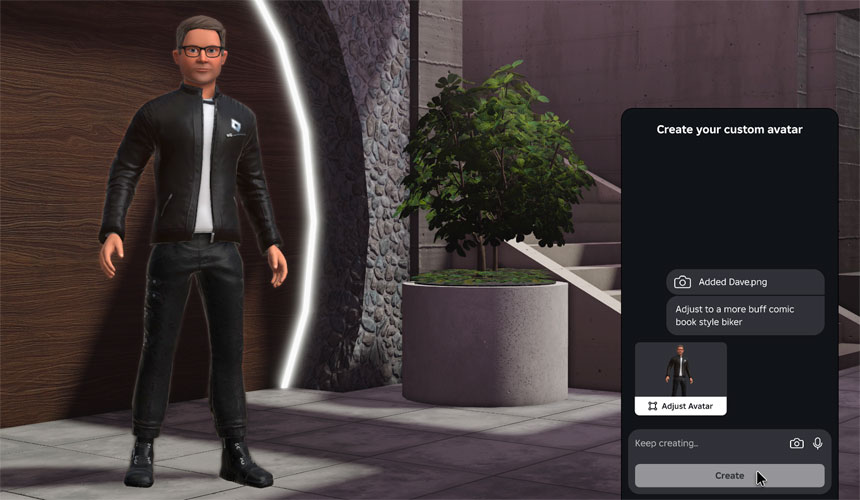
At the RDC conference, Roblox also discussed the possibility of letting users create a cartoony avatar of themselves from an image and a text prompt. Another tool that would be based on AI to moderate voice conversations in real-time, could cut down on toxicity on the platform.
The IRS (Internal Revenue Service) has deployed AI to investigate tax evasion and open examinations into large hedge funds, private equity groups, real estate investors, and law firms.
The federal agency this Friday announced that it will use some of the $80 billion allocated through last year’s Inflation Reduction Act to target the wealthiest Americans who use sophisticated accounting maneuvers to avoid paying taxes.
This agency’s new funding has generated a political fight between Republicans and Democrats.
Republicans claim that the IRS will use the funding to harass small businesses and middle-class taxpayers while Democrats say that the funding is primarily enabling the IRS to target wealthy Americans and corporations who may have engaged in tax evasion.
“These are complex cases for IRS teams to unpack,” Daniel Werfel, the IRS Commissioner, said. “The IRS has simply not had enough resources or staffing to address partnerships; in a real sense, we’ve been overwhelmed in this area for years.”
Mr. Werfel explained that artificial intelligence is helping the IRS identify patterns and trends, giving the agency greater confidence that it can find where larger partnerships are shielding income. This is leading to the kinds of major audits that the IRS might not have previously tackled.
The agency said it would open examinations into 75 of the nation’s largest partnerships, which were identified with the help of artificial intelligence, by the end of the month. The partnerships all have more than $10 billion in assets and will receive audit notices in the coming weeks.
More audits are likely to come, according to The New York Times. In October, the IRS will send 500 notifications, known as compliance alerts, to other large partnerships indicating that the agency has found discrepancies in their balance sheets. These partnerships could also face audits if they cannot explain the differences in their balances from the end of one year to the start of the next.
The focus on partnerships is part of a broader push by the IRS to scrutinize wealthier taxpayers in 2024. Mr. Werfel said that the agency is dedicating dozens of revenue officers to pursue 1,600 millionaires who the IRS believes owe at least $250,000 in unpaid taxes.
In the coming year, the IRS said it plans to increase scrutiny of digital assets as a vehicle for tax evasion and investigate how high-income taxpayers are using foreign bank accounts to avoid disclosing their financial information.
As part of its recruiting strategy, the IRS has been looking to hire data scientists to develop new in-house artificial intelligence tools. Mr. Werfel said that the agency is also collaborating with outside experts and contractors on the project.
.
Anthology plans to release generative AI features on its Blackboard Learn LMS in September. These new functionalities, which are being tested in August, will include Course-Building Tools that suggest a possible course structure, generate images, suggest test questions, and grading rubrics.
Additionally, at its annual Anthology Together 2023 conference, Anthology introduced two new Intelligent Experiences and announced that it has adopted Microsoft’s Azure Open AI to power its tech solutions.
These experiences, planned for Fall 2023, will provide “alignment of data across historically siloed systems to deliver personalized and actionable insight to learners and instructors,” Anthology said.
They will create a data flow between Anthology Occupation Insight, Anthology Milestone, and Anthology Student; and Connect Blackboard Learn’s Progress Tracking data and the advising module inside Anthology’s CRM and lifecycle engagement tool.
Meta last week released a new benchmark open-sourced dataset named FACET (Fairness in Computer Vision Evaluation), which is designed to evaluate and improve fairness in AI vision models.
FACET consists of 32,000 images containing 50,000 people labeled by human annotators. It accounts for classes related to occupations and activities like “basketball player” or “doctor”, as shown in the picture above.
“Our goal is to enable researchers and practitioners to perform similar benchmarking to better understand the disparities present in their own models and monitor the impact of mitigations put in place to address fairness concerns,” Meta wrote in a blog post.
“It’s unclear whether the people pictured in them were made aware that the pictures would be used for this purpose,”explained TechCrunch.
In a white paper, Meta said that the annotators were “trained experts” sourced from “several geographic regions”, including North America (United States), Latin America (Colombia), Middle East (Egypt), Africa (Kenya), Southeast Asia (Philippines) and East Asia (Taiwan).
In addition to the dataset itself, Meta has made available a web-based dataset explorer tool.
.
OpenAI will host its first developer conference, OpenAI DevDay, on November 6, 2023, in San Francisco. It will be a one-day that expectedly will bring hundreds of developers.
Today, over two million developers are using GPT-4, GPT-3.5, DALL·E, and Whisper for a wide range of use cases, from integrating smart assistants into existing applications to building new applications.
Members of OpenAI’s technical staff will showcase new tools, participate in breakout sessions, and open conversations with in-person attendees.
Sam Altman, CEO of OpenAI, said, “We’re looking forward to showing our latest work to enable developers to build new things.”