Category: Platforms | Tech

  • View: A MOOC Platform Catalog is No-Marketing. Leveraging Institutional Networks Is Key

    View: A MOOC Platform Catalog is No-Marketing. Leveraging Institutional Networks Is Key

    Mikel Amigot | IBL News

    An effective marketing plan will drive enrollment, engage with learners and increase word of mouth awareness.

    We start defining our target audience: who are the type of students who would be interested, what is the course about, and why should learners enroll in the course –what new skills and knowledge will they gain, and how will they benefit and help advance their career. In addition, we need to determine what is the key differentiator of the course: is it the institution, the instructor, the topic?

    We all agree on this approach. We also agree that promoting the course description page (or About page) will require an SEO, Twitter / Facebook / LinkedIn social campaign and maybe some paid Adwords.

    But this isn’t enough. A well-crafted plan needs to activate the college’s existing institutional web properties, faculty networks, PR department media capabilities, blog spaces, newsletters, and landing pages. The outreach of the organization, either is a university or a large company, is simply impressive.

    A client of ours forgot or was unable to activate, this little detail, and the enrollment fell short. This department thought that the failure was due to the lack of presence on a catalog of a big MOOC platform like Coursera o edX.

    Institutions tend to believe before joining a consortium that a MOOC platform is a magic bullet for marketing. When they launch their first course or program, they discover that enrollments are surprisingly low. What happens? Well, first, they put too much faith on those platform advertising pitches, and, second, they don’t activate their institutional networks.

    Truth be told, Coursera and edX do advise about the importance of undertaking an integrated marketing approach between the institution and MOOC platform, with the university’s web assets as the most important. In the end, Google is always your best ally. A centralized catalog has a limited impact.

  • An Innovative, Stackable Online Master’s in Supply Chain Management from ASU On edX

    An Innovative, Stackable Online Master’s in Supply Chain Management from ASU On edX

    IBL News | New York

    edX, Arizona State University (ASU), and MIT announced today the launch of an innovative, stackable online Master’s of Science in Supply Chain Management, starting in January 2020.

    Learners who pass the MIT MicroMasters Supply Chain Management on edX.org will have the opportunity to transition to a full master’s degree from ASU’s W.P. Carey School of Business and ASU Online (also hosted on edX).

    “This new offering truly transforms traditional graduate education by bringing together two top-ranked schools in supply chain management to create the world’s first stackable, hybrid graduate degree program. This approach to a stackable, flexible, top-quality online master’s degree is the latest milestone in addressing today’s global skills gap,” said Anant Agarwal, edX CEO and MIT professor.

    “We believe there will be many students who are eager to dive deeper after their MicroMasters program to earn a master’s degree from ASU, and that more learners will be drawn to the MIT Supply Chain Management MicroMasters program as this new pathway to a graduate degree within the edX platform becomes available,” added Amy Hillman, dean of the W. P. Carey School of Business at ASU.

    Students currently enrolled in, or who have already completed, the MITx Supply Chain Management MicroMasters program can apply now for the online Master of Science in Supply Chain Management from ASU, with an application deadline of Dec. 16.

    With this new offering, the MIT Supply Chain Management MicroMasters program now offers learners pathways to completing a master’s degree at 21 institutions.

    Master’s degrees on edX are stacked, degree programs with a MicroMasters program component.


  • Coursera’s Google IT Support Certificate Program Gets a Good Response

    Coursera’s Google IT Support Certificate Program Gets a Good Response

    IBL News | New York

    Out of 75,000 enrollees, over 8,000 students have completed the Google IT Support Professional Certificate program, hosted in Coursera.

    Google created this $49 a month program in early 2018. It was designed to take beginner learners to job readiness in about eight months.

    There are 215,000 unfilled IT support staff roles nationwide, Google estimates. The average annual starting salary for these entry-level IT jobs is $52,000, federal data shows.

    Around 70 percent of enrollees come from underrepresented populations in tech, including women, Latinos, African-Americans, veterans and learners without a college education.

    Employers that are recruiting from the Google IT Support Certificate program include Bank of America, General Electric, Walmart, Wyndham Hotels, Sprint, Home Depot, H&R Block, Infosys, Intel and Cognizant.

    Community colleges with a strong track record in workforce development are also successfully offering the certificate to their students with additional support and in-person instruction. Google partnered with an initial group of 25 community colleges in 2018 but intends to grow that number to 100.

    The Internet giant provided a grant that allows community colleges to offer the program for free.

    Some colleges are offering the course for credit as part of a degree program. Others are including it as part of their continuing-education programs.

    “The IT support role, which involves troubleshooting and solving technical issues, typically doesn’t require a four-year college degree, so it should be a strong entry point for nontraditional talent,” Natalie Van Kleef Conley, Product Manager for Grow with Google, said in Inside of Higher Education.

    Moving forward, Google wants to expand partnerships and move into new areas of tech training.

  • MITx Prepares 30 New MOOCs and Builds with Other Universities a Blockchain System for Credentials

    MITx Prepares 30 New MOOCs and Builds with Other Universities a Blockchain System for Credentials

    IBL News | New York

    MITx has become, along with Harvard University and Microsoft, the most prolific course creator on edX.org, with 111 MOOCs shared in the past year, and 26 of them being run for the first time.

    “We have about 30 more in the pipeline. At this point we have worked with faculty from 29 of MIT’s departments across all of its 5 schools, as we strive to share the best of MIT’s teaching, and learning, with the world,” said Krishna Rajagopal, Dean for Digital Learning, Open Learning, and Professor of Physics at MIT.

    Two of the newest MOOCs from the past Spring have been:

    • Healthcare Finance. Professor Andrew Lo, from MIT Sloan School of Management, teaches how to apply financial techniques to biomedical contexts, following its personal mission of bringing more life-saving therapies to patients faster.


    • Qualitative Research Methods: Conversational Interviewing. Professor Susan Silbey, a winner of MIT’s Killian Award, teaches learners how to prepare for and conduct a conversational interview for the purpose of gathering data.


    Another remarkable initiative where MIT collaborates with eight other top research universities is related to the design of a digital, distributed infrastructure for issuing, storing and displaying verifiable credentials and certificates of academic achievement.

    “We aim to utilize strong cryptography to prevent tampering and fraud, and shared ledgers to create a global infrastructure for anchoring academic achievements that build upon earlier research and pioneering efforts  — including MIT’s pilot program via which it issued all of its 2018 graduates a digital version of their diplomas that are verified against a blockchain,” explained Professor Krishna Rajagopal.

    MIT: Digital Credentials

  • Half of Employees That Need to Re-Skill Don’t Ask for Help, an edX Survey Finds

    Half of Employees That Need to Re-Skill Don’t Ask for Help, an edX Survey Finds

    IBL News | New York

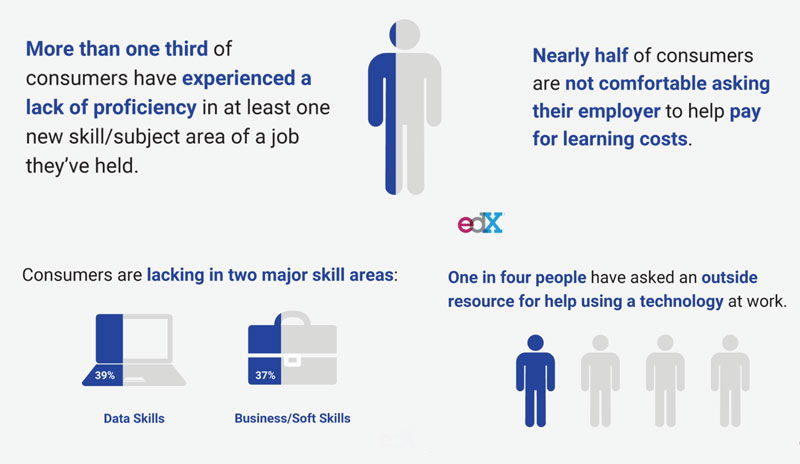
    More than one-third of employees have experienced a lack of proficiency in at least one new skill or subject area of a current or past job – usually related to data science (39%) or business and soft skills (37%). However, nearly half of these employees don’t feel comfortable asking their employer to help pay for learning costs, and one in four people have asked an outside resource for help.

    These are the main conclusions of a survey conducted by edX on 1,000 consumers aged 18+ on reskilling trends.

    “The fourth industrial revolution is here, and as technology continues to evolve rapidly, employees must continue to reskill to keep up with the shifting demands of their job,” explained Adam Medros, President & COO at edX.

    According to the World Economic Forum, 1.4 million U.S. jobs alone are expected to be disrupted by technology and other factors between now and 2026.

    Survey’s respondents are split between who should be responsible for making sure that they are prepared for the jobs of the future with the right skills – 41% feel it is an individual’s responsibility; 33% feel its an employer’s responsibility; 16% believe it’s higher education’s responsibility; and 9% believe it’s up to the government.

    edX’s Press release

  • A Billionaire Will Cover the Cost of Coursera’s Illinois Data Science Master’s Degree for His Employees

    A Billionaire Will Cover the Cost of Coursera’s Illinois Data Science Master’s Degree for His Employees

    Marie I. Rose | IBL News

    AI-software provider C3.ai, a company owned by billionaire Tom Siebel, has started to offer employees a fully paid tuition for the Master of Computer Science in Data Science (MCS-DS) from the University of Illinois at Urbana Champaign, available on Coursera for $21,000.  

    Those who complete the degree will get three more career incentives: a $25,000 cash bonus, a 15% salary increase, and a stock option equity award.

    “In this new economy where people are talking about digital transformation; for companies to stay at the top of their game they need to have state-of-the-art continuing education programs,” said Siebel, who got a degree in Computer Science –although residentially – at the same university.

    In 2007, Thomas Siebel, 66, pledged $1000 million to support science and engineering at this institution. Currently, CEO at C3.ai, Siebel, with a fortune of $2.9 billion, is a former salesman who became a billionaire after creating and selling Siebel Systems to rival Oracle in 2006 for $5.8 billion. C3.ai is valued at $2.1 billion.

    In addition to this degree, C3.ai employees, 330 in total today, already have free access to other Coursera courses and Specializations in AI, IoT, clouding computing, and advanced computing.

    “This model of stackable learning will become standard as more companies realize the value of providing a variety of flexible learning pathways for employees to acquire critical skills,” stated Leah Belsky, VP of Enterprise at Coursera.

    “We believe that more and more companies will move in this direction in the future. C3.ai is showing real foresight, and they are putting an incredible amount of employee support behind that foresight,” said Rashid Bashir, Dean of The Grainger College of Engineering at the University of Illinois. “New modes of delivering professional education are crucial to both companies like C3.ai and to universities like Illinois.”

    The Coursera-based MCS degree was launched in 2016. Nearly 700 hundred students are enrolled in the program. The acceptance rate is 30%.

    Illinois’ Department of Computer Science is consistently ranked as one of the top computer science programs in the world. In 2018, it was ranked #5 on the U.S. News and World Report list of Best Computer Science Schools.

    Thomas Siebel, in the picture, shows a clear vision: “At C3.ai, we are assembling a team of inquisitive self-learners, motivated and properly trained to solve some of the world’s most challenging technology problems. This program further enables our employees’ success by encouraging them to further develop their computer science and AI expertise at one of the world’s leading universities.”

    Siebel’s educational offering to employees is probably the most generous one within corporate America, beyond  Starbucks‘, which covers a portion of the tuition for those who earn online B.A.’s from Arizona State University, and Walmart‘s incentive of $1,500 cash bonuses to some workers who finish degrees at three subsidized schools.

    He claimed in Forbes that “the money his company will spend on employee degrees and cash bonuses are a drop in the bucket when you consider how much we spend on human capital.” When you add in other benefits and travel, he says each employee already costs the company more than $350,000 a year. “If someone is increasing their skills, advancing their career, setting themselves up for multiple promotions, providing better service for their customers, in that context the amount we’re spending on this benefit is nothing.”

  • Open edX | June 2019: Stanford, UBx, LTI 1.3, Coursera, Udacity…

    Open edX | June 2019: Stanford, UBx, LTI 1.3, Coursera, Udacity…

    Newsletter format  |  Click here to subscribe ]


    JUNE 2019 – NEWSLETTER #17  |  More breaking news at IBL News 


    Open edX

    • Open edX Issues Ironwood.2, a New Release of Its Platform

    • UBx, University at Buffalo’s Continuing Education Open edX-Based Platform, Expands with New Courses

    • A Fascinating Free Course About Beethoven’s Music from Stanford University

    • The Open edX Software Ranks #36 on GitHub’s Top 100 Projects


    edX

    • Chatbots Gain Traction Among Businesses – Now a Course About Them on edX

    • Afghanistan’s Ministry of Higher Education Creates AfghanX and Joins the edX Consortium


    COURSERA

    • Illinois Shuts Down its Traditional MBA and Focuses into Online’s iMBA

    • What’s Next for Coursera and FutureLearn? Insights Revealed at the EMOOCS Conference

    • Coursera Expands into Canada by Opening an Engineering Office


    UDACITY

    • Georgia Tech Will Deploy this Summer an Improved Version of its AI-Based Teacher Assistant

    • Analysis: Sebastian Thrun, Creates the University of Silicon Valley and the Fourth Degree

    • Sebastian Thrun Told Harvey Mudd Graduates to “Stay Curious and Always Believe in Themselves”

    • Udacity Offers Two Programs to Train Cloud Engineers on AWS


    INDUSTRY

    • The New Standard LTI 1.3, which Allows Interoperability of Grades and Assignments, Excites the Industry

    • The Good and the Bad: Choose the Best OPM, According to Dr. Chuck


    2019 UPCOMING EVENTS

    Education Calendar  –    JUNE  |  JULY  |  AUG – DEC 2019


    This newsletter about Open edX is a monthly report compiled by the IBL News staff, in collaboration with IBL Education, a New York City-based company that builds AI analytics-driven, revenue-oriented learning ecosystems, and courses with Open edX and other educational software. 

    Read the latest IBL Newsletter on Online Education at Scale  |  Archive of Open edX Newsletters

  • Learning At Scale | June 2019: SNHU, SUNY, USC, Emeritus, Walmart, Carnegie Mellon…

    Learning At Scale | June 2019: SNHU, SUNY, USC, Emeritus, Walmart, Carnegie Mellon…

    Newsletter format  |  Click here to subscribe ]

    JUNE 2019  –  NEWSLETTER #23 ON ONLINE EDUCATION AT SCALE


    HIGHER ED

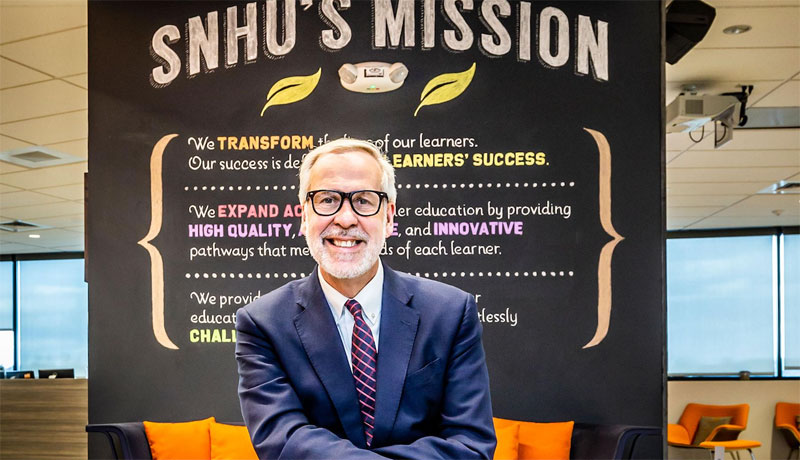
    • SNHU, with 135K students and an army of 6k adjuncts, wants to be the “Nordstrom’s of higher education”, says its president Paul LeBlanc.

    NY University System will focus on increasing its online presence.

    “Emerging markets are a large opportunity to boost online enrollment”, says Emeritus CEO.

    Higher education enrollments will continue its decline throughout the next decade. College closures will increase in 2019.


    ACADEMIA

    Canadian educator Heather Payne says that tenure should be abolished.

    Ángel Cabrera, George Mason University’s president, named the sole finalist for the Georgia Tech presidency.

    Michigan State named Stony Brook president as the new leader. Samuel Stanley Jr. created 240 faculty positions.

    A billionaire investor pledged to pay off the student debt of Morehouse College’s 396 graduating young men during his commencement speech.

    • USC’s partnership with 2U didn’t work at all. The school is facing a budget crisis that may result in nearly half of the staff losing their jobs.


    INDUSTRY

    Walmart expanded the $1 a day degree program to more universities.

    OpenSesame corporate learning marketplace, with 20,000 courses, raised $28 million to help it grow faster.

    SAS software provider debuted in higher education with an advanced cloud-based analytical solution. Jenzabar improved its analytics suite.


    RESEARCH

    Carnegie Mellon University released its first wave of open-source learning tools. Interview with the leader behind the initiative.

    Tecnológico de Monterrey released an elaborated report on alternative credentials (PDF).


    VIEWS

    Actionable data is the most disappointing late arrival in teaching and learning in higher ed.

    Online education doesn’t work for disadvantaged populations, those unprepared for college and first-time students.

    Achieving 85% completion rates for online courses.

    It’s all about money? There is no difference between for-profit and public higher ed, said George Siemens.

    Instructional designers forget what makes a course successful.

    A model involving faculty for course design.

    An Institution prepares students for jobs which won’t be automatized.

    Netflix-style service Cengage Unlimited reaches 1.5 million subscribers.


    2019 UPCOMING EVENTS

    Education Calendar  –    JUNE  |  JULY  |  AUG – DEC 2019


    This newsletter about learning innovation is a monthly report compiled by IBL News and IBL Education. If you enjoy what you read please consider forwarding it to spread the word. Click here to subscribe.

    Archive:
    IBL Newsletter #22– May 2019
    IBL Newsletter #21– April 2019
    IBL Newsletter #20– March 2019
    IBL Newsletter #19– January 2019

  • Open edX Issues Ironwood.2, a New Release of Its Platform

    Open edX Issues Ironwood.2, a New Release of Its Platform

    Paul G. John | IBL News

    edX engineers have released an update on the new Ironwood version of the platform, implementing changes into the ironwood branch on GitHub.

    The new release is called ironwood.2, and it is located at open-release/ironwood.2. 

    These changes since ironwood.1 include:

    • Reverting and feature-flagging of “honor code not eligible for certificate”
    • A handful of security fixes
    • Small changes to bring the default installation into compliance with edX trademark policy


    Open edX Ironwood was issued March 21. This version is the ninth release of the Open edX platform and includes improvements over the former Hawthorn.2 version.

    One of the most notorious improvements involved the login process into Studio –by redirecting the user to the LMS to log in, and then redirecting back to Studio.

    Another remarkable feature was called “Public Course Content”, which allowed users to access materials and components without registration or enrollment.


  • View: A Model Involving Faculty for Course Design

    View: A Model Involving Faculty for Course Design

    Mikel Amigot | IBL News

    The course development process usually tends to be too complex. As instructional designers, we schedule too many milestones and we overcomplicate things.

    Two experts in the field shared their view at SUNY’s annual technology conference, CIT, which took part this May 29-31 in Purchase, New York.

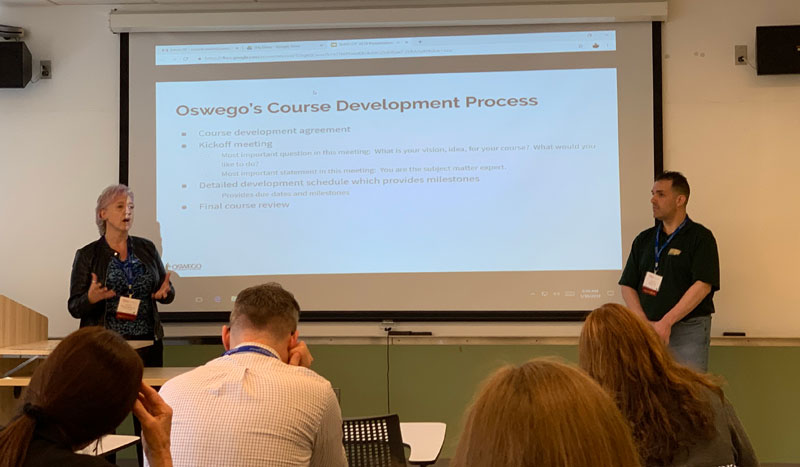
    Learning designers Joseph Stabb and Theresa Guillard-Cook [in the picture] described SUNY Oswego’s four-step process for course development: 1) Agreement; 2) Kickoff Meeting; 3) Schedule Set Up; 4) Final Course Review.

    The second one is particularly critical. The most important questions in the meeting with professors are: “what is your vision and idea for your course? What would you like to do?” These obvious questions and answers are usually forgotten; consequently, the class becomes ineffective.

    “The most important statement in this meeting is: you are the subject matter expert,” said Joseph Stabb and Theresa Guillard-Cook.

    Regarding the third stage, a detailed development schedule with milestones and due dates is required. A template is necessary.

    A well-defined process, based on continuous collaboration where faculty feel supported, will meet educational standards and drive student outcomes.