Category: Views

  • Google Introduces New Analytics with Machine Learning and Predictive Models

    Google Introduces New Analytics with Machine Learning and Predictive Models

    IBL News | New York

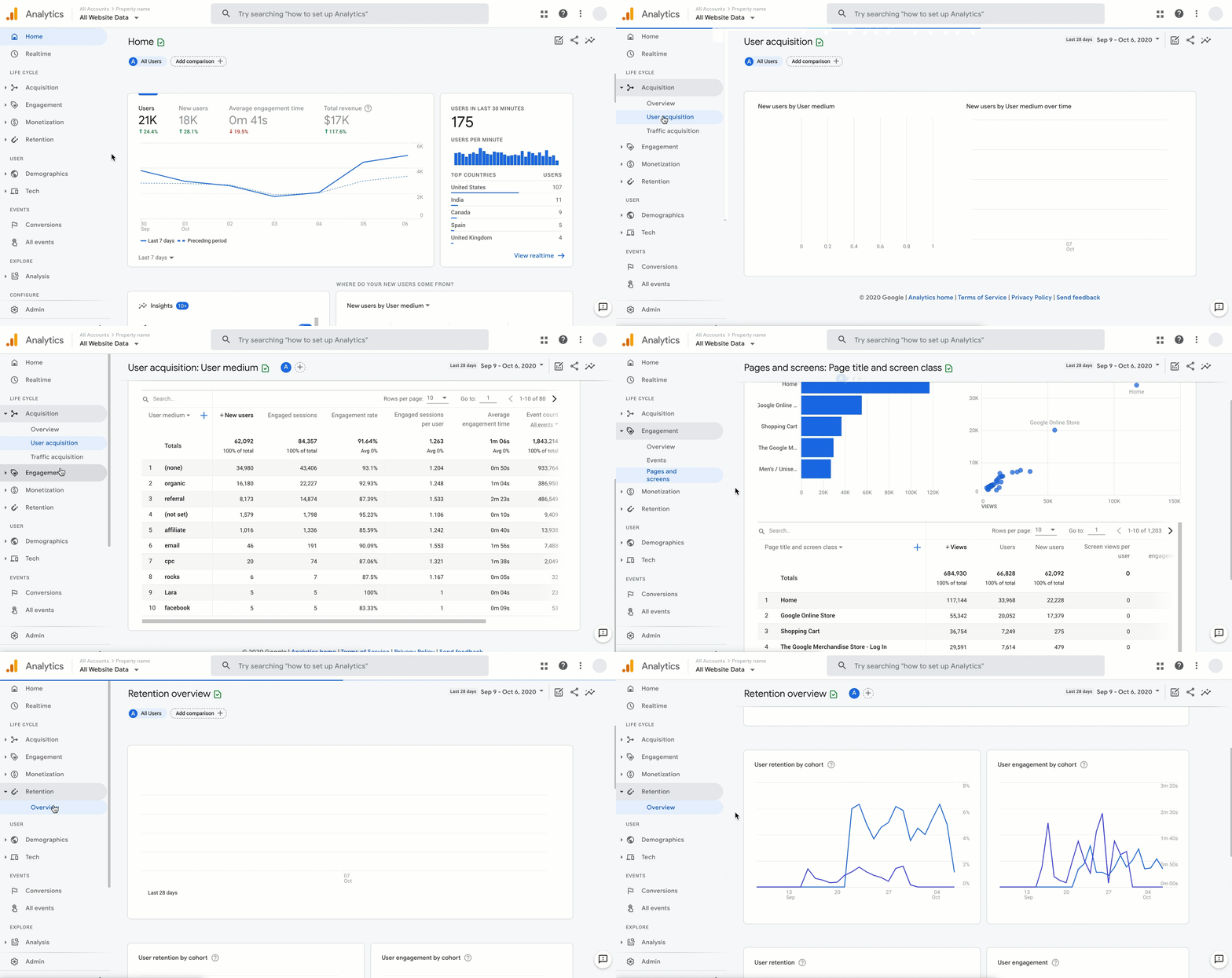
    Google announced the introduction of its new Google Analytics with machine learning at its core, which is privacy-centric by design. They are built on the foundation of the App + Web property presented last year.

    The goal of the giant searching company is “to help users to get better ROI and improve their marketing decisions.” It follows what a survey from Forrester Consulting points out that improving the use of analytics is a top priority for marketers.

    The machine learning models include will allow the ability to alert on trends in data, like products seeing rising demand, and help to anticipate future actions from customers. “For example, it calculates churn probability so you can more efficiently invest in retaining customers at a time when marketing budgets are under pressure,says in a blog-post Vidhya Srinivasan, Vice President, Measurement, Analytics, and Buying Platforms at Google.

    It also adds new predictive metrics indicating the potential revenue that can be earned from a particular group of customers. “This allows you to create audiences to reach higher-value customers and run analyses to better understand why some customers are likely to spend more than others, so you can take action to improve your results,” wrote Vidhya Srinivasan.

    The new Google Analytics provides customer-centric measurement, including conversion from YouTube video views, Google and non-Google paid channels, search, social, and email. The setup works with or without cookies or identifiers.

    They come by default for new web properties. In order to replace the existing setup, Google encourages to create a new Google Analytics 4 property (previously called an App + Web property). Enterprise marketers are currently using a beta version with an Analytics 360 version with SLAs and advanced integrations with tools like BigQuery.


    Resource:
    • Introduction to Google Analytics 4 for Higher Education Institutions

  • Another Zoom Challenger: Engageli Capitalizes on Video Conferencing Limitations

    Another Zoom Challenger: Engageli Capitalizes on Video Conferencing Limitations

    IBL News | New York

    Coursera’s Co-Founder and CEO of Insitro Daphne Koller and her husband, computer scientist Dan Avida launched this month Engageli, an online learning platform that tries to give an answer to Zoom video conferencing limitation for higher ed.

    This Silicon Valley startup company started a few months ago, raised $14.5 million in seed funding. In addition to Koller and Avida, investors include RM, Emerge Education, Alex Balkanski–general partner at Benchmark Capital–Lip-Bu Tan–CEO of Cadence Design Systems–and Rob Cohen–former president of 2U.

    The story is similar to ClassEDU, recently started by the co-founders of Blackboard with $16 million in funding. The two companies want to replicate the social feeling of being in a classroom while adding live data about student engagement on a browser-based tool. However, Engageli is designed from the ground up to work on any browser, and ClassEDU is built on top of Zoom. Engageli’s users won’t have to download an app to access class.

    Engageli features students seated at different virtual tables, in groups of up to 10, assigned by instructors. Students can see, hear, and chat with one another, along with the teacher. But they cannot do so with students at other tables. Students raise their hands and are given permission to speak. A color-coded circle overlaid on each student indicates how engaged he or she is.

    Instructors can add questions to any presentation slide and stream videos directly on the platform.

    “For anyone who’s used Zoom or Google Meet or Microsoft Teams, Engageli doesn’t take long to learn,” said Dan Avida, CEO of Engageli.

    Engageli–which currently has 20 full-time staff–is now introducing the platform through a pilot program with a small set of universities considered to be early adopters. Pricing has not been disclosed yet.

    Press Release of the launch 

  • IBM Will Focus More on Cloud and AI, while Placing Its Low-Margin, Legacy Tech into a New Public Company

    IBM Will Focus More on Cloud and AI, while Placing Its Low-Margin, Legacy Tech into a New Public Company

    IBL News | New York

    IBM (International Business Machines) announced yesterday it will split into two public companies, in a bid to focus more on higher-margin businesses like cloud computing and AI. Currently, AWS (Amazon Web Services) and Microsoft dominate the market for cloud services.

    The 109-year old company shifted into the cloud with the acquisition of Red Hat for $34 billion in July 2019.

    IBM –which currently has more than 352,000 workers – said it expects the separation to cost $5 billion.

    The tech giant will list its legacy IT infrastructure services unit as a separate entity named NewCo by the end of 2021. Software sales and demand for mainframe servers have been in decline in recent years.

    NewCo will have 90,000 employees and $19 billion in annual revenue. It will serve 75% of Fortune 100 companies when it makes its share market debut, according to IBM.

    The market received well IBM’s announcement, and investors praised the move by CEO Arvind Krishna [in the picture], with shares closing nearly 6% higher.

    “We divested networking back in the 1990s, we divested PCs back in the 2000s, we divested semiconductors about five years ago because all of them didn’t necessarily play into the integrated value proposition,” Arvind Krishna – who took over as CEO in April –wrote in a blog post. “To drive growth, our strategy must be rooted in the reality of the world we live in and the future our clients strive to build. Today, hybrid cloud and AI are swiftly becoming the locus of commerce, transactions, and over time, of computing itself.”

    Wedbush Securities analyst Moshe Katri said, “IBM is essentially getting rid of a shrinking, low-margin operation given the cannibalizing impact of automation and cloud, masking stronger growth for the rest of the operation.”


  • Thinkific Reports a 200% Increase in People Making Courses and Raises $22M

    Thinkific Reports a 200% Increase in People Making Courses and Raises $22M

    IBL News | New York

    Course-creation platform Thinkfic announced that it raised $22 million in new funding led by Rhino Ventures, which was already an investor. Previously, the Canadian startup raised $3 million.

    Vancouver–based Thinkific claims that over 50,000 users have earned over $650 million by building and selling online courses through its platform. The startup company also reported a 200% increase in people making courses since March.

    “We have been profitable for many years [since 2018], but we chose to raise this additional funding to accelerate innovation, and scale our team,” wrote Greg Smith, CEO & Co-Founder at Thinkific in a blog-post. The plan is to grow from a current team of 180 employees to 500 people within a year or so. “We want to help one million knowledge entrepreneurs grow successful businesses in 5 or 10 years.”

    The company – which competes with Udemy, Teachable, and Skillshare, among others – highlights stories like those of John Michaloudis, who was able to grow an Excel course to $20,000/month in just 6 months, or Tim Vipond, co-founder and CEO of Corporate Finance Institute (CFI), who’s been able to train 600,000 financial advisors.”

    “Our users want control over their brand, own customer relationship, and build their own sustainable businesses,” explained Greg Smith. The firm doesn’t take a cut of the revenue from creators nor charges transaction fees, contrary to its competitors.

    “Thinkific’s business model, user numbers, and ~ 150% year-over-year revenue growth tracks, by stage, very closely to Shopify which is now Canada’s most valuable public company,” stated Rhino Managing Partner, Fraser Hall.

    The company was built out of a need for Greg Smith when he wanted to offer an LSAT class online as an instructor. Along with three more co-founders [in the picture below], he created Thinkific to enable entrepreneurs to build and commercialize courses of their own.


  • Teachers Worldwide Find Creative Solutions to Avoid Education Disruption Due to COVID

    Teachers Worldwide Find Creative Solutions to Avoid Education Disruption Due to COVID

    IBL News | New York

    The education of over 90% of the world’s enrolled student population–nearly 1.6 billion learners–continues to be affected by the COVID-19 pandemic.

    Teachers have worked individually and collectively to find solutions and create new learning environments. For six months now, teachers around the world have been finding creative approaches to face school closures, adapting, and improvising to keep their students learning.

    There are many inspiring stories on how teachers kept doing their job throughout the crisis. They remind us that teachers are a vital lifeline for their students.

    Some teachers traveled for hours each day to establish small learning groups around a laptop, others walked door to door to distribute thousands of much-needed school meals during the lockdown, yet others delivered their classes from the back of a truck.

    “This crisis has created an unprecedented context that has brought to the fore teacher leadership, creativity and innovation,” said a recent report by UNESCO.

    “In the majority of cases, teachers were forced to act without much warning and with little time to prepare. Curriculums were modified or condensed, lesson plans adapted, working methods turned on their heads. But, whether via the internet, mobile phone, television, radio broadcast, or the mail, teachers continued to provide an education to their students.”

    In countries with poor connectivity, where over 40% of households do not have a computer or online access, many teachers have prepared take-home packages for their students, along with digital communities and support groups on Facebook and Twitter.

    In order to celebrate teachers’ leadership during the COVID-19 crisis, UNESCO plans to celebrate their work on October 5th, with World Teachers’ Day, on the anniversary of the signature of the 1966 ILO/UNESCO Recommendation concerning the Status of Teachers.

    The organization has released an event’s website.

  • A Startup Company Raises $16M for User Interface that Adds LMS Capabilities to Zoom

    A Startup Company Raises $16M for User Interface that Adds LMS Capabilities to Zoom

    Mikel Amigot, IBL News | New York

    ClassEDU Inc, a startup company led by Blackboard co-founder and former CEO Michael Chasen, plans to launch at the end of October a powerful LMS interface for Zoom, which will be adding in live assessments, an attendance tracker, a proctoring tool, and a gradebook, along with other capabilities and features. [See below the video showing the platform]

    Washington DC-based, Class for Zoom announced this week that it closed $16 million in seed financing. Early prominent investors in Zoom, along with Deborah Quazzo, Partner at GSV Ventures, and other edtech venture capitalists participated in the funding.

    “Teachers using Zoom today need frictionless tools to take attendance, hand out assignments, give quizzes, grade items, or even talk with students one-on-one,” said Michael Chasen. “We designed Class for Zoom to feel and work like an in-person classroom.”

    Zoom web conferencing is currently used by over 100,000 K-12 schools and colleges across 25 countries, becoming de facto a learning platform. ClassforZoom.com took advantage of the Zoom phenomenon and built on top of this platform, attracting plenty of capital. For its initiative, it used the software development kit that Zoom makes available to third-party developers.

    Due to COVID, students and teachers needed a better tool than Zoom to complete their daily learning tasks.

    “Class for Zoom fills a major pedagogical gap at a critical time, by making the virtual classroom feel and operate more like the traditional classroom,” said Lev Gonick, Chief Information Officer at Arizona State University and board member of ClassEDU.

    The app, designed for small virtual or hybrid classrooms, is still in development. The price of the product hasn’t been announced yet, although Michael Chasen disclosed that it will be sold to schools as an annual subscription.


    Another startup built expressly atop of Zoom is Grain.co, which lets users take notes and share clips from video calls on other media platforms. It attracted $4 million in April 2020.

  • The University of Illinois Had a Comprehensive Anti-Virus Plan, but Students Partied On

    The University of Illinois Had a Comprehensive Anti-Virus Plan, but Students Partied On

    IBL News | New York

    The most comprehensive plans to limit the COVID-19 virus’ spread can break down when students party on.

    The New York Times yesterday narrated the case of the University of Illinois at Urbana-Champaign, where over 40,000 students take tests twice a week, cannot enter campus building unless an app vouches that they test negative, and everyone wears a mask.

    University scientists developed a quick, inexpensive saliva test, and other researchers put together a detailed computer simulation, modeling the movements of everyone on campus–including some little partying of students.

    However, enough students continued to go to parties even after testing positive, dismissing commands from public health officials. Common sense was absent. Partying after receiving a positive test result wasn’t on anyone’s expectation.

    Some fraternities and sororities, as well as some off-campus housing, throw large parties and gatherings ignoring containment plans.

    Some of the infected students even tried to circumvent the app so they could enter buildings instead of staying isolated in their rooms, university administrators said in a letter to students.

    Last week, the University of Illinois at Urbana-Champaign reported an uprising in cases and imposed a lockdown. Students had to stay in their off-campus dorms.

    Some of the students who tested positive even tried to circumvent the app so that they could enter buildings instead of staying isolated in their rooms.

  • Analysis: UX / UI Will Determine the Success or Failure of Your Next Web Project

    Analysis: UX / UI Will Determine the Success or Failure of Your Next Web Project

    IBL News | New York

    Today, creating memorable and effective user experiences adjusted to the target audience determines ultimately the success or failure of any web enterprise.

    Consumers have millions of products to choose from. What separates the excellent from the mediocre comes down from the user experience.

    The UX (user experience) design process starts by understanding the psychology of the user. It needs to effectively address the user’s desire to find the information quickly and convince him or her to come back.

    The UI (user interface) layout should be designed to engage the audience, identifying the type of actions the user will take, whether it’s requesting more information, signing up for a service, or purchasing a product.

    That’s when visuals, blocks of content, intuitive navigation, logical structure, call to action buttons, and other interactions will all come together.

    UX and UI designers will start by keeping sight of businesses’ branding, marketing goals, and corporate strategy. They then put themselves in the user’s shoes, anticipating their motivators and turn-offs. Instead of making assumptions, by conducting user testing, surveys, and research on how people interact, it removes the guesswork and provides a starting point.

    Consider also that consumer habits change. A website that left people satisfied two years ago, may now be less effective. It’s interesting to check the latest trends in web design.

    Tools like FlowMappStormboard, and Whimsical can help construct user flows, determining how a design needs to be structured to later building a wireframe and prototype. Lastly, usability testing is the final step before the project goes live.

    The golden rule on UX, UI, and usability processes, is to keep users at the center.

    ResourceUX design process: a simple (but complete) guide


  • President Trump Pushes Universities to Reopen Despite a Spike of Virus Infections

    President Trump Pushes Universities to Reopen Despite a Spike of Virus Infections

    IBL News | New York

    President Trump urged universities to continue reopening their campuses, even as some institutions have reported clusters of COVID-19 outbreaks and hundreds of new cases.

    We have learned one thing, there’s nothing like campus there’s nothing like being with a teacher as opposed to being on a computer board,” Trump said during a White House press briefing yesterday. “The iPads are wonderful but you’re not going to learn the same way as being there.”

    President Donald Trump blasted universities that have canceled in-person classes, arguing that the virus is akin to the seasonal flu for college students–despite the commonly shared view of health experts that the novel coronavirus is deadlier than the flu and more easily transmitted.

    “For older people and individuals with underlying conditions, the China virus is very dangerous, but for university students, the likelihood of severe illness is less than or equal to the risk of the seasonal flu.”

    Currently, universities are rethinking opening plans after a spike in infections in the last week as students returned to campus. The pressure is mounting to close campuses. The University of North Carolina at Chapel Hill decided on Monday to suspend in-person classes for the fall. Notre DameMichigan State University, and The University of Pittsburgh also pivoted to online-only classes for undergraduates before they arrive on campus.

    The COVID-19 virus is already spreading through colleges mostly because of off-campus parties, and daily life in sororities and fraternities. A recent example was known yesterday. Last weekend at the University of Alabama, in Tuscaloosa, bars and sidewalks were crowded with sorority members and other students reveling in their return-to-school rituals, sparking the fury of university officials.

    Also, yesterday, The New York Times linked at least 251 cases of the virus to fraternities and sororities across the country, including in Washington, North Carolina, Berkeley, Calif., and Oxford, Miss.


  • More Colleges Expected to Follow UNC’s Switch to Remote Learning Amid a Surge of Covid Cases

    More Colleges Expected to Follow UNC’s Switch to Remote Learning Amid a Surge of Covid Cases

    IBL News | New York

    Experts predicted yesterday that many colleges will follow the University of North Carolina at Chapel Hill’s decision to backtrack plans to reopen its campus for in-person learning and shift to remote learning amid a surge of COVID-19 cases among students.

    For now, two major research universities have announced to reverse plans to resume in-person instruction, although at a smaller scale than UNC. The University of Notre Dame decided yesterday to suspend in-person classes for almost 12,000 students, moving undergraduate classes online for two weeks while keeping students on campus. Michigan State asked undergraduates who had planned to live in residence halls to stay home.

    Crowded, mask-free parties at Oklahoma State University, Notre Dame, Iowa State, Villanova, and other colleges took place over the weekend. The lack of social distancing, along with dorm contact environments, are predictable scenarios for the spread of the pandemic–epidemiologists claim.

    UNC-Chapel Hill decided to move all undergraduate classes online starting today Wednesday, while it offered students the opportunity to cancel residence hall requests with no penalty.

    The announcement on Monday followed reports of four Coronavirus clusters over three days in dorms, apartments, and a fraternity house. As a result, 130 students tested positive.

    As of Monday morning, 954 students were tested, 177 students were put in isolation and another 349 in quarantine.

    This week, UNC’s infectious disease experts are making changes to de-densify campus.

    “As much as we believe we have worked diligently to help create a healthy and safe campus living and learning environment, we believe the current data presents an untenable situation,” UNC-Chapel Hill’s Chancellor, Kevin M. Guskiewicz, and Provost, Robert A. Blouin, wrote in a statement.

    In April, the interim president of the UNC announced that he wanted all campuses to re-open in the fall. In August, the UNC Board of Governors announced their mandate for campuses to reopen. Last week they all got their way, with the dorms at UNC re-opening at full capacity, despite faculty and staff workers’ protests.

    Yesterday, the editorial board for the Daily Tar Heel, the University of North Carolina at Chapel Hill’s student newspaper, called out university leadership after the outbreak.

    “Everybody told the university not to reopen, and it was only a matter of time,” said Nikhil Rao, a student government senior adviser who has participated in online meetings with provost Bob Blouin every month since April along with other student leaders. “I would be shocked if I didn’t know this was going to happen.”

    Meanwhile, university officials are blaming off-campus parties and activities for the surge in COVID-19 cases.