Category: Top News

  • MITx Prepares 30 New MOOCs and Builds with Other Universities a Blockchain System for Credentials

    MITx Prepares 30 New MOOCs and Builds with Other Universities a Blockchain System for Credentials

    IBL News | New York

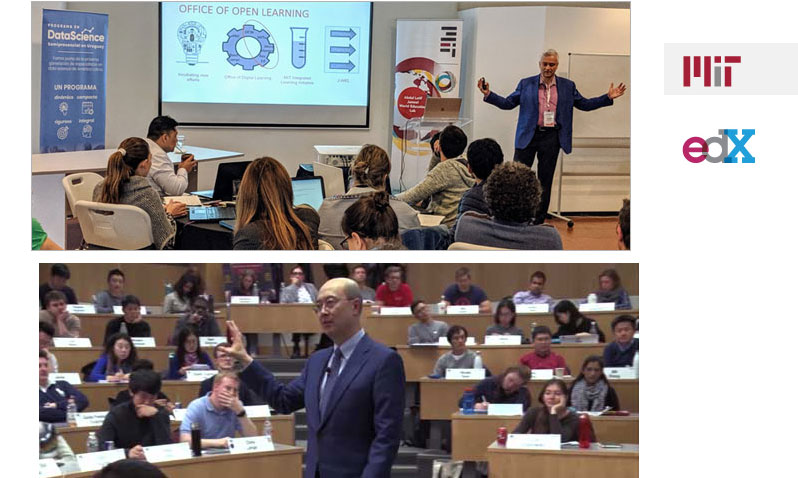
    MITx has become, along with Harvard University and Microsoft, the most prolific course creator on edX.org, with 111 MOOCs shared in the past year, and 26 of them being run for the first time.

    “We have about 30 more in the pipeline. At this point we have worked with faculty from 29 of MIT’s departments across all of its 5 schools, as we strive to share the best of MIT’s teaching, and learning, with the world,” said Krishna Rajagopal, Dean for Digital Learning, Open Learning, and Professor of Physics at MIT.

    Two of the newest MOOCs from the past Spring have been:

    • Healthcare Finance. Professor Andrew Lo, from MIT Sloan School of Management, teaches how to apply financial techniques to biomedical contexts, following its personal mission of bringing more life-saving therapies to patients faster.


    • Qualitative Research Methods: Conversational Interviewing. Professor Susan Silbey, a winner of MIT’s Killian Award, teaches learners how to prepare for and conduct a conversational interview for the purpose of gathering data.


    Another remarkable initiative where MIT collaborates with eight other top research universities is related to the design of a digital, distributed infrastructure for issuing, storing and displaying verifiable credentials and certificates of academic achievement.

    “We aim to utilize strong cryptography to prevent tampering and fraud, and shared ledgers to create a global infrastructure for anchoring academic achievements that build upon earlier research and pioneering efforts  — including MIT’s pilot program via which it issued all of its 2018 graduates a digital version of their diplomas that are verified against a blockchain,” explained Professor Krishna Rajagopal.

    MIT: Digital Credentials

  • Half of Employees That Need to Re-Skill Don’t Ask for Help, an edX Survey Finds

    Half of Employees That Need to Re-Skill Don’t Ask for Help, an edX Survey Finds

    IBL News | New York

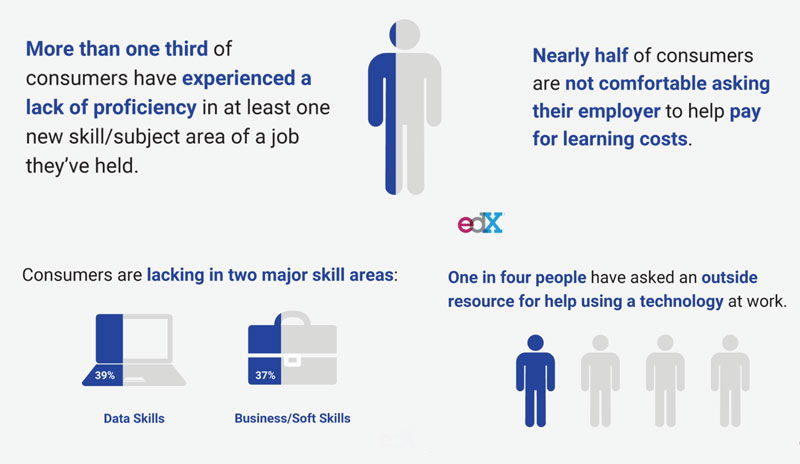
    More than one-third of employees have experienced a lack of proficiency in at least one new skill or subject area of a current or past job – usually related to data science (39%) or business and soft skills (37%). However, nearly half of these employees don’t feel comfortable asking their employer to help pay for learning costs, and one in four people have asked an outside resource for help.

    These are the main conclusions of a survey conducted by edX on 1,000 consumers aged 18+ on reskilling trends.

    “The fourth industrial revolution is here, and as technology continues to evolve rapidly, employees must continue to reskill to keep up with the shifting demands of their job,” explained Adam Medros, President & COO at edX.

    According to the World Economic Forum, 1.4 million U.S. jobs alone are expected to be disrupted by technology and other factors between now and 2026.

    Survey’s respondents are split between who should be responsible for making sure that they are prepared for the jobs of the future with the right skills – 41% feel it is an individual’s responsibility; 33% feel its an employer’s responsibility; 16% believe it’s higher education’s responsibility; and 9% believe it’s up to the government.

    edX’s Press release

  • A Billionaire Will Cover the Cost of Coursera’s Illinois Data Science Master’s Degree for His Employees

    A Billionaire Will Cover the Cost of Coursera’s Illinois Data Science Master’s Degree for His Employees

    Marie I. Rose | IBL News

    AI-software provider C3.ai, a company owned by billionaire Tom Siebel, has started to offer employees a fully paid tuition for the Master of Computer Science in Data Science (MCS-DS) from the University of Illinois at Urbana Champaign, available on Coursera for $21,000.  

    Those who complete the degree will get three more career incentives: a $25,000 cash bonus, a 15% salary increase, and a stock option equity award.

    “In this new economy where people are talking about digital transformation; for companies to stay at the top of their game they need to have state-of-the-art continuing education programs,” said Siebel, who got a degree in Computer Science –although residentially – at the same university.

    In 2007, Thomas Siebel, 66, pledged $1000 million to support science and engineering at this institution. Currently, CEO at C3.ai, Siebel, with a fortune of $2.9 billion, is a former salesman who became a billionaire after creating and selling Siebel Systems to rival Oracle in 2006 for $5.8 billion. C3.ai is valued at $2.1 billion.

    In addition to this degree, C3.ai employees, 330 in total today, already have free access to other Coursera courses and Specializations in AI, IoT, clouding computing, and advanced computing.

    “This model of stackable learning will become standard as more companies realize the value of providing a variety of flexible learning pathways for employees to acquire critical skills,” stated Leah Belsky, VP of Enterprise at Coursera.

    “We believe that more and more companies will move in this direction in the future. C3.ai is showing real foresight, and they are putting an incredible amount of employee support behind that foresight,” said Rashid Bashir, Dean of The Grainger College of Engineering at the University of Illinois. “New modes of delivering professional education are crucial to both companies like C3.ai and to universities like Illinois.”

    The Coursera-based MCS degree was launched in 2016. Nearly 700 hundred students are enrolled in the program. The acceptance rate is 30%.

    Illinois’ Department of Computer Science is consistently ranked as one of the top computer science programs in the world. In 2018, it was ranked #5 on the U.S. News and World Report list of Best Computer Science Schools.

    Thomas Siebel, in the picture, shows a clear vision: “At C3.ai, we are assembling a team of inquisitive self-learners, motivated and properly trained to solve some of the world’s most challenging technology problems. This program further enables our employees’ success by encouraging them to further develop their computer science and AI expertise at one of the world’s leading universities.”

    Siebel’s educational offering to employees is probably the most generous one within corporate America, beyond  Starbucks‘, which covers a portion of the tuition for those who earn online B.A.’s from Arizona State University, and Walmart‘s incentive of $1,500 cash bonuses to some workers who finish degrees at three subsidized schools.

    He claimed in Forbes that “the money his company will spend on employee degrees and cash bonuses are a drop in the bucket when you consider how much we spend on human capital.” When you add in other benefits and travel, he says each employee already costs the company more than $350,000 a year. “If someone is increasing their skills, advancing their career, setting themselves up for multiple promotions, providing better service for their customers, in that context the amount we’re spending on this benefit is nothing.”

  • Open edX | June 2019: Stanford, UBx, LTI 1.3, Coursera, Udacity…

    Open edX | June 2019: Stanford, UBx, LTI 1.3, Coursera, Udacity…

    Newsletter format  |  Click here to subscribe ]


    JUNE 2019 – NEWSLETTER #17  |  More breaking news at IBL News 


    Open edX

    • Open edX Issues Ironwood.2, a New Release of Its Platform

    • UBx, University at Buffalo’s Continuing Education Open edX-Based Platform, Expands with New Courses

    • A Fascinating Free Course About Beethoven’s Music from Stanford University

    • The Open edX Software Ranks #36 on GitHub’s Top 100 Projects


    edX

    • Chatbots Gain Traction Among Businesses – Now a Course About Them on edX

    • Afghanistan’s Ministry of Higher Education Creates AfghanX and Joins the edX Consortium


    COURSERA

    • Illinois Shuts Down its Traditional MBA and Focuses into Online’s iMBA

    • What’s Next for Coursera and FutureLearn? Insights Revealed at the EMOOCS Conference

    • Coursera Expands into Canada by Opening an Engineering Office


    UDACITY

    • Georgia Tech Will Deploy this Summer an Improved Version of its AI-Based Teacher Assistant

    • Analysis: Sebastian Thrun, Creates the University of Silicon Valley and the Fourth Degree

    • Sebastian Thrun Told Harvey Mudd Graduates to “Stay Curious and Always Believe in Themselves”

    • Udacity Offers Two Programs to Train Cloud Engineers on AWS


    INDUSTRY

    • The New Standard LTI 1.3, which Allows Interoperability of Grades and Assignments, Excites the Industry

    • The Good and the Bad: Choose the Best OPM, According to Dr. Chuck


    2019 UPCOMING EVENTS

    Education Calendar  –    JUNE  |  JULY  |  AUG – DEC 2019


    This newsletter about Open edX is a monthly report compiled by the IBL News staff, in collaboration with IBL Education, a New York City-based company that builds AI analytics-driven, revenue-oriented learning ecosystems, and courses with Open edX and other educational software. 

    Read the latest IBL Newsletter on Online Education at Scale  |  Archive of Open edX Newsletters

  • Learning At Scale | June 2019: SNHU, SUNY, USC, Emeritus, Walmart, Carnegie Mellon…

    Learning At Scale | June 2019: SNHU, SUNY, USC, Emeritus, Walmart, Carnegie Mellon…

    Newsletter format  |  Click here to subscribe ]

    JUNE 2019  –  NEWSLETTER #23 ON ONLINE EDUCATION AT SCALE


    HIGHER ED

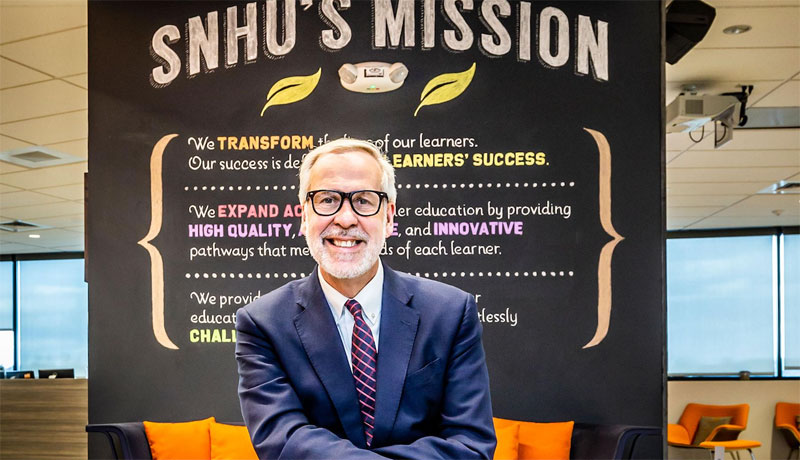
    • SNHU, with 135K students and an army of 6k adjuncts, wants to be the “Nordstrom’s of higher education”, says its president Paul LeBlanc.

    NY University System will focus on increasing its online presence.

    “Emerging markets are a large opportunity to boost online enrollment”, says Emeritus CEO.

    Higher education enrollments will continue its decline throughout the next decade. College closures will increase in 2019.


    ACADEMIA

    Canadian educator Heather Payne says that tenure should be abolished.

    Ángel Cabrera, George Mason University’s president, named the sole finalist for the Georgia Tech presidency.

    Michigan State named Stony Brook president as the new leader. Samuel Stanley Jr. created 240 faculty positions.

    A billionaire investor pledged to pay off the student debt of Morehouse College’s 396 graduating young men during his commencement speech.

    • USC’s partnership with 2U didn’t work at all. The school is facing a budget crisis that may result in nearly half of the staff losing their jobs.


    INDUSTRY

    Walmart expanded the $1 a day degree program to more universities.

    OpenSesame corporate learning marketplace, with 20,000 courses, raised $28 million to help it grow faster.

    SAS software provider debuted in higher education with an advanced cloud-based analytical solution. Jenzabar improved its analytics suite.


    RESEARCH

    Carnegie Mellon University released its first wave of open-source learning tools. Interview with the leader behind the initiative.

    Tecnológico de Monterrey released an elaborated report on alternative credentials (PDF).


    VIEWS

    Actionable data is the most disappointing late arrival in teaching and learning in higher ed.

    Online education doesn’t work for disadvantaged populations, those unprepared for college and first-time students.

    Achieving 85% completion rates for online courses.

    It’s all about money? There is no difference between for-profit and public higher ed, said George Siemens.

    Instructional designers forget what makes a course successful.

    A model involving faculty for course design.

    An Institution prepares students for jobs which won’t be automatized.

    Netflix-style service Cengage Unlimited reaches 1.5 million subscribers.


    2019 UPCOMING EVENTS

    Education Calendar  –    JUNE  |  JULY  |  AUG – DEC 2019


    This newsletter about learning innovation is a monthly report compiled by IBL News and IBL Education. If you enjoy what you read please consider forwarding it to spread the word. Click here to subscribe.

    Archive:
    IBL Newsletter #22– May 2019
    IBL Newsletter #21– April 2019
    IBL Newsletter #20– March 2019
    IBL Newsletter #19– January 2019

  • Open edX Issues Ironwood.2, a New Release of Its Platform

    Open edX Issues Ironwood.2, a New Release of Its Platform

    Paul G. John | IBL News

    edX engineers have released an update on the new Ironwood version of the platform, implementing changes into the ironwood branch on GitHub.

    The new release is called ironwood.2, and it is located at open-release/ironwood.2. 

    These changes since ironwood.1 include:

    • Reverting and feature-flagging of “honor code not eligible for certificate”
    • A handful of security fixes
    • Small changes to bring the default installation into compliance with edX trademark policy


    Open edX Ironwood was issued March 21. This version is the ninth release of the Open edX platform and includes improvements over the former Hawthorn.2 version.

    One of the most notorious improvements involved the login process into Studio –by redirecting the user to the LMS to log in, and then redirecting back to Studio.

    Another remarkable feature was called “Public Course Content”, which allowed users to access materials and components without registration or enrollment.


  • An Institution Prepares Students for Jobs which Won’t Be Automatized

    An Institution Prepares Students for Jobs which Won’t Be Automatized

    Mikel Amigot | IBL News (Boston)

    Job automation has already started. Stats indicate that 10% of American jobs will be automated in 2019. An upsetting forecast indicates that up to 73 million U.S. jobs will be automated by 2030.

    But there is hope. First: nearly 2 million new non-routine jobs which machines cannot easily perform are being created every year in the United States. Second: an increasing number of colleges and universities understand the challenge and are starting to prepare students who demand jobs which won’t be automated.

    Foundry College is one of them. Its Founder, Dr. Stephen Kosslyn, addressed the issue yesterday during the Eduventures Summit in Boston with a physician example. “Diagnosis of illness will soon be accomplished well by machines. But sitting with the family to discuss treatment options will be difficult to automate.”

    At least two skills are automation resistant: “Recognizing and responding to emotion when communicating and making decisions. And taking context into account when analyzing situations, creatively solving problems, and prioritizing goals,” Stephen Kosslyn said.

    Foundry College, which is focused on what’s difficult to automate, has listed five key underpinnings:

    • Critical thinking
    • Creative problem solving
    • Clear communication
    • Constructive personal interactions
    • Good judgment

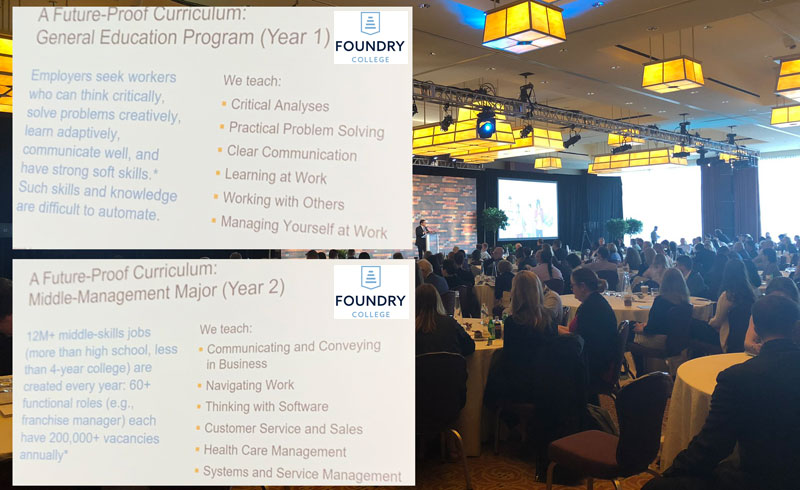
    To pair these essential skills, this institution has reimagined a future-proof, two-year curriculum. On the first year, Foundry teaches:

    • Critical Analyses
    • Practical Problem Solving
    • Clear Communication
    • Learning at Work
    • Working with Others
    • Managing Yourself at Work

    On the second year:

    • Communicating and Conveying in Business
    • Navigating Work
    • Thinking with Software
    • Customer Service and Sales
    • Health Care Management
    • System and Service Management


  • View: A Model Involving Faculty for Course Design

    View: A Model Involving Faculty for Course Design

    Mikel Amigot | IBL News

    The course development process usually tends to be too complex. As instructional designers, we schedule too many milestones and we overcomplicate things.

    Two experts in the field shared their view at SUNY’s annual technology conference, CIT, which took part this May 29-31 in Purchase, New York.

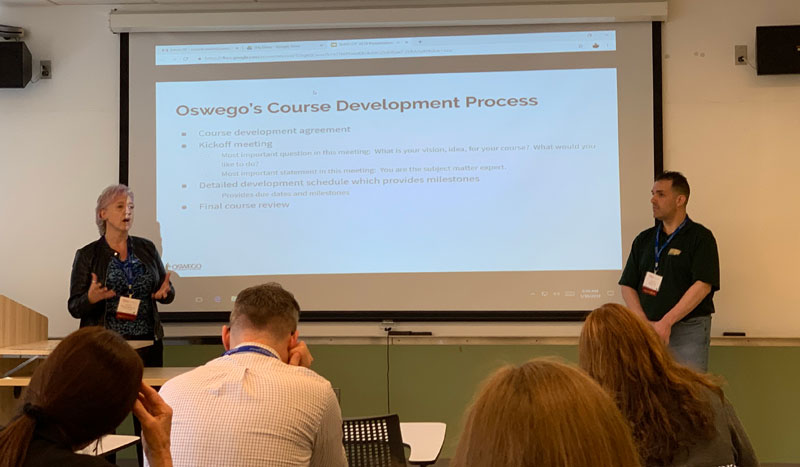
    Learning designers Joseph Stabb and Theresa Guillard-Cook [in the picture] described SUNY Oswego’s four-step process for course development: 1) Agreement; 2) Kickoff Meeting; 3) Schedule Set Up; 4) Final Course Review.

    The second one is particularly critical. The most important questions in the meeting with professors are: “what is your vision and idea for your course? What would you like to do?” These obvious questions and answers are usually forgotten; consequently, the class becomes ineffective.

    “The most important statement in this meeting is: you are the subject matter expert,” said Joseph Stabb and Theresa Guillard-Cook.

    Regarding the third stage, a detailed development schedule with milestones and due dates is required. A template is necessary.

    A well-defined process, based on continuous collaboration where faculty feel supported, will meet educational standards and drive student outcomes.

  • Netflix-Style Service Cengage Unlimited Reaches 1.5 Million Subscribers

    Netflix-Style Service Cengage Unlimited Reaches 1.5 Million Subscribers

    Zoe Mackay | IBL News

    Cengage Unlimited, launched last September, has reached 1.5 million subscribers to date. George Moore, CTO at Cengage [in the picture], spoke to this success on “The Changing EdTech Business Model” panel at the IMS Global Learning Consortium. The panel was moderated by Ray Henderson, and Moore was joined by Curtiss Barnes, Melissa Loble, and Jason Palmer.

    Software is eating the world, “ said Palmer, a General Partner at New Markets Venture Partners. “All jobs are tech jobs. All companies, no matter what those companies are, are in fact tech companies. Everything has been digitized.”

    Barnes, a Managing Director at Pearsons, noted that a clearly evident trend in edtech is that technology “is not transformative. It just is.” Particularly for what he calls the current generation of learners, Gen Z, technology “is part of their daily life.”

    Moore agreed, following Barne’s train of thought, saying “technology is. It’s not another modality.” Nine months after it’s launch, Cengage Unlimited has 1.5 million subscribers and has saved $60M for students to date. Moore estimates this number will surpass $100M by September.

    Created with the Netflix subscription service as a model, Moore says that “from an affordability perspective, we feel it’s very successful. From an adoption standpoint, students love it…this is how they buy music [and] videos.” The commercial model was created for students, “to help them with their 100 year learning career.”

    Loble, a SVP at Instructure, has been shifting their emphasis on the full journey, “from the first day of school to the last day of work.” This learning continuum, as she refers to it, necessitates being aware “of where there are skills and where there are gaps” so lifelong learning flows smoothly.

    To watch the full panel discussion, please see the video below.


  • “Emerging Markets Are a Large Opportunity to Boost Online Enrollment”, Says Emeritus CEO

    “Emerging Markets Are a Large Opportunity to Boost Online Enrollment”, Says Emeritus CEO

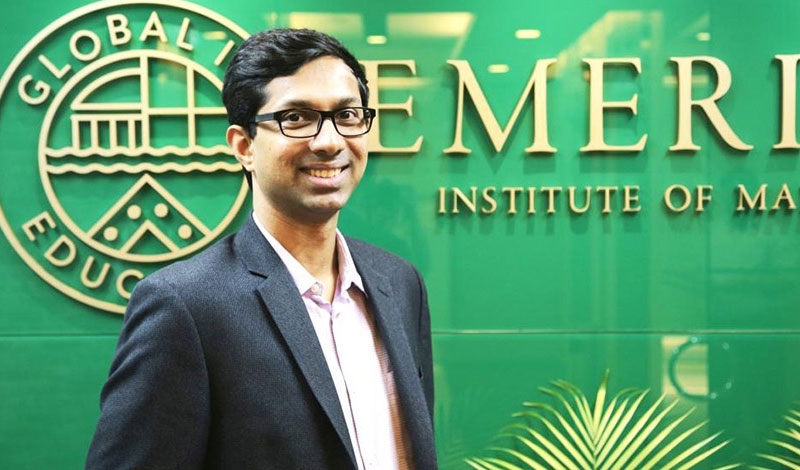
    The Promises and Challenges of Emerging Markets in Higher Education: Emeritus CEO Ashwin Damera in Conversation


    Henry Kronk | IBL News


    Numerous U.S.-based online program managers (OPM) have made the news lately for better or for worse. But what about similar companies operating in different countries?

    Emeritus currently employs over 400 people and partners with many top U.S. institutions, but has offices in India, Dubai, Singapore, and Mexico. And they don’t exactly consider themselves an OPM.

    IBL News recently contacted CEO and Co-Founder Ashwin Damera to learn more about the value proposition involved in such a decentralized business model.


    Henry Kronk: How did you come to found Emeritus in the first place?

    Ashwin Damera: I grew up in India. I worked at Citigroup for five years. I then went to do my MBA at Harvard Business School. After that I came back to start an online travel company. It was funded by Sequoia. We started in 2005, I ran it for four years. Eventually, we were acquired by Travelocity. I had a year where I spent some time for Travelocity Asia Pacific, just advising them about regional strategy in the online travel space.

    At that point in time, I met my co-founder Chaitanya Kalipatnapu who had gone to INSEAD and was working there at the time. When I was thinking about what I wanted to do next, I was looking at two sectors: education and healthcare. Both have the ability to touch peoples’ lives.

    So we kind of joined hands and started the parent company of Emeritus, which is called Eruditus, in 2010. Chaitanya [Kalipatnapu] went to INSEAD, I went to Harvard. Those are obviously great places to go and it actually changed our careers and made us very successful. It had a catalyzing effect. So we wanted to see how we could make these universities more accessible to a larger number of people across the world.

    That was our mission statement then; it’s our mission statement today.

    We started in 2010, INSEAD was our first partner, and we started offering programs in the region. We started in India and then moved to Dubai and Asia Pacific. The idea was to get students to sign up for these classroom programs initially, delivered partly on campus, partly in region, and partly online.

    In 2015, we created Emeritus to say, listen, not everyone can come to a classroom program, for many reasons, right? (Travel, price, days away from work.) So why not leverage online? MOOCs had already launched, schools were warming up to the idea of online delivery. But we took a different approach. We wanted high-touch online because, at the end of the day, the learning outcomes matter.

    What we loved about our educational background was the fact that you had some contact with the faculty, you had peer-to-peer learning, you had projects and assignments and you got feedback. So we tried to incorporate all of that into what is now known as SPOC (small private online courses), which we offer through Emeritus.

    We went to our partners at that time, MIT, Columbia, and Dartmouth. They became the first three schools. Today that has expanded. We work with Wharton School of Business, Kellogg School of Management, Berkeley, London Business School, Cambridge [and more]—all elite schools. We offer classes both in person and online. Last year, we taught about 30,000 students through these university courses.

    We continue to be very mission-focused. Part of this global access has resulted in us opening an office in Mexico City. We are starting to offer courses in Spanish and Portuguese because we understand that language is also part of access. Access means many things to many people. It usually means price point. Online is helpful because there’s no travel, but the language is also valuable.

    In general, we are a platform. I’m not sure we would actually qualify as a traditional OPM. I’m not even sure if we would want to be called an OPM. The reason for that is, while we provide a lot of the OPM-type services, I think we are far more flexible and unbundled than a typical OPM. For example, we work on classroom programs through Eruditus. Those could be 2-day programs delivered in, say, Singapore, Dubai, Mexico City, or India. Or they could be a six-month journey delivered both in a classroom and online. Or they can be purely online. We are very flexible with the type of program we can work.

    OPM is an online program management—they don’t do any classroom stuff. We do. That’s one reason that jacket doesn’t fit.

    More importantly, each school has its own goals and objectives. Somebody might say, ‘Listen, what I want you guys to do is to boost enrollment online in emerging markets. I don’t need your help in the U.S.’

    Somebody else might say, ‘Hey, we’ve created this course, we want you to help us deliver it.’ And then of course, the majority of our partners want us to do everything for them. For the same partner school, for some courses, we might do everything, and for some other courses, just parts of it. We’re very flexible.

    As a consequence of that, our terms with our clients are also flexible. No clawbacks, no 15-year contracts, no exclusivities and all of that. If we follow our mission—if more people at more universities have access—we are excited.


    Henry Kronk:  Many American colleges and universities are currently worried about their existence. Enrollments have been dropping and are expected to continue to fall. Many believe that emerging markets, where data infrastructures are starting to be able to support online course might a factor that helps them stay afloat and might even be a silver bullet. Do many institutions turn to Emeritus with this strategy?

    Ashwin Damera: Yes, emerging markets are a large opportunity. However, it’s a different opportunity. It’s not that you can take what works in the U.S., cut, copy, and paste it into emerging markets.

    What do I mean by that? The first thing is the brands that resonate in the U.S. may resonate very differently in different parts of the world. It’s absolutely true that there are some brands, some top schools, many of which we work with, that have reach everywhere in the world. The second tier, third-tier brands, for example, a college that may be very popular in certain parts of the U.S. may not resonate in India or Latin America or China.

    The opposite is also true. A college that is ranked, let’s say, outside of the top 100, can still be a very strong brand in other markets. So you have to think about that carefully.

    Price points are also different because the willingness to pay is different. You have to be really clear which price points you want to target.

    The third thing is that tuition for most students (in the U.S.) is funded by student loans, which are funded by the U.S. government. In many emerging markets, that ecosystem is still nascent. A lot of people might take loans themselves, but the interest rates are much higher. It’s not 3% or 4%, it’s more like 12% or 15% in some places.

    The implication of that plays out in ROI. If I do this degree program through the school either online or in the classroom, what do I get at the end of that? What does that mean in terms of my ability to pay back what I’ve borrowed? You have to couple these things with career outcomes. Those questions are asked a lot more.

    So large markets—if you just look at enrollment numbers in a place like India, there are 30 million students in higher education, but the gross enrollment ratio is still only about 27%. There’s a huge room to grow. In China, it’s about 35%. So there’s lots of room to grow, and these economies are still growing. The population is still growing.

    Are institutions reaching out to us [to target these markets]? Yes. Both with certificate courses and online degrees, we have always had emerging markets as our focus. We have offices in Mumbai, in Dubai, in Singapore, in Mexico City. Emerging markets are part of our DNA. Schools realize that.

    Especially when you’re targeting emerging markets, you probably want a partner, because there are many unknowns. Today about 70% of our enrollments are non-U.S. That is very different from other players in the U.S. who are quartered locally.


    Henry Kronk:  Establishing a business in not two, but many different countries—I can’t begin to imagine all of the challenges that have posted. What’s the return on investment with creating such a decentralized business?

    Ashwin Damera: Think of our customers—the universities. Whether they’re sitting on the East coast, the West coast, in Europe (maybe in Toronto). If you’re looking at their on-campus programs, especially at the Master’s level. It’s very common for more than 50%, even 70%, to be international students. The U.S. and Europe are great brands. They have great institutions and many students from around the world want to come and study. There’s a huge demand for these education experiences globally. That’s a given.

    The reason why we do what we do is because our university partners want to have students from across the world. That’s part of what they do.

    In some ways in the U.S. and Europe, there is plateauing demand. Populations are aging. It’s always good to think about the next 10-20 years as a university. You need to be in these high-growth markets, that is clear.

    The complexity, for example, of offering a course for students in China, Indonesia, India, Peru, Chile, South Africa, Nigeria—it’s very difficult. As a university, do you want to go and tie up with 10 different providers in each different market? Or would you rather work with one who can help you access all of these different markets and take care of the operational complexities?

    That’s the value in our business model. It’s very difficult to do what we’re doing. But it’s much easier to come to a client and say, ‘We will market your course in North America and Europe.’ These are fairly politically advanced economies. The students are mature. The buying process is fairly evolved. Versus saying I’m going to take this course and offer it in 35 or 40 other countries and take care of all the other things involved in that. You have to speak to students, counsel them, manage the taxation issues, the regulations, a whole bunch of stuff. But that’s the value to the university and it’s also our mission: to make high-quality education accessible. If we weren’t doing what we’re doing, we wouldn’t be living up to our mission.


    Henry Kronk:  Many people (especially those with vested interests) still discount credentials as all but useless and land far in favor of diplomas. How would you weigh in on the worth of credentialing internationally?

    Ashwin Damera: I tend to think three things matter: what is the credential, who is giving it, and what is the acceptability of it.

    In general, a degree is still far more valuable than whatever you call the certificate. You can call it a Nanodegree, you can call it a MicroMasters, you can call it a verified certificate, or you can just call it a certificate. That pales in comparison to the value of a degree.

    I’m talking about mostly emerging markets here. It’s very social-cultural. You can look at the ‘70s and ‘80s when a lot of people went to great local institutions or went to the U.S., got a degree, did very well in life. The degree is kind of an indicator of success.

    But even in the degree space, people understand that an MBA from XYZ school is very different from an MBA from a top school. Like I said earlier, it all depends on career outcomes. The starting salaries of graduates from a school probably matter a lot more than just saying, ‘I have an MBA.’

    The third thing that also matters is, people are starting to realize that you can get an MBA in Mexico or parts of Latin America for anywhere between $1,000 and $8,000 to $10,000 depending on the institution. What does the $1,000 MBA give you? What is the rigor of the assessments? What are the criteria? People are able to ask the question even in credential programs, what’s the value and how are they related to each other.

    Of course, if you charge $150,000 for an online MBA, will you get a lot of students from emerging markets? Probably not. But if you charge a reasonable fee, provide the rigor and the career outcomes, there’s a market for it.

    I would say there’s an exception to what I’m saying—there may be a few. One is the concept of bootcamps where they’re not providing a credential, but they’re providing very strong career services. They address the students needs for ROI and career advancement, though they’re not providing a credential at the end. These are definitely more popular in the U.S. and continue to make headlines. But in emerging markets, they’re still nascent. My intuition is, if done well, there’s a huge market for that product.


    Henry Kronk:  When MOOCs received all their hype 6 or 7 years ago, many believed they would democratize education and improve equity. It then turned out that most people who really benefited from them were actually mid-career professionals in Europe and North America. Is there a typical demographic that Emeritus serves?

    Ashwin Damera: Yes. In our typical online courses, the average work experience is about 10-12 years. These are mid-career working professionals. They may not have a graduate or undergraduate degree in some cases. But they have significant work experience. They’re not looking at this as getting their first job; they’re adding a skill that will help them advance in their current job or in their current company.