Category: Top News

  • More Laid-Offs In Tech Companies: The Highest Job Cuts Since Dot-Com Crash

    More Laid-Offs In Tech Companies: The Highest Job Cuts Since Dot-Com Crash

    IBL News | New York

    Since the start of this year, more than 50,000 workers have been laid off from over 200 tech companies, according to tracking website Layoffs.fyi. In addition, tech salaries have largely stagnated in the last two years.

    Tech is a notable outlier in a labor market that’s been largely steady over the past two years. The U.S. economy added 275,000 jobs in February, topping 200,000 for a third straight month.

    These cuts follow the trend that arose in 2023 when over 260,000 workers across nearly 1,200 tech companies lost their jobs.

    In fact, 2023 was the second-biggest year of cuts in the technology sector, behind only the dot-com crash in 2001.

    Moreover, February’s job cut count was the highest of any February since 2009, when the financial crisis forced companies into cash preservation mode.

    Alphabet, Amazon, Meta, and Microsoft have all taken part in the downsizing this year, along with eBay, Unity Software, SAP, and Cisco.

    PayPal announced that it was eliminating 9% of its workforce, or about 2,500 jobs.

    The markets have cheered on the cost-cutting, estimating that spending discipline and efficiency gains from AI will lead to rising profits. As a result, tech stocks reached record highs.

    Software developers and data scientists whose skills were highly valued two years ago now face an increasingly competitive market with lower pay than their prior jobs. Many are now considering whether they need to exit the industry to find employment.

    Others, like people who worked at Google, are organizing themselves to find new opportunities.
    .


    Post: Developers are on edge

  • Apple In Talks with Google to Integrate Gemini Model on iPhone Later This Year

    Apple In Talks with Google to Integrate Gemini Model on iPhone Later This Year

    IBL News | New York

    Apple is reportedly in talks with Google to integrate its Gemini model into iPhone’s iOS 18 later this year. It means that powerful AI-integrated phones are arriving soon.

    If negotiations result in an agreement, Google would license Gemini, and this model would enable some features on the iPhone, such as its ability to create images and write text, along with other native enhancements in those devices.

    Tim Cook Apple’s CEO has promised major AI announcements at WWDC in June, though some experts say that a potential deal with Google may not be finalized by then. Apple also held previous discussions with OpenAI about using its models.

    Meanwhile, OpenAI now is also reportedly in talks with Samsung.

    The consensus in the tech industry is that Gemini on iOS would be a massive power play as Apple has over two billion active Apple devices.

    It could also help allay investor fears about the slow roll-out of AI apps by Apple, which has lost its position as the world’s most valuable firm after a 10% decline in its shares this year.

    Apple has a years-long partnership that makes Google the default search engine on Apple’s Safari web browser.

    A Generative AI tie-up may help Google to navigate fears that services like ChatGPT could threaten its search dominance.

    OpenAI with Samsung would be an equally compelling counter.
    .

  • Elon Musk Open-Sources Grok, But Without Training Code

    Elon Musk Open-Sources Grok, But Without Training Code

    IBL News | New York

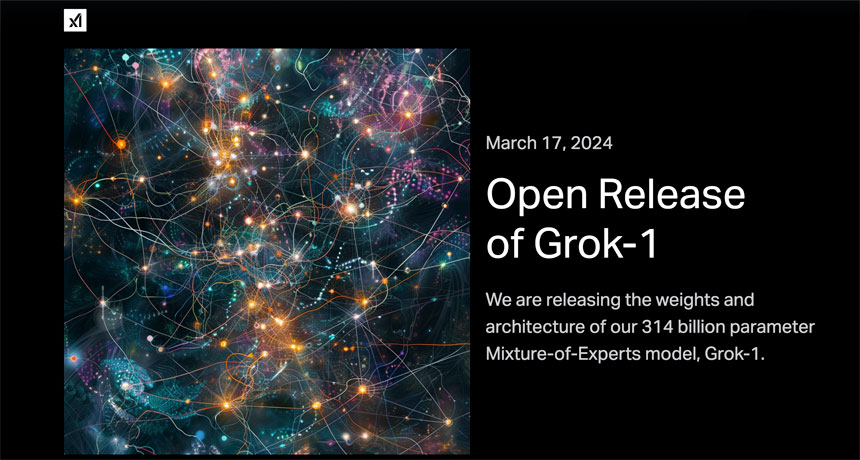
    Elon Musk’s xAI.com was finally released as open-source under the Apache 2.0 license — which permits commercial use — the base code of its LLM ‘Grok-1’ yesterday.

    Grok-1 was released without any training code; only with the base model weights and network architecture.

    According to its description, it’s “a 314 billion parameter Mixture-of-Expert model trained from scratch by xAI”, and “not fine-tuned for any specific application, such as dialogue.”

    This release doesn’t include connections to the X social network.

    Other large companies such as Meta and Google have also released their open-source versions. LLaMA, from Meta; Gemma2B, and Gemma7B, from Google; along with Mistral, Falcon, and A12, are some of the most popular.

    Perplexity CEO Arvind Srinivas posted on X that the company will fine-tune Grok for conversational search and make it available to Pro users.
    .


  • Civitai.com AI Content Marketplace Reaches 4M Registered Users

    Civitai.com AI Content Marketplace Reaches 4M Registered Users

    IBL News | New York

    Civitai.com, an online community platform where members can post their own Stable Diffusion-based AI models, reached 4 million registered users, with over 12 million unique visitors per month and 10,000 unique creators.

    “We became the de facto standard for sharing your model and various AI resources and the images that you’d made,” stated the founder of the startup in an interview with TechCrunch.

    As a result of its growth, Civitai raised a $5.1 million round in June led by Andreessen Horowitz (a16z) at a $20 million valuation.

    For now, the site is free to use — it uses Cloudflare’s R2 to keep costs down around downloads.

    The company plans to allow users to monetize their work and companies to expand their brands and products.
    .

  • Coursera Introduces a Business Guide for Acquiring Skills in Generative AI

    Coursera Introduces a Business Guide for Acquiring Skills in Generative AI

    IBL News | New York

    Coursera, which provides learning pathways to upskill users, introduced this month a business guide for acquiring skills in Generative AI. [PDF download]

    This guide, titled “The Business Leader’s Playbook to Generative AI Skills Training”, features insights from leaders at Microsoft, Vanderbilt University, and Coursera.

    “GenAI is a top priority for business leaders, as it promises to transform workforce productivity,” states the report.

    “GenAI isn’t just a learning initiative. It’s a company and culture initiative that can supercharge talent and productivity.”

    Elisa Graceffo, General Manager, Technical Content, Worldwide Learning at Microsoft, said: “AI is coming to your job; it’s not coming for your job.”

    “If we can do our work more productively and focus on higher-level tasks that drive more value, then we have happier employees and more successful teams. We can reach company goals faster,” explained Trena Minudri, VP & Chief Learning Officer at Coursera.

    “Employees might feel empowered to experiment and bring innovation to their discipline.”

    Currently, Coursera hosts more than 35 GenAI-related courses from institutions like Microsoft, Stanford, Google Cloud, IBM, AWS, and Vanderbilt University, which have accumulated more than 570,000 enrollments.

    In an effort to improve productivity, Coursera’s own employees are actively learning with the company’s GenAI Academy how to use GenAI for their roles.

    According to Coursera, 89% of executives listed AI and GenAI as one of their top three tech priorities for 2024—yet two out of three (66%) executives are ambivalent or outright dissatisfied with their organization’s progress on AI/GenAI so far, citing a lack of talent and skills (62%) as their primary reason for dissatisfaction.

    “This dissonance makes sense because only 19% of HR and L&D leaders are ranking AI as a top priority for them. Mindset shifts and individual AI upskilling need to happen—and fast—so that they can meet this major inflection point in the history of technology.”

    “At the company level, when infused into the culture at large, GenAI can unify a company. It’s something everyone in the organization can learn, at the same time, whether it’s your financial analysts, marketing reps, sales leaders, C-suite, or software engineers. Everyone can benefit from prompt engineering and other foundational GenAI skills.”

    “Move too fast, and you can hit ethical and regulatory hurdles. Move too slow, and you’ll find yourself outpaced by your competitors,” added Coursera.

  • An Autonomous AI Agent Called ‘Devin’ Plans and Executes Complex Coding Tasks

    An Autonomous AI Agent Called ‘Devin’ Plans and Executes Complex Coding Tasks

    IBL News | New York

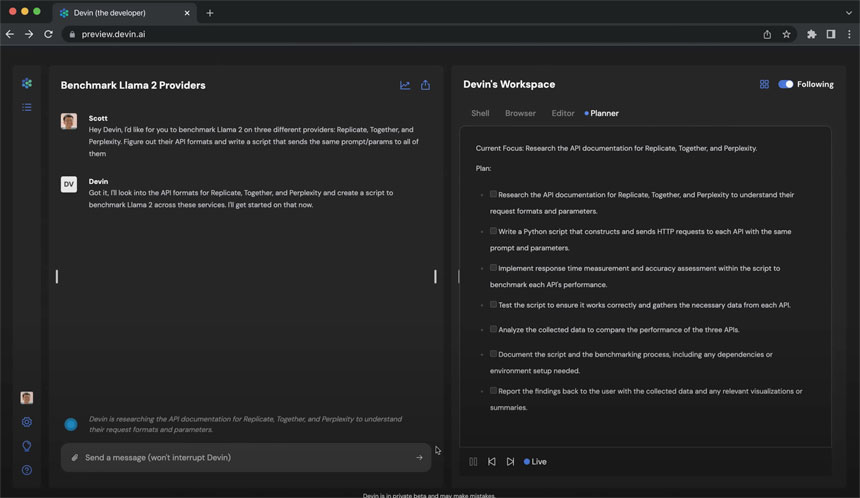
    Cognition AI, which builds AI teammates, introduced this week an autonomous AI software engineer called Devin.

    This AI agent can independently write entire software projects from scratch based on simple text prompts.

    Devin can plan and execute complex coding tasks with hundreds of steps.

    The autonomous agent can code while learning, recall relevant context at every step, fix errors, and collaborate with users in real time.

    “With our advances in long-term reasoning and planning, Devin can plan and execute complex engineering tasks requiring thousands of decisions,” said the company.

    Cognition AI has equipped Devin with common developer tools including the shell, code editor, and browser within a sandboxed compute environment.

    This agent can report on its progress in real-time, accept feedback, and work together with the user through design choices as needed.

    In the demos shown below, Devin built complete websites and apps in under 10 minutes. It also successfully completed real gigs posted on Upwork by itself.

    On a coding benchmark, the AI agent solved 13.86% of real-world GitHub issues end-to-end, crushing the previous SOTA benchmark of 1.96%.

    Funded with a $21 million Series A led by Founders Fund, Cognition AI is dedicated to building AI teammates with capabilities far beyond today’s existing AI tools by solving reasoning.
    .

  • Elon Musk Announces that It Will Open-Source Its Chatbot Grok

    Elon Musk Announces that It Will Open-Source Its Chatbot Grok

    IBL News | New York

    Elon Musk’s AI startup xAI will open-source its chatbot Grok this week, the entrepreneur said.

    The owner of Tesla and SpaceX made this announcement days after suing OpenAI and complaining that the Microsoft-backed startup had deviated from its open-source roots.

    Available to customers paying a $16 monthly subscription, Grok includes access to “real-time” information and views undeterred by “politically correct” norms.

    The promise to imminently open-source Grok will help xAI join the list of a number of growing firms, including Meta and Mistral, that have published the codes of their chatbots to the public.

    Musk has long been a proponent of open source. Tesla has open-sourced many of its patents. “Tesla will not initiate patent lawsuits against anyone who, in good faith, wants to use our technology,” Musk said in 2014.

    X, formerly known as Twitter, also open-sourced some of its algorithms last year.

    Musk reaffirmed his criticism of the Altman-led firm Monday, saying, “OpenAI is a lie.”

    On the other hand, OpenAI lambasted Elon Musk’s allegations against it, saying in a court filing that the billionaire entrepreneur’s claims “rest on convoluted — often incoherent — factual premises.”

    The strongly worded filing is the company’s first legal response to Musk’s February lawsuit against the company, Chief Executive Officer Sam Altman, and President Greg Brockman.

  • Microsoft Plans to Launch a Copilot Chatbot for Finance

    Microsoft Plans to Launch a Copilot Chatbot for Finance

    IBL News | New York

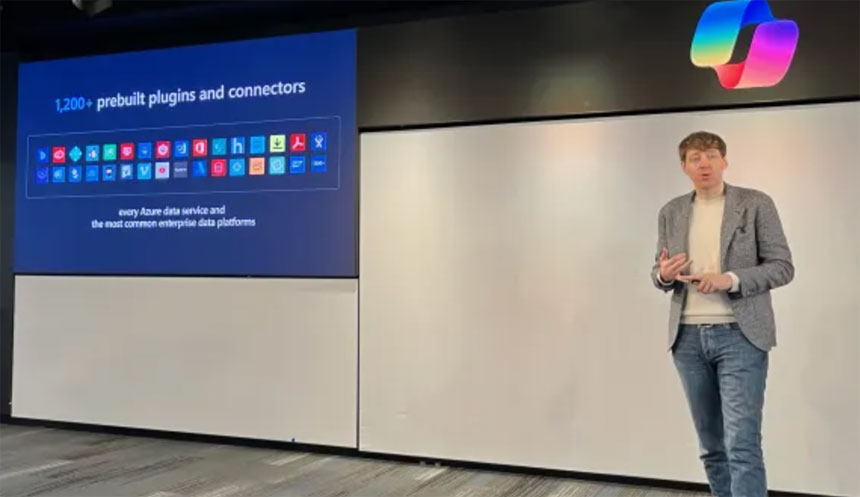
    Microsoft announced this week that it will release a Copilot chatbot that can perform and automatize key tasks for people working in finance.

    Comparing and reconciling data taken from different systems is a recurring task in finance planning and analysis.

    This Copilot for finance will initially run a variance analysis, reconcile data in Excel, and speed up the collections process in Outlook, Charles Lamanna, a Microsoft Vice President, said in an interview with CNBC.

    This tool will draw on information stored in SAP and Microsoft Dynamics 365.

    Microsoft already has a Copilot for general-purpose industrial use in Office applications.


  • Inflection Introduced an Upgraded Model for Its Chatbot ‘Pi’

    Inflection Introduced an Upgraded Model for Its Chatbot ‘Pi’

    IBL News | New York

    Inflection announced an upgraded model that makes its chatbot called Pi competitive with GTP-4 and Google’s Gemini, according to this AI start-up.

    “Inflection-2.5 approaches GPT-4’s performance, but used only 40% of the amount of computing for training,” said the company. “We’ve made particular strides in areas of IQ like coding and mathematics.”

    Hosted in Azure, Inflection-2.5 is available at pi.aiiOS, Android, and a new desktop app.

    Pi also incorporates real-time web search capabilities, providing users with breaking news, current events, and up-to-date information.

    According to the AI start-up, Pi has one million daily users and six million monthly active users.

    An average conversation with Pi lasts 33 minutes, and one in ten lasts over an hour each day.

    About 60% of people who talk to Pi on any given week return the following week, and we see higher monthly stickiness than leading competitors.
    .

  • OpenAI Reinstates Sam Altman as a Board Member and Announces New Ones

    OpenAI Reinstates Sam Altman as a Board Member and Announces New Ones

    IBL News | New York

    Sam Altman, as CEO, will rejoin the OpenAI Board of Directors four months later after losing his seat and being fired, the company announced in a blog post yesterday.

    Joining alongside him, three new members will be added to the Board: former CEO of the Bill and Melinda Gates Foundation, Dr. Sue Desmond-Hellmann, ex-Sony Entertainment president Nicole Seligman, and Instacart CEO Fidji Simo. These additions will bring OpenAI’s board to seven people.

    The members of the transitory board designated after Altman’s firing in November won’t be stepping down. Salesforce co-CEO Bret Taylor (OpenAI’s current board chair), Quora CEO, Adam D’Angelo, and Larry Summers, the economist and former Harvard president, will remain in their roles on the board, as will Dee Templeton, a Microsoft-appointed board observer.

    The almost all-male board has received criticism given its lack of diversity.

    • Desmond-Hellmann, in addition to heading the Bill and Melinda Gates Foundation for six years, was previously chancellor of the University of California, San Francisco, and before that, president of product development at Genentech, where she helped develop gene-targeted cancer drugs. Desmond-Hellmann is an oncologist by training is and board-certified in both internal medicine and medical oncology.

    • Nicole Seligman, an attorney and corporate director, received national attention for her representation of Lieutenant Colonel Oliver North during the Iran–Contra hearings and President Bill Clinton during his impeachment trial. Seligman was Sony’s VC and general counsel before rising through the ranks to CEO of Sony Corporation and president of Sony Corporation of America.

    • Fidji Simo, before becoming CEO of Instacart, was head of the Facebook app at Meta and the VP overseeing Meta’s various video, games, and monetization efforts. Simo also co-founded — and is currently president of — The Metrodora Foundation, a health clinic and research institute.

    Altman’s reinstatement and the board’s expansion also followed an investigation by the law firm WilmerHale, retained by OpenAI, that unanimously concluded that “Sam and OpenAI president Greg Brockman are the right leaders for OpenAI.”

    But not all at OpenAI agree.

    This week, The New York Times described Altman as a manipulative leader who undermines the credibility of those who challenged him. Both OpenAI CTO Mira Murati and Ilya Sutskever expressed concerns about Altman’s behavior prior to his ouster last year.
    .