Category: Platforms

  • Open Resources Such as Jupyter and Open edX Transform STEM Education, Proves Prof. Barba

    Open Resources Such as Jupyter and Open edX Transform STEM Education, Proves Prof. Barba

    Mikel Amigot | IBL News

    Using open educational resources such as Jupyter and Open edX to teach STEM will transform teaching and learning and result in an engaging active experience in the classroom.

    This was the central idea of a faculty workshop conducted by Professor Lorena A. Barba, from The George Washington University (GW), at the University at Buffalo this weekend.

    During this hands-on seminar, participants reviewed some of the education research underpinning design decisions and discovered practices of open education.

    Also, it included an introduction to the Jupyter toolbox for teaching and learning.

    “Jupyter is a killer app, it provides a medium for expression using computing as part of the learning,” said Professor Lorena Barba who has been using Jupyter for over six years.

    “Using the Open edX course platform, you can construct learning pathways using content pulled dynamically from a public Jupyter notebook (e.g., on GitHub), with the Jupyter Viewer Xblock.”

    GW, along with IBL Education, contributed two XBlocks to build edX-style courses based on Jupyter: the Viewer, and a Jupyter Grader for auto-graded student assignments.

    Jupyter-based courses can be written using an open development model (like any open-source software project), collaboratively and under version control. Once the material is ready, instructors can build a MOOC-style course on Open edX, pulling the content from the notebooks without duplication in the course platform.

    Instructors can interleave short videos and graded sub-sections using the built-in problem types, or using the Graded Jupyter XBlock.

    “Our course development workflow is the product of several years of refinement and applies evidence-based instructional design. Combined with modern pedagogies used in the classroom, like active learning via live coding, you can create learning experiences that are effective on campus and online,” explained Prof. Barba.

    Watch the interview with Professor Lorena A. Barba in the video below.


    Valuable resource: Jupyter-first courses

  • Interview with Dr. Charles Severance, World’s #1 Python Professor

    Interview with Dr. Charles Severance, World’s #1 Python Professor


    Mikel Amigot, Zoe Mackay | IBL News

    Dr. Charles Severance, Clinical Professor at the University of Michigan School of Information, discussed with IBL News the success of his world-renowned python course and where he sees his future in online education.

    While Severance did not have the first python course online, he has the world’s most popular course which has reached over 4 million students. “Across all the platforms it exists on (Coursera, edX, and others), I have probably graduated about 200,000 students.

    “What I’ve found is a very unique niche… computer science professors actually don’t know how to teach an introductory computer science course. They know how to teach [this] to someone who has been programming for several years. I specialize in actually teaching introduction to programming, which is a prerequisite to introduction to computer science.”

    With Severance’s course, students were able to get the fundamental skills in programming that they necessitate to succeed in other introductory computer science courses. “I became, over the last 5 years, the de facto prerequisite for literally everything python.”

    As the need for programmers is expanding, Dr. Severance’s courses offer a possibility to students who have no background in the computer sciences. Right now “you could learn python, you could work an entire 50-year career, and never learn another programming language. And in the future, python is going to further dominate.”

    Primarily, his courses were offered on Coursera, but as of January 2019, Severance’s courses are available on edX.

    I knew that edX was missing a course that was a beginning programming course, and if I could just give that as a gift to the entire edX community, then edX would be better.”

    That is python for everybody, everywhere. And that is my joy, my joy is everywhere. No matter what country, what language, everyone has a chance to get a decent technical job that can take care of their families and give them a life and a future, and give them a step into education.”

    The “Django for Everybody” Course Will Start In the First Quarter of 2020

    With the most successful online introductory programming courses in the world, everyone is excited about new releases from Dr. Severance.

    His “Django for Everybody” course, he says, will be started in the first quarter of 2020, after teaching it once more on campus. He aims to alter the course into a MOOC to be offered on Coursera or edX but will be available on his own website by January 2020.

    Severance’s main goal is to adequately prepare students to fully succeed within computer science curricula. “I think there are many good degrees in computer science… My goal in life is to get as many people ready to go into a real degree with 40 or 50 faculty members.”

    Speaking at the Open edX conference, Severance says that while he is attending “partly as a happy and satisfied faculty member successfully teaching on edX,” he is also aware that online learning is bound to change, and he also attended to see how “the next generation of LMS’s might take benefit from all of the wonderful experience that the edX software base [has provided].”

    I think the greatest mistake that we can make is that just because products are successful in the marketplace does not mean they cannot be replaced by the next generation. If there has been anything in the last 15 years of education technology, it’s that there is always a new generation… and a wheel of progress.

    I believe that there’s going to be a transformation…and the next LMS generation is going to be based on the next generation of standards — learning tools interoperability LTI advantage is just coming out.”


    Watch the first part of the interview with Dr. Chuck Severance in the two videos below.

    Part I


    Part II

  • MIT’s ‘Intro to CS Using Python’ On EdX Reaches 1.2 Million Enrollments

    MIT’s ‘Intro to CS Using Python’ On EdX Reaches 1.2 Million Enrollments

    The “Introduction to Computer Science Using Python” course on edX has reached 1.2 million enrollments to date, becoming the most popular MOOC in MIT’s history, the institution reported.

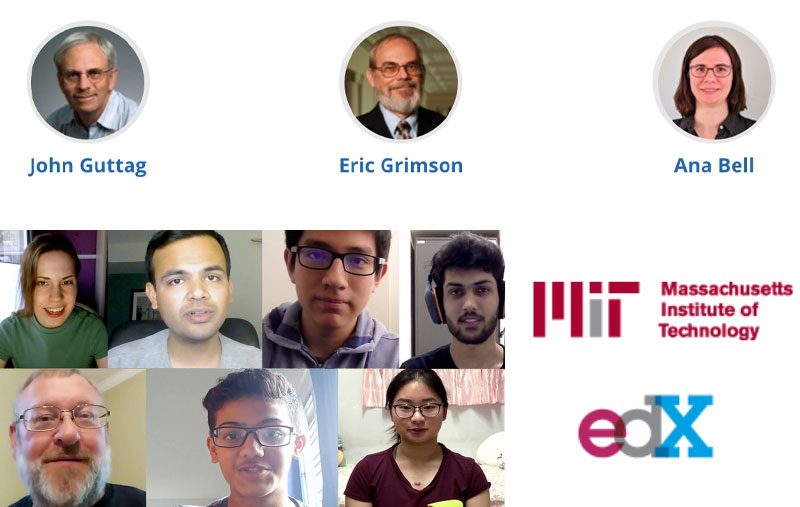
    Launched as an online offering in 2012, this course was derived from a campus-based and Open CourseWare subject at MIT developed and originally taught by John Guttag, the Dugald C. Jackson Professor of Computer Science and Electrical Engineering. It was initially developed as a 13-week course, but in 2014 it was separated into two courses, 6.00.1x and 6.00.2x.

    Also, it was one of the very first MOOCs offered by MIT on the edX platform.

    “This course is about teaching students to use computation, in this case described by Python, to build models and explore broader questions of what can be done with computation to understand the world,” said John Guttag.

    “It is designed to help students begin to think like a computer scientist,” says Grimson. “By the end of it, the student should feel very confident that given a problem, whether it’s something from work or their personal life, they could use computation to solve that problem.”

    “At its core, the 6.00 series teaches computational thinking,” adds Bell. “It does this using the Python programming language, but the course also teaches programming concepts that can be applied in any other programming language.”


  • Research: Top Online Artificial Intelligence Courses and Programs

    Research: Top Online Artificial Intelligence Courses and Programs

    Artificial Intelligence (AI) and Machine Learning algorithms are transforming entire industries and defining the next generation of software solutions.

    Experts in these data-driven technologies who understand natural language, speech, vision, etc. are in high demand.

    AI is estimated to create an additional $13 trillion of value annually by 2030, according to McKinsey Global Institute.

    This list features the most successful programs collected by IBL News.


    – MIT Management Executive Education and MIT CSAIL

    Artificial Intelligence: Implications for Business Strategy – Online Short Course

    • In collaboration with online education provider GetSmarter, subsidiary of 2U, Inc.
    • 6 weeks, excluding 1-week orientation; 6-8 hours per week, self-paced, entirely online; weekly modules, flexible learning
    • Program fees: $2,800
    • Certificate of completion from the MIT Sloan School of Management
    • 6 modules; personalized, people-mediated online learning experience
    • Brochure


    – MIT

    Deep Learning, Self-Driving Cars, Artificial General Intelligence

    • Collection of MIT courses and lectures on deep learning, deep reinforcement learning, autonomous vehicles, and artificial intelligence taught by Lex Fridman.


    – Imperial College London – Coursera.org

    Master of Science of Machine Learning


    – Emeritus Institute of Management

    Postgraduate Diploma in Machine Learning and Artificial Intelligence 

    • In collaboration with Columbia Engineering Executive Education
    • Starts on March 28, 2019
    • Duration: 9 months, online, 6-8 hours per week
    • Program Fees: $3,000. Payable in two equal installments. Non-refundable application fee: $50
    • Learning journey includes video lectures, discussions, quizzes, application assignments, capstone project, and live online teaching sessions
    • Two modules (Applied machine learning; Applied artificial intelligence) and a capstone project
    • Access upon completion to the Emeritus network


    – Emeritus Institute of Management

    Applied Artificial Intelligence Advanced Program

    • In collaboration with Columbia Engineering Executive Education
    • Starts on 28 Febrero 2019
    • Duration: 3 months, online, 6-8 hours per week. Twelve modules.
    • Program Fees: $1,200.
    • Pre-Requisites: Undergraduate knowledge of linear algebra (vectors, matrices, derivatives), calculus, basic probability theory. You should be comfortable with Python or any other programming language. All assignments/application projects will be done using the Python programming language.
    • Learning journey includes video lectures, discussions, quizzes, application assignments, capstone project, and live online teaching sessions


    – Columbia University – ColumbiaX on edX

    MicroMasters Program in Artificial Intelligence

    • 4 Courses for $1,080. Free Audit, with no certificate, graded assignments, and limited access
    • Each course is 8-10 hours per week, for 12 weeks, with an individual cost of $300
    • Courses in this program: Artificial Intelligence (AI), Machine Learning, Robotics, Animation and CGI Motion
    • Instructor-led format, with assignments and exams with due dates
    • Credit-eligible MicroMasters program credential
      If the learner is accepted in the Master of Computer Science, it will count 7.5 of the 30 credits required for graduation on-campus or online Master of Computer Science program. The program represents 25% of the coursework toward a Master’s degree in Computer Science at Columbia.
    • Video


    – Microsoft – edX.org

    Professional Program in Artificial Intelligence


    – Georgia Tech – edX.org

    Machine Learning

    • 14 weeks, 8-10 hours per week
    • Free. Add a Verified Certificate for $99
    • Intermediate level
    • English. Subtitles: English
    • Taught by Charles Isbell


    – Universidad Carlos III de Madrid (UC3M) – edX.org

    Introducción a la visión por computador: desarrollo de aplicaciones con OpenCV

    • 7 weeks, 5-7 hours per week
    • Free. Add a Verified Certificate for $50
    • Intermediate level
    • Spanish. Subtitles: Spanish
    • Taught by Arturo de la Escalera, José María Armingol, David Martín Gómez, Fernando García, Abdulla H. Al-Kaff


    – Stanford University – Coursera.org

    Machine Learning

    • 100% online, flexible deadlines, free online course (audit)
    • Approx. 55 hours to complete; 11-weeks; suggested: 7 hours/week
    • English. Subtitles in English, Chinese (Simplified), Hebrew, Spanish, Hindi, Japanese, Korean, Portuguese
    • Enrolling for a Certificate gives access to all course materials, including all videos, quizzes, and programming and graded assignments
    • One of the best and most popular courses at Coursera, with 2.2 million students
    • Taught by Andrew Ng, AI guru, Co-Founder at Corsera and Adjunct Professor at Stanford University


    – Deeplearning.ai – Coursera.org

    AI For Everyone

    • 100% online, flexible deadlines, free online course except for graded items (audit)
    • Approx. 11 hours to complete. Suggested: 4 weeks of study, 2-3 hours/week. Beginner level
    • $49
    • Certificate
    • English. Subtitles: English.
    • 4 Weeks: What is AI, Building All Projects, AI in Your Company, AI and Society
    • Taught by AI guru Andrew Ng


    – Deeplearning.ai – Coursera.org

    Deep Learning Specialization

    • 100% online, flexible deadlines
    • Approx. 3 months to complete. Suggested 11 hours/week. Intermediate level
    • $49 per month
    • English. Subtitles: English, Chinese (Traditional), Arabic, Ukrainian, Chinese (Simplified), Portuguese (Brazilian), Korean, Turkish, Japanese
    • 5 courses: Neural Networks and Deep Learning, Improving Deep Neural Networks: Hyperparameter tuning, Regularization and Optimization, Structuring Machine Learning Projects, Convolutional Neural Networks, Sequence Models.
    • Taught by AI guru Andrew Ng, with two teaching assistants.
    • NVIDIA’s Deep Learning Institute as an industry partner.


    – Google Cloud – Coursera.org

    Machine Learning with TensorFlow on Google Cloud Platform Specialization

    • 100% online, flexible deadlines
    • Approx. 1 month to complete. Suggested: 15 hours/week. Intermediate level
    • $49 per month
    • English. Subtitles: English, French, Portuguese (Brazilian), German, Spanish, Japanese
    • 5 courses: How Google does Machine Learning, Launching into Machine Learning, Intro to TensorFlow, Feature Engineering, Art and Science of Machine Learning.


    – University of Washington – Coursera.org

    Machine Learning Specialization

    • 100% online, flexible deadlines
    • Approx. 8 months to complete. Suggested 6 hours/week. Intermediate level
    • $49 per month
    • English. Subtitles in English, Korean, Vietnamese, Chinese (Simplified), Arabic
    • 4 courses: Machine Learning Foundations: A Case Study Approach; Machine Learning: Regression; Machine Learning: Classification; Machine Learning: Clustering & Retrieval
    • Taught by Carlos Guestrin, Amazon Professor of Machine Learning; and Emily Fox, Amazon Professor of Machine Learning


    – NYU Tandon School of Engineering – Coursera.org

    Machine Learning and Reinforcement Learning in Finance Specialization

    • 100% online, flexible deadlines
    • Approx. 5 months to complete. Suggested: 9 hours/week. Intermediate level
    • $49 per month
    • English. Subtitles: English.
    • 4 courses: Guided Tour of Machine Learning in Finance, Fundamentals of Machine Learning in Finance, Reinforcement Learning in Finance, Overview of Advanced Methods of Reinforcement Learning in Finance.
    • Taught by Dr. Igor Halperin


    – Imperial College London – Coursera.org

    Mathematics for Machine Learning Specialization

    • 100% online, flexible deadlines
    • Approx. 2 months to complete. Suggested: 12 hours/week. Beginner level
    • $49 per month
    • English. Subtitles: English.
    • 3 courses: Mathematics for Machine Learning: Linear Algebra, Mathematics for Machine Learning: Multivariate Calculus, Mathematics for Machine Learning: PCA.


    – National Research University – Higher School of Economics (HSE) (Russia) – Coursera.org

    Advanced Machine Learning Specialization

    • 100% online, flexible deadlines
    • Advanced level
    • $49 per month
    • English. Subtitles in English
    • 7 courses: Introduction to Deep Learning, How to Win a Data Science Competition: Learn from Top Kagglers, Bayesian Methods for Machine Learning, Practical Reinforcement Learning, Deep Learning in Computer Vision, Natural Language Processing, Addressing Large Hadron Collider Challenges by Machine Learning.
    • Taught by 21 instructors


    – School of Artificial Intelligence – Udacity

    Intro to Artificial Intelligence

    • Free online, self-paced
    • Approx. 4 months. Two lessons
    • Intermediate level
    • Taught by Sebastian Thurn (Udacity) and Peter Norvig (Google)


    – School of Artificial Intelligence – Udacity

    Artificial Intelligence for Robotics

    • Free online, self-paced
    • Approx. 2 months. Seven lessons
    • Advanced level
    • Taught by Sebastian Thurn, Founder at Udacity


    –  Georgia Tech – Udacity

    Knowledge-Based AI: Cognitive Systems

    • Free online, self-paced
    • Approx. 7 weeks. Nine lessons
    • Advanced level
    • Taught by Ashok Goel, David Joyner


    –  Georgia Tech – Udacity

    Artificial Intelligence (CS 6601)

    • Free online, self-paced
    • Approx. 4 months. Three lessons
    • Intermediate level
    • Taught by Thad Starner


    –  Georgia Tech – Udacity

    Machine Learning (Supervised, Unsupervised & Reinforcement)

    • Free online, self-paced
    • Approx. 4 months. Three lessons
    • Intermediate level
    • Taught by Michael Littman, Charles Isbell, Puskar Kolhe


    –  Georgia Tech – Udacity

    Machine Learning: Unsupervised Learning (Conversations on Analyzing Data)

    • Free online, self-paced
    • Approx. 4 months. Six lessons
    • Intermediate level
    • Taught by Charles Isbell, Michael Littman, Puskar Kolhe


    –  Georgia Tech – Udacity

    Introduction to Computer Vision (CS 6476)

    • Free online, self-paced
    • Approx. 4 months. Ten lessons
    • Intermediate level
    • Taught by Aaron Bobick, Irfan Essa, Arpan Chakraborty


    –  Google – Udacity

    Intro to Deep Learning

    • Free online, self-paced
    • Approx. 3 months. Four lessons
    • Intermediate level
    • Taught by Vincent Vanhoucke, Arpan Chakraborty


    – School of Artificial Intelligence – Udacity

    Intro to Self-Driving Cars Nanodegree

    • One 4-month term. Study 10 hours/week and complete in four months. Intermediate level
    • $999 one time payment or $84 per month
    • Prerequisites: Programming & Mathematics
    • A dedicated personal mentor, weekly live Q&A sessions and webinars, personalized learning plan
    • Syllabus PDF
    • Taught by Sebastian Thurn, Founder at Udacity


    – School of Artificial Intelligence – Udacity

    Self Driving Car Engineer – Nanodegree Program

    • Two 3-months terms. Study 15 hours/week and complete in six months. Advanced level
    • $1,199 one time payment or $100 per month
    • Prerequisites: Python, C++, Mathematics
    • Term 1: Computer Vision, Deep Learning, and Sensor Fusion. Term 2: Location Path Planning, Control, and System Integration.
    • A dedicated personal mentor, weekly live Q&A sessions and webinars, personalized learning plan
    • Syllabus PDF
    • Built in partnership with Mercedes Benz, Nvidia, Uber ATG, Didi, BMW, McLaren
    • Taught by Sebastian Thurn, Founder at Udacity


    – School of Artificial Intelligence – Udacity

    Flying Car and Autonomous Flight Engineer Nanodegree

    • One 4-month term. Study 15 hours/week and complete in four months. Intermediate level
    • $1,199 one time payment or $100 per month
    • Prerequisites: Programming & Mathematics
    • A dedicated personal mentor, weekly live Q&A sessions and webinars, personalized learning plan
    • Syllabus PDF
    • Taught by Sebastian Thurn, Nicholas Roy, Angela Schoelig, Raffaello D’Andrea, Sergei Lupashin


    –  School of Artificial Intelligence – Udacity

    Deep Learning – Nanodegree Program

    • One 4-month term. Study 12 hours/week and complete in four months.
    • $999 one time payment or $84 per month
    • Concepts covered: Deep learning, Neural Networks, Jupyter Notebooks, CNNs, GANS
    • A dedicated personal mentor, weekly live Q&A sessions and webinars, personalized learning plan
    • Syllabus PDF
    • Built in collaboration with AWS, Facebook Artificial Intelligence
    • Taught by Sebastian Thurn, Ian Goodfellow, Jun-Yan Zhu, Andrew Trask


    –  School of Artificial Intelligence – Udacity

    Natural Language Processing – Nanodegree Program

    • One 3-month term. Study 10-15 hours/week and complete in three months.
    • $999 one time payment or $84 per month
    • A dedicated personal mentor, weekly live Q&A sessions and webinars, personalized learning plan
    • Syllabus PDF
    • Built in collaboration with Amazon Alexa, IBM Watson
    • Taught by Luis Serrano, Jay Alammar, Arpan Chakraborty, Dana Sheahen


    –  School of Artificial Intelligence – Udacity

    Machine Learning Engineer

    • Two 2-month terms. Study 10 hours/week and complete in six months.
    • $999 one time payment or $84 per month (Per-term)
    • Concepts covered: Machine Learning, Supervised Learning, Unsupervised Learning, Reinforcement Learning, Deep Learning
    • A dedicated personal mentor, weekly live Q&A sessions and webinars, personalized learning plan
    • Syllabus PDF
    • Built in collaboration with Kaggle, AWS
    • Taught by Arpan Chakraborty, Mat Leonard, Alexis Cook, Jay Alammar, Sebastian Thurn, Ortal Arel


    –  School of Artificial Intelligence – Udacity

    Artificial Intelligence

    • One 3-month term. Study 10-15 hours/week and complete in three months.
    • $999 one time payment or $84 per month
    • Concepts covered: AI Algorithms, Search Algorithms, Optimization, Planning, Pattern Recognition
    • A dedicated personal mentor, weekly live Q&A sessions and webinars, personalized learning plan
    • Syllabus PDF
    • Taught by Peter Norvig (Google), Sebastian Thurn (Udacity), Thad Starner (Georgia Tech)


    –  School of Artificial Intelligence – Udacity

    Computer Vision

    • One 3-month term. Study 10-15 hours/week and complete in three months.
    • $999 one time payment or $84 per month
    • A dedicated personal mentor, weekly live Q&A sessions and webinars, personalized learning plan
    • Syllabus PDF
    • Built in collaboration with Affectiva, Nvidia’s Deep Learning Institute
    • Taught by Sebastian Thurn, Founder at Udacity


    –  School of Artificial Intelligence – Udacity

    Deep Reinforcement Learning

    • One 4-month term. Study 10-15 hours/week and complete in four months.
    • $999 one time payment or $84 per month
    • A dedicated personal mentor, weekly live Q&A sessions and webinars, personalized learning plan
    • Syllabus PDF
    • Built in collaboration with Unity, Nvidia’s Deep Learning Institute


    –  School of Artificial Intelligence – Udacity

    AI Programming with Python

    • One 3-month term. Study 10 hours/week and complete in three months.
    • $599 one time payment or $50 per month
    • A dedicated personal mentor, weekly live Q&A sessions and webinars, personalized learning plan
    • Syllabus PDF
    • Taught by Luis Serrano, Jennifer Staab, Juan Delgado, Grant Sanderson, Mat Leonard, Mike Yi, Juno Lee, Andrew Paster


    –  School of Artificial Intelligence – Udacity

    Artificial Intelligence for Trading

    • Two 3-month terms. Study 10 hours/week and complete in six months.
    • $999 one time payment or $80 per month (per term)
    • Prerequisites: Python programming & Mathematics
    • Term 1: Quantitative Trading; Term 2: AI Algorithm in Trading.
    • A dedicated personal mentor, weekly live Q&A sessions and webinars, personalized learning plan
    • Syllabus PDF
    • Built in partnership with WorldQuant
    • Taught by Arpan Chakraborty, Elizabeth Otto Hamel, Eddy Shyu, Brok Bucholtz, Parnian Barkatain, Juan Delgado, Luis Serrano, Cezanne Camacho, Mat Leonard


    –  NVIDIA Deep Learning Institute

    All of the courses


    –  IBM Cognitive Class .ai

    Deep Learning


    –  Stanford University

    CS224n: Natural Language Processing with Deep Learning

    • 3 months
    • Certification only for Stanford students
    • Supplement: YouTube videos

    CS231n: Convolutional Neural Networks for Visual Recognition

    • 3 months
    • Certification only for Stanford students
    • Supplement: YouTube videos


    –  Caltech

    CS156: Machine Learning Course


    –  University College London (UCL)

    Introduction to Reinforcement Learning

    Advanced Deep Learning & Reinforcement Learning

  • “When It Comes to Paying Users, the Completion Rate Is Pretty High”

    “When It Comes to Paying Users, the Completion Rate Is Pretty High”


    Have MOOCs Become Something People Love to Hate? Class-Central’s Dhawal Shah in Conversation


    By
     Henry Kronk | IBL News

    In the fall semester of 2011, Stanford University Professors Sebastien Thrun and Peter Norvig launched one of the first of a new generation of massive open online courses (MOOCs) on artificial intelligence. Dhawal Shah signed up for his course. Within that fall semester, more and more MOOCs were launched. An aspiring developer, Shah built and launched a site to track and catalog these courses. Ever since Class-Central.com has provided a map to the MOOC-iverse. IBL News reached out to Shah the ongoing evolution of MOOCs, and the occasionally negative reputation they have garnered.


    Henry Kronk
    : Many publications have declared recently that MOOCs
    have failed to live up to their promise. Many of these authors don’t mention what MOOCs promised them in the first place, but if we can look beyond that and view this issue from 10,000 feet, do you think their characterization is fair?

    Dhawal Shah: I was part of the first-ever cohort of MOOCs back in 2011. I did the AI class from Sebastian Thrun and Peter Norvig. This was the first one before they were called MOOCs and before there was Coursera or Udacity. They were just called Stanford Online Courses. For me, personally, the part of the experience was the community. Any question I had, somebody had already asked it and it had been answered. Another draw was access to high-quality education.

    One of those has expanded. There are more courses than ever in 2018. There are almost 12,000 MOOCs from 900 universities. But the community itself isn’t thriving. The community has split into multiple smaller cohorts. That’s why you don’t get the same feeling that I had back in 2011.

    In that case, I feel MOOCs haven’t lived up to my expectations of what I hoped they would be. But when the thought pieces come out, they usually talk about the completion rates and other barometers which I don’t think are very important. You set up the expectations to fail if the definition of success is completion rates. With any online activity where people aren’t invested—it doesn’t matter if it’s online courses—completion rates will be low. It’s the same even with books. I have so many books that I own, but I haven’t read most of them. That doesn’t mean that books are failures.


    Henry Kronk: Let’s talk more about completion rates because that’s been a known phenomenon—that MOOCs have low completion rates—since really early in their lifetime. This obviously varies depending on the platform and the individual course, but MOOCs still have a completion rate—one might be lucky to get above 10%.

    In their January issue, Science Magazine published an article by MIT researchers Justin Reich and Jose Ruiperez-Valiente titled “MOOC Pivot: From Teaching the World to Online Professional Degrees.” In the article, the authors describe some familiar arguments against MOOCs, one of which is the low retention rates they have maintained. Now the authors describe these low retention rates as both the “bane of MOOCs” and as a “bugaboo.” How would you characterize low-retention rates in MOOCs?

    Dhawal Shah: Regarding the study, I don’t think the authors analyzed the business decisions that MOOC providers and universities have taken. If you look at their numbers, you see that in 2015-16, there’s a sudden drop in retention and course completions. And that’s probably because, at that time, Coursera and edX stopped offering free certificates. That reduced retention, that reduced completion, was because the reward wasn’t there. They failed to look at that.

    Also to put the article in context, out of the 900 universities that offer MOOCs, they only looked at two institutions [MIT and Harvard] that offered about 250 out of the 11,000 available courses. So the retention rates were only those of MIT and Harvard courses. When the free certificate went away, these courses went down in value.

    There are so many other options available. If you don’t want to do a course that offers a certificate, you can choose one from other universities, not just MIT or Harvard. So I think that analysis failed to look at the business decisions of the providers and the universities.

    I also think that nowadays, providers are more focused on the users who are paying. When it comes to paying users, the completion rate is pretty high.

    For free users, they might choose to sample a few classes and then they finish only one. Most learners have limited time. So if someone tries out five courses and completes one, their completion rate is 20%. It doesn’t accurately convey my participation.

    I still think completion rates are low, but if you set that up as a metric of success, then anything online that is free and open will fail.


    Henry Kronk: We don’t talk about completion rates of YouTube videos. We don’t talk about completion rates of podcasts, or completion rates of Facebook messages, etc. Why do you think this metric has been such a sticky point of contention when it comes to MOOCs.

    Dhawal Shah: The only reason we talk about completion rates with MOOCs is because we know about them. If you think about companies like lynda.com or Pluralsight, these companies have been around a lot longer, but we don’t know anything about them. You don’t know any metrics. You don’t know how many people are taking them, you don’t know how many people finish them. I think we should appreciate the fact that, because it’s universities who are running these courses and willing to share that data, we know about it. That’s probably the reason they get hammered more. It’s a stat that we know.

    When I write things on Medium, it tells me how many people have read it. But it doesn’t tell me how many people have finished it. I don’t think completion rates accurately captures the impact or the value of the article.


    Henry Kronk: Ok, so let’s move on to another point that the MIT authors make. And, like you already said, this only applies to their sample, which looked at just courses offered by Harvard and MIT, so it’s already limited in that respect. They make the point that most of the learners the MOOCs serve are based in “affluent countries or affluent communities.” Is this something that is widespread, in your experience, throughout MOOCs in general, and, if yes, is that a source of concern?

    Dhawal Shah: First of all, the MOOC providers are businesses, so I don’t think there’s any reason for them to look beyond affluent countries to recoup their costs. $50 in the U.S. is very different from $50 in India or other developing countries, so I think that matters.

    I think just launching a website and building up some technology, you won’t magically reach people in other countries.

    We should also look at the topic of subject matter. I grew up in India and studied in India. There’s no way that I would have taken 90% of the courses offered at MIT or Harvard, especially in the humanities. I would have loved to do a course taught by David Malan in CS, which is more practical. That’s something we need to take into context.

    One interesting fact that I recently learned is 800 students graduate every week from Dr. Chuck’s Python Specialization on Coursera. Around 20% are from India. So I think in that case, the penetration in other countries is much higher. But if you aggregate numbers across the board, it does not reflect an accurate picture of MOOCs. There is still a lot of work to be done. But as the paywalls continue to go up, it will become more difficult to reach people in other countries.

    There’s also a whole set of local platforms coming up that offer courses in local languages. MOOCs are mostly for an English speaking audience and, to some extent, Spanish speaking. If you want to reach more people in non-affluent countries, there’s still much more work that needs to be done. But I’m not sure there are any financial rewards to achieve that. The price of these countries is too high.


    Henry Kronk: What you’re saying is, for this to be a global education initiative, MOOCs will need to maintain a base in communities who are willing to pay for not only certificates but also to clear paywalls.

    Dhawal Shah: Yes. And also, MOOCs need to be free to break into some countries.


    Henry Kronk: I began by talking about the negative coverage of MOOCs in the past year or so. I want to return and even zoom out of further. Forbes’ Derek Newton even compared credentialing and micro degrees as a “Bait-and-Switch” tactic last November. Why do you think MOOCs are all of a sudden a subject people love to hate?

    Dhawal Shah: I think the original media coverage and hype in 2011 and 2012 made for a very adversarial environment. Some of the founders also made huge claims. I think Sebastian Thrun predicted that, in the future, the world would only have 10 universities. That got more attention than what other founders were saying. That created a ‘Us vs. Them’ mentality. It implied that only one would survive.

    So whenever people have the opportunity, they write about MOOCs’ negative aspects because of this relationship that was created. But other providers were more measured. Coursera, edX, FutureLearn—from the beginning, they always saw themselves as partners with universities.


    Henry Kronk: This question could also benefit from a much deeper discussion about the media, but, for my last question, I wanted to switch gears again and talk about the role MOOC providers among universities and with online courses. In the U.S., there’s been a trend recently where for-profit colleges and universities have begun transitioning and spinning their institutions off as non-profits while maintaining the original company as an online program manager (OPM). There’s also a checkered past in the U.S. with for-profit universities that has been going on at least since the passage of the G.I. Bill after World War II. American for-profits have in the past been found to misrepresent their programs and defraud their students.

    In my opinion, OPMs are some of the most mercurial entities operating in edtech right now. They might provide simply the digital infrastructure to bring a course online. But they also might take care of advertising, recruitment, marketing, and all these roles that for-profits have previously come under fire for. With the mandate to exceed the bottom line, do you think that there’s any danger that MOOC providers will one day become the for-profit colleges of the previous decade?


    Dhawal Shah: They have in some cases been aggressive about monetization. They sometimes aggressively change policies. But they also still work with traditional universities, and I think that’s the big difference between this world and the old world.

    I don’t know of any for-profit college that’s launching degrees on these platforms. I actually think that providers don’t want that. They are much more exclusive. A lot of the smaller universities can’t even offer courses on edX or Coursera. They are very selective and they’re very concerned about their brand. At least for the next few years, I don’t think what you described will be possible.

    But also the amount of money put into these courses does bring pressure to monetize. That has led to taking away the free component from MOOCs and slowly raising the paywall. Udacity has increased prices steadily over the past year, year and a half. They used to offer $200/month and if you finish a micro degree at their college, you get half the money back. That was the early model. Now the model is, for a four-month program, you pay $800-$1000 and there’s no money-back guarantee. If you don’t finish in the allotted time, you lose access to the content. If you want to finish it, you basically have to pay $1,000 and sign up again.

    So there is some aggressive monetization happening on different platforms. And sometimes people do get caught unaware. But overall, these companies do have much higher aspirations. They don’t just want to make good revenue. They want to be global brands. The universities also will likely put some pressure and hold them back.


    For regular updates on the MOOC space, check out Shah’s
    MOOC Watch, which he updates regularly.
  • Master’s Degrees which Can Be Completed Online

    Master’s Degrees which Can Be Completed Online

    Over 36 MOOC-based degrees can be completed online through a platform at scale, while several others have been announced but are not yet open for enrollment, reports ClassCentral.com, which has classified these programs into six categories.

    In most cases, the final degree doesn’t indicate that the credential was earned online.


    COMPUTER SCIENCE AND ENGINEERING MASTER’S DEGREES

    Online Master of Science in Computer Science (OMSCS), Georgia Tech via Udacity
    Total Cost: $8,000
    Duration: 24-60 months

    Master of Computer Science, University of Illinois at Urbana-Champaign via Coursera
    Total Cost: $21,000
    Duration: 12-36 months

    Master’s Degree in Computer Science, University of Texas at Austin via edX
    Total Cost: $10,000
    Duration: 18-36 months

    Master of Computer and Information Technology, University of Pennsylvania via Coursera
    Total Cost: $26,300
    Duration: 24-40 months

    Master of Science in Electrical Engineering, University of Colorado, Boulder via Coursera
    Total Cost: $20,000
    Duration: 24 months

    Master of Computer Science, Arizona State University via Coursera
    Total Cost: $15,000
    Duration: 18-36 months

    Master of Science of Machine Learning, Imperial College London via Coursera


    BUSINESS AND MANAGEMENT MASTER’S DEGREES

    iMBA, University of Illinois, Urbana-Champaign via Coursera
    Total Cost: $22,000
    Duration: 24-36 months

    iMSA, University of Illinois, Urbana-Champaign via Coursera
    Total Cost: $22,050 – $27,170
    Duration: 18-36 months

    MSc in Innovation and Entrepreneurship, HEC Paris via Coursera
    Total Cost: $22,600 (20,000 EUR)
    Duration: 18 months

    MBA (various areas of focus), Coventry University via FutureLearn
    Total Cost: $20,511 (15,900 GBP)
    Duration: 24-60 months, part-time only

    Master’s Degree in Accounting, Indiana University via edX
    Total Cost: $21,000
    Duration: 15-36 months

    Master’s Degree in Marketing, Curtin University via edX
    Total Cost: $18,926
    Duration: 18-36 months

    Global Master of Business Administration, Macquarie University via Coursera
    Total Cost: $23,430 ($33,000 AUD)
    Duration: 12-18 months

    Master’s Degree in Leadership: Service Innovation, University of Queensland via edX
    Total Cost: $17,914
    Duration: 24 months

    MSc Business and Organisational Psychology, Coventry University via FutureLearn
    Total Cost: $17,222 (13,350 GBP)
    Duration: 24-60 months

    MSc Construction Management with BIM, Coventry University via FutureLearn
    Total Cost: $19,415 (15,050 GBP)
    Duration: 24-60 months

    MSc Construction Project and Cost Management, Coventry University via FutureLearn
    Total Cost: $19,415 (15,050 GBP)
    Duration: 24-60 months


    DATA SCIENCE AND ANALYTICS MASTER’S DEGREES

    Online Master of Science in Analytics, Georgia Tech via edX
    Total Cost: $9,900
    Duration: 12-36 months

    Master of Computer Science in Data Science, University of Illinois, Urbana-Champaign via Coursera
    Total Cost: $21,000
    Duration: 12-36 months

    Master of Applied Data ScienceUniversity of Michigan via Coursera
    Total Cost: $31,688 – $42,262
    Duration: 12 months minimum


    CYBER SECURITY, IT MANAGEMENT, AND TECHNOLOGY MANAGEMENT MASTER’S DEGREES

    Master’s Degree in Cybersecurity, Georgia Tech via edX
    Total Cost: $9,920
    Duration: 24-36 months

    Master of Cyber Security, Deakin University via FutureLearn
    Total Cost: $18,659 ($26,280 AUD)
    Duration: 24 months

    MSc Cyber Security, Coventry University via FutureLearn
    Total Cost: $19,425 (15,050 GBP)
    Duration: 24-60 months (part time only)

    Master’s Degree in IT Management, Indiana University via edX
    Total Cost: $21,000
    Duration: 15-36 months


    PUBLIC HEALTH, HEALTHCARE, AND PUBLIC SECTOR MANAGEMENT MASTER’S DEGREES

    Master of Public Health, University of Michigan via Coursera
    Total Cost: $44,520 (maybe lower for Michigan residents)
    Duration: 20-22 months

    Global Master of Public Health, Imperial College London via Coursera
    Total Cost: $25,000 (lower for UK residents)
    Duration: 24 months

    Master of Development and Humanitarian Action, Deakin University via FutureLearn
    Total Cost: $8,158 ($11,490 AUD)
    Duration: 12 months (full time)

    MSc Nursing, Coventry University via FutureLearn
    Total Cost: $16,125 (12,500 GBP)
    Duration: 24-60 months

    MSc Disaster Management and Resilience, Coventry University via FutureLearn
    Total Cost: $17,222 (13,350 GBP)
    Duration: 24-60 months

    MSc Emergency Management and Resilience, Coventry University via FutureLearn
    Total Cost: $17,222 (13,350 GBP)
    Duration: 24-60 months


    BACHELOR’S DEGREES

    Bachelor of Science in Computer Science, University of London via Coursera
    Total Cost: $13,014 – $19,520 (10,088 – 15,132 GBP)
    Duration: 36-72 months

    Bachelor of Arts (Multiple Subjects), University of Newcastle via FutureLearn
    Total Cost: est. $77,280 (24 Programs x $3,220/Program)
    Duration: 36 months or more


    Class Central: 35+ Legit Master’s Degrees You Can Now Earn Completely Online

  • “Massive Online Courses Are Alive”, Says Pioneer of OMSCS Affordable Degree

    “Massive Online Courses Are Alive”, Says Pioneer of OMSCS Affordable Degree

    By Zoe Mackay

    “MOOCs haven’t died. They are alive,” said Zvi Galil, Dean of the College of Computing at the Georgia Institute of Technology and the pioneer of the Online Master of Science in Computer Science (OMSCS), during an interview at the IBL Studios in New York.

    “I have never been in a funeral for MOOCs. I think MOOC-based degrees proved to be a better use for MOOCs, to reach people because people want degrees and credentials.”

    Responding to the critics of online courses and degrees, Galil offered the counterpoint that “the online degree has the ability to reach many more people, and with improving technologies, some of the perceived deficiencies of online education get ameliorated and get replaced by closer interaction.”

    “While traditional on-campus students utilize social media for personal interaction, OMSCS students “use it in a very extensive way, and it’s very part and parcel of their education.”

    In today’s job market, continuing education is a lifelong effort. As technology is constantly changing and employment sectors necessitate continuous learning from their employees, online education is an ideal and flexible model.

    “We are moving into a period where we must have adult education. We must have lifelong learning. And online will be a major tool to do it. Some very capable people can take the time off to move, to go to a place where they can have classes, and some do, but a majority, I believe, will be using online courses or degrees or certificates.”

    When it comes to the quality of education, OMSCS provides a stunning example. Galil notes that OMSCS was created with the same attention to detail as its on-campus counterpart, with “no compromises in quality… the same criteria for admission, the same students, projects, homework and exams.”

    Please watch below the full interview with Zvi Galil at IBL Studios.


  • Dr. Chuck’s MOOC on Python Is Now Also on edX.org

    Dr. Chuck’s MOOC on Python Is Now Also on edX.org

    Is your course hosted on Coursera or edX? Well, it can be on both platforms.

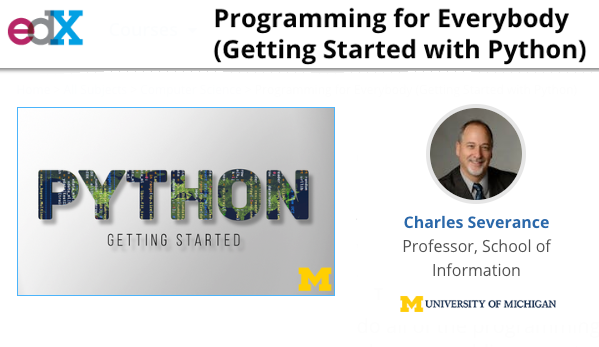
    Take Charles Severance (Dr. Chuck)’s Python for Everybody. This course has been a hit in Coursera for years, with over a million enrollments. Last week, it was posted on edX.

    In both cases, it is a paid course. In Coursera it is part of a Specialization, and the free trial goes for seven days. In edX.org, an upgrade to the verified certificate level, at a price of $49, is needed to access graded exercises and to keep it open after two months.

    The creator of the course offers some free options on his page, although these seem mostly oriented to computer science instructors who want to use the materials after setting a learning environment. This course content, including a free textbook and support materials, is also available on GitHub.

    The Python for Everybody course was one of the first successful MOOCs in this computing language. Almost ten years ago, Charles Severance, who teaches at the University of Michigan, created the course aimed at beginners with no technical training or math knowledge.

    “I created a course that does not try to teach Computer Science using Python but instead teaches a subset of Python that represented the essentials of programming. When I was originally building the course (in Python 2.0 at the time), I would not have predicted the exciting growth of Python and the success of the MOOC movement. Ten years later, PY4E [Python for Everybody] has reached more than 2 million learners to become the largest Python course in the world, graduating thousands of new Python programmers every week,” wrote Professor Severance on edX.org’s blog site.


    • Course on edXProgramming for Everybody (Getting Started with Python) and Python Data Structures
    • Course on Coursera: Python for Everybody Specialization

  • A Free MIT Course for Practitioners on Competency-Based Education

    A Free MIT Course for Practitioners on Competency-Based Education

    Competency-based education (CBE) forces us to think what it is we want students to know, and makes learning a more personal experience. Learners need to demonstrate proficiency in skills and content, not by how many hours they spend sitting in class, and move at their own pace.

    MIT Teaching Systems Lab professor Justin Reich, in the video below, explores the why, what and how of competency-based education in a free six-week course on edX.org, beginning today, January 31, 2019.

    “You will learn why so many educators are excited about CBE and its potential for closing opportunity gaps, as well as challenges and concerns. You will get a closer look at what the implementation of CBE looks and feels like for students, teachers, administrators, families, and community members. You will consider the kinds of system-wide shifts necessary to support this innovation in education,” explains Profesor Reich.

    KQED NewsWhy Competency-Based Education Is Exciting And Where It May Stumble

  • Georgia Tech’s Pioneer Master’s Reached 8,672 Students This Term

    Georgia Tech’s Pioneer Master’s Reached 8,672 Students This Term

    The legendary Online Master of Science in Computer Science (OMSCS) reached 8,672 students this term and the number of graduates so far exceeds 2,000. It includes learners representing all 50 U.S. states and nearly 120 different countries.

    “Each year over 1,000 are graduating and this number can reach 1,500 in two or three years,” explained Zvi Galil to IBL News — Galil is the Dean of the Georgia Institute of Technology College of Computing and creator of the OMSCS program.

    The number of programs that are following in the footsteps of OMSCS now exceeds 40, as explained in recent research.

    The number of undergraduate students on Introduction to Computing Using Python (or CS1301) who are taking it online is 297 compared to 247 who take it in the regular sections.

    The Online Master of Science in Computer Science program started in 2014, and it was the first degree of its kind to operate entirely on a MOOC platform for course delivery (Udacity). The program began with 380 students.

    The Georgia Tech’s Online Master of Science in Computer Science (OMSCS) program was the first degree of its kind to entire operate on the massive online, or MOOC, a platform for course delivery.

    Its success inspired Georgia Tech to launch two additional degrees (on edX). The OMS Analytics degree began in Fall 2017 with 250 students; this semester’s enrollment is 1,500. The OMS Cybersecurity degree launched in January with about 250 students.

    “OMSCS has been successful beyond our imagination. Our success really has rested on the faculty, who overwhelmingly approved OMSCS and then enthusiastically executed the program,” said Zvi Galil.

    “This was all uncharted territory, and Georgia Tech has achieved accessibility through affordability and technology.”


    Georgia Tech: Five Years a Cyber Pioneer
    IBL News: 45 MOOC-Based Master’s Degrees Worldwide