Category: Views

  • Open Resources Such as Jupyter and Open edX Transform STEM Education, Proves Prof. Barba

    Open Resources Such as Jupyter and Open edX Transform STEM Education, Proves Prof. Barba

    Mikel Amigot | IBL News

    Using open educational resources such as Jupyter and Open edX to teach STEM will transform teaching and learning and result in an engaging active experience in the classroom.

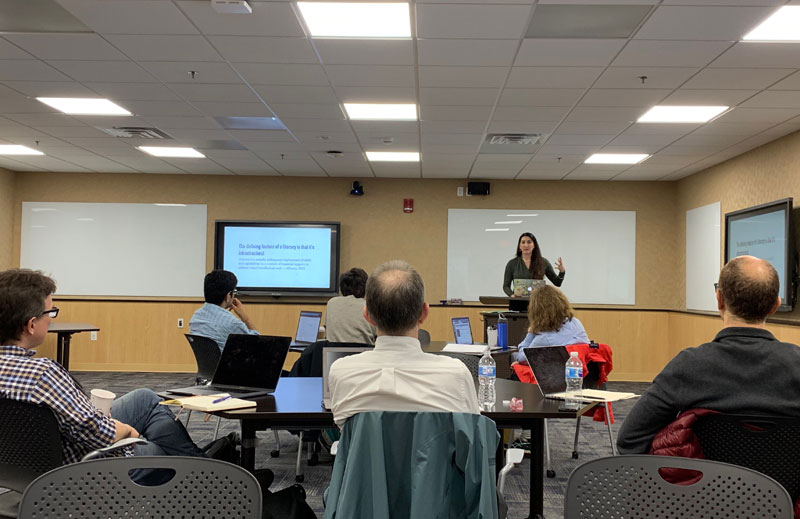
    This was the central idea of a faculty workshop conducted by Professor Lorena A. Barba, from The George Washington University (GW), at the University at Buffalo this weekend.

    During this hands-on seminar, participants reviewed some of the education research underpinning design decisions and discovered practices of open education.

    Also, it included an introduction to the Jupyter toolbox for teaching and learning.

    “Jupyter is a killer app, it provides a medium for expression using computing as part of the learning,” said Professor Lorena Barba who has been using Jupyter for over six years.

    “Using the Open edX course platform, you can construct learning pathways using content pulled dynamically from a public Jupyter notebook (e.g., on GitHub), with the Jupyter Viewer Xblock.”

    GW, along with IBL Education, contributed two XBlocks to build edX-style courses based on Jupyter: the Viewer, and a Jupyter Grader for auto-graded student assignments.

    Jupyter-based courses can be written using an open development model (like any open-source software project), collaboratively and under version control. Once the material is ready, instructors can build a MOOC-style course on Open edX, pulling the content from the notebooks without duplication in the course platform.

    Instructors can interleave short videos and graded sub-sections using the built-in problem types, or using the Graded Jupyter XBlock.

    “Our course development workflow is the product of several years of refinement and applies evidence-based instructional design. Combined with modern pedagogies used in the classroom, like active learning via live coding, you can create learning experiences that are effective on campus and online,” explained Prof. Barba.

    Watch the interview with Professor Lorena A. Barba in the video below.


    Valuable resource: Jupyter-first courses

  • Interview with Dr. Charles Severance, World’s #1 Python Professor

    Interview with Dr. Charles Severance, World’s #1 Python Professor


    Mikel Amigot, Zoe Mackay | IBL News

    Dr. Charles Severance, Clinical Professor at the University of Michigan School of Information, discussed with IBL News the success of his world-renowned python course and where he sees his future in online education.

    While Severance did not have the first python course online, he has the world’s most popular course which has reached over 4 million students. “Across all the platforms it exists on (Coursera, edX, and others), I have probably graduated about 200,000 students.

    “What I’ve found is a very unique niche… computer science professors actually don’t know how to teach an introductory computer science course. They know how to teach [this] to someone who has been programming for several years. I specialize in actually teaching introduction to programming, which is a prerequisite to introduction to computer science.”

    With Severance’s course, students were able to get the fundamental skills in programming that they necessitate to succeed in other introductory computer science courses. “I became, over the last 5 years, the de facto prerequisite for literally everything python.”

    As the need for programmers is expanding, Dr. Severance’s courses offer a possibility to students who have no background in the computer sciences. Right now “you could learn python, you could work an entire 50-year career, and never learn another programming language. And in the future, python is going to further dominate.”

    Primarily, his courses were offered on Coursera, but as of January 2019, Severance’s courses are available on edX.

    I knew that edX was missing a course that was a beginning programming course, and if I could just give that as a gift to the entire edX community, then edX would be better.”

    That is python for everybody, everywhere. And that is my joy, my joy is everywhere. No matter what country, what language, everyone has a chance to get a decent technical job that can take care of their families and give them a life and a future, and give them a step into education.”

    The “Django for Everybody” Course Will Start In the First Quarter of 2020

    With the most successful online introductory programming courses in the world, everyone is excited about new releases from Dr. Severance.

    His “Django for Everybody” course, he says, will be started in the first quarter of 2020, after teaching it once more on campus. He aims to alter the course into a MOOC to be offered on Coursera or edX but will be available on his own website by January 2020.

    Severance’s main goal is to adequately prepare students to fully succeed within computer science curricula. “I think there are many good degrees in computer science… My goal in life is to get as many people ready to go into a real degree with 40 or 50 faculty members.”

    Speaking at the Open edX conference, Severance says that while he is attending “partly as a happy and satisfied faculty member successfully teaching on edX,” he is also aware that online learning is bound to change, and he also attended to see how “the next generation of LMS’s might take benefit from all of the wonderful experience that the edX software base [has provided].”

    I think the greatest mistake that we can make is that just because products are successful in the marketplace does not mean they cannot be replaced by the next generation. If there has been anything in the last 15 years of education technology, it’s that there is always a new generation… and a wheel of progress.

    I believe that there’s going to be a transformation…and the next LMS generation is going to be based on the next generation of standards — learning tools interoperability LTI advantage is just coming out.”


    Watch the first part of the interview with Dr. Chuck Severance in the two videos below.

    Part I


    Part II

  • View: Few Impactful AI Developments On Education At Scale

    View: Few Impactful AI Developments On Education At Scale

    Mikel Amigot

    Developments in AI are now accelerating at an unprecedented rate. Several corporations are deploying AI at scale, as we noticed this week at the O’Reilly AI Conference in New York.

    There is faster hardware for sensing, model training and model inference; we saw new cloud and on-premise tools, architectures and pipelines. Among those impactful implementations, we didn’t find emerging developments for our learning industry.

    Only one exhibitor out of 28 was on education: a Chinese company called Squirrel AI Learning, squirrelai.com. It featured itself as “the first pure-play AI-powered adaptive education provider in China”. “We provide personalized and high-quality K-12 after-school tutoring at an affordable price”.

    This company, owned by Yixue Group, says it has opened 1,700 schools, with a teaching staff of 3,000 in 200 cities across China. Apparently, it accumulates funding of $15 million.

    Is China so ahead in AI-driven education?

    We attended the O’Reilly-organized press conference with the experts in that industry to inquire about it.

    Martial Hebert, a leading researcher and Director of Carnegie Mellon Robotics Institute, explained to us that there are a number of elements of AI that can be used on education at scale such as facial recognition.

    This is an application which some companies already use in China, including the parent organization of Open edX-based platform XuetangX.com.

    However, the state of this technology seems to be at a very early stage.

    The goal of all of these tools, including the data analytics approach, aligns with the adaptive and personalized learning requirement. It means being able to respond to the student’s interaction in real-time by automatically providing her with individual support.

    In small traditional classrooms, the lack of personalized attention can be tackled with an AI-based face recognition solution, especially if there is no data-protection concern, as it happens in China.

    The machine reads the learner’s expression in order to determine whether he or she is struggling to grasp a subject. If so, the instructor receives a notification and modifies the lessons to respond accordingly.

    This can be done with a reduced number of students, but is it feasible in online education at scale?

    Carnegie Mellon is working on it, but it doesn’t seem to be close.

  • Analysis: Certifications to Grow Your Developer Community

    Analysis: Certifications to Grow Your Developer Community

    By Miguel Amigot II (*)


    The Problem

    We all have too much information to process, too many things to do, and too many libraries, frameworks, and languages to learn. Moreover, everything has an opportunity cost… but not everything has an equal return.

    In order to grow an open source community, it’s not enough to release great software, blog posts, and videos, if the truly relevant KPI’s have to do with developer engagements and statistics on GitHub like how many people interact with our repositories by starring, creating issues and submitting pull requests.

    Since we compete for engineers’ very limited attention and time, we have to make it worth it for them to learn and benefit from our software.

    From an incentive analysis standpoint, what can we do to attract and retain engineers’ attention? What is the real reason that they would choose to invest four hours of their time learning about some tools out of the many others that flood Hacker News every week?


    The Solution: Certifications

    Engineers need to learn the latest technology in order to advance their careers and establish with their employers, peers, and recruiters that they’ve learned it.

    Consequently, if they have to choose between spending four hours per week learning X as opposed to Y, they’re going to focus on the tool that has the highest rate of return for their careers. All else being equal, if they can get some sort of certificate or credential from one of them, then that’s going to make it that more compelling. Especially if it’s one that can be posted on LinkedIn or another channel.

    From the educator’s perspective, sharing certificates on social media is also going to viralize the offering and lead to a positive feedback loop, as peers are going to view and wonder what it takes to earn it.

    The level of effort that goes into earning that certificate or microcredential can vary: sometimes it can be indicative of an understanding of the fundamentals of a topic while other times it can represent true mastery. The important thing is that the learners be able to obtain some sort of credit or recognition for the time they invest.


    Case Study: NVIDIA Deep Learning Institute

    In less than a year, the NVIDIA Deep Learning Institute at courses.nvidia.com surpassed 100k users following a simple idea: in order to attract users, you have to make their time worth it.
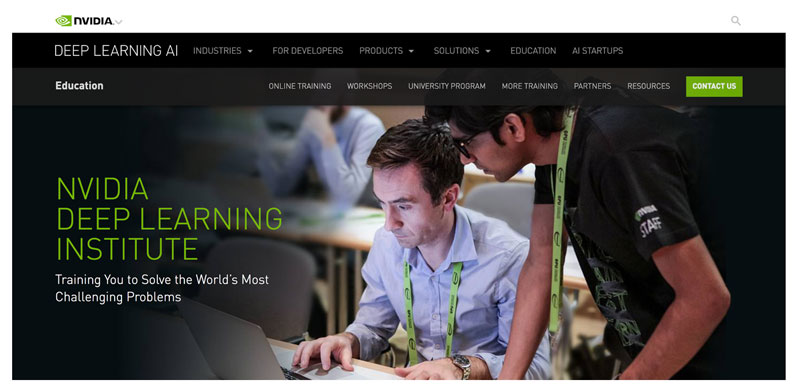
    NVIDIA launched a catalog of high-quality deep learning courses and provided learners with tangible, verifiable and visible certificates that they could post on LinkedIn and Twitter.

    This allowed learners to go to their employers and prove that they know the topics since NVIDIA’s certificates cannot be earned unless students train models sufficiently well.
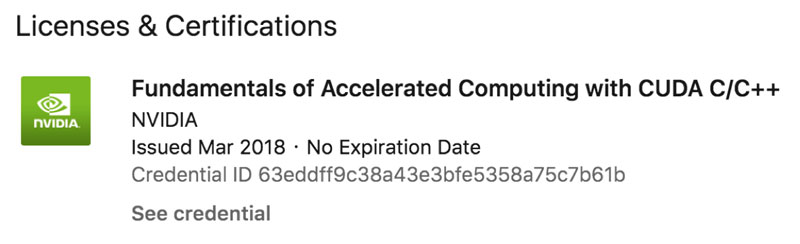
    From a market standpoint, NVIDIA’s deep learning education program has become much more valuable than any other which does not issue a certificate.

    Needless to say, many other organizations such as Udacity, Coursera, edX, IBM, Red Hat, Databricks and others have also followed this mantra, evidenced by the frequency with which their learners share their credentials on social media.


    Next Steps: Certify Your Open Source Community

    Grow your open source community by issuing certificates that explicitly make it worthwhile for engineers to learn your technologies.

    Implement an online learning platform which compiles documentation, readings, videos and multimedia materials (most of which likely exist from conferences and blog posts, anyway) into attractive online courses which, ideally, won’t last for longer than four hours.

    These courses will culminate in certifications or microcredentials, which can correspond to any of the following: understanding the fundamental use cases and codebase, maintenance, unit testing, extensions or applications to a certain industry.

    They will also provide developers with a “how to” venue to get answers, collaborate with each other and, potentially, benefit from mentor support.

    If you want to implement a high level of rigor in your courses then, like NVIDIA, issue labs that provide learners with programming environments where they must achieve certain outcomes in order to pass assignments.

    In any case, the argument is clear: if you want engineers to invest time learning about your technologies, then you have to make it worth it for them.

    * Miguel Amigot II is CTO at IBL Education

  • View: OPMs As Banks and Enrollment Machines

    View: OPMs As Banks and Enrollment Machines

    Mikel Amigot

    Now that online degrees are widely accepted by employers in the U.S., there is a new demand for the Master’s program business and universities are considering the OPMs (Online Program Managers) outsourcing solution.

    OPM for-profit companies are mostly providing financial, enrollment, marketing, and curriculum design services. In a way, they are both banks and student recruitment/retention machines.

    2U is the leading publicly traded company, with a market value of over $4.5 billion.

    Universities that partnered with an OPM have outperformed their peers in increasing online enrollment, a recent study by Eduventures found.

    The problem lies in the fact that institutions do not want to give up academic control and don’t like the way OPMs make money –by attracting students and keeping them enrolled, many times with aggressive techniques.

    They tend to forget that OPMs need a certain enrollment threshold –typically 2,000 students, according to two experts– to recoup their investment or turn a profit.

    Non-profit colleges seem to be living under the assumption that corporations follow an altruistic idea of higher education. They are not, despite their fancy mission statements.

    Many academic administrators and faculty members would be scandalized listening to some of the conversations happening on OPM’s enrollment call-centers, as IBL News checked. They would immediately break their contracts and refuse to hire these companies again. These practices are one of the best-kept secrets in the industry.

    To be honest, OPMs also offer a proven track record when is about designing high-quality programs.

    Moreover, by overcoming universities’ enrollment stagnation challenge, OPMs are keeping institutions flourishing.

    We can romanticize the higher education landscape as much as we wish, but in the end, it is a business, a genuinely American business. And OPMs, despite some of their practices, are fit partners for universities in the common goal of generating revenues in the new digital economy while educating.

  • View: Master’s Degrees At Scale Must Follow a Stackable Approach

    View: Master’s Degrees At Scale Must Follow a Stackable Approach

    Mikel Amigot

    The new MOOC-based professional master’s degrees usually include fewer or no synchronous sessions, limited contact with leading instructors and more auto-graded assignments.

    But more important than those features is stackability, as we are experiencing on Coursera’s MasterTrack or edX’s MicroMasters. This means that learners earn a credential and then apply for an on-campus or an online master’s degree program.

    However, the crucial innovation is stackability.

    Stackability is also a learning strategy, as James DeVaney (University at Michigan) and Matthew Rascoff (Duke University) innovation experts rightly explain on Inside Higher Ed. “Educational providers meet learners where they are, and provide the right level and amount of learning, and an appropriate credential, for their needs.”

    At the same time, a stackable strategy can reduce the cost of the program without compromising quality, and can be the basis for admissions instead of the existing flawed tests.


  • View: Master’s Degrees, a Cash Cow and Vehicle for Advancement

    View: Master’s Degrees, a Cash Cow and Vehicle for Advancement

    Mikel Amigot

    Around 800,000 master’s degrees were awarded by U.S. universities in 2018, becoming an essential credential.

    A baccalaureate degree doesn’t suffice for an increasing number of jobs in education, healthcare, business, and STEM. And a master’s is now the educational minimum for many occupations and professions.

    This new entry credential conveys more salary: $12K more than a bachelor’s degree, according to the Bureau of Labor Statistics.

    Between 1990 and 2010, public universities increased the number of programs in business from 266 to 321, in public administration from 153 to 220 and in communications from 90 to 141, according to Michael T. Nietzel, President Emeritus of Missouri State University and contributor of Forbes.

    For employees, it’s a vehicle for career advancement, and it helps to build a personal brand (Ph.D. programs are dramatically more expensive and difficult to achieve). For universities, it’s a cash cow, mostly because scholarships are seldom used to discount tuition and can reach a large number of students.

    Students’ and institutional interests are aligned and, as result of it, master’s programs continue to thrive.

            Mikel Amigot is Founder at IBL Education and Editor in Chief at IBL News         

  • View: MOOC-Based CME Programs, a New Hot Area

    View: MOOC-Based CME Programs, a New Hot Area

    By Mikel Amigot

    Continuing medical education (CME) and healthcare content is a new area for MOOC providers.

    Professionals are obligated to complete CME credits every two years to maintain their medical licenses, and Coursera, edX, and other platforms are providing timely digital courses in new areas (machine learning, data analytics, law, and regulations, etc.) to re-skill them.

    Coursera has announced an entire vertical with 100 new courses and 30 new “specializations”, with six accredited CME universities: Columbia University, the University of California at Davis, University of Minnesota, Icahn School of Medicine Mount Sinai, University of Pennsylvania and Emory University.

    Additionally, Coursera has launched two degrees: a Master of Public Health from the University of Michigan School of Public Health, and Master of Public Health from Imperial College London.

    There are other entrants in the programs-based CMEs such as Lambda School, a well-funded coding boot camp, and Grand Canyon Education, who recently purchased healthcare OPM Orbis Education for $362 million.

    [Disclosure: IBL works for Vermont Oxford Network who trains healthcare professionals through an Open edX-based ecosystem]

  • View: Master’s Degrees Are Increasingly Online

    View: Master’s Degrees Are Increasingly Online

    By Mikel Amigot

    Master’s degree programs are increasingly offered online.

    Over 31 percent of students enrolled in master’s degrees took them entirely online, while 21 percent took some, but not all, classes online, according to an analysis from the Urban Institute.

    Digital education fits particularly well for these students because they tend to be proactive and self-directed learners. This segment tends to achieve better outcomes as they are more likely to be employed.

    For every five taken bachelor’s there were two master’s degrees during the 2015-16 academic year. In total, about 785,000 master’s degrees were awarded in the U.S.

    In terms of pricing, tuition and fees for full-time master’s rose by 79 percent during the last 20 years, compared to a 47 percent increase for full-time bachelor’s programs.

         Mikel Amigot is CEO at IBL Education        

  • Analysis: Build vs. Buy vs. Open edX

    Analysis: Build vs. Buy vs. Open edX

    By Miguel Amigot II

    The initial process for learning innovators aiming to launch a large-scale online learning initiative may seem daunting, as there are many paths to getting started. This post offers information to help clarify best practices for learning initiatives supporting a significant number of students (above 10k) that expect to provide added value with innovative software and exceptional online learning solutions.

    The classic dilemma is “build vs. buy” when launching an online learning ecosystem – should you build a proprietary platform from scratch or buy/license an existing platform?

    • Building a proprietary platform allows your team to design the platform end-to-end, and control all integrations and intimate knowledge of your process.
    • There is also the added benefit of no vendor lock-in, which gives you the ability to modify the platform in the future.

    Building a platform will have a longer production timeline, in comparison to buying or licensing an existing one, and would also require the assembly of a dedicated team as an engineering organization: product, designers, frontend, backend, and devops. Depending on your organization, this could prove costly when factoring in salaries and staff opportunity costs.

    Another consideration is that developing proprietary platforms is difficult. It must be extensible in order to incorporate future features (minimal technical debt). It must also be well-documented for the purpose of incorporating and training new staff on your proprietary solution. The level of difficulty will depend on the culture of your organization, the mindset of your engineers and any deadlines and short-term incentives to ship code.

    Buying or licensing an existing platform comes with its own host of considerations. They offer immediate deployments and are reliable, given that you will most likely not be their only client. However, unlike the flexibility offered in building a platform, buying or licensing will include vendor lock-in — you will be unable to incorporate new features to the platform, unless the vendor decides that it’s worth it to include additional features unless you pay top-dollar to get them. In terms of cost, there will be expensive licensing fees, especially for a non-negligible number of students. Realistically, your organization could end up paying $100k – $220k per year to host 10k students.

    Case Study: Global Knowledge

    Global Knowledge, the largest private IT training company in the world, offers an interesting case study for this build vs. buy dilemma. About four years ago, Global Knowledge realized they needed a new learning platform that would support classroom, virtual and on-demand training. Their primary approach was to build the platform themselves. However, a year in, they realized their path of innovation was moving too slowly. Too much time was being spent shipping their needed features that were already available across a plethora of platforms, and they came to the realization that they would end up developing rudimentary features like multiple choice problems, rather than developing value-added features like custom labs or analytics.

    Global Knowledge found that building their own proprietary platform offered too few features to start with, and an innovation timeline that was too long, so they chose not to build from the ground up an LMS for delivering on-demand training. They realized it would only make sense to build non-LMS capabilities, and developed a student portal, MyGK, that allows learners to access their courses, irrespective of their modality.

    Global Knowledge’s second approach was to acquire an LMS startup to radically increase the features provided “out of the box.” This approach came equipped with staff to accelerate innovation. However, it was still too slow in comparison to its competitors and the at-large market of learning platforms. Although there were more features to begin with, the innovation was at a slightly higher slope but still unsatisfactory. Global Knowledge decided to make an acquisition in this space to accelerate the delivery of their learning platform, especially around digital asset management and jump-starting their team.

    Finally, Global Knowledge’s third approach started in the winter of 2017-2018 under the new management of their Director of Engineer, Paul Tocatlian. The ask was simple: deliver a better solution that allows Global Knowledge to come out with a superior learning experience, cost-effectively, that allows faster innovation and can integrate with their existing backend systems.

    For the reasons mentioned above, building their platform was not feasible. Neither was licensing a solution, as it would be inflexible and cost-prohibitive to license a learning platform with hundreds of thousands of users, costing Global Knowledge tens of millions per year. They had plans to innovate, and needed a cost-effective and flexible solution.

    Given these considerations, Paul Tocatlian recommended using open source technology, and specifically Open edX. It comes equipped with most features, has the highest rate of innovation, extensibility, and integration. Open edX is also proven, built by MIT and Harvard for edx.org’s 16M+ learners. In the nonprofit and government fields, the Open edX technology is used by the US Air Force and millions of learners across XueTangX (China), FUN (France), Campus IL (Israel), and Edraak (Jordan and the Middle East).

    As a practical example of Open edX’s extensibility, consider a recommendation engine (to put this into perspective, Amazon makes 30 percent of its sales from recommendations), which the platform does not currently support. They are focusing on this task, with zero vendor lock-in, by utilizing their own engineers and leveraging IBL’s consultancy services as their development partner.


    More About Open edX


            Miguel Amigot II is the CTO at IBL Education (Open edX)