Category: Views

  • Meta Invests $14.3 Billion in Scale and Hires Its CEO

    Meta Invests $14.3 Billion in Scale and Hires Its CEO

    Mikel Amigot, IBL News | New York

    Mark Zuckerberg’s Meta Platforms Inc. has finalized a $14.3 billion investment in Scale AI — taking a 49% stake — and recruited the company’s CEO, Alexandr Wang, 28, to join its AI team for producing data models.

    Scale offers data services to help companies, including Meta and OpenAI, train and improve their AI systems. It also builds custom AI applications for businesses and governments. The startup generated approximately $870 million in revenue in 2024 and is expected to reach $2 billion in revenue by the end of this year. Its new interim CEO will be Jason Droege.

    Zuckerberg was frustrated with Meta’s progress following the rollout in April of the company’s latest large language model, Llama 4. Not wanting to be left behind, the CEO of Meta took a more hands-on approach, making the recruitment of AI experts and scientists a top priority.

    He has been offering lucrative pay packages to attract top researchers from Alphabet Inc.’s Google and startup Sesame AI Inc. He has been following a playbook similar to Amazon.com Inc., Microsoft Corp., and Google, with arrangements designed to avoid the regulatory scrutiny that comes with significant acquisitions.

    Alphabet’s Google, the largest customer of Scale AI, announced it would cut ties with Scale after rival Meta bought a 49% stake in the AI data-labeling startup.

    Google was paying Scale approximately $200 million this year for the human-labeled training data, which is crucial for developing technology, including the sophisticated AI models that power Gemini, its ChatGPT competitor, one of the sources said.

    Other major customers of Scale, including Microsoft, are also backing away. Elon Musk’s xAI plans are exiting, too, arguing their concern to expose their research priorities and road map to a rival.
  • Web Search, Built on Links, Starts to Shift Away Toward LLM Platforms

    Web Search, Built on Links, Starts to Shift Away Toward LLM Platforms

    Mikel Amigot, IBL News | New York 

    Web search, built on links, started to shift away from traditional browsers toward LLM platforms in 2025, according to a report by Andreessen Horowitz.

    The foundation of the $80 billion+ SEO market just cracked with Apple’s announcement that AI-native search engines like Perplexity and Claude will be built into Safari, said the VC firm. This put Google’s distribution chokehold in question.

    “A new paradigm is emerging, one driven not by page rank, but by language models. We’re entering Act II of search: Generative Engine Optimization (GEO),” stated the report.

    Page ranks are determined by indexing sites based on keyword matching, content depth and breadth, backlinks, and user experience engagement.

    However, today, it’s not about ranking high on the results page. LLMs are the new interface for how people find information. Visibility is obtained by showing up directly in the answers of LLMs like GPT-4, Gemini, and Claude.

    Users’ queries are longer (averaging 23 words vs. 4), sessions are deeper (averaging 6 minutes), and responses provide personalized, multi-source synthesis, remembering and showing reasoning, rather than just relying on keywords.

    Additionally, the business model and incentives have changed. Google monetizes user traffic through ads; users are paid with their data and attention. In contrast, most LLMs are paywalled, subscription-driven services.

    However, an ad market may eventually emerge on top of LLM interfaces, but the rules, incentives, and participants would likely look very different than traditional search.

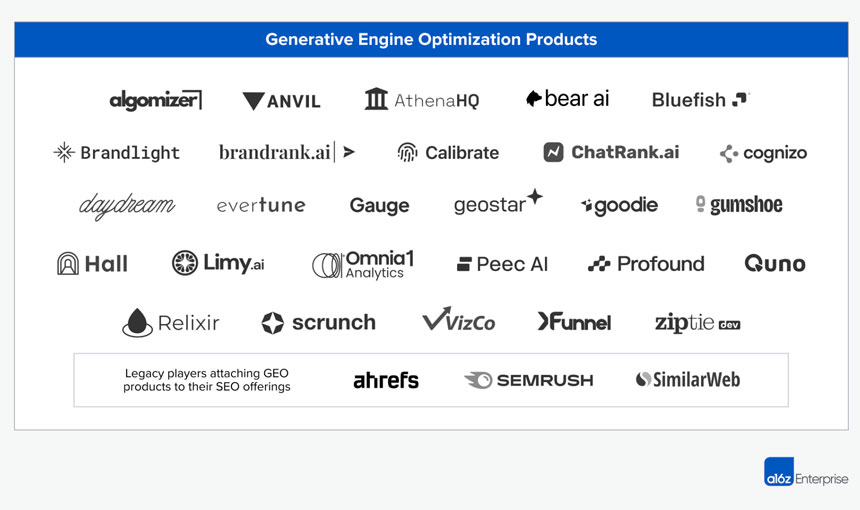
    New monitoring platforms, such as ProfoundGoodie, and Daydream, enable brands to analyze how they appear in AI-generated responses.

    Tools like Ahrefs’ Brand Radar track brand mentions in AI Overviews, enabling companies to understand how they’re framed and remembered by generative engines. Semrush has a dedicated AI toolkit designed to help brands track perception across generative platforms, optimize content for AI visibility, and respond quickly to emerging mentions in LLM outputs.

  • Google Announced an Initiative to Invest in AI Startups

    Google Announced an Initiative to Invest in AI Startups

    Mikel Amigot, IBL News | New York

    Google announced its AI Futures Fund this month. The fund will invest in startups from seed to late-stage using AI tools developed by DeepMind, the company’s R&D lab.

    Google’s support will also include early access to Google AI models from DeepMind, working with experts from DeepMind and Google Labs, and Cloud credits. Some startups will also have the opportunity to receive direct investment from Google.

    “When we come across companies that align with the fund’s thesis, we may choose to invest,” said a Google representative.

    AI Futures Fund already has some case studies, such as the meme-making platform Viggle and the webtoon app Toonsutra.

    Over the past few months, Google has committed to supporting the next generation of AI talent and scientific breakthroughs.

    • In November 2024, Google.org, the company’s charitable wing, announced a $20 million cash commitment to researchers and scientists working in AI.

    • In September, Google CEO Sundar Pichai announced the company was creating a $120 million Global AI Opportunity fund to help bring AI education and training to more places worldwide.

    • Google.org also launched a $20 million generative AI accelerator program to cut checks to nonprofits developing AI tech.

    • Google for Startups Founders Fund supports founders from an array of industries and backgrounds building companies, including AI companies.

  • Harvard President Takes a 25% Pay Cut While the Institution Faces Another Freeze of $450M in Federal Grants

    Harvard President Takes a 25% Pay Cut While the Institution Faces Another Freeze of $450M in Federal Grants

    IBL News | New York

    Harvard University’s President Alan M. Garber will take a voluntary 25% pay cut for the fiscal year 2026, which runs from July 1, 2025, to June 30, 2026, on a salary not disclosed, but presumably upward of $1 million. Several other Harvard’s top officials are making voluntary cuts on their own.

    Garber’s pay cut is a gesture to share the financial strain that has hit faculty and staff since the Trump administration froze nearly $3 billion in funding.

    Over 80 faculty members — from several schools and academic units — have pledged to donate 10 percent of their salaries for up to a year to support the University if it continues to resist the Trump administration.

    In 2020, as provost, Garber took a similar 25% cut in response to the COVID-19 pandemic. Then, President Lawrence S. Bacow and several deans accepted temporary reductions as Harvard confronted a projected $750 million revenue shortfall.

    Garber’s decision also mirrors similar moves from leaders of other schools. Brown University President Christina H. Paxson announced last month that she and two other senior administrators would take a 10 percent salary cut in fiscal year 2026.

    On Tuesday, the Trump administration announced it would cut another $450 million in federal grants and contracts from Harvard. The Federal Government alleged Harvard had failed to check race-based discrimination and antisemitism. Earlier this month, it pledged to no longer award grants or contracts to the University.

    The cut, which covers grants awarded by eight unspecified federal agencies, is in addition to the $2.2 billion funding cut announced last month.

    Harvard’s lawsuit against the Trump administration, filed in April, remains in its early stages. Oral arguments are scheduled to begin on July 21, and the legal battle will be drawn out for months.

  • President Trump Announces He Will Revoke Harvard’s Tax-Exempt Status

    President Trump Announces He Will Revoke Harvard’s Tax-Exempt Status

    IBL News | New York

    President Trump doubled down on his announcement last month and said he would remove the university’s tax-exempt status on Friday, adding, “It’s what they deserve.”

    The Trump administration has frozen more than $2 billion of Harvard’s federal funding, and the university has sued.

    If the tax-exempt revocation is confirmed, Harvard would have to pay federal income taxes on its revenue, and donations could be lost if donors can’t claim tax deductions on their gifts.

    Philanthropic contributions account for about 45 percent of Harvard’s annual operating revenues.

    Harvard University, the nation’s oldest and richest university (with an endowment of $53 billion), signaled Friday that it would resist President Trump’s renewed offensive, a move for which it said there was “no legal basis.”

    “Such an unprecedented action would endanger our ability to carry out our educational mission,” the statement said. “It would result in diminished financial aid for students, abandonment of critical medical research programs, and lost opportunities for innovation. More broadly, the unlawful use of this instrument would have grave consequences for the future of higher education in America.”

    Despite Mr. Trump’s assertion online and Harvard’s sharp response, it was not immediately clear Friday whether the I.R.S. was moving forward with revoking Harvard’s tax-exempt status. This change could typically occur only after a lengthy process, as the federal law prohibits the president from directing the I.R.S. to conduct tax investigations.

    In recent weeks, Harvard has taken a confrontational posture toward the Trump administration, rejecting a roster of Federal government demands.

    Those demands include that Harvard submit reports to Washington, alter its admissions and hiring policies, and bring in an outsider to examine “those programs and departments that most fuel antisemitic harassment or reflect ideological capture.”

    A Harvard commentator explained how the endowment of the institution works. “Increasing the tax on Harvard’s endowment — or worse, stripping our tax-exempt status entirely — would utterly cripple this University.”

  • The White House Issued Executive Orders to Advance AI Education

    The White House Issued Executive Orders to Advance AI Education

    IBL News | New York

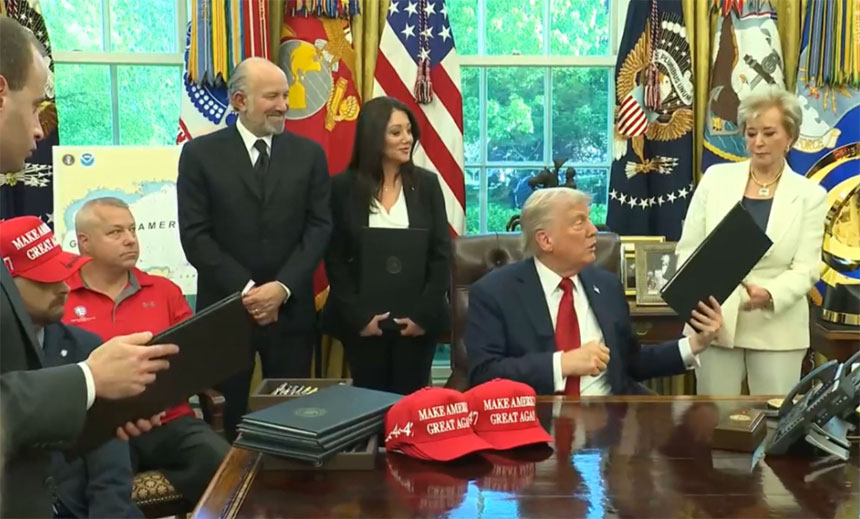
    President Donald Trump signed seven executive orders on April 23 impacting elementary, secondary, and postsecondary education, addressing AI, school discipline, workforce development, apprenticeships, HBCUs, and accreditation, among other issues.

    Leaders from labor, commerce, and education departments, including Secretary Linda McMahon, joined the president in the Oval Office. She released a statement about the orders.

    Trump’s executive order on AI stated that it will ensure that “schoolchildren, young Americans, are adequately trained in AI tools so that they can be competitive in the economy years from now into the future as AI becomes a bigger and bigger deal.”

    The order broadly seeks to improve K-12 education through AI and enhance teacher training on AI:

    • Establishes the White House Task Force on AI Education;
    • Establishes a Presidential AI Challenge, which will encourage and highlight student and educator achievements in AI, promote wide geographic adoption of technological advancement, and foster collaboration between government, academia, philanthropy, and industry to address national challenges with AI solutions.
    • Seek to increase participation in AI-related Registered Apprenticeships;
    • Establishes public-private partnerships to provide resources for K-12 AI education; and
    • Prioritizes the use of AI in discretionary grant programs for teacher training and prioritizes research on the use of AI in education.

    Another executive order, Preparing Americans for High-Paying Skilled Trade Jobs of the Future,” focused on modernizing American workforce programs. It seeks “to align with our country’s reindustrialization needs and equip American workers to fill the growing demand for skilled trades and other occupations.”

    “My Administration will further protect and strengthen Registered Apprenticeships and build on their successes to seize new opportunities and unlock the limitless potential of the American worker.”

    The order plans to reach and surpass 1 million new active apprentices.

    In her statement, McMahon said, “Not every student needs to attend a four-year university to enter a family-sustaining career. The Trump Administration will support communities across the country offering career-aligned programs like apprenticeships and dual enrollment to meet the needs of their workforce best.” 

    Trump signed an executive order titled “White House Initiative to Promote Excellence and Innovation at Historically Black Colleges and Universities (HBCUs),” accompanied by this additional information.

    The order stated that the administration’s policy is to support HBCUs. It established the White House Initiative on HBCUs and the President’s Board of Advisors on HBCUs.

    Trump signed an executive order titled “Reforming Accreditation to Strengthen Higher Education,” which was accompanied by this additional information.

    “Many third-party accreditors have relied on a sort of woke ideology to accredit universities instead of accrediting based on merit and performance,” said a Trump administration representative.

    “The Department of Education will create a competitive marketplace of higher education accreditors, which will give colleges and universities incentives and support to focus on lowering college costs, fostering innovation, and delivering a high-quality postsecondary education,” said Linda McMahon.

  • Columbia University Replaced Its President as the White House Threatened Funding

    Columbia University Replaced Its President as the White House Threatened Funding

    IBL News | New York

    Dr. Katrina Armstrong, president of Columbia University, left her post this Friday after her leadership threatened $400 million in federal funding. She was Columbia’s third leader since August 2024, when the university became a hub of a campus protest movement against the war in Gaza and the Israelis.

    Claire Shipman, a journalist with two degrees from Columbia and co-chair of the university’s board of trustees, was named the acting president and replaced Dr. Katrina Armstrong.

    One week before this abrupt replacement, Columbia University bowed to a series of White House demands, and no resignations seemed involved.

    However, a leaked revelation pointed to comments from Dr. Armstrong at a faculty meeting last weekend saying privately that the school would not stick to some of its agreements with the Trump administration.

    Following this punitive approach at Columbia, the Trump Administration is now threatening to end the funding of billions of dollars to several universities across the country. Many colleges are facing inquiries from agencies that range from the Justice Department to the Department of Health and Human Services.

    DEI Scrutiny

    • Two days before Columbia announced its decision, the government said it would withhold about $175 million in funding to the University of Pennsylvania because the school allowed a transgender woman to be a member of its women’s swim team in 2022.

    • Last week, the University of Michigan announced it will close its diversity, equity, and inclusion (DEI) office due to recent executive orders from President Trump and funding uncertainty. The institution had spent $250 million on DEI efforts through last fall and had 163 DEI personnel.

    This DEI closure announcement comes as federal funding for schools has been under scrutiny by Trump.

    Antisemitic Scrutiny

    Another focus from the Trump Administration is what is considered antisemitic activity on campus following the October 7, 2023, Hamas attacks on Israel. On March 10, the White House warned 60 institutions that they risk losing federal government funding.

    Moreover, nineteen of those academic institutions are under investigation for antisemitism by the Trump administration, according to Reuters.

    “Universities are experiencing distress because they don’t even know the nature and extent of the allegations against them,” said Lynn Pasquerella, president of the advocacy group American Association of Colleges and Universities (AACU).

    Secretary of Education Linda McMahon said Jewish students at “elite U.S. campuses” are in fear for their safety. “American colleges and universities benefit from enormous public investments funded by U.S. taxpayers. That support is a privilege contingent on scrupulous adherence to federal antidiscrimination laws.”

  • Trump Signed Order Aimed at Shutting Down the U.S. Department of Education

    Trump Signed Order Aimed at Shutting Down the U.S. Department of Education

    IBL News | New York

    President Trump signed a long-awaited executive order on Thursday that begins the process of dismantling the U.S. Department of Education, fulfilling a longstanding campaign promise to conservatives.

    The order is designed to leave school policy almost entirely in the hands of states and local boards, a prospect that alarms liberal education advocates.

    Surrounded by schoolchildren seated at desks in the East Room of the White House, President Trump cited poor test scores as a key justification for the move.

    He instructed Education Secretary Linda McMahon to begin shutting down her agency. According to Article I of the Constitution, this task cannot be completed without congressional approval.

    However, Trump also said Thursday that the department would continue to provide critical functions required by law, such as administering federal student aid, including loans and grants, funding special education and districts with high levels of student poverty, and continuing civil rights enforcement.

    Since taking office, Trump has slashed the department’s workforce by more than half and eliminated $600 million in grants.

    “This is political theater, not serious public policy,” said Ted Mitchell, the president of the American Council on Education, an association that includes many colleges and universities in its membership. “To dismantle any cabinet-level federal agency requires congressional approval, and we urge lawmakers to reject misleading rhetoric in favor of what is in the best interests of students and their families.”

    Lawyers for supporters of the Education Department anticipated they would challenge Mr. Trump’s order by arguing that the administration had violated the Constitution’s separation of powers clause and the clause requiring the president to take care that federal laws are faithfully executed.

    Senator Bill Cassidy, a Louisiana Republican who chairs the chamber’s Health, Education, Labor and Pensions Committee, said he would submit legislation to eliminate the Education Department.

    “I agree with President Trump that the Department of Education has failed its mission,” Cassidy said.

    “Since the department can only be shut down with congressional approval, I will support the president’s goals by submitting legislation to accomplish this as soon as possible.”

    Under the Biden administration, the department was criticized as being deferential to teachers’ unions and overreaching on specific issues, such as student loan forgiveness and its interpretations of civil rights laws on behalf of transgender students.

  • AI-Created Personalized Reports with Visuals and Graphics Help Students to Improve Test Scores

    AI-Created Personalized Reports with Visuals and Graphics Help Students to Improve Test Scores

    IBL News | New York

    Researchers at the South China Normal University in Guangzhou, highly focused on teacher education and training, explored how AI-driven visual reports can transform assessment in K12. A 13-week study analyzed the performance of half of the students who received personalized reports with clear visuals, personalized feedback, and actionable insights versus the other half who received oral feedback from instructors.

    The “AI reports” group demonstrated a 12.8% improvement in test scores over those only receiving oral.

    In addition, the vast majority expressed interest in using the report for other classes.

    Experts highlighted that AI tools get learners more efficient and faster personalized feedback and actionable feedback.

    Students can see their learning journey in these reports and act on it. They review areas of strength, identify learning gaps, and plan where to focus their effort.

  • OpenAI Issues Video Generator Sora For Its Paying Users

    OpenAI Issues Video Generator Sora For Its Paying Users

    IBL News | New York

    OpenAI announced yesterday the launch of its video model Sora, an AI tool for creating realistic clips from text. It lets users generate videos up to 20 seconds long. It includes dropping images in as prompts and a timeline editor that allows users to add new prompts at specific moments in a video.

    “We don’t want the world just to be text,” OpenAI CEO Sam Altman said in a live-streamed announcement Monday. “Video is important to our culture,” Altman added.

    The San Francisco-based research lab, backed by Microsoft, said that this current version of Sora, named Sora Turbo, is faster than the model showed in February.

    Sora has been released as a standalone product at Sora.com to ChatGPT Plus and Pro users.


    ChatGPT Plus offers up to 50 videos at up to 480p resolution, up to 20 seconds long, or fewer videos at 720p monthly. These videos are in widescreen, vertical, or square aspect ratios at no additional cost. Users bring their assets to extend, remix, and blend or generate entirely new content from text.

    Meanwhile, ChatGPT Pro offers up to 500 monthly videos at up to 1080p resolution and longer duration.

    OpenAI developed new interfaces to make it easier to prompt Sora with text, images, and videos. Its storyboard tool lets users precisely specify inputs for each frame.

    OpenAI acknowledged that “the version of Sora we are deploying has many limitations, and it often generates unrealistic physics and struggles with complex actions over long durations.” “Although Sora Turbo is much faster than the February preview, we’re still working to make the technology affordable for everyone.”

    The Sora model is blocking particularly damaging forms of abuse, such as child sexual abuse materials and sexual deepfakes.

    Sora could also violate many creators’ rights, experts said.

    Sora features
    Video